


Aydınlatma metni yükleniyor…
Building organic visibility is about more than ranking for selected keywords. The real objective is to help the right people discover your brand, find dependable answers and take an appropriate next step. A content marketing agency approaches this objective through a coordinated system of research, planning, user experience and measurement—not a stream of disconnected blog posts.
For corporate brands, content is a digital asset that demonstrates expertise, explains complex services and answers important questions before a sales conversation begins. Yet even excellent writing may underperform within a slow, confusing or unconvincing website. Content strategy must therefore connect with brand positioning, information architecture, design, software infrastructure and conversion journeys.
What does a content marketing agency do?
A content marketing agency analyses a brand’s business objectives, audiences and digital visibility to determine which subjects should be covered, in which formats and through which channels. Its role extends beyond generating ideas. Search intent research, topic clusters, editorial calendars, brand voice, production standards, publishing workflows and performance monitoring should all be managed within one plan.
This approach creates a content ecosystem that supports a defined customer journey. A prospective customer may initially investigate the cause of a problem, then compare possible solutions and finally evaluate service providers. When content addresses the awareness, consideration and decision stages, the brand can remain useful at different points in that research process.
An agency should also turn internal knowledge into accessible material. Questions heard by sales teams, requests received by customer service, lessons from completed projects and insights from subject-matter experts are valuable inputs. They enable the brand to publish content shaped by real experience instead of merely repeating generic information found elsewhere.
Why is organic traffic not enough on its own?
A high visitor count does not necessarily create commercial value. Traffic from queries unrelated to the brand’s services may produce impressive growth reports without generating qualified demand. A sound strategy therefore evaluates keywords according to user needs and business relevance, not search volume alone.
Google’s SEO Starter Guide explains how SEO helps search engines understand content and helps users decide whether to visit a site through search results. Visibility and usefulness should not be separated: technical accessibility, a comprehensible page structure and genuinely helpful information need to work together.
Evaluation should cover meaningful behaviours alongside organic sessions. Visits to a service page, views of project work, form starts, contact clicks and sales-qualified enquiries can all indicate progress. The aim is not to force every reader into an immediate purchase. It is to offer a measurable next step appropriate to that person’s stage of research.
How is a research-led content strategy created?
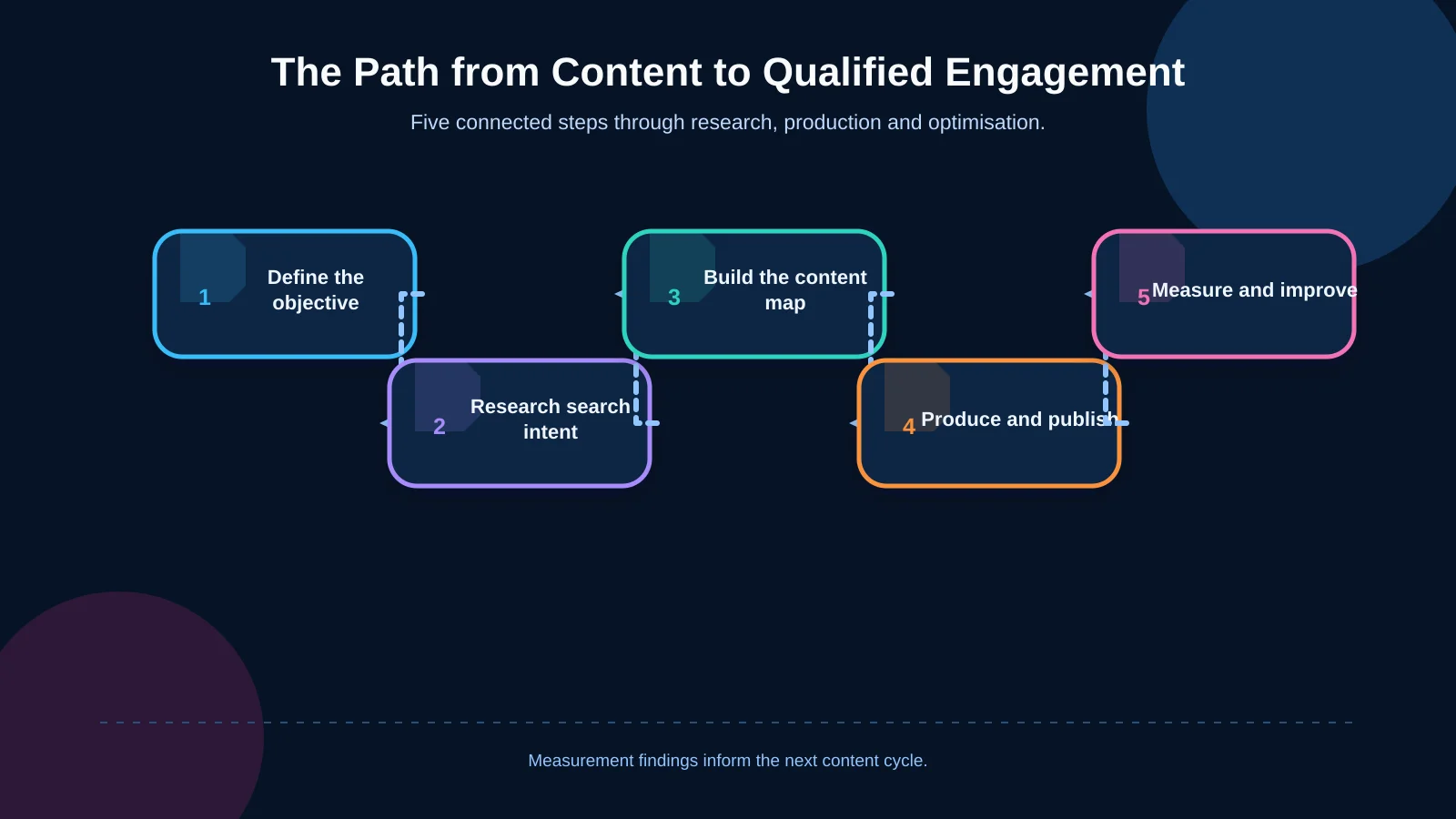
Define the business objective and target audience
The process begins with a business outcome rather than a broad ambition such as “more traffic.” Generating qualified demand for a specific service, establishing awareness in a new market and building confidence during a long sales cycle require different plans. Audience roles, existing knowledge, objections and decision criteria should also be documented.
Research search intent and topic clusters
Keywords should not be treated simply as a list of article titles. The team needs to understand whether users want to learn, compare alternatives, solve a problem or select a provider. Related subjects can then be organised around authoritative guides and supporting articles. This creates thematic depth while enabling natural internal links that help readers continue their research.
The resulting plan should distinguish informational opportunities from commercially relevant ones. It should also identify where a service page, project example or direct conversation would answer the user more effectively than another article. That distinction protects the site from publishing multiple pages that compete for the same intent.
Audit existing content and the competitive landscape
Before producing new material, review existing pages for performance, accuracy, freshness and overlap. Pages serving the same intent may need to be consolidated; outdated claims may need revision; unanswered questions may need to be added. Competitive analysis should look beyond repeated keywords to find gaps in explanation, evidence, experience and usability.
How does a content marketing agency structure its workflow?
An effective operating model is a repeatable cycle extending from research to measurement. First, the agency and brand agree on objectives and success indicators. Audience questions, search intent, sales insights and available website data are then combined. These findings become a content map, prioritised editorial calendar and detailed brief for each page.
During production, subject-matter experts contribute practical knowledge while editors, SEO specialists, designers and developers work towards the same outcome. Each piece is reviewed for accuracy, originality, brand voice, readability and the quality of its next-step guidance—not only grammar. After publication, indexing, search visibility and user behaviour are monitored.
Measurement begins the next cycle. If a page earns impressions but few clicks, its search title and description may need attention. If it attracts traffic but little engagement, its structure or intent alignment may be weak. If readers engage without progressing, the links and calls to action may be unsuitable. The editorial calendar consequently becomes a roadmap informed by real behaviour rather than a fixed publishing list.
How does content strengthen customer trust?
Trust comes from consistent, verifiable information, not a large number of ambitious claims. A service page should explain scope, working practices, deliverables and responsibilities clearly. Educational content should genuinely help readers make a decision instead of becoming a disguised sales pitch.
Google’s guidance on helpful, reliable, people-first content encourages publishers to consider whether a page provides original information or analysis, covers its subject thoroughly and leaves readers able to achieve their goal. These principles matter for brand confidence as well as search visibility. Content becomes more credible when it cites dependable sources, acknowledges limitations and demonstrates first-hand expertise.
Author or expert information, review dates, relevant project examples, transparent process descriptions and concrete evidence can reinforce that credibility. Unverifiable statistics, exaggerated guarantees and superficial commentary across unrelated topics can undermine it. A consistent editorial standard helps the brand demonstrate the same care at every digital touchpoint.
What turns organic content into qualified customer engagement?
Landing on a page is only the beginning of the journey. Its opening should fulfil the promise made in the search result, answer the central question promptly and present supporting detail in a logical order. Descriptive headings, concise paragraphs and meaningful links allow readers to scan for the information they need.
Nielsen Norman Group’s explanation of information scent shows that people assess whether a link is likely to answer their question through its label, surrounding context and what they already know about the source. Link text should therefore communicate the destination’s value instead of relying on vague phrases such as “learn more.”
Guidance should match the reader’s decision stage. An educational article might direct them to a related guide or a clear service explanation. A decision-stage page may invite them to examine project work, share requirements or request a conversation. For a closer look at the operational path beyond a form, see the guide to planning website–CRM integration from submission to sales follow-up.
Conversion points should avoid unnecessary fields, explain what will happen after a click and work smoothly on mobile devices. Correct routing, permission management and response tracking are also part of content performance. An effective call to action does more than attract attention: it gives the user a clear, low-uncertainty way to continue.
| Checkpoint | Value to the user | Signal to monitor |
|---|---|---|
| Intent alignment | Finding the right answer | Qualified organic visit |
| Evidence and expertise | Making a confident decision | Visit to a relevant page |
| Information architecture | Navigating with ease | Use of internal links |
| Clear call to action | Understanding the next step | Form submission or contact |
Why should content strategy, web design and development work together?
Content is only as effective as the digital experience carrying it. Valuable pages may disappear within menus when information architecture does not reflect user questions. Weak visual hierarchy makes key information difficult to distinguish. Slow, inaccessible, mobile-unfriendly or technically unindexable pages can damage both organic performance and perceived reliability.
Website templates should be planned around the needs of different content types. Guides, services, projects and category pages do not serve identical purposes. Each template should support readability, evidence, related content and context-appropriate calls to action. Visual communication should clarify complex information rather than compete with the message.
On the development side, the content management system should let authorised teams update headings, links, media and metadata reliably. Analytics, CRM, forms, on-site search and other necessary integrations should support a dependable flow of information. This makes content operations manageable and reduces unnecessary dependence on developers for routine publishing.
Kumsal Agency brings digital brand consulting, web design, web development, digital design and production together around shared objectives. The brand voice defined in strategy can therefore extend into the visual system, page experience and technical infrastructure. This connected model supports consistency from initial discovery through conversion and ongoing content management.
Which metrics demonstrate content marketing success?
The measurement plan should be tied to business objectives before production begins. At the visibility stage, teams can monitor indexed pages, impressions for relevant searches and organic clicks. Engagement measures may include journeys to related pages, meaningful content consumption and returning users. At the commercial stage, qualified forms, meeting requests and contacts accepted into the sales process become more important.
No metric should be interpreted in isolation. If traffic increases while qualified enquiries decline, the strategy may be targeting unsuitable queries. A low-traffic page that generates valuable opportunities may deserve an update and stronger supporting content. Especially in long decision cycles, contribution should be assessed across the journey instead of being credited only to the final click.
What should you look for when choosing a content marketing agency?
- Ask how the agency researches your sector, target audiences and commercial objectives.
- Evaluate its strategy, prioritisation and quality-control methods instead of focusing on article volume.
- Examine how it coordinates SEO, brand voice, user experience, design and technical development.
- Ensure reporting covers qualified behaviour and business outcomes as well as traffic.
- Clarify content ownership, update responsibilities and content-management workflows at the outset.
A credible partner explains assumptions, risks and opportunities to learn instead of promising guaranteed rankings. It defines how internal experts will contribute, who will approve content and how performance evidence will shape future decisions. The relationship then becomes a system for expanding organisational knowledge, not simply a contract for delivering copy.
Sustainable organic growth requires a connected system
Organic traffic and customer trust are not the result of a one-off campaign. They emerge from useful answers, consistent brand communication and a dependable web experience. Research-led strategy attracts relevant users; clear explanations and evidence establish confidence; thoughtful pathways turn attention into qualified engagement.
Kumsal Agency treats content marketing as part of the brand’s digital position, visual direction, communication system and website infrastructure. To assess your content needs, target audiences and digital growth objectives together, contact Kumsal Agency.