


Aydınlatma metni yükleniyor…
When an organisation seeking web design in Başakşehir has several branches, facilities, departments or application types, placing every service on one homepage is not enough. A visitor should understand which location provides a service, who it suits, whether an appointment or application is required and which team owns the record. The organisation must also update this information without different teams creating contradictions.
This guide does not assume that every organisation in Başakşehir operates across several locations. A simpler structure may be right for a single-office service company. The specific focus is an organisation with branches, campuses, facilities, sales points or departments where service conditions are not identical everywhere.
Why do location and role distinctions matter in Başakşehir?
The Başakşehir Municipality 2025–2029 Strategic Plan places the organised industrial structure, industrial facilities around Kayabaşı and a new centre containing commercial areas, management centres, educational facilities and the Çam and Sakura City Hospital within the same local development context (Başakşehir Municipality 2025–2029 Strategic Plan). This does not prove that every organisation follows one sector or a multi-location model. It shows why one generic district page may be insufficient for distinct service and visit tasks.
An organisation may have its headquarters in Başakşehir but deliver services elsewhere; a campus may contain several departments; a particular task may be available only at one facility or online. The website should represent the actual operating structure and avoid assumptions about physical presence or service coverage.
Separate organisation, location, service and user records first
Many websites repeat the same details across branch, service and contact pages. When one copy changes, contradictions appear. Separate four primary entities before design:
- Organisation: Legal or institutional identity, central contact and shared policies
- Location: Branch, facility, campus, office, shop or service point
- Service: The task a visitor wants to access, review or apply for
- User: Individual customer, business buyer, applicant, student, visitor, dealer or another verified group
These entities can have many-to-many relationships. One service may be available in several locations, and one location can provide many services, while hours, team, eligibility or application conditions differ. Design navigation after establishing this data model.
The Kumsal six-field location-service ownership matrix
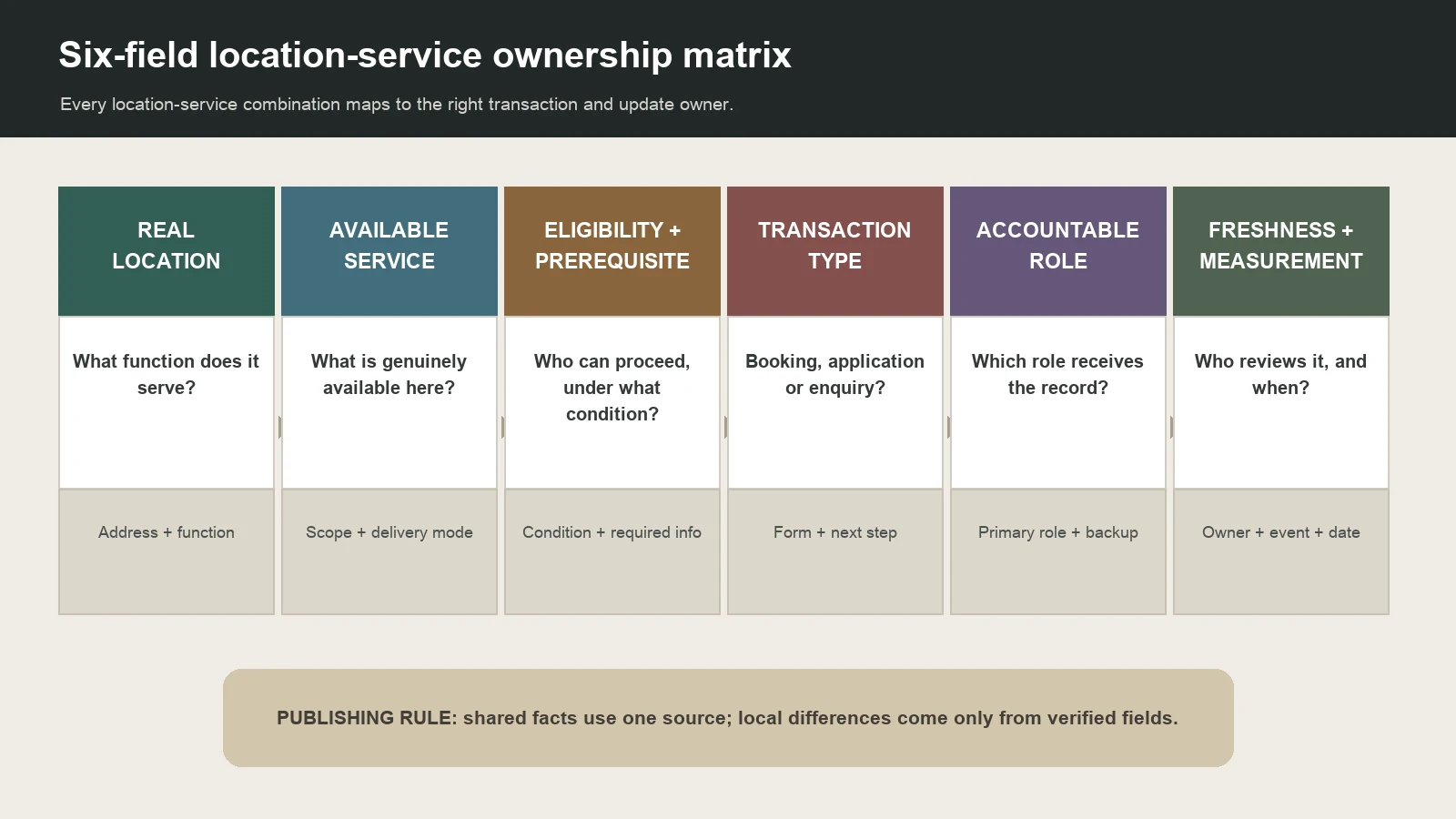
The matrix records six decision fields for every relevant service-location combination. It does not require a separate page for every combination; it defines the correct public information and accountable update role.
1. Real location
State the function of an address: headquarters, service point, production facility, warehouse, campus, sales office or correspondence only. Map listing, contact information and website copy should agree. Do not present an address that does not receive visitors as a public service location.
2. Available service
Mark the services genuinely delivered at each location. An organisation-wide capability should not appear as capacity at every branch. Store whether delivery is online, on-site, by appointment, project-led or seasonal in separate fields.
3. Eligibility and prerequisite
Explain the verified audience, document, date, capacity, age, territory, contract or project conditions a user should know before applying. In health, legal, financial or other areas requiring expert assessment, the website should not make a definitive eligibility decision; it should provide verified general conditions and the professional-review route.
4. Transaction type
Separate appointments, registration, quotation, job application, dealer application, visit request, support ticket and general contact. Instead of sending every visitor to one generic form, define the shortest safe route for each task.
5. Accountable role
Define a sustainable role rather than relying on one employee's name: location team, human resources, sales, technical support, student services or event owner. A staff change should not break the page or integration rule. Define a backup and response boundary for the role.
6. Freshness and measurement
Assign an update owner and review frequency for address, hours, service, eligibility and form routing. Measure location selection, booking start, form error, successful record and misrouting separately where useful. Measurement should not expand personal-data collection unnecessarily.
The matrix's original contribution is to treat a multi-location website as a governed publishing system for location, service, eligibility, transaction, owner and freshness decisions—not as a series of branch pages.
What belongs on a location page?
A location page needs more than an address and embedded map. Select information that prevents the visitor from travelling to the wrong place or starting the wrong task:
- Clear location name and its function within the organisation
- Verified address, entrance and arrival information
- Visit or service hours and appointment requirement
- Services actually available at that location
- Accessibility details where they can be verified
- Purpose of phone, email and other contact routes
- Correct action for booking, applying or requesting a proposal
- Planned closure, relocation or temporary-change notice
- Information owner and last review date
Publish locations with a verifiable physical or operating difference instead of copying pages for every neighbourhood. Do not confuse a service-area page with a real branch page.
How should service and location pages connect?
A service page explains scope, fit, process and evidence; a location page shows where and under which conditions it is available. Visitors should move from service to location and from location to service. Shared explanations can come from a central service record, while local hours, capacity and contact remain in the location record.
Use the corporate website content matrix to define each page's audience, decision question and action. A separate page for a service-location combination needs genuine user demand and distinct information.
How should appointments, applications and contact forms differ?
An appointment reserves a time or resource. An application may require eligibility and document assessment. A contact form handles general questions or routing. Combining these tasks can produce unnecessary fields, incorrect expectations and misrouted records.
Define the minimum data, record owner and confirmation for each transaction. If file upload is required, include type, size, malware checks, retention and access in the scope. Where data concerns children, patients, job applicants or other sensitive groups, do not add fields without legal and information-security approval.
A success screen does not prove delivery. Regularly verify that an appointment or application reaches the correct location and role using the end-to-end website form monitoring guide.
How should editorial permissions be distributed?
A central team may manage brand, legal copy, primary service definitions and the design system. Location editors may update restricted fields such as hours, local contact, team or temporary announcements. Specialist teams can approve service eligibility and technical accuracy. Publishing permission can remain separate from authoring permission.
The role table should answer:
- Who may propose content?
- Who verifies a material claim?
- Who approves localization?
- Who publishes or rolls back?
- Who updates emergency closure or relocation details?
- Who tests delivery to the correct team?
- Who removes access when a staff member leaves?
Editors should see which pages a shared-field change will affect. Version history and rollback matter when an update reaches many locations.
How should location and service counterparts work across languages?
TR and EN pages should share the same organisational and location facts, while explanations are independently localized. Do not create an empty or machine-translated English page merely to mirror every Turkish location. If service is unavailable in English, explain the actual communication boundary without misleading the visitor.
Keep language counterparts within one linked record relationship. Each canonical points to its own locale URL, while hreflang identifies reciprocal real counterparts. When locations or services merge, map both languages and activate 301 redirects only after verifying the new targets.
Which boundaries apply to structured data and local claims?
Use Organization, LocalBusiness or a relevant subtype only with verified information visible on the page. Do not mark every location as a separate business when it is not. Name, address, phone, URL, hours and parent-organisation relationship should remain consistent.
Structured data is not proof of physical presence and does not guarantee rankings. Separate a service area, physical branch, virtual office and correspondence address. Health, education and other regulated activities require additional review of types and claims by the appropriate specialists.
How should web design companies serving Başakşehir be compared?
For a project with several locations or departments, a homepage concept is insufficient. Give each candidate the same example: two locations, three services, different hours, one booking and one application process. Ask how they would deliver:
- Organisation-location-service data model
- Location and service templates with filtering
- Form fields, routing rules and failure behaviour
- Author, approver and publisher roles
- TR/EN linkage, canonicals, hreflang and redirect mapping
- Maps, booking, CRM, email and analytics integrations
- Mobile, accessibility, performance, security and personal-data controls
- Content migration, training, acceptance, maintenance and access handover
Use the website requirements document guide to brief providers consistently. Assess experience through comparable role and integration complexity rather than logos or sector labels alone.
What should a web design proposal for Başakşehir contain?
The proposal should contain more than a count of branch pages. Treat the data model, field dictionary, templates, content ownership, migration, locale counterparts, permission system, form routing, integrations and acceptance criteria as distinct deliverables. State licensing, outage behaviour and data responsibility for third-party booking or map services.
Acceptance testing can include wrong-location selection, unavailable service, full calendar, missing document, form error, email/CRM delivery, staff-role change, language switching and mobile use. Prepare backup, DNS, SSL, redirect and rollback plans before release.
Conclusion: Build the multi-location website as a publishing system
For an organisation with branches, facilities or departments in Başakşehir, a website is not a collection of repeated contact pages. A visitor should find the correct service and location, understand eligibility, start the correct transaction and know that the record reaches an accountable role. The organisation should govern each fact's owner and freshness rule.
The existing Turkish and English slugs remain unchanged, so this article refresh requires no 301. Preparing the location-service ownership matrix and real transaction scenarios before requesting proposals makes provider scopes more concrete and comparable.