


Aydınlatma metni yükleniyor…
A digital agency brief is the starting document that explains the business problem, audience, intended outcome, scope, budget and timing constraints to a prospective agency. It should not prescribe the solution. It should make the problem, decision conditions and unknowns clear enough for several agencies to respond to the same need.
The brief does not need to be long or perfect. Marking an unknown as “agency recommendation required” is more useful than inventing certainty. The twelve-part template below can be copied and shortened for the project.
What Is a Digital Agency Brief?
A brief answers “what needs to change?” before “which channels should we use?” It gathers the context needed for research, strategy and delivery, but it is not a substitute for a proposal, contract or detailed project plan.
ISBA's agency briefing guide centres the brief on a clear overriding objective that enables an effective response. Start with a decision-ready objective rather than a list of activities. (ISBA agency briefing guide)
Are a Client Brief, Creative Brief and Requirements Document the Same?
| Document | Typical owner | Main question | Output |
|---|---|---|---|
| Client/agency brief | The commissioning organisation | What problem must be solved, for whom and within which constraints? | A frame for the agency response |
| Creative brief | Strategy and creative teams | Which insight, message and behaviour should guide the creative work? | Direction for copy, design, video or campaign production |
| Technical requirements document | Business and technical owners | Which functions, integrations and acceptance conditions are required? | An implementable technical scope |
For a website project, use the website requirements document guide to define pages, content, forms and integrations. This article covers the broader starting brief for SEO, paid media, social, content, design and multi-channel agency work.
Who Should Contribute to the Brief?
One person can own the document, but goals, budget, data and approvals should be checked by the relevant owners. Include the business sponsor, marketing owner, sales or customer team and, where needed, the technical or data owner.
- Business sponsor: Confirms priority, commercial constraints and the definition of success.
- Marketing: Supplies audience, message, channel history and existing assets.
- Sales/customer team: Defines a qualified enquiry, objections and real customer language.
- Technical/data owner: Documents accounts, measurement, integrations and access boundaries.
- Approver: States the feedback route and final decision timing.
Define the Business Problem and “Why Now?”
“We need more visibility” is not enough. Explain which business outcome visibility should support and what currently prevents it. A useful three-layer statement separates the business problem, user behaviour and marketing or communication task.
- Business problem: Qualified demand is insufficient for a priority service.
- User behaviour: Relevant buyers do not understand the offer, compare it confidently or complete the enquiry.
- Marketing task: Explain the offer with credible evidence and guide the right visitor towards a measurable next action.
Add the real trigger—such as a launch, market change, sales objective, ageing platform or expiring supplier agreement. If the date is fixed, distinguish the minimum scope required by that date from work that can follow.
Describe the Audience and Intended Behaviour
Go beyond age and location. State who makes the decision, what creates the need, which objections exist and what the person should do next. In B2B buying, the researcher and budget owner may be different people.
| Vague | Actionable |
|---|---|
| Increase brand awareness | Help procurement managers in the new market understand our three solutions and their differences |
| Get more customers | Increase demo requests that meet the sales team's qualification criteria |
| Grow social media | Test whether expert content produces qualified profile visits and website sessions in the target sector |
Share the Current Channels, Assets and Data
Summarise the website, active channels, previous campaigns, content, tools and known problems. Include failed experiments and data gaps as well as successful work.
- Website, store, app and social profile URLs
- Active advertising, analytics, CRM and email systems
- Available results from the previous 6–12 months and their limitations
- Brand guidelines, approved assets and content archive
- Internal capacity, other suppliers and continuing contracts
- Sensitive data or regulatory boundaries the agency must respect
Do not solve access by sharing a common password. Record who owns each account and which permission level is required. Google Ads explains that an existing client account can be linked to a manager account while the original account and its history remain intact. (Google Ads account linking)
Separate Scope, Deliverables and Exclusions
Replace broad labels such as “digital marketing management” with the intended outcome and known deliverables. Allow the agency to recommend a different scope, but require it to explain the change.
For each area, state the starting inputs, delivery format, frequency, review rounds, implementation owner and exclusions. The digital marketing agency services guide can help distinguish service areas and responsibilities.
Be Clear About Budget, Timing and Approval
Withholding every budget signal can produce proposals designed at entirely different scales. If no fixed amount exists, provide a decision range, separate media spend from agency fees and identify conditions that could change the budget.
- Start date and any immovable launch date
- Project engagement or ongoing relationship
- Agency fees, media spend and third-party costs
- Proposal reviewers and decision date
- Feedback owner, expected approval time and legal or technical review
How Should the Brief Define KPIs?
Do not make the agency solely responsible for sales outcomes it cannot control. Separate the business outcome, user behaviour, channel indicator and data-quality check. Google Analytics defines a key event as an event measuring an action particularly important to the business. That makes it important to name the valuable behaviour rather than writing only “conversion”. (Google Analytics key events)
- Business outcome: Qualified enquiry, sale, application or repeat purchase.
- Intermediate behaviour: Form start, demo view, pricing view or add to basket.
- Channel indicator: Query, reach, click, cost or engagement.
- Data control: Tag accuracy, duplicate records, consent and CRM matching.
Copyable Twelve-Part Digital Agency Brief Template
- Company and offer: What do we sell, how do we earn revenue and which offer is the priority?
- Project summary: What do we need in one sentence?
- Why now? Which change or problem triggered the work?
- Business problem: Which commercial or operational result must change?
- Audience: Who decides, in which situation and with which objections?
- Intended behaviour: Which measurable next action should the user take?
- Current state: Which channels, assets, accounts and data exist?
- Requested scope: Which disciplines and deliverables are being considered?
- Exclusions and constraints: What cannot change and which areas are sensitive?
- Budget and timing: What is the range, cost split and key timetable?
- Success and measurement: How will outcomes, behaviours and data quality be assessed?
- Governance: Who owns the decision, day-to-day contact, approvals and proposal schedule?
Illustrative Completed Brief
This example is fictional and does not describe a client or measured result.
Company: A fictional B2B provider of industrial maintenance software. Problem: Website traffic exists, but demo requests accepted by sales are limited. Audience: Maintenance and operations managers, with procurement and leadership involved in budget approval. Intended behaviour: A suitable visitor reviews a use case and completes the demo form.
Expected scope: Offer and message analysis, an SEO content plan, two campaign landing pages, measurement review and a limited paid-media test. Current state: A website and CRM exist, but form-to-CRM matching is unreliable. Constraint: Pricing will not be published and product claims require product-team approval. Success: Data quality will be verified first; qualified demo requests and sales acceptance will then be reviewed together.
Is the Brief Ready for Proposals?
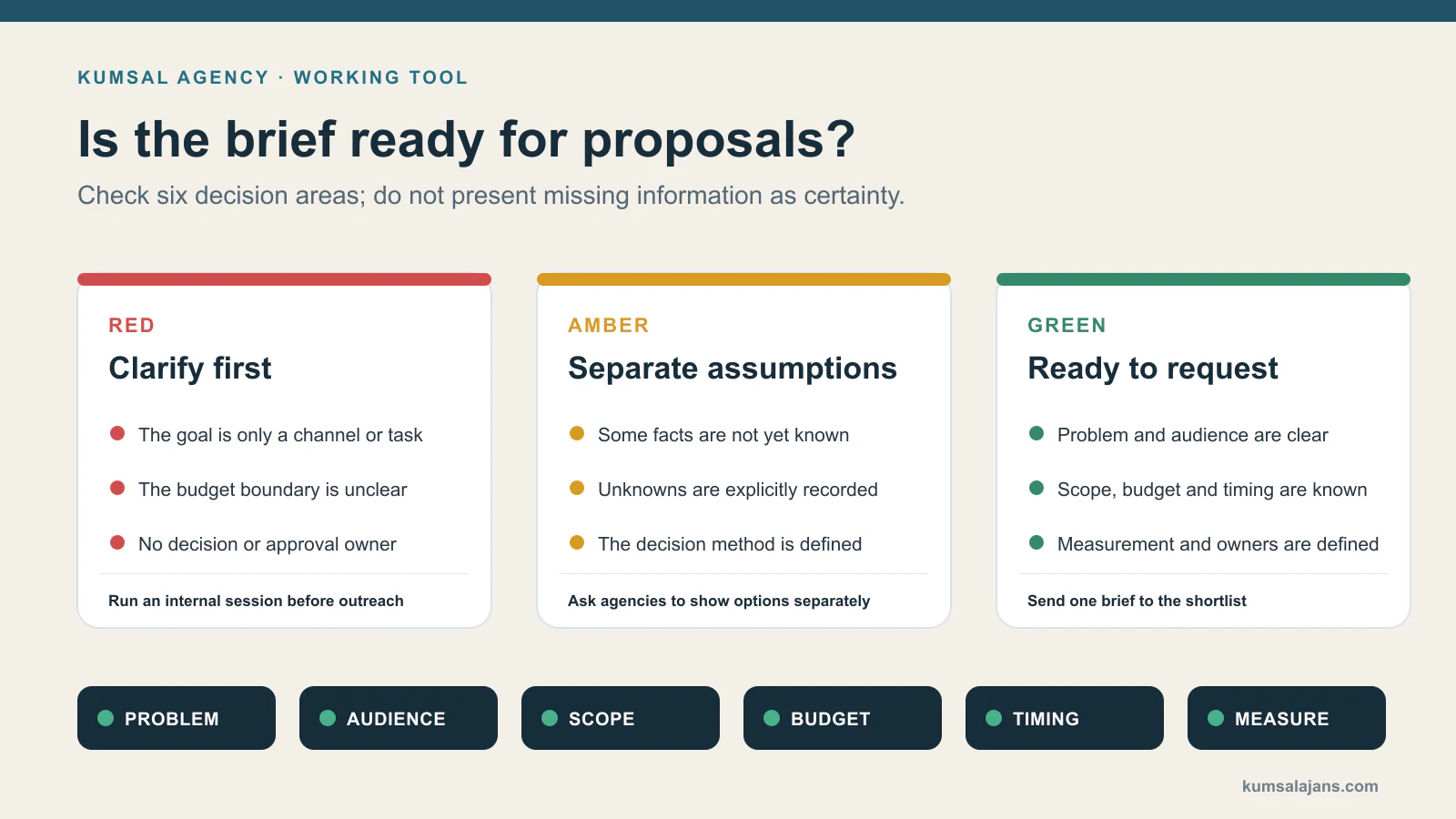
| Status | Signal | Next action |
|---|---|---|
| Green | Problem, audience, scope boundary, budget, timing and decision owner are clear | Send the same brief to the shortlisted agencies |
| Amber | Some facts are unknown, but the unknowns and decision method are stated | Ask agencies to show assumptions and options separately |
| Red | The goal is only a channel/activity; budget and decision ownership are unclear | Run an internal clarification session before requesting proposals |
Once the brief is complete, use the digital agency selection guide to compare team, method, evidence, scope, measurement and ownership on the same basis.
Common Agency Brief Mistakes
- Choosing the channel and solution before defining the business problem
- Describing the audience as “everyone”
- Withholding budget, fixed dates and the approval owner
- Hiding failed experiments or known data problems
- Listing quantities without acceptance conditions
- Expecting an unconditional guarantee for outcomes outside the agency's control
- Giving each agency different information and comparing only total price
Conclusion
A useful digital agency brief is not a long questionnaire. It creates a shared decision frame by explaining the problem, audience, intended behaviour, current state, scope boundary, budget, timing, measurement and governance. It also makes unknowns explicit so that agency assumptions can be evaluated.
After completing the brief, assess which specialisms the scope requires or contact Kumsal Agency to discuss the project context.
Related guides: For the next decision steps, review the digital agency pricing and proposal comparison guide and the digital agency contract and handover checklist.