


Aydınlatma metni yükleniyor…
Content is eligible to appear as a source in AI-generated answers when the target platform can access it, the page works technically, the content answers a real question with verifiable evidence, the publisher and brand can be identified, and visibility can be measured with a consistent method.
Eligibility is not a citation guarantee. Search and generative answer systems decide which sources to use and when. A useful GEO audit therefore does not assign a fictional score to the question “Will this page definitely be cited?” It identifies evidence-backed barriers that may limit discovery, interpretation, trust or measurement.
Use the five-layer audit card in this guide to review one priority page or a controlled group of URLs across:
- Access and indexability
- Answer and content adequacy
- Sources and verifiability
- Brand consistency and external corroboration
- Visibility, citations and business-outcome measurement
Fix the audit scope before testing
“Audit our website for GEO” is not an actionable scope. Without defined pages, platforms and query groups, teams can become lost among hundreds of URLs and variable answer outputs.
The starting record should include:
- The domain and relevant subdomains
- Five to twenty commercially important target URLs
- The user task completed by each URL
- Platforms to be assessed
- Brand, service, problem, comparison and decision query groups
- Test date, country, language and, where possible, session conditions
- Technical, content, brand and analytics owners
- Baseline organic sessions, impressions, clicks and conversions
Begin with a URL inventory. If multiple pages address the same user task, the primary issue may be content overlap rather than AI readiness. Consider consolidation and refresh decisions before producing more pages with limited original value.
The Kumsal Ajans Five-Layer AI Source Eligibility Audit Card
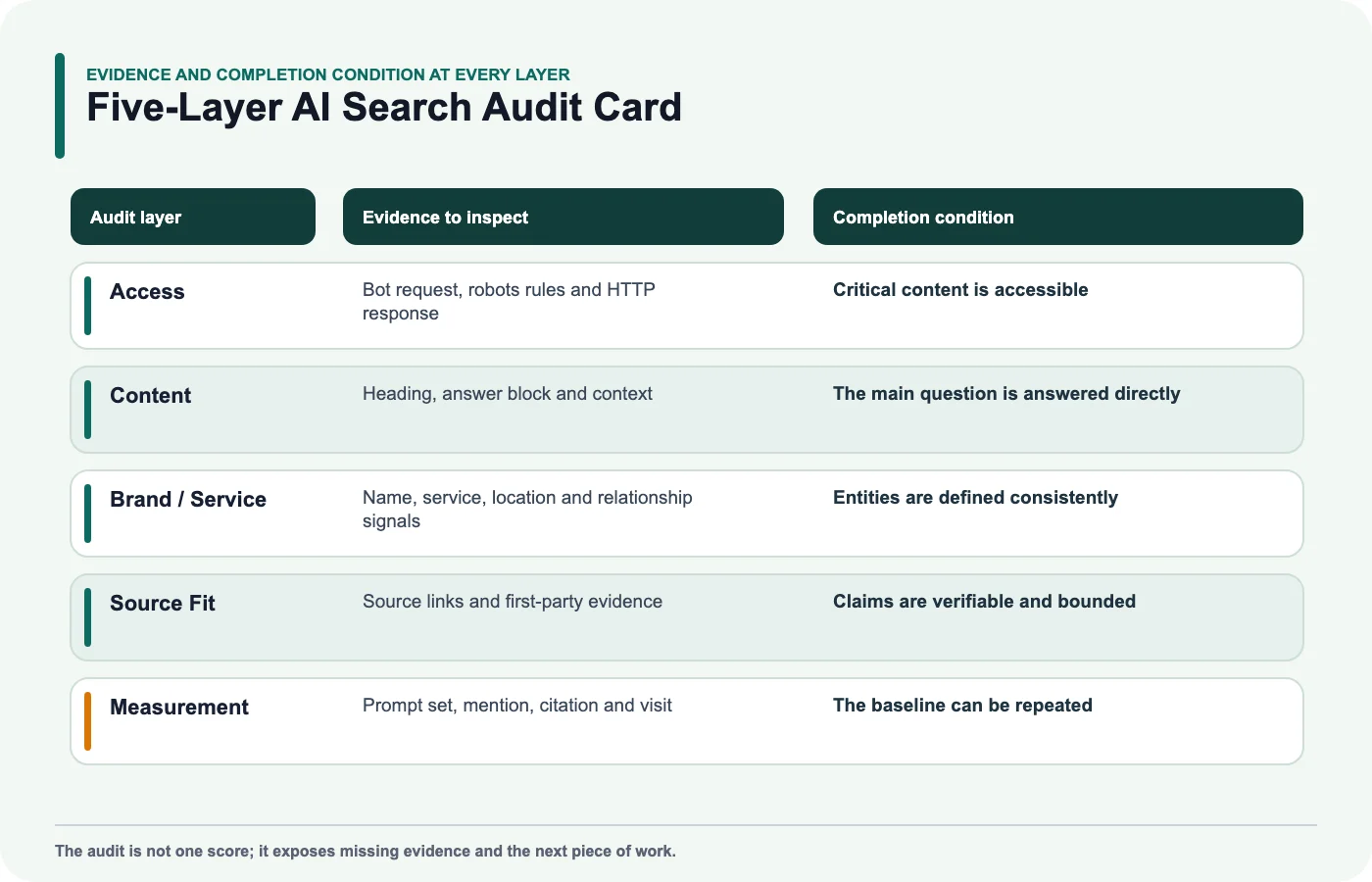
A binary “present/absent” checklist is rarely enough. Use the following fields to turn a finding into a decision:
| Field | What to record |
|---|---|
| Target | URL, page type and user task |
| Platform | Google, ChatGPT Search, Perplexity, Bing/Copilot or another named system |
| Check | One clear condition being tested |
| Evidence | HTTP output, official tool report, page section, log or dated observation |
| Status | Verified, review required, critical blocker or not applicable |
| Risk | Likely effect on the user and visibility |
| Owner | Technical, content, brand/communications or analytics team |
| Remediation | A specific action to take |
| Retest | Date and method for verifying the change |
These statuses do not produce a universal GEO score. One critical access barrier can matter more than dozens of minor editorial improvements. Prioritise by impact and evidence, not by adding up checks.
For the shared search foundation behind this card, see our guide to effective SEO techniques.
Layer 1: Access and indexability
The first layer checks the technical conditions that allow the target platform to discover and process a page.
HTTP status and accessible content
A priority URL should return the intended successful response when accessed directly. A soft 404, redirect loop, login requirement, empty HTML response or critical content available only after unsupported browser interaction can obstruct discovery.
Google’s minimum technical requirements state that Googlebot must not be blocked, the page must return HTTP 200 and it must contain indexable content to be eligible for indexing. Google also makes clear that meeting these conditions does not guarantee indexing.
Useful evidence includes:
- HTTP status and redirect chain
- Presence of the main content in the delivered HTML
- Canonical and robots meta directives
- JavaScript errors or rendering dependencies
- Google Search Console URL Inspection results
Platform-specific crawler policies
There is no single “AI bot.” Platforms may use different user agents for search, model development and user-initiated visits.
OpenAI’s official crawler documentation distinguishes OAI-SearchBot, used for ChatGPT search visibility, from GPTBot, which relates to content that may be crawled for developing and training generative AI foundation models. ChatGPT-User is separately described for certain user-initiated visits.
Perplexity’s official crawler documentation also distinguishes PerplexityBot, which supports search results, from Perplexity-User, which can access a page in response to a user request.
For each platform, ask:
- Is the correct user agent blocked in
robots.txt? - Does the CDN, WAF or bot-protection layer reject requests from official IP ranges?
- Does the crawler decision match the company’s search visibility and data-use policy?
- After a policy change, was the platform’s stated processing interval respected before retesting?
Allowing a crawler does not guarantee crawling, indexing, a citation or a ranking. Access only makes the remaining layers possible to assess.
Indexing, snippets and display controls
Google states that a page must be indexed and eligible to appear in Search with a snippet to be considered as a supporting link in AI Overviews or AI Mode. Its AI features documentation also says there is no additional technical requirement or special AI schema type.
An audit should not therefore treat “schema present” as a success condition by itself. If structured data is used, verify that it matches visible content, uses a supported type and does not make misleading claims.
Layer 2: Answer and content adequacy
A technically accessible page is not a strong source if it fails to complete the reader’s task. The second layer evaluates what the page answers and how clearly it does so.
Answer the primary question early
When a title promises a specific answer, the opening should provide a concise and direct response. A long brand introduction, keyword-heavy lead or vague definition delays the information the reader needs.
Check whether:
- The title and the first 150–200 words address the same task
- Essential terms are defined
- Audience, conditions and scope are clear
- Important limitations and exceptions are visible
- The reader can make a practical decision after reading
Present distinguishable information blocks
There is no need to force every paragraph into tiny “AI chunks.” Descriptive headings, tables, steps and examples are useful because they make context clearer for people.
An important information block may include:
- A claim or direct answer
- The context in which it applies
- Evidence or a source
- A limitation, exception or next step
Use only the elements required for the decision. The purpose is not to repeat generic statements in multiple formats.
Test for original value
A page that only restates general information from other sources has limited value as a new source. Record whether the page provides one or more of the following:
- A verified company process
- An anonymised real project example
- Owned data or observation
- Expert commentary with a defined scope
- A reusable checklist, calculation or decision matrix
- Original analysis that connects primary sources to a specific user task
Originality is not created by attaching a brand name to a generic framework. Explain how the method works, what evidence supports it and where it stops being valid.
Layer 3: Sources and verifiability
The third layer tests whether material claims can be traced by a reader or editor.
Separate material claims
Not every sentence needs an external citation. The evidence map should, however, include:
- Platform crawler, indexing or measurement behaviour
- Time-sensitive product and policy changes
- Numerical outcomes, rates and comparisons
- Company performance, client outcomes and service scope
- Claims with legal, health, financial, security or safety consequences
For each claim, record the source URL, access date, supported statement and the section where it appears.
Prefer primary sources
Use current official documentation when describing platform behaviour. Read the original paper when reporting research. Support company experience with a dated interview note, owned record, anonymised case identifier or reproducible first-party framework.
Do not hide all sources in a bibliography. Place a source near the material claim it supports, and confirm that it actually substantiates the wording used.
Record freshness
Crawler names, reporting features and platform policies change. Add access dates to technical claims and assign a review date to the content. A source may still load while its guidance is no longer current enough for the decision.
Layer 4: Brand consistency and external corroboration
Even accurate content is harder to verify when the publisher, author or relationship to the organization is unclear.
Check on-site consistency
Compare:
- Organization name, contact details and physical location where relevant
- Service-page scope and expertise claims in articles
- Author name, visible byline and structured data
- About, contact, service and policy pages
- Material facts across English and Turkish versions
A translation that changes service scope, a guarantee limitation or contact information creates a user-trust problem as well as a search-quality risk.
Review external corroboration
External visibility does not mean distributing the brand name artificially. The goal is to establish whether credible third-party sources represent the organization and its services consistently.
Possible checks include:
- Official business profiles and industry registrations
- Permitted customer or partner references
- Verifiable contributions in news, events, research or professional publications
- Consistent brand, product and service naming
- Prevalence of obsolete addresses, phone numbers, services or leadership information
Purchased, fake or context-free mentions are not a trust strategy. Remediation should focus on correcting real organizational information.
Layer 5: Visibility, citations and business outcomes
The final layer prevents the audit from ending as an on-page checklist. Record visibility with the platform, query group, date and evidence.
Build a controlled prompt and query sample
The sample may include:
- Brand queries
- Service and category queries
- Problems the user is trying to solve
- Alternatives and comparisons
- Purchase and decision queries
For each observation, record platform, language, date, country and, where possible, session state. The same prompt can produce different results over time, so one screenshot is not persistent performance evidence.
Keep mentions, citations and visits separate
A brand appearing in answer text, a URL being shown as a source and a person visiting the website are different events.
Microsoft’s Bing Webmaster Guidelines state that SEO does not guarantee ranking or traffic and GEO does not guarantee grounding or citation. Bing’s AI Performance documentation also cautions that citation data should not be treated as traffic, clicks, authority or ranking.
Preserve the following distinctions in reporting:
| Signal | What it shows | What it does not show |
|---|---|---|
| Brand mention | The brand appears in the answer text | Correct context, source link or visit |
| Citation/source | A URL appears as a visible source | Click, conversion, authority or ranking |
| Organic impression/click | Search visibility and visits within the reporting scope | Visibility across every AI platform |
| Session and conversion | Behaviour after reaching the site | Which answer component caused the decision |
| Prompt sample | A dated observation for selected queries | Results for all users or all queries |
Examine competitor visibility by context
Competitor analysis should not stop at counting mentions. Record the query group, source type and claim context in which a competitor appears. Use the finding to locate missing evidence, explanation or decision support—not to imitate the competitor’s page.
How to prioritise audit findings
Hundreds of recommendations are not an actionable output. Group findings by severity and decision value.
Critical blockers
- A priority URL fails or redirects incorrectly
- Directives prevent the required indexing or snippet eligibility
- A target platform crawler is blocked against company policy
- Main content is absent from accessible HTML
- A false or high-risk company claim is published
High-impact content and evidence gaps
- The page does not answer the question promised by its title
- Material claims lack sources
- Service scope or responsibility limits are unclear
- Pages repeat or compete with one another
- Platform information is outdated
Measurement gaps
- No baseline exists
- Prompt observations lack platform or date records
- Mentions, citations, visits and conversions are conflated
- Competitor visibility is not segmented by query group
Improvement opportunities
- A clearer comparison table or example
- Verified expert input
- Better internal linking or user journey
- A useful visual or data presentation
Resolve critical access and accuracy issues first, then improve the content and evidence required to complete the user task. Cosmetic edits should not outrank a material blocker.
Example audit record
The table below illustrates the recording format for a B2B service page. It is not a real result.
| Check | Evidence | Status | Risk | Owner | Next action |
|---|---|---|---|---|---|
| Does the target URL return HTTP 200? | Dated HTTP output | Verified | Low | Technical team | Retest after release |
| Is OAI-SearchBot blocked by the CDN? | robots.txt plus WAF log | Review required | High | Technical team | Test official user agent and IP range |
| Is the main service question answered near the start? | First 200 words | Critical blocker | High | Content team | Add a direct answer with scope and limits |
| Is there evidence for the performance claim? | No evidence record | Critical blocker | High | Editor | Remove the claim or add verified evidence |
| Does the brand mention include a source link? | Dated prompt record | Review required | Medium | SEO/GEO team | Repeat across dates within the query group |
| Is conversion tracking working? | Analytics event record | Verified | Low | Analytics team | Compare monthly |
The priority in this example is not to publish more pages. It is to remove the unsupported performance claim and answer the primary service question.
Common audit mistakes
Treating one tool score as the decision
Tools can accelerate crawling and observation. They cannot independently determine company scope, evidence quality or whether the page supports a real user decision. A score does not replace the underlying evidence.
Treating all crawlers as interchangeable
Search, model development and user-initiated access may be separate. Review each platform’s current official documentation.
Guaranteeing citations
No technical check or content change guarantees a citation on a particular platform. Kumsal Ajans works toward measurable improvement and sustainable growth without promising rankings or specific outcomes.
Creating pages for every query variation
Similar pages can weaken the site when they do not offer distinct value. Before recommending a new URL, assess refresh, consolidation and overlap options.
Treating citation count as conversion
A citation is a visibility signal. Qualified visits, engagement and conversion must be evaluated separately.
What should happen after the audit?
The output should be a limited, evidence-backed worklist:
- Resolve critical technical and accuracy barriers.
- Assign an owner and retest date to every change.
- Improve content and evidence around the user task.
- Confirm platform-specific crawler decisions against company policy.
- Preserve baseline visibility, citation, traffic and conversion data.
- Measure again with the same method and disclose any change to the sample or conditions.
For assigning continuing responsibilities, our guide to website maintenance and SEO scope helps separate routine platform upkeep from visibility work.
Instead of declaring “GEO complete,” report which barriers were removed, which uncertainties remain and how each observed signal changed.