


Aydınlatma metni yükleniyor…
Choose a type of digital agency by the problem and its dependencies, not by the longest service list. Labels such as full-service, performance, creative and web agency do not guarantee a consistent team standard. The useful comparison is the deliverable, specialist, implementation owner and evidence.
An organic-visibility problem may require technical implementation as well as content. Weak advertising may originate in the offer, measurement or landing experience rather than media management. Define the problem first, then map the specialisms and handoffs required to solve it.
Choose by Problem, Not Service-List Length
A list containing SEO, social, advertising and web design does not explain capacity. The same label can mean strategy, production, implementation or reporting only. A gap between the purchased name and expected output becomes a scope dispute.
Write the need in this order: current problem, intended business outcome, required change, specialist capability, internal dependency and verification data. The agency type matters only in relation to the gaps it can close reliably.
Full-Service and Integrated Digital Agencies
An integrated agency can coordinate several disciplines—such as strategy, content, creative, media, web and measurement—under one plan. Its value is not selling every service at once but managing dependent decisions against one objective and timetable.
Verify the real team, use of partners, accountable lead, specialist capacity and implementation ownership. Breadth is not automatic depth; require a named owner and working evidence in the critical field.
Performance and Paid-Media Agencies
These agencies may plan and operate search, social, display or other paid channels, covering setup, budget control, targeting, creative testing and measurement. Suitable channels and optimisation methods depend on the business model.
Clicks and impressions are not final value. Ask how platform activity connects to a verified enquiry, sale or other value event and how data loss and attribution limitations are reported. Document dependencies when the offer, landing page or sales follow-up sits outside agency scope.
SEO and Organic-Visibility Agencies
SEO can cover search demand, content architecture, page quality, internal links, crawling, indexability, structured data and measurement. Some agencies are strongest in strategy and content; others in technical review and implementation.
Reporting should produce page- or query-level decisions, not only a traffic chart. If code, servers, content operations or approval belong to other teams, name the implementation owner and timetable. An unimplemented recommendation is not the same as an implemented recommendation that failed.
Social-Media and Community Agencies
A social agency may provide channel strategy, planning, copy, design, publishing, moderation, community operations and some paid social work. Production shoots, customer service, crisis communication and weekend moderation may not be included.
Review audience quality, content purpose, community response and behaviour towards the business outcome rather than follower count alone. Define who answers customer questions, escalates sensitive comments and supplies brand approval.
Content and Creative Agencies
A content agency may research, plan and produce copy, video, design or distribution assets. A creative agency may concentrate on brand ideas, campaign concepts and visual systems. Verify ideas, production and distribution capability separately.
A portfolio shows aesthetic fit, not research accuracy, revision governance or channel impact. Ask about briefing, source checks, usage rights, editable-file delivery and format adaptation.
Web-Design and Digital-Product Agencies
A web-design agency may provide information architecture, user flows, interface design, accessibility, content placement, prototyping and front-end experience. A product agency may add discovery, research, roadmaps and continuous improvement.
A design and a working product are different deliverables. Separate content entry, back end, integrations, measurement, testing, hosting, maintenance and release responsibilities. Assess success through task completion and operational needs as well as visual approval.
Web-Software and Integration Specialists
These agencies may deliver custom software, content or commerce platforms, API integrations, data flows, automation, maintenance and technical migration. Design and marketing may sit elsewhere.
Define workflow, security, permissions, existing systems, data ownership, testing and acceptance before selecting technology. Source code, database, domain, deployment access, backups and handover should be contractual assets.
E-Commerce and Growth Agencies
E-commerce specialists may combine product data, category and search experience, campaigns, conversion flows, CRM, retention and measurement. “Growth” is a broad label that can mean anything from channel optimisation to product experimentation.
Confirm what the agency controls. Price, stock, logistics, call handling and product margin often belong to client teams. Ask about experiment implementation, data quality, prioritisation and how unsuccessful tests are recorded.
Digital PR and Reputation Specialists
Digital PR may cover media relationships, news value, expert commentary, online visibility and brand mentions. Reputation work may involve search results, reviews, crisis preparation, response operations and stakeholder communication.
No provider can absolutely control independent publications or search results. Prefer verifiable content, responsible responses, operational improvement and qualified legal or communications coordination over unethical removal, fake reviews or guarantees.
Specialist Boutiques versus Broad Teams
A boutique may offer senior attention and focus in one field while having limited capacity or cover. A broad team may handle several disciplines and more volume, but buyers should confirm which level of seniority is assigned.
Do not use agency size as a proxy for quality. Compare access to the critical specialist, delivery team, quality control, continuity, decision speed and external dependencies.
The Problem–Specialism–Deliverable–Dependency–Evidence Map
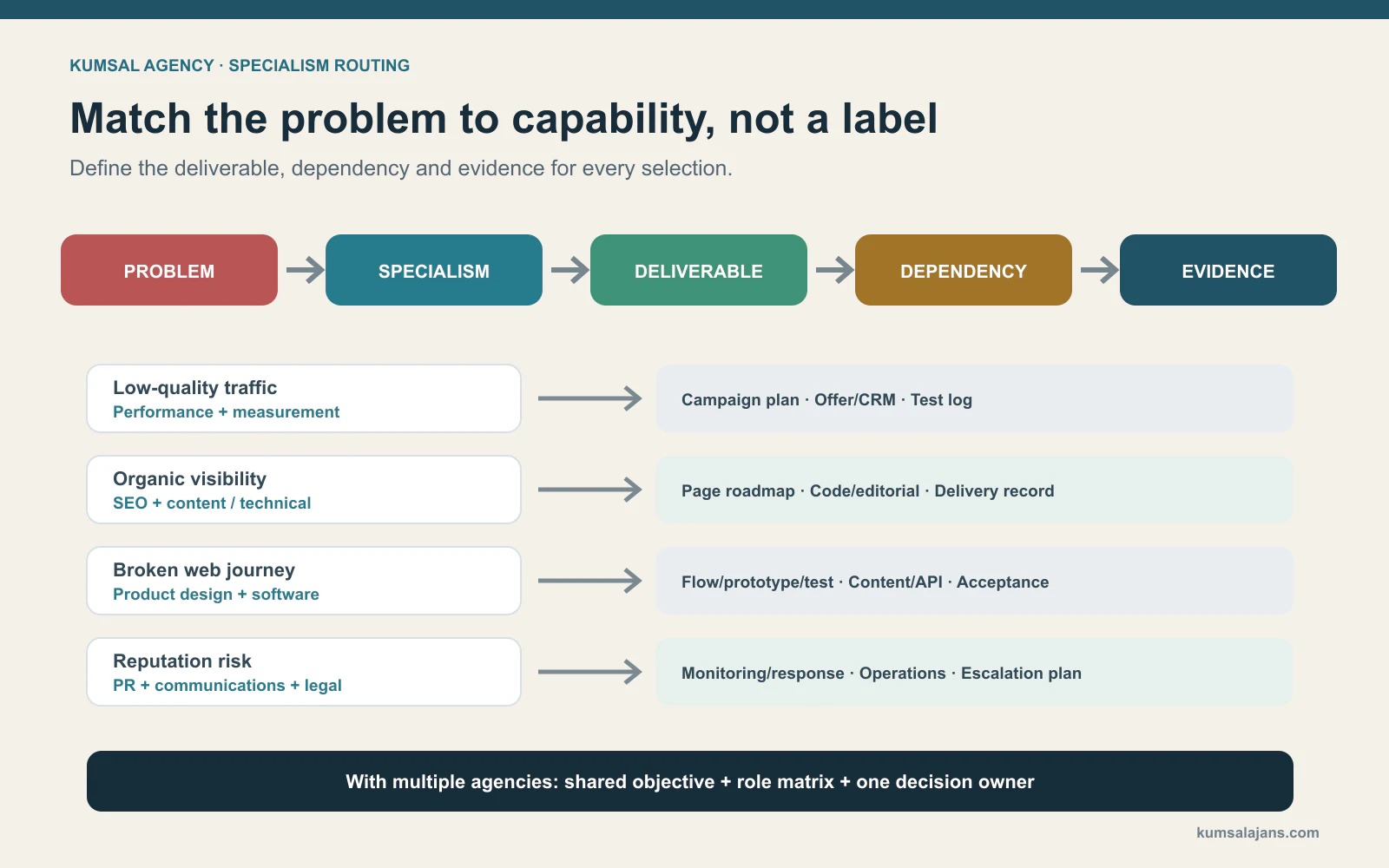
| Problem | Primary specialism | Deliverable | Critical dependency | Evidence |
|---|---|---|---|---|
| Low-quality paid traffic | Performance + measurement | Targeting, creative and value-event plan | Offer, landing page, CRM | Test and decision log |
| Weak organic discovery | SEO + content/technical | Page and implementation roadmap | Code and editorial capacity | Prioritised review |
| Fragmented brand message | Strategy + creative | Message and channel system | Approval and brand knowledge | Applied examples |
| Broken web journey | Product design + software | Flow, prototype, build and test | Content, integration, data | Acceptance scenarios |
| Reputation risk | PR + communications + legal where needed | Monitoring, response and crisis flow | Underlying operational issue | Authority and escalation plan |
Coordinate Multiple Agencies
A specialist-agency model can work, but it needs a shared brief, one objective hierarchy, consistent channel and data definitions, asset ownership and a decision owner. SEO changes need web capacity; performance message tests may need creative and sales alignment.
Use a role matrix to name who delivers, approves, contributes and receives updates. A shared reporting meeting should focus on business outcomes and dependency decisions rather than a contest between channel metrics.
A Short Decision Flow
- Write the business problem and verifiable outcome in one sentence.
- Separate required specialisms from implementation tasks.
- Record existing internal capacity, decision ownership and access.
- Put the external deliverable and dependencies in the brief.
- Verify the agency's real team, working method and exclusions.
- Agree measurement, reporting, ownership and handover before selection.
Use the digital marketing agency services guide to review scope and the digital agency selection guide to evaluate candidates.
Conclusion
Do not search for the perfect label. Match the problem, specialist capability, deliverable, dependency and evidence. Prioritise integration when several disciplines are required and specialist depth when the need is narrow but critical.
To discuss which working scope fits your need, contact Kumsal Agency.
Related guides: For the next decision steps, review the agency, freelancer and in-house team comparison and the digital agency brief guide.