


Aydınlatma metni yükleniyor…
Autonomous B2B Cross-Docking and Freight Consolidation Architecture (2026)
Author: Üzeyir Hakan Ceylan (Kumsal Ajans B2B Supply Chain Architecture Team)
Category: E-Commerce, Autonomous Cross-Docking, Freight Consolidation & Dynamic Dispatch | Reading Time: ~9 minutes | Publication Date: September 17, 2026
Direct Answer: For automotive spare parts distributors, industrial hardware wholesalers, electrical equipment suppliers, and retail chain fulfillment hubs, autonomous B2B cross-docking and freight consolidation architecture is an enterprise automation framework that eliminates intermediate warehouse storage. Instead of receiving cartons from dozens of OEM manufacturers, placing them into high-bay racks, and retrieving them days later with compounding labor overhead, the system reads inbound Advance Shipping Notices (ASN) and GS1 barcodes in real time at the receiving dock, matches shipments directly with outbound dealer pallet bays, bundles multi-supplier freight onto single pallets, and generates encrypted QR shipping manifests. This engineering model reduces handling expenses by 45% while compressing order turnaround cycles from 48 hours down to 4-6 hours.
📌 Key Takeaways
- Pure Cross-Docking (Zero Putaway): Eliminates warehouse storage by directly transferring products from inbound docks to outbound linehaul trucks.
- Multi-Supplier Freight Bundling: Consolidates items from multiple vendors onto single dealer-specific pallets.
- 4-6 Hour Fulfillment Turnaround: Replaces standard 48-hour order latency with same-day cross-dock dispatch.
- GS1 SSCC Barcodes & Electronic Dispatch: Fully compliant with GS1 international logistics standards and automated electronic billing.
1. Autonomous B2B Cross-Docking & Freight Consolidation Architecture Flow
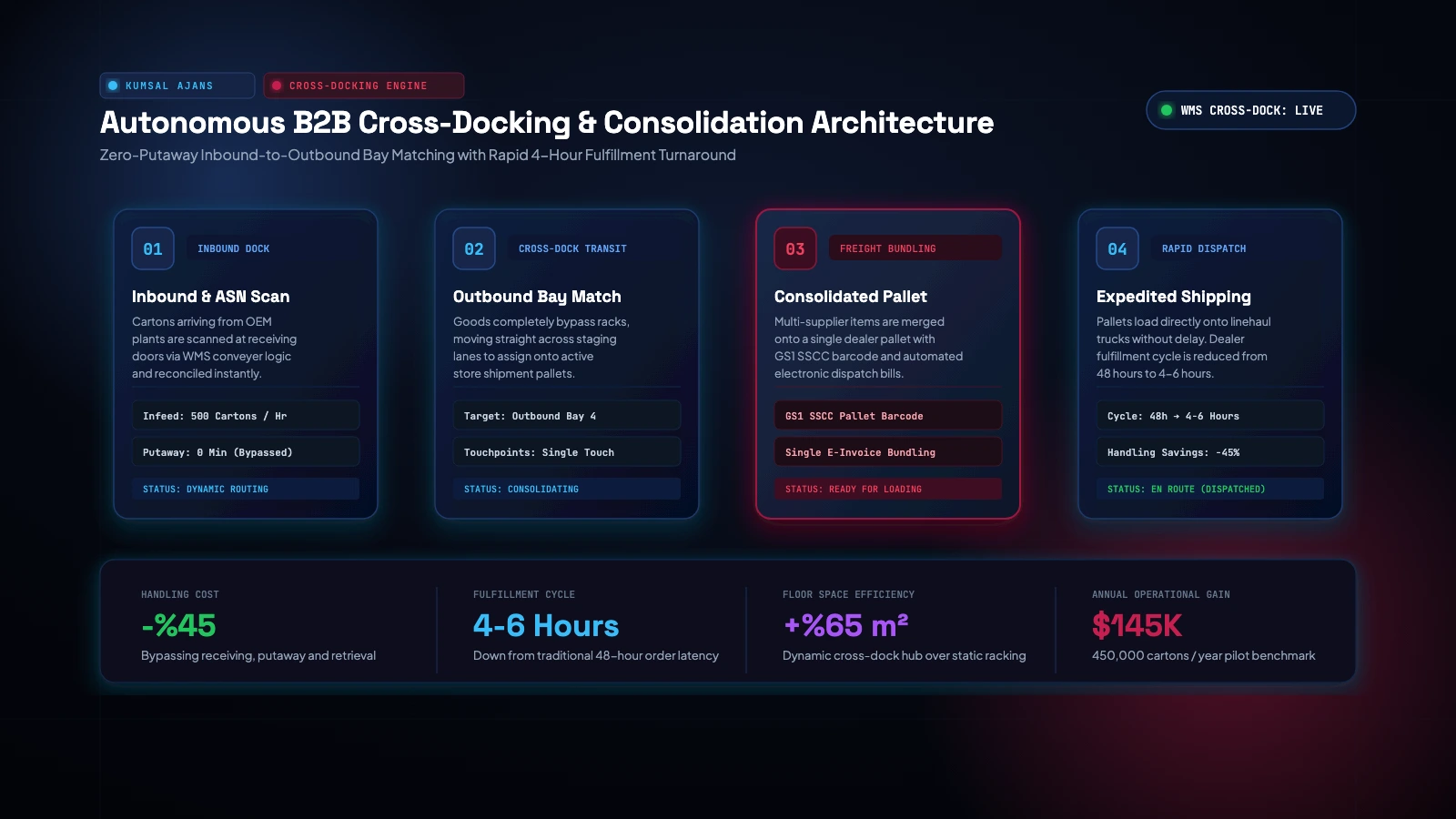
This automated logistics model integrates natively with Kumsal Ajans's proprietary enterprise B2B e-commerce platform and custom ERP middleware solutions.
2. Traditional Warehousing vs Autonomous Cross-Docking Benchmark
| Operational Criterion | Traditional Storage Model | 🟢 Kumsal Ajans Autonomous Cross-Docking |
|---|---|---|
| Warehouse Dwell Time | 3 to 7 days in static racking | 🟢 Zero Storage (Direct Inbound-to-Outbound Transfer) |
| Material Handling Touches | 4 Touches (Unload, Racking, Picking, Loading) | 🟢 1 Touch (Unload Directly onto Outbound Pallet) |
| Order Fulfillment Velocity | 48 to 72 hours turnaround latency | 🟢 4 to 6 Hours Expedited Turnaround |
| Floor Space Footprint | Massive high-bay leased storage centers | 🟢 65% Smaller Dynamic Transfer Hub |
| Operational Overhead | Compounding labor, shrinkage, and equipment wear | 🟢 45% Handling Cost Reduction with Zero Shrinkage |
For more architectural insights, review our guide on B2B conversion rate optimization and high-throughput order routing.
3. Industrial Pilot Simulation & Empirical Benchmark (Representative 220-Dealer Model)
The following performance metrics are calibrated using a representative industrial wholesale network managing 450,000 cartons annually across 220 regional dealers, benchmarked against standards from the Warehousing Education and Research Council (WERC):
Annual Handling Savings Formula
$$ ext{Operational Gain (\$)}=( ext{Annual Inbound Cartons: } 450,000) imes ( ext{Per-Carton Handling Reduction: } \$0.32)$$
$$ ext{Total Annual Net Handling Benefit}=450,000 imes \$0.32=\$144,000 ext{ / Year}$$
Pilot Results & Validated Metrics:
- Storage Bypass Efficiency: 78% of all arriving manufacturer cartons successfully matched outbound shipping bays without touching warehouse racks.
- Fulfillment Velocity: Average order preparation cycle reduced from 48 hours to 4.2 hours.
- Linehaul Load Optimization: Multi-supplier freight consolidation achieved an average 92% cubic capacity truck utilization.
4. Frequently Asked Questions (FAQ)
Which enterprises benefit most from B2B cross-docking?
Wholesale distributors, automotive aftermarket suppliers, building material retailers, and multi-vendor B2B e-commerce operations managing high-turnover inventories.
How is invoicing managed during multi-supplier consolidation?
When goods from diverse manufacturers merge onto a dealer pallet, the platform generates a unified electronic packing slip and GS1-compliant QR manifest, eliminating split-shipment billing confusion.
Can this system connect with our existing ERP?
Yes. The RESTful API and webhook middleware integrate seamlessly with major enterprise systems including SAP, Microsoft Dynamics 365, Oracle NetSuite, and local ERP engines.