


Aydınlatma metni yükleniyor…
Translating a website into multiple languages is not enough to succeed in international search. Search engines need to understand which language and market each page serves, while visitors should reach the right products, prices, contact details and content. International SEO architecture therefore extends far beyond adding hreflang tags. Domain structure, URL standards, content mapping, canonicalisation, redirects, XML sitemaps and measurement must operate as one coherent system.
A well-designed architecture reduces the risk of a Turkish page appearing in German search results or UK visitors seeing US prices and delivery terms. It can also prevent closely related regional pages from competing unnecessarily. For corporate brands, exporters and e-commerce teams, the objective is not simply to publish more URLs. It is to create a maintainable system in which every market receives an experience aligned with its search behaviour, commercial expectations and operational reality.
What is international SEO architecture?
International SEO architecture defines how language and country targeting are represented across URLs, content models, technical signals and user experience. A multilingual website may offer the same services in Turkish and English. A multi-regional website may publish different products, prices, regulations or fulfilment information for countries that share a language. For example, en-GB and en-US use English but serve distinct markets.
The first decision is whether each target represents a language, a country or a combination of both. Will one Spanish version serve every Spanish-speaking visitor, or will Spain and Mexico receive separate experiences? This choice affects URL patterns, hreflang codes, product catalogues, governance and content budgets. Google recommends using separate URLs for language versions and signalling their relationships clearly, as explained in its guide to managing multi-regional and multilingual websites.
A market should not receive a separate site section merely because it appears on an expansion plan. A dedicated version requires a meaningful reason: distinct demand, inventory, pricing, regulations, fulfilment, terminology or customer support. Creating regional URLs without the content and operational capacity to maintain them produces duplication and an inconsistent customer experience.
How should you choose between ccTLDs, subdomains and subdirectories?
Three structures are commonly used: country-code top-level domains, or ccTLDs; subdomains; and subdirectories under a generic domain. Each can work technically. The right choice depends on market importance, operational independence, brand strategy, development resources and content-management capacity.
ccTLDs: a strong country signal with greater operational overhead
Country domains such as example.de and example.fr clearly communicate a national focus to users and search engines. They can support local trust, independent campaigns and country-specific operations. However, registration, maintenance, security, analytics and authority development must be managed for every domain. Some countries may also impose local-presence requirements for registration.
A ccTLD model is most suitable when markets have independent teams, catalogues, legal requirements and budgets. If a central team is translating a limited number of pages for many countries, the governance and infrastructure costs may outweigh the benefit of a stronger geographic signal.
Subdirectories: centralised authority and simpler management
A structure such as example.com/de/ or example.com/tr/ keeps every market under one domain. Infrastructure, analytics, authority signals and content administration can be centralised, and launching another market is often faster than creating a new domain. The trade-off is that country targeting may be less visually obvious, while a serious platform-level issue could affect every market.
Subdomains: a middle ground between separation and centralisation
Subdomains such as de.example.com allow teams or platforms to be separated. They may be useful when markets rely on different technology stacks, although technical management and performance reporting can become more fragmented than with subdirectories. Users may also be unsure whether “de” represents the German language or Germany.
Parameter-based URLs such as ?lang=de are generally a weak foundation for a permanent international architecture. They complicate crawling, sharing, analytics, caching and segmentation. Whichever model you choose, document whether each URL segment identifies a language, a country or both, and enforce that convention consistently.
How should hreflang be implemented?
Hreflang groups URLs that are language or regional alternatives of one another. It is not a ranking guarantee. It is a matching signal that helps search engines show the most appropriate version to a user. Language values use ISO 639-1 codes, while optional country values use ISO 3166-1 Alpha-2 codes. Examples include tr for Turkish, de-DE for German in Germany and de-CH for German in Switzerland.
Every alternate page should list itself and all equivalent pages in the cluster. References must be reciprocal: if the Turkish page points to the English alternative, the English page must point back. Use absolute URLs, including protocol and domain. A general version or selection page for users who do not match a specific language or region can be declared with x-default. Google’s documentation on localised page versions explains implementation through HTML, HTTP headers and XML sitemaps.
You do not need to express the same relationship through all three methods. XML sitemaps can simplify central management for large, frequently changing catalogues. HTML annotations may be sufficient for smaller corporate websites. The important requirement is that the chosen method can be generated reliably and kept consistent as pages are published, changed or removed.
Automated validation should detect missing return links, invalid codes, redirected destinations, non-200 responses and URLs excluded from indexing. These checks should run before release and continue after launch, because a correct initial implementation can deteriorate as editors add pages or product availability changes.
Why does content mapping come before technical tagging?
Hreflang should connect genuinely equivalent pages. Mapping a Turkish product page to an English category page, or a service page to a foreign-language homepage, creates a misleading relationship. Begin with a market matrix that displays every page and its alternatives on the same row. Each row should contain URLs that answer the same search intent and help users complete the same task.
If a page has no equivalent in another language, do not create an artificial match. The missing version can be produced later; until then, it should remain outside that hreflang cluster. This is safer than publishing hundreds of weak machine-translated pages. Useful localisation must account for product availability, measurements, currency, shipping, legal copy, terminology, imagery and support information.
This makes international SEO an information-architecture and user-experience challenge, not just a translation assignment. The content model should let editors define market availability, local copy, alternative URLs and publication status without changing templates manually. Clear ownership is also essential: content, SEO, legal and product teams need an agreed process for approving and maintaining each market version.
| Structure | Primary advantage | Primary cost | Best-fit scenario |
|---|---|---|---|
| ccTLD: example.de | Strong country signal | Separate infrastructure and authority | Independent country operation |
| Subdomain: de.example.com | Technical separation | Fragmented management | Different platform or team |
| Subdirectory: example.com/de/ | Centralised, simpler management | Less visible country distinction | Growth on shared infrastructure |
How should canonical and hreflang work together?
Canonical tags identify a preferred representative among duplicate or closely similar URLs. Hreflang explains the relationship between language and regional alternatives. The two signals are not interchangeable. In general, every localised page intended for indexing should use a self-referencing canonical. Pointing the German page’s canonical to the English or global page may weaken the German URL’s ability to remain independently indexed.
Country versions written in the same language can be very similar. In that situation, each market page should normally retain its self-referencing canonical while the pages reference one another through hreflang. Google’s explanation of URL canonicalisation describes how canonical and hreflang signals should remain aligned. XML sitemaps, internal links and redirects must also point consistently to the selected canonical URLs.
Why are automatic redirects risky?
Forcing visitors to another version based on their IP address or browser language can prevent search engines from discovering all variations. Location does not always reflect preference: travellers, VPN users and multilingual visitors may be trapped on the wrong site. A safer pattern is to display a market or language suggestion and remember the visitor’s confirmed choice.
A language selector should not rely on flags alone. Flags represent countries, while language names communicate languages. The selector should be visible, keyboard accessible and built with crawlable links. When someone changes language on a product page, direct them to the equivalent product whenever one exists instead of returning them to the homepage.
Use a 301 redirect for a permanent URL change and a 302 where a move is genuinely temporary, such as a limited campaign or maintenance state. Avoid redirect chains and loops. Redirect rules must also account for discontinued products, merged categories and markets in which an item is unavailable, rather than sending every retired URL to a generic homepage.
International SEO launch and indexing checklist
International SEO should be part of development acceptance criteria, not a tag package added after launch. The content-management system should expose each page’s language, market, equivalent URLs, publication state and indexing preference. Custom web development also needs to model page deletion, country-specific product withdrawal and future market launches.
- Give every indexable language or country version a unique, permanent URL.
- Validate self-references, reciprocal links, supported codes and 200-status destinations in every hreflang cluster.
- Keep canonicals, hreflang, XML sitemaps and internal links aligned to one URL standard.
- Ensure alternatives are not blocked by robots.txt, noindex directives, authentication or faulty redirects.
- Localise titles, meta descriptions, core content, image alternatives and structured data.
- Test mobile performance, basic accessibility, cookie preferences and form validation in every market.
- Measure search performance by country, language, directory or domain, and investigate appearances in the wrong market.
How do you build a sustainable international structure?
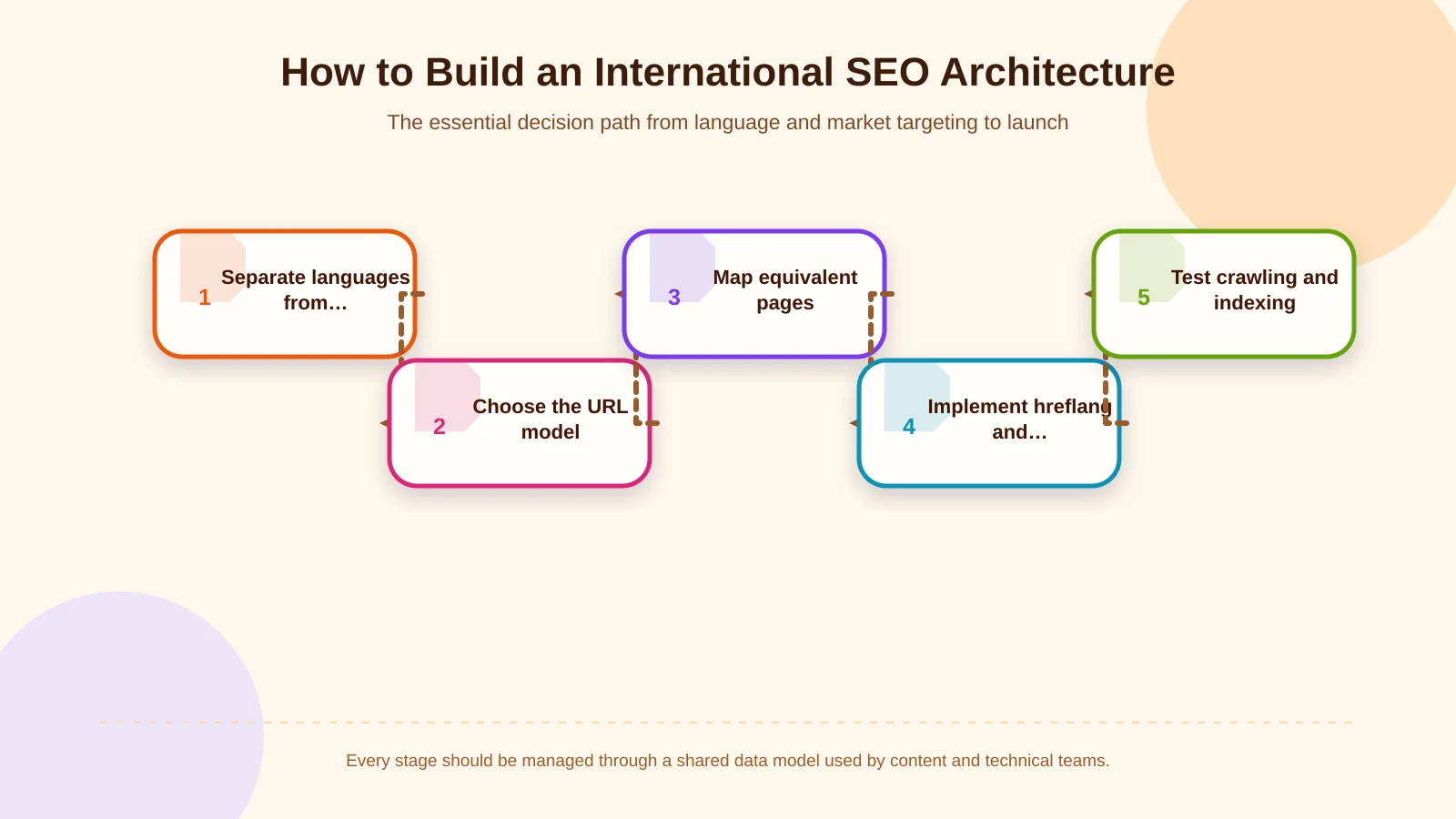
A sustainable system begins with market research. Evaluate search demand, local competitors, brand awareness, product suitability and operational capacity. Then select the domain model, define URL naming conventions and create the content matrix. During design and development, implement the language selector, local components, hreflang generation, canonical rules, sitemaps, performance controls and analytics as one connected architecture.
The work continues after launch. New pages must enter the correct alternate clusters, removed URLs need appropriate destinations, and missing translations should be reported. Shared data models across content, SEO and development teams reduce manual errors. Dashboards should distinguish traffic losses from indexing problems, content gaps and commercial limitations such as unavailable inventory.
As an Istanbul-based digital agency, Kumsal Agency combines research-led digital brand consulting, multilingual information architecture, corporate web design, custom web development, content planning, performance, analytics, accessibility fundamentals and technical SEO. This end-to-end approach treats international visibility as a product and governance challenge rather than an isolated hreflang task.
Plan a scalable international SEO and multilingual web architecture with Kumsal Agency around your target countries, languages and current domain structure. The result should be more than technically valid annotations: it should be a system your teams can manage, your users can understand and your organisation can expand into new markets with control.