


Aydınlatma metni yükleniyor…
The first 90 days of an SEO and Generative Engine Optimization (GEO) programme should not be sold as a promise to rank first on Google or to become a guaranteed source in AI-generated answers. The practical goal is to establish a measurable baseline, prioritise technical and content problems, implement the most important changes and use the resulting evidence to decide what happens next.
Kumsal Ajans uses a three-phase working model:
- Days 1–30: technical assessment, current-state analysis and competitor analysis
- Days 31–60: technical changes, content optimisation and page optimisation
- Days 61–90: visibility monitoring, content development, implementation of new opportunities and performance improvements
This is not a fixed prescription for every organisation. The length of the B2B sales cycle, the site's technical condition, internal approval times, data quality and market competition can all change the order of work. Ninety days is a management framework for moving from analysis to implementation and learning—not a deadline by which a particular result is guaranteed.
Why should SEO and GEO share one plan?
GEO focuses on making a brand understandable and discoverable in generative AI-assisted search and answer experiences, and on improving the conditions under which its material may be selected as a source. It is not an isolated set of “AI tricks”.
Google's current guidance for generative AI search says that the same foundational SEO practices remain relevant to experiences such as AI Overviews and AI Mode. Accessible pages, original and useful content, a clear site structure and a sound user experience form a shared foundation. A coherent programme therefore manages two connected tracks:
- SEO track: crawling, indexing, page quality, search demand, organic visibility and conversion
- GEO track: AI crawler access, clarity of brand and service information, visibility for selected prompts and queries, source appearances and competitor comparisons
The two tracks do not always use identical metrics. They do, however, rely on many of the same technical resources, subject-matter expertise and content capacity. Managing them together makes shared work visible and reduces duplicated audits or contradictory recommendations.
Make four decisions before day one
The objective, access requirements, baseline and owners should be clear before the calendar begins. Without them, the first month's “analysis” can become a long list of observations that nobody is ready to act on.
1. Define the business objective
“Increase organic traffic” is not specific enough for a B2B programme. Which service or solution group has priority? Who is the decision-maker? Is the valuable action a request for proposal, a demo, a phone call, an email enquiry or a document download? How does the sales team define a qualified opportunity?
Document primary and secondary goals during the first phase. A high-volume topic with little commercial relevance should not automatically outrank a lower-volume query used by genuine decision-makers.
2. Prepare access and evidence
Identify the required Search Console and analytics access, the content management platform, robots.txt and sitemap locations, server/CDN/WAF controls, conversion definitions and—where possible—sales data. If access cannot be granted, document which evidence will be used instead.
Choose the GEO platforms to be observed as well. “All AI systems” is not a measurable scope. ChatGPT search, Google's generative AI features and other experiences should be prioritised according to the market and the audience. Prompt-based visibility checks can be included where they answer a real business question; they do not have to be a standard deliverable in every project.
3. Freeze the baseline
Record the starting position before making changes: the technical and indexing state of priority pages, organic clicks and impressions, conversion tracking, target query groups, gaps in brand or service explanations, and the selected AI prompts. Include the baseline date and comparison period. Otherwise, a later before-and-after claim may combine incomparable datasets.
4. Assign owners
An agency cannot complete every dependency alone. Technical changes may need a developer; service claims may require a subject-matter expert; legal or brand language may need an internal approver; conversion quality may need input from marketing and sales. Every work package needs a decision owner as well as the people supporting it.
Days 1–30: turn findings into a decision map
The first phase covers technical, current-state and competitor analysis. Its purpose is not merely to deliver an audit deck. Each finding should become a decision item with evidence, expected impact, an owner, effort and a completion test.
Technical assessment
For SEO, review at least crawlability, indexability, HTTP responses, canonical signals, robots directives, XML sitemaps, internal links, mobile usability, JavaScript-dependent visibility and important page templates.
Google's technical requirements include allowing Googlebot access, returning a successful HTTP response and providing indexable content. Meeting those minimum conditions does not guarantee indexing, but failing them can undermine later content investment.
For GEO, check relevant AI crawler access, CDN or WAF blocks, the accessibility of important company and service information, and consistency between visible content and structured descriptions. Treat bots according to purpose. OpenAI's crawler documentation, for example, describes different roles for OAI-SearchBot, GPTBot and user-initiated ChatGPT-User access. Allowing one crawler does not guarantee an appearance or citation in a search answer.
Current-state analysis
Do not stop at a traffic chart. Review the pages involved in the B2B buying journey:
- Do service and solution pages explain the offer precisely?
- Are industry use cases available where the company has real evidence?
- Are process, scope, risk and measurement questions answered?
- Are expertise claims supported by verifiable evidence?
- Can enquiries and other valuable actions be measured?
- Is the relationship between the brand and its services clear to people and machines?
Keyword presence alone does not make a page useful. Google's people-first content guidance recommends content that provides original value, demonstrates relevant experience or expertise and helps the intended audience complete its task.
Competitor analysis
Do not select competitors by company size alone. Publishers, specialist sites, directories and adjacent solution categories may also compete for attention in search. For selected GEO prompts, record which brands appear, which sources are visible and which competitor proposition is explained more clearly.
The purpose is not to copy everything a competitor publishes. The analysis should answer:
- Which user need does the competitor satisfy better?
- What expertise can we substantiate but fail to show on the site?
- What is the likely business impact of the technical or content gap?
Day 30 decision gate: what will be implemented?
At the end of the first month, replace the hundred-item findings deck with an approvable implementation queue. Kumsal's 30–60–90 Implementation Canvas records seven fields for each work package:
| Field | Question to answer |
|---|---|
| Work package | What exactly will change? |
| Deliverable | What observable output will be produced? |
| Owner | Who implements it, and who approves it? |
| Evidence | How will the issue and its completion be verified? |
| Decision gate | What conditions define “done”? |
| Risk or dependency | Is access, development or approval blocking the work? |
| Next decision | Which metric or follow-up action will inform the next phase? |
Prioritise commercial impact, technical severity, implementation effort and strength of evidence together. A template error that prevents core service pages from being indexed takes precedence over ten new articles. Broken form measurement should also be repaired before anyone interprets lead performance.
Days 31–60: implement technical, content and page changes
The second phase puts the approved queue into production. In Kumsal's working model, technical changes and content/page optimisation proceed as connected streams.
Technical changes
Depending on priority, this may include crawl blocks, incorrect indexing directives, canonical mistakes, redirect chains, wrong HTTP statuses, sitemap inconsistencies, internal-link gaps or template-level visibility problems. If the organisation has approved an AI crawler policy, verify that robots.txt, CDN and security controls express the same decision.
Keep before-and-after evidence for each material change. Closing a task card is not proof that the problem was solved. Use the appropriate verification: HTTP tests, URL inspection results, crawl comparisons, rendered/source checks or server logs.
Content optimisation
The goal of B2B content is not to make the page longer. It is to answer the decision-maker's missing questions with genuine subject expertise. Clarify scope, process, deliverables, suitability, limitations, evidence and the next step. Remove unsupported success claims and add verified company information or subject-matter input.
Short answers and descriptive headings can improve clarity for both human readers and answer systems, but the page should not be artificially fragmented for AI. Google's guidance does not prescribe a special AI writing format or ideal word count. The correct length is the length required to answer the reader's task clearly without repetition.
Page optimisation
Review titles and descriptions, H1–H2 hierarchy, the order of core information, contextual links, trust signals and the conversion path as one experience. A page may answer an informational query yet fail commercially because it gives the B2B visitor no relevant next step.
Useful contextual references to practical SEO techniques can help a reader understand individual actions, while the 90-day plan explains how to sequence and govern them.
If a new page is required, do not create a thin page for every keyword variation. Plan a page that addresses the primary need thoroughly and has a defensible original contribution, an internal expert source and a distinct role within the existing content architecture.
Day 60 decision gate: is the change actually complete?
The second gate requires three separate lists:
- Implemented and verified: the change is live and has passed technical or editorial quality control.
- Implemented; awaiting data: the change is live, but there has not been enough time or activity to assess its effect.
- Pending or blocked: development, content, legal, brand or management approval is still required.
This distinction matters. “Released” and “produced a result” are not the same state. Search systems may need to recrawl pages, reports may need time to populate and B2B conversions may have a long decision cycle. The day-60 report is therefore an implementation and quality-assurance record, not an early success declaration.
Days 61–90: measure, improve and validate new opportunities
The third phase emphasises visibility monitoring, content development, implementation of new opportunities and performance improvement. It should not start a disconnected list of activities; observations must be traceable to the baseline and the changes already recorded.
Visibility monitoring
For organic search, inspect movements in queries, pages, clicks and impressions. The Search Console Performance report supports analysis using metrics such as clicks, impressions, CTR and average position. These figures are decision inputs, not proof of revenue or qualified demand. Interpret them alongside analytics, defined conversions and sales feedback where available.
For GEO visibility, use a selected, version-controlled prompt set. Record brand/service mentions, visible sources, answer context and relevant competitors. Prompt-based checks can be added when useful; they are not a universal measurement method. Because responses may vary by platform, time and context, do not generalise from a single screenshot.
Content development and new opportunities
Derive new opportunities from gaps found in phase one, page observations from phase two and questions heard by sales teams. Prioritise contributions such as:
- processes the company can explain from first-hand knowledge;
- industry-specific decision and risk guides;
- honest comparisons that clarify service boundaries;
- genuine expert methods, checklists or viewpoints; and
- supporting material that strengthens an existing high-value page.
Do not add a topic to the calendar solely because it has search volume. Check commercial relevance, evidence availability, production capacity and overlap with existing pages.
Performance improvement
Evidence may justify a change to the title, content order, internal links, conversion step or technical implementation. Record when, why and where each material change was made. Untracked simultaneous changes make the next performance interpretation less reliable.
If recurring technical maintenance is a dependency, the distinction between website maintenance and SEO work helps teams assign responsibility without treating the two as interchangeable.
Deliverables for each phase
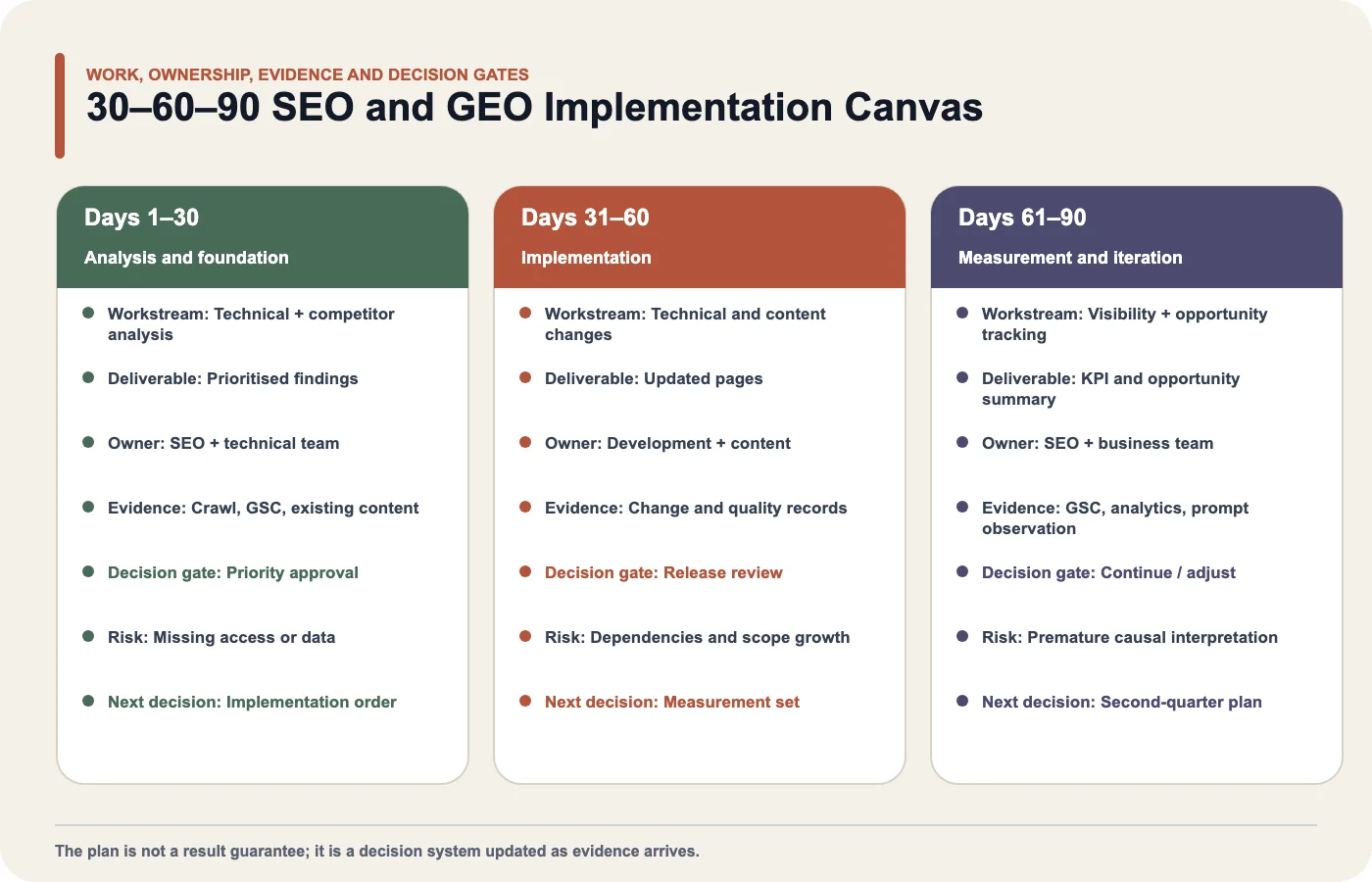
| Period | Main work | Expected deliverables | Decision gate |
|---|---|---|---|
| Days 1–30 | Technical, current-state and competitor analysis | Baseline, technical findings, page/content inventory, competitor and GEO visibility summary, prioritised queue | Work without evidence, an owner and a priority does not enter implementation |
| Days 31–60 | Technical changes and content/page optimisation | Change log, updated pages, technical tests, content approvals, blocked-work list | Live work passes the relevant technical and editorial checks |
| Days 61–90 | Monitoring, development and opportunity implementation | Organic/GEO visibility summary, conversion review, opportunity list, performance changes, next-period plan | Observed data is separated from interpretation; continue, stop or improve decisions are documented |
Who should be responsible?
A simple responsibility model can reduce avoidable waiting time:
- Executive sponsor or marketing lead: decides business goals, budget and priority conflicts.
- SEO/GEO team or agency: performs analysis, gathers evidence, prioritises work and interprets measurement.
- Developer or IT: implements technical work and checks server, CDN, WAF and template effects.
- Subject-matter expert: verifies service, industry and method claims and supplies the original contribution.
- Content, brand or legal owner: approves language and any relevant brand or regulatory requirement.
- Sales team: reports lead quality, real buyer questions and downstream outcomes.
Each work package should have one accountable decision owner. Several people may contribute, but unclear accountability is a frequent source of delay in corporate B2B programmes.
How should reporting work?
Kumsal's confirmed scope can cover organic traffic, rankings, impressions and clicks, conversions, technical SEO status and GEO visibility. Search Console, analytics and relevant reporting access can be provided where appropriate to the engagement.
A useful report does not try to colour every metric green. It separates:
- the baseline and measurement period;
- the changes completed;
- the observations recorded;
- the interpretation of those observations;
- assumptions that are not yet verified; and
- the next decision and its owner.
There is no ranking or fixed-result guarantee. Technical eligibility does not guarantee indexing, and crawler access does not guarantee selection or citation by an AI system. The goal is to build a reliable process for measurable improvement and better decisions that support sustainable growth.
What should be decided at the end of 90 days?
The closing review should answer more than “shall we continue?” It should determine:
- Which technical debt moves into the next period?
- Which service or topic cluster will expand, pause or stop?
- Which pages will be improved, consolidated or repositioned?
- Which GEO prompts still represent meaningful business questions?
- Which measurement gaps need to be closed?
- How will sales feedback change the content and conversion plan?
- What are the success and stop criteria for the next experiment?
The second 90-day period should not be a copy of the first. It should be more selective: major obstacles have been reduced, measurement discipline is stronger and the next programme is informed by observed evidence.