


Aydınlatma metni yükleniyor…
For B2B companies, selling on credit can support revenue growth while increasing exposure to late payment and default. Trade credit insurance helps manage this exposure within the terms of a policy, but holding a policy is not enough on its own. If buyer limits, orders, shipments, invoices, due dates, collections, overdue notices and claim documents are stored in separate systems, operational errors can still put coverage or claim quality at risk. The practical opportunity for 2026 is to connect these records through a shared, controlled and auditable data flow.
In this article, an “autonomous claims robot” does not mean an off-the-shelf product that independently makes legal, insurance or financial decisions. It describes a custom automation layer that applies configured policy rules, monitors ERP transactions, gathers supporting documents, identifies missing information and prepares a case for authorised human approval. The final scope must be defined by considering the insurer’s procedures, the policy currently in force, the company’s risk policy and applicable legislation together.
Why trade credit insurance is not only a finance responsibility
Effective credit insurance begins before an invoice becomes overdue. Sales teams request or offer payment terms, credit-risk teams verify buyer limits, operations create shipment and invoicing records, collections teams follow overdue balances, and finance manages notifications and claim submissions. A break anywhere in this chain can turn an apparently insured transaction into a disputed case because of missing evidence, late notification, an exceeded limit or activity outside the policy terms.
The General Conditions for Trade Credit Insurance published by Türkiye’s Insurance and Private Pension Regulation and Supervision Agency addresses matters such as buyer limits, maximum payment terms, notification obligations and the determination of indemnity. However, the controls required by each organisation may vary according to its specific policy terms and sales model. Software should therefore use configurable, version-controlled policy rules instead of permanent assumptions embedded in code.
What should “autonomous” mean in 2026?
Autonomy should move people towards exceptions and material decisions rather than remove them from the process. A system can identify invoices approaching maturity, match collection transactions, flag limit breaches and prepare a draft claim file. Policy interpretation, disputes, high-value cases, incomplete evidence and actions that may affect customer relationships should still be routed to an authorised user.
This approach requires explainability. Users should not see only an “ineligible” result; they should be able to identify the customer, policy version, buyer limit, payment term, invoice or missing document that produced it. NIST’s voluntary Artificial Intelligence Risk Management Framework also highlights characteristics such as accountability, transparency, explainability, security and human oversight for trustworthy systems. Not every automation needs artificial intelligence. Many business-critical controls are more predictable when implemented as explicit rules.
A shared data model from ERP to claim outcome
A reliable architecture begins by deciding which system is authoritative for each record. The ERP is usually the main source for customer accounts, orders, shipments, invoices, due dates, returns and collections. Policy and buyer-limit data may arrive through an insurer integration, a controlled file transfer or authorised manual entry. Email and document repositories may contain correspondence, proof of delivery and collection evidence.
The integration layer must do more than display these records on one screen. It should reconcile customer identifiers, standardise currencies and dates, track cancellations and returns, and record when and from which system each value arrived. Failed transfers must not disappear silently. They should enter an error queue with retry status, assigned ownership and resolution notes. This makes integration failure an operationally managed event rather than a hidden data-quality problem.
Which core records should the model include?
- Policy number, version, coverage period, currency and applicable special conditions
- Buyer identity, group relationships, assigned limit and limit-validity dates
- Links between orders, shipments, invoices, due dates, collections, returns and offsets
- Overdue start date, collection attempts, notification dates and responsible team
- Claim-file version, document checklist, approvals, submission and indemnity outcome
This data model can be considered alongside a B2B order-tracking portal. Earlier visibility into orders, partial shipments and delivery documents helps maintain a clearer evidence chain for the receivable that may later become part of an insured claim.
Workflow of an autonomous claims robot
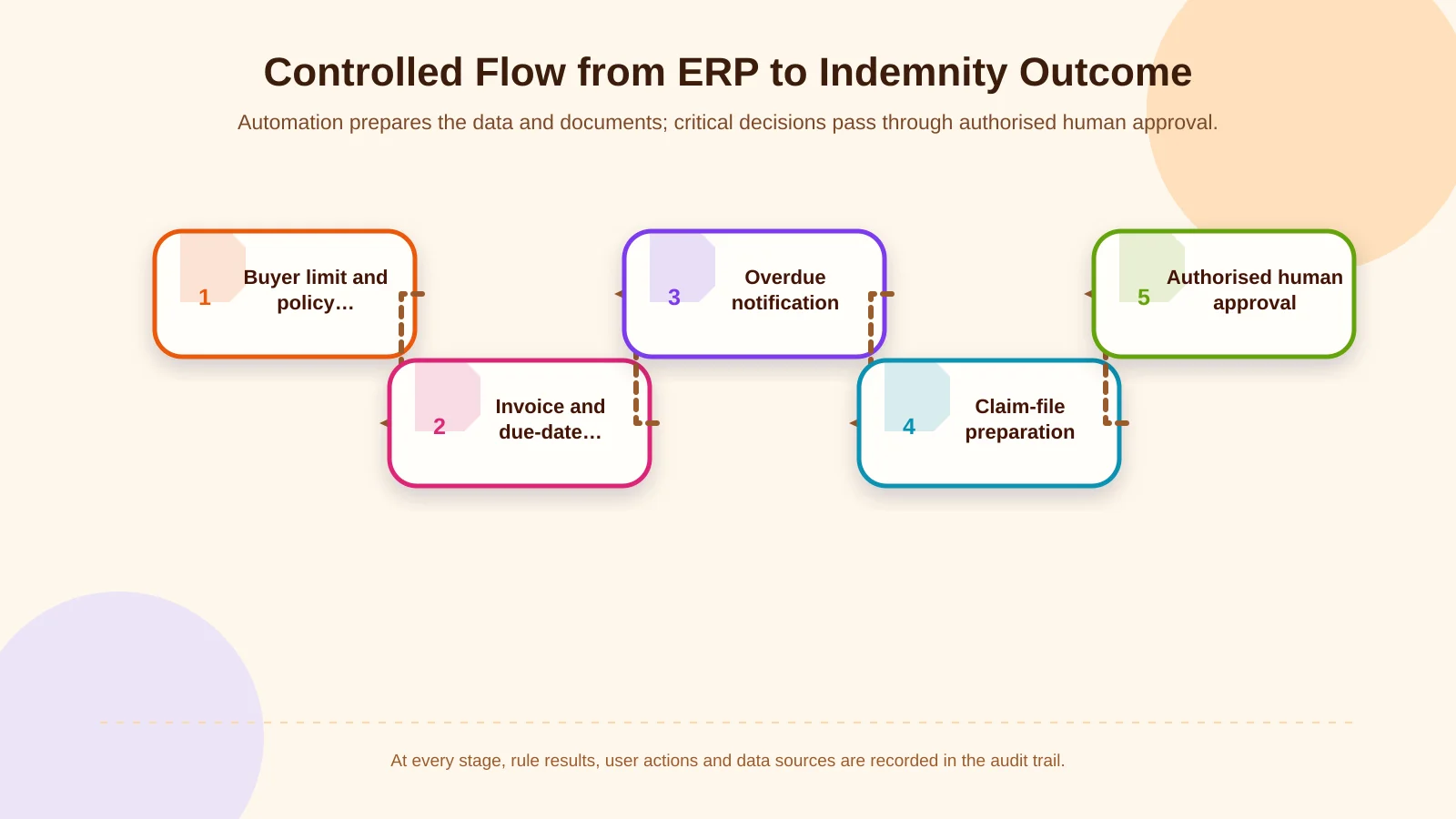
1. Policy and buyer-limit checks
Before a new order or shipment is released, the system checks the applicable policy version, buyer limit, current open exposure and permitted payment terms. It can present an understandable status such as “eligible”, “approval required” or “blocked”. Users should be able to see which transactions consume the limit. Any manual override should require a reason, supporting evidence where appropriate and approval from a user with the necessary authority.
2. Invoice and collection monitoring
Invoices imported from the ERP are placed on a maturity schedule. Transactions from the bank, ERP or collection system are matched to invoices using controlled rules. Partial payments, offsets, credit notes, returns and exchange-rate differences should not be reduced to a single paid-or-unpaid field. Ambiguous matches should enter an exception queue for review instead of being accepted through an unreliable automated assumption.
3. Overdue and notification management
Once a due date passes, the system can create tasks and notifications according to policy-specific thresholds. It may assign customer communication to the sales representative, follow-up activity to collections and a new-shipment review to the credit-risk team. The notification date, channel, customer response and payment commitment should be recorded. Teams can then work from one timeline and avoid sending inconsistent messages to the same customer.
4. Claim-file preparation
The robot gathers invoices, orders, delivery evidence, account statements, correspondence and collection records according to a defined checklist. It must not quietly mark a file as complete when a document is missing or inconsistent. Instead, it should identify the deficiency, source and responsible owner. When a document changes, the previous version should remain available, with a record of who changed it, when the change occurred and why.
5. Human approval and secure submission
The file is routed to an authorised user according to its amount, risk level and exception status. Where a four-eyes principle applies, the preparer and approver must be different people. After approval, the file can be transferred through a channel supported by the insurer, and technical acceptance should be retained. If no direct integration exists, controlled export and manual submission can still be included in the audit trail.
6. Outcome, accounting and feedback
The indemnity decision, payment, deduction, rejection reason and any appeal process are linked to the case. The system may prepare a draft ERP accounting entry, but material financial postings should remain subject to the organisation’s authority matrix. Outcome data can then support management dashboards that reveal repeated deficiencies, policy-application issues and operational bottlenecks.
Designing roles, authority and exceptions
If one person can change a buyer limit, grant an exception and approve the resulting claim, automation concentrates risk instead of controlling it. Sales, finance, credit risk, collections, legal, operations and system-administration roles should have distinct responsibilities. The authority model may also include amount thresholds, legal entity, region, customer group and temporary delegation periods.
Exception management should not be an unrestricted text field used to bypass the process. Each exception type should record its reason, evidence, expiry, risk owner and approver. The same principles of role separation, limits and delegation also apply when designing a B2B order approval workflow. Connecting these controls can prevent commercial approval and credit-insurance approval from becoming contradictory processes.
| Stage | System task | Human control | Audit record |
|---|---|---|---|
| Limit check | Calculates open exposure | Approves the exception | Rule and rationale |
| Overdue monitoring | Creates thresholds and tasks | Assesses the customer situation | Notification time |
| File preparation | Compiles documents | Verifies missing items | Document versions |
| Indemnity outcome | Prepares the ERP entry | Approves the financial posting | Decision and approval |
Document management and the audit trail
A claim file is reliable only when each document is connected to the correct transaction. Document type, customer, invoice, upload time, uploading user and version should be mandatory metadata. Integrity controls, access history and retention rules need to be defined during solution design rather than added after implementation.
The audit trail should timestamp sign-ins, rule results, manual changes, approvals, rejections, transfers and notifications. Existing records should not be silently overwritten. When correction is necessary, the system should append a new event while preserving the earlier state. An auditor or authorised manager can then reconstruct why a file was submitted, which data supported it and who approved it.
How should data security be planned?
Trade credit insurance software may process customer financial information, contact details, invoices and commercially sensitive documents. Least-privilege access, strong authentication, encryption in transit and at rest, environment separation, backups, security updates and event logging should therefore form part of the project scope. Where personal data is processed, the data inventory, legal basis, access requirements and retention period should also be evaluated.
Türkiye’s Personal Data Protection Authority states that safeguards should be appropriate to the data controller’s structure, activities and risks. Its guidance on data-security obligations is an official reference for considering technical and organisational measures together. The project should cover not only application security but also user training, access reviews, supplier access and incident response.
Which management-dashboard metrics matter?
Dashboards should show more than total receivables or total indemnity. Decision-support metrics may include buyer-limit utilisation, exposure approaching maturity, overdue ageing, time remaining before notification deadlines, files with missing documents, approval waiting time, integration errors and claim status. Every metric should be traceable to its source records and calculation rule.
An operational dashboard should prioritise daily actions, while an executive dashboard should expose trends, concentrations and bottlenecks. Users should be able to move from a chart to the cases behind it. This turns reporting into an actionable workspace and makes unusual results easier to investigate.
Questions to ask before starting the project
- Which policy terms, special conditions and buyer-limit records are digitally available?
- How reliable are customer, invoice, due-date and collection records in the ERP?
- Which decisions can be automated, and which require human approval?
- What operational calendar governs overdue events, notifications and claim submission?
- Who owns missing data, integration outages and conflicting rules?
- How long must documents be retained, and who may access them?
- Will success be measured through speed, fewer errors, visibility or file quality?
The first release does not need to automate every scenario. A high-volume flow with clear rules can be selected, then operated in shadow mode alongside the current manual process. Rule accuracy, data gaps, exception rates and user behaviour can be reviewed before automation is expanded in controlled stages.
A project-specific approach with Kumsal Agency
Kumsal Agency approaches the autonomous claims robot as custom web software designed around the organisation’s real process—not as a standard product available out of the box. The scope may include ERP and third-party integrations, user roles and permissions, workflows, management dashboards, document management, notifications, error and exception queues, data security and a maintainable software architecture.
Analyse your trade credit insurance and claims workflow with Kumsal Agency using your existing ERP, policy rules, data sources, approval authorities and real exceptions. This discovery process can define which steps are suitable for automation, where human judgement must remain, how integration boundaries should be managed and what a project-specific solution needs to include.