


Aydınlatma metni yükleniyor…
An organisation looking for web design services in Avcılar needs more than a modern-looking homepage. A person arriving through search, advertising, social media, a map profile or a direct visit should find the page that matches their task, understand the scope, inspect credible decision evidence and send the enquiry to the correct team. When one link in this chain fails, more visits can still produce incomplete, irrelevant or undelivered records.
This guide does not assume that every organisation in Avcılar has the same audience, sales model or local customer behaviour. Education, production, trade, professional services, retail and business procurement require different decision paths. The objective is not to repeat “Avcılar” throughout generic copy. It is to build a measurable website system that connects genuine intent with the right page, evidence and contact route.
Why is intent separation a relevant planning question in Avcılar?
The Avcılar Municipality 2025–2029 Strategic Plan lists accessible transport networks, the presence of important educational institutions, the existence of industrial, commercial and service sectors, and the positive effect of daily population movement on trade among local strengths and opportunities. It also records socioeconomic differences between neighbourhoods as a weakness (Avcılar Municipality 2025–2029 Strategic Plan).
These official observations do not prove the audience, website performance or customer behaviour of a particular private organisation. They support a narrower design implication: a website serving varied use contexts should not push every visitor into one generic page and one contact button. The distinctions that matter must be verified through Search Console queries, advertising terms, form topics, call records, sales-team feedback and customer research.
Why is traffic alone an incomplete website objective?
A person searching for a web design company in Avcılar may be comparing providers and proposals. Someone searching for a corporate website may be clarifying scope; a website redesign search may concern migration risk; an SEO agency search may concern visibility; and a branded search may be checking an address, project or contact route. One opening paragraph and one form cannot necessarily serve all of these tasks.
A click is a useful visibility signal, but it does not show that the visitor understood the right service or that the resulting record is actionable for the organisation. A more useful measurement sequence asks:
- Which task does the source or query represent?
- Did the visitor reach a page suited to that task?
- Did scope and evidence answer the decision question?
- Was the action completed without losing essential context?
- Did the record reach the accountable recipient?
- How did the team classify it: suitable, incomplete, wrong service or spam?
This distinction makes the gap between more traffic and a better business outcome visible. A website cannot guarantee a sale. It can, however, reduce the friction created when valid intent is sent to the wrong page or channel.
The Kumsal six-link enquiry chain
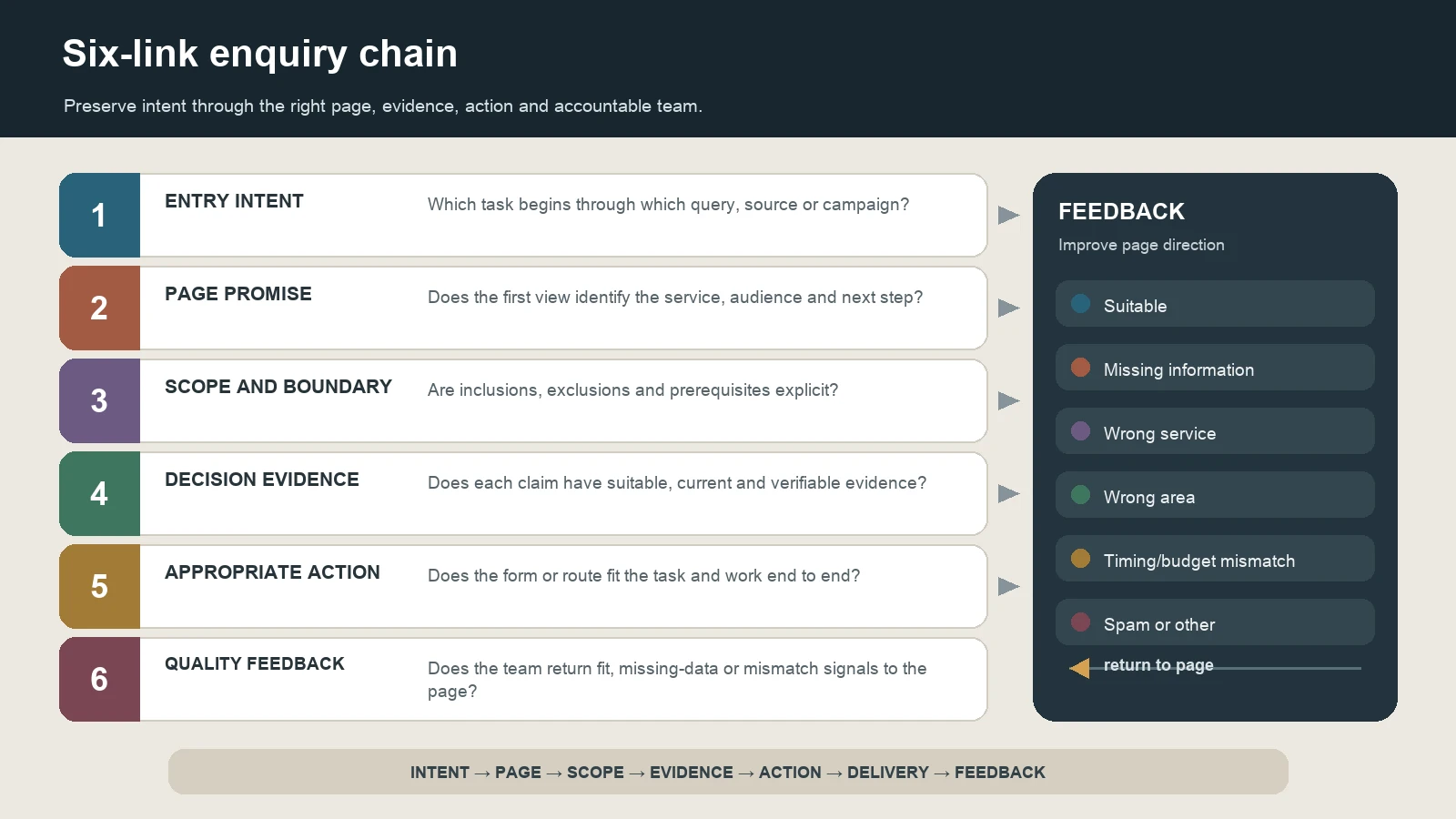
This original framework connects six records: entry intent, page promise, scope and boundary, decision evidence, appropriate action, and enquiry-quality feedback. Each stage defines the context that must reach the next. SEO, advertising, content, design, forms and sales records can then operate as one system rather than as disconnected reports.
1. Record entry intent
Define the task before optimising the keyword. Provider comparison, price or scope research, verification of a particular service, existing-customer support and physical-visit information represent different intentions. A query can also carry more than one meaning, so the phrase alone is not sufficient evidence.
Review source, campaign, search term, device, landing page and, where available, the form topic together. Preserve only the minimum context needed for a decision and avoid unnecessary personal or sensitive data. When evidence is limited, record a hypothesis to test rather than presenting a conclusion as fact.
2. Tie the page promise to one task
Each important landing page should make the intended user and question clear in the first view. Replace an expansive label such as “digital solutions” with the service type, relevant audience and expected next step. The SEO title, advertisement, social post and H1 should behave as connected parts of the same promise.
Giving web design, SEO, advertising, social media, software and support equal weight on one page can weaken intent separation. Create another page only when it has a distinct decision question, scope, evidence and action. Do not create copies whose only difference is a place name or keyword.
3. Explain scope, boundaries and prerequisites
Visitors should know what is included, what is priced separately, which inputs they must provide and which situations require an initial assessment. Terms such as turnkey, full service or unlimited should not appear without a precise contractual meaning.
For a web design project, record page types, content ownership, language count, forms and integrations, data migration, accessibility, testing, training, hosting, maintenance and the boundary between support and new development. Use the website requirements document guide to give each candidate provider the same input.
4. Match decision evidence to the claim
Different claims need different evidence. Design capability may call for permitted and explained project examples; technical performance needs a method, test scope and current measurement; process management needs deliverables, owners and approval gates; expertise may require named authorship, experience or verifiable qualifications.
Stock imagery, an unexplained logo wall, an unreferenced counter or an unverified testimonial is weak decision evidence. Claims such as first on Google, flawless, best, perfect on every device or guaranteed conversion turn outcomes outside the provider's full control into promises. The page should explain measurable scope and acceptance conditions instead.
5. Select the action for the intent
Do not default every page to the same “get a quote now” button. An early researcher may need a scope example or comparison table; a prepared buyer may need a requirements form; an existing customer with an urgent problem needs a separate support route; and a physical visitor needs a verified location and opening information.
A form should request only fields that the receiving team will use. Service type, project status, objective, relevant timescale and preferred contact route may be enough for many evaluations; the exact fields depend on the organisation's process. A success screen does not prove email or CRM delivery, so apply the end-to-end checks in the website form monitoring guide.
6. Return enquiry quality to the page
The chain does not finish at submission. Sales or service teams should return a shared classification: suitable, missing information, wrong service, wrong area, budget or timing mismatch, existing-customer support, job application, supplier, spam or another defined category. These labels are not a judgement of a person's value; they help diagnose the direction supplied by the page.
If one page repeatedly produces wrong-service records, its entry promise or scope may be unclear. If the records are appropriate but seen too late, the problem is delivery and ownership rather than page copy. If volume is low but the fit rate is strong, declaring the page unsuccessful from quantity alone may also be misleading.
The framework's original value is that it manages channels through preserved intent, decision evidence, delivery and human-classified enquiry quality, not merely sessions and form counts.
Which pages should be separated or consolidated?
A separate page needs at least one genuine difference: user task, service scope, decision evidence, process, action or accountable team. If two weak pages answer the same need with the same evidence and action, consolidation may be appropriate. Do not make that decision from keyword similarity alone; review current queries, links, outcomes, content quality and language pairing together.
When consolidating content or changing a slug, sequence the work carefully:
- Publish the new TR and EN targets.
- Verify content, canonical and reciprocal language relationships.
- Add a 301 from each old URL to its closest new target.
- Update internal links and the sitemap to point directly to the new URL.
- Recheck that old URLs do not create chains or 404 responses.
This Avcılar refresh preserves web-tasarim-avcilar and web-design-in-avcilar, so it requires no new 301 record.
How should Turkish and English enquiry paths be paired?
The English page should not be an automatic, context-free copy of the Turkish text. Service scope and critical evidence remain equivalent, while search language, terminology, examples and calls to action can be rewritten in natural English. Record the real counterpart, content owner, last review date and form-delivery endpoint for both pages.
If a service choice exists on the Turkish form but not the English form, or the two languages notify different teams for the same record, hreflang alone does not solve the mismatch. Test content, choices, confirmation message, automatic email and CRM fields together. The language selector should open the true counterpart; where none exists, it should not present an unrelated page as equivalent.
How should web design companies in Avcılar be compared?
Give candidate agencies the same concise scenario: three entry intentions, their corresponding pages, the evidence required on each page, two languages, one proposal form and separate record classifications. Compare more than visual examples; ask how each proposal solves the scenario.
Review these deliverables:
- User-task and landing-page map
- Page types, components and content ownership
- Claim-to-evidence register and approval process
- TR/EN content and form pairing
- Form validation, spam control, delivery and accountable recipient
- Analytics events and enquiry-quality feedback method
- Mobile, keyboard, screen-reader and browser test scope
- Performance budget and acceptance measurement
- CMS roles, training, backup, hosting and maintenance boundaries
- Publication, canonical, hreflang, sitemap and any required 301 checks
Use the website proposal comparison scorecard to apply a common assessment method. The lowest total or longest feature list is not automatically the best fit; coverage of critical requirements and transparent cost assumptions matter more.
What determines web design cost in Avcılar?
The district name does not determine price. Research and content scope, number of distinct page types, design system, languages, data migration, forms, CRM and other integrations, commerce or custom business rules, accessibility, testing, training, hosting and maintenance responsibilities do.
A five-page brochure site is not the same project as a multilingual system with separate landing pages for different intentions, form classification and CRM delivery. A proposal should separate initial delivery, third-party licences, usage-based services, content production, routine maintenance and new-feature development. A precise price becomes meaningful only after requirements and acceptance conditions are defined.
How should success be measured?
Record a baseline before publication; otherwise the effect of the redesign can be confused with seasonality, advertising spend or another change. Do not use one universal metric. Observe each stage of the chain:
- Impressions, clicks and suitable landing pages by intent group
- Completion of priority tasks on mobile and desktop
- Reach of critical evidence and scope sections
- Form starts, validation errors, submissions and actual delivery
- First-response time and record owner
- Suitable, incomplete, wrong-service and spam classifications
- Content update time and TR/EN consistency
Process these signals with appropriate permissions and without collecting unnecessary personal data. A low rate is not automatically a design failure, and a high rate does not prove commercial success; interpret it alongside source quality, offer, capacity and the sales process.
Conclusion: design the website as a measurable decision path
For an organisation operating in or serving Avcılar, effective web design is more than adding the district name to repeated copy. Entry intent should connect to the right page, explicit scope, credible decision evidence, appropriate action and accountable team. Enquiry-quality feedback should then improve the chain over time.
The existing Turkish and English slugs remain unchanged, so this refresh needs no 301. When applied with real operational data, the six-link enquiry chain allows web design providers in Avcılar to be compared through intent separation, evidence quality, delivery reliability and measurable acceptance conditions rather than generic ranking or conversion promises.