


Aydınlatma metni yükleniyor…
When planning a B2B portal, dealer ordering system or ERP-connected operations platform, the architectural choice can shape the product’s long-term cost, reliability and ability to evolve. Yet the familiar claim that “microservices are modern and monoliths are outdated” is misleading. The right decision depends on business-process boundaries, integration intensity, team structure, transaction volume and the organisation’s ability to operate the resulting system.
A well-designed modular monolith can provide a secure, fast and economical foundation for many enterprise web applications. Microservices become valuable when clearly separated business capabilities need to be deployed, operated or scaled independently. The practical question is therefore not which approach is more fashionable, but which measurable business requirement justifies additional architectural complexity.
What are monolithic and microservices architectures?
In a monolithic architecture, capabilities such as user management, products, pricing, orders, inventory and reporting are generally developed within one application package and deployed together. This does not mean the code must be disorganised. A monolith with deliberate layers, module boundaries and internal interfaces can remain understandable, testable and maintainable.
In a microservices architecture, the system is divided into independently operated services responsible for specific business capabilities. An order, pricing or notification service may have its own deployment cycle, API contract and, commonly, its own data store. Microsoft’s microservices architecture guidance explains that this independence can support scalability and agility, but also introduces distributed-system challenges involving communication, service discovery, testing and data consistency.
For enterprise projects, a third and often balanced option is the modular monolith. The application is deployed as a single unit, while domains such as sales, inventory, customers and finance remain explicitly separated in the codebase. This limits the initial operational burden and makes it easier to extract a module into a service later—once evidence shows that independent operation would create real value.
In what order should you make the architecture decision?
Architecture should begin with the organisation’s real operating model, not a list of technologies. Defining service boundaries before understanding user tasks, system interactions and failure outcomes is premature optimisation.
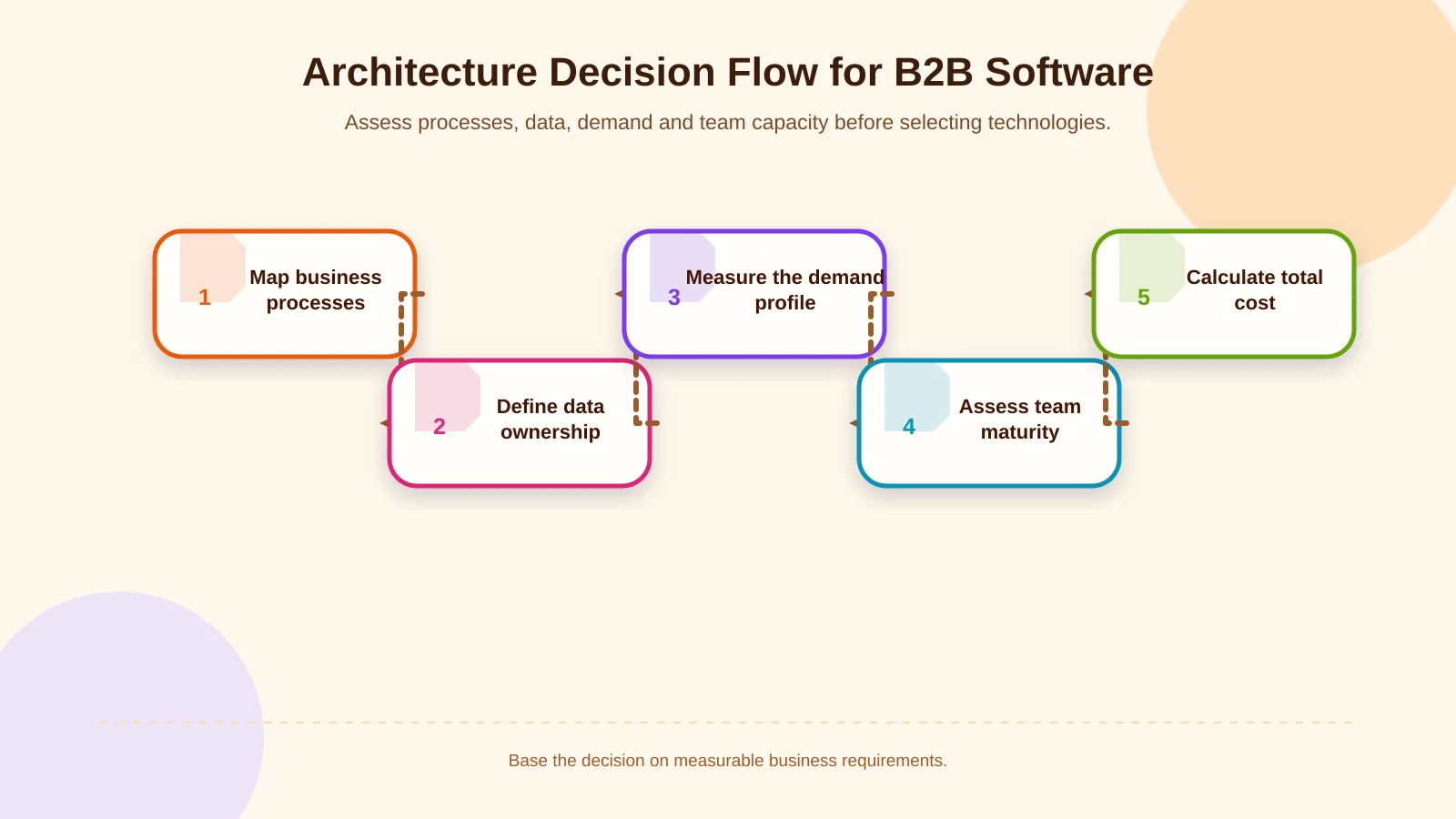
1. Map business processes and ownership
Model quotation, ordering, approval, shipment, invoicing and returns from end to end. Record the owner of each process, its data, critical rules and dependencies. For example, a B2B order approval workflow may need roles, spending limits, budgets, delegation and exception rules to remain within one consistent transaction boundary.
2. Identify integrations and data authority
For ERP, CRM, payment, logistics, identity and document systems, establish where each record originates and which system is authoritative. If product and inventory data come from the ERP, the portal should not behave as their independent owner. Choose synchronous APIs, message queues or scheduled transfers according to latency tolerance, transaction volume and failure-handling requirements—not simply developer preference.
3. Measure the scaling profile
Determine whether the entire platform will experience similar growth or whether only catalogue search, pricing or document generation will face concentrated demand. Horizontal scaling of a monolith may be sufficient when modules grow together. Independent services become more compelling when a small number of capabilities consume resources very differently from the rest.
4. Assess team and operational maturity
Microservices involve much more than dividing code into smaller repositories. They require automated testing, reliable CI/CD, centralised logging, distributed tracing, alerting, version compatibility and incident response. For a small team without these capabilities, dozens of services can slow delivery and increase operational risk.
5. Plan cost and the migration path together
Look beyond the initial development budget. Include cloud resources, monitoring tools, security controls, backups, test environments and specialist expertise. The decision is not irreversible: starting with a modular monolith and selectively extracting measured bottlenecks is often a credible roadmap.
When is monolithic architecture the better choice?
A monolithic architecture often delivers value faster when the first release has a clear scope, traffic is predictable and one team owns the product. A single deployment package and fewer infrastructure components simplify development environments, testing and releases. That simplicity is particularly useful for a new B2B product when time to market matters.
A shared transactional model can also help when several checks must succeed together—for example, recording an order, reserving inventory and validating a credit limit. If distributed transactions, compensating actions and event ordering do not yet generate corresponding business value, introducing them can be unnecessary.
The result should not be one unrestricted block of code. Modules need explicit interfaces, uncontrolled access to one another’s tables should be prevented, and business rules should not be scattered through the user interface. This discipline preserves maintainability and keeps future extraction options open.
When does microservices architecture create value?
Microservices can be appropriate when ordering, catalogue, pricing and notification capabilities change at different speeds, belong to separate teams or have distinct capacity requirements. During a campaign, for example, catalogue traffic may surge while financial reconciliation remains stable. Scaling only the busy service can make infrastructure use more controlled.
Independent deployment is another strong signal. Allowing a pricing correction to go live without redeploying the entire platform can improve delivery speed across multiple teams. However, the services must be genuinely loosely coupled. Small applications that share one database and must be released together create distributed-system costs without delivering microservices’ main benefits.
AWS’s guidance on decomposing monoliths into microservices discusses decomposition by business capability, subdomain and transaction. The broader lesson is that boundaries should follow value-producing business domains rather than technical layers such as controllers, databases or user interfaces.
Critical comparison points for B2B projects
| Criterion | Modular monolith | Microservices | Hybrid |
|---|---|---|---|
| Deployment | Together | Independent | Mixed |
| Data consistency | Easier | Requires additional design | Depends on the domain |
| Scaling | Whole application | By service | Selected components |
| Operational burden | Low–medium | High | Medium |
| Suitable team | One or a few teams | Independent teams | Transition team |
ERP and third-party integration
In a monolith, integration adapters can be managed through a shared layer. In a microservices environment, the team must decide which service communicates with the ERP and how other services receive the same information. Allowing every service to connect independently and without governance can increase quota, security, monitoring and consistency problems.
Ownership of each status must also be explicit. Visibility from ERP acceptance through warehouse preparation and shipment should be designed alongside retry rules and exception scenarios, as described in planning a B2B order-tracking portal. Architecture should make integration failures visible and recoverable instead of hiding them behind a generic error.
Data consistency and reporting
Strong consistency and relational queries are generally easier to manage in a monolithic system. When each microservice owns its data, screens and reports may need to combine information from several sources. If eventual consistency is acceptable, users should see clear states such as “pending”, “transferred” or “failed”. Management reporting may also require a separate analytical data layer rather than live cross-service queries.
Security and access control
A single application may appear to have a smaller attack surface, but poorly separated permissions can expose the whole system. In microservices, increased network communication makes service identity, encryption, API gateways, secrets management and centralised observability essential. NIST’s security strategies for microservices-based systems identify identity and access management, secure communication, monitoring, load balancing and resilience among the core considerations.
Maintenance and total cost of ownership
A monolith can offer lower initial operating costs because it requires fewer deployment pipelines and runtime environments. As it grows, longer test cycles and coordinated releases may raise those costs. Microservices can enable independent delivery, but every service needs logs, metrics, traces, security scanning, backups and operational ownership. Total cost of ownership must therefore include people, governance and incident response—not just the hosting bill.
Common architecture mistakes
Turning every module into a separate service before understanding the business domains, creating a distributed monolith.
Allowing multiple microservices to access the same database tables directly.
Treating remote service requests like local function calls and ignoring latency, timeouts and network failure.
Creating dozens of pipelines and runtime environments for a team too small to operate them safely.
Growing a monolith without modular boundaries until every change affects the whole application.
Launching critical integrations without observability, rollback procedures, idempotent retries or dead-letter handling.
A practical selection framework for your B2B software
A modular monolith is a strong candidate when one team follows a shared release schedule, transactions require strong consistency and traffic is predictable. It supports a faster first release while limiting unnecessary infrastructure. Microservices deserve closer consideration when there are well-defined business domains, several independent teams, sharply different scaling profiles and a genuine need for frequent independent releases.
You do not have to select either extreme. The order and finance core can remain in a modular monolith while high-volume document generation or notifications operate as separate services. A hybrid model succeeds when its boundaries are intentional, ownership is documented and temporary integration shortcuts do not become permanent dependencies.
Before deciding, document business processes, user roles, data ownership, integration contracts, volume forecasts and service-level objectives. Compare the options against security requirements, operational capacity and the expected three-to-five-year cost. A focused proof of concept can validate uncertain or high-risk integrations, but it should test a specific architectural assumption rather than become an ungoverned parallel system.
The decision can also be expressed as a threshold: keep a capability inside the modular monolith until independent scaling, ownership or release cadence provides a benefit greater than the operational cost of separating it. Review that threshold using production evidence such as queue depth, response times, release frequency, incident patterns and team dependencies.
Choose the most manageable architecture, not the most fashionable one
Microservices can provide independent development, deployment and scaling for complex enterprise systems that change quickly. Those benefits come with the costs of distributed data, network communication, observability and security. A monolithic architecture, when structured around disciplined module boundaries, can offer a fast, consistent and sustainable foundation for many B2B applications.
Kumsal Agency is an Istanbul-based digital agency and software partner that develops custom web applications around user roles, data flows and integration requirements. Its ERP-connected B2B ordering and dealer portals bring finance, sales, inventory, purchasing, production and operations into manageable systems while prioritising data security, customer privacy and sustainable software quality.
Evaluate your B2B software’s processes, integrations and scaling expectations with Kumsal Agency to define an appropriate architecture and technical roadmap. The goal is not to adopt the largest possible platform, but to build a system your organisation can operate securely, improve confidently and scale when evidence justifies it.