Aydınlatma metni yükleniyor…
A doctor or clinic website is more than a digital showcase for healthcare services. It is an important point of contact where people learn about physicians and healthcare organisations, consider their options, find communication channels and, in some cases, share sensitive information. Design decisions must therefore address ethical communication, patient privacy, accessibility and accurate information—not aesthetics alone.
Effective doctor website design communicates expertise clearly without presenting healthcare as an ordinary commercial product. It avoids unrealistic promises and explains credentials, service scope and contact options through verifiable information. Trust does not come from bold slogans; it grows from consistent content, a calm user experience and visible accountability.
Why Trust in a Healthcare Website Starts with Design
People searching for health information may already feel uncertain or anxious. Confusing navigation, excessive motion, ambiguous credentials and misleading calls to action can intensify that feeling. A clear page hierarchy, readable content and easy-to-find contact information instead suggest that the organisation is structured, transparent and accessible.
A trustworthy clinic website should keep physicians’ names, professional and academic titles, specialties, the clinic address, opening hours and contact channels accurate and current. Service pages should not read like aggressive sales copy. They should answer practical questions: What is this service? What does it generally cover? Which department provides it? What is the appropriate next step?
The visual identity should support the same principles. Consistent colours, sufficient whitespace, authentic photographs of the clinic and team, and restrained animation can create professional coherence. Yet a white coat, medical icon or luxurious interior is not evidence of quality by itself. Design should make verifiable information visible and help users make informed decisions without pressure.
The Ethical Boundary Between Information and Advertising
In healthcare communication, the essential distinction is between informing the public and using promotional language intended to generate demand. Turkey’s Ministry of Health framework, set out in the Regulation on Promotional and Informational Activities in Healthcare Services, defines the scope of permitted promotion for healthcare professionals and private healthcare organisations and prohibits direct or indirect advertising. This framework should inform both website language and the organisation’s content approval process.
Communication practices to avoid
Claims such as “the best,” “guaranteed solution,” “certain result,” or “completely painless and risk-free” are difficult or impossible to substantiate. They can create ethical concerns while distorting patient expectations. Presenting a treatment outcome as universal oversimplifies clinical assessment. Superiority comparisons, pressure-driven campaigns and messages that turn fear into a sales device also undermine credibility.
Patient testimonials, case narratives and before-and-after images require particular care. Obtaining explicit consent does not automatically make every use lawful or ethically appropriate. Image selection, publication purpose, personal-data protection and current healthcare promotion rules must be assessed together. A documented review process involving the organisation’s authorised medical and legal specialists can reduce risk before publication.
How should informative healthcare content be written?
A service page may explain the general scope of a procedure, its relevant specialty, the assessment process and the appropriate contact route in plain language. It should not diagnose visitors, prescribe individual treatment or suggest that online content replaces a medical examination. Showing the publication date, review date and responsible medical reviewer strengthens editorial accountability.
Healthcare SEO should answer genuine user questions rather than repeat keywords unnaturally. Logical headings, descriptive page addresses and original meta descriptions support both discoverability and readability. SEO for clinic website design is not about gaining visibility through exaggerated claims; it is about helping the right audience find accurate, useful information.
Patient Privacy and Form Design
Contact and appointment forms are among the most sensitive components of a healthcare website. A free-text field inviting users to describe symptoms, or a file-upload feature, can result in the collection of health data. Every field should therefore have a defined purpose and necessity. Collecting information simply because it may be useful later conflicts with a privacy-conscious approach.
According to the Turkish Personal Data Protection Authority’s guidance on the obligation to inform data subjects, information including the identity of the data controller, processing purpose, potential recipients, collection method, legal basis and data-subject rights must be provided when personal data is obtained. A privacy notice and explicit consent should not be presented as if they were the same action. Specialists should assess every data flow according to its purpose and legal basis.
Essential checks for a privacy-conscious form
- Request only fields that are genuinely necessary for the stated purpose.
- Do not encourage users to enter medical details into a standard contact form.
- Make the applicable privacy notice easy to access before submission.
- Clearly distinguish required fields from optional ones.
- Document which team and system receive the submitted data.
- Define authorisation, retention, deletion and breach-response procedures.
Sending form data through an encrypted connection is necessary, but it is not sufficient. Administrative user roles, strong authentication, activity logs, secure backups and responsibility for updates must also be included in the project. If the website connects to an appointment platform, CRM, call centre or email service, its data flows should be mapped before integration. A custom web software approach should model roles, permissions and integrations around the healthcare organisation’s actual operations.
The handover between a website form and internal teams deserves equal attention. Field mapping, duplicate records, ownership rules and follow-up status should be defined so that requests do not disappear between systems. The guide to planning website–CRM integration provides a useful process perspective, although healthcare data requires additional legal, privacy and access-control review.
Accessible and Mobile-Friendly User Experience
Access to health information should not be obstructed by small text, poor contrast or warnings communicated through colour alone. The W3C’s Web Content Accessibility Guidelines (WCAG) 2.2 provide testable criteria for making content perceivable, operable, understandable and compatible with assistive technologies. The relevant criteria should be evaluated against project goals and applicable obligations.
In practice, this means readable type sizes, sufficient colour contrast, keyboard-accessible navigation, visible focus indicators and meaningful alternative text for informative images. Form labels should be explicit. Error messages should not rely on colour and should explain how to correct the problem. Videos may require captions, while moving content should offer controls to pause or stop it.
Mobile compatibility involves more than fitting a page onto a small screen. Phone numbers, addresses, directions and appointment actions should be comfortable to use with a thumb. Pop-ups must not obscure essential content. Images should be optimised, unnecessary scripts reduced and access to core information preserved on slower connections. The journey should be tested on different devices using real tasks, such as finding a physician, checking opening hours or requesting an appointment.
Information Architecture and a Trustworthy Content System
A clinic’s navigation should reflect visitors’ questions rather than its internal departmental chart. The homepage should provide clear routes to specialties, physicians, information about the clinic and contact details. Presenting every physician’s title, specialty, education and experience in a consistent structure lets visitors understand profiles without learning a new layout on each page.
Service pages and educational health articles should also remain distinct. A service page explains what the organisation provides; an editorial article offers broader educational information. The site should state clearly that a web form is not an emergency channel and avoid expressions such as “instant response” unless the organisation can reliably fulfil that commitment. On multilingual sites, medical content, forms, validation messages and legal texts need consistent professional localisation—not just translated menus.
A generic healthcare template rarely meets every organisation’s operational and communication needs. Kumsal Agency plans brand-specific creative concepts, information architecture, mobile behaviour, content systems and technical requirements as one connected digital experience. The goal is not a decorative interface, but a sustainable website through which users can safely reach clear and verified information.
Doctor and Clinic Website Project Process
A healthcare website project should not begin by choosing colours or a homepage layout. It starts by defining goals, audience groups, the regulatory framework, content owners and data flows. This gives clinic management, medical reviewers and the design and development teams a shared definition of success.
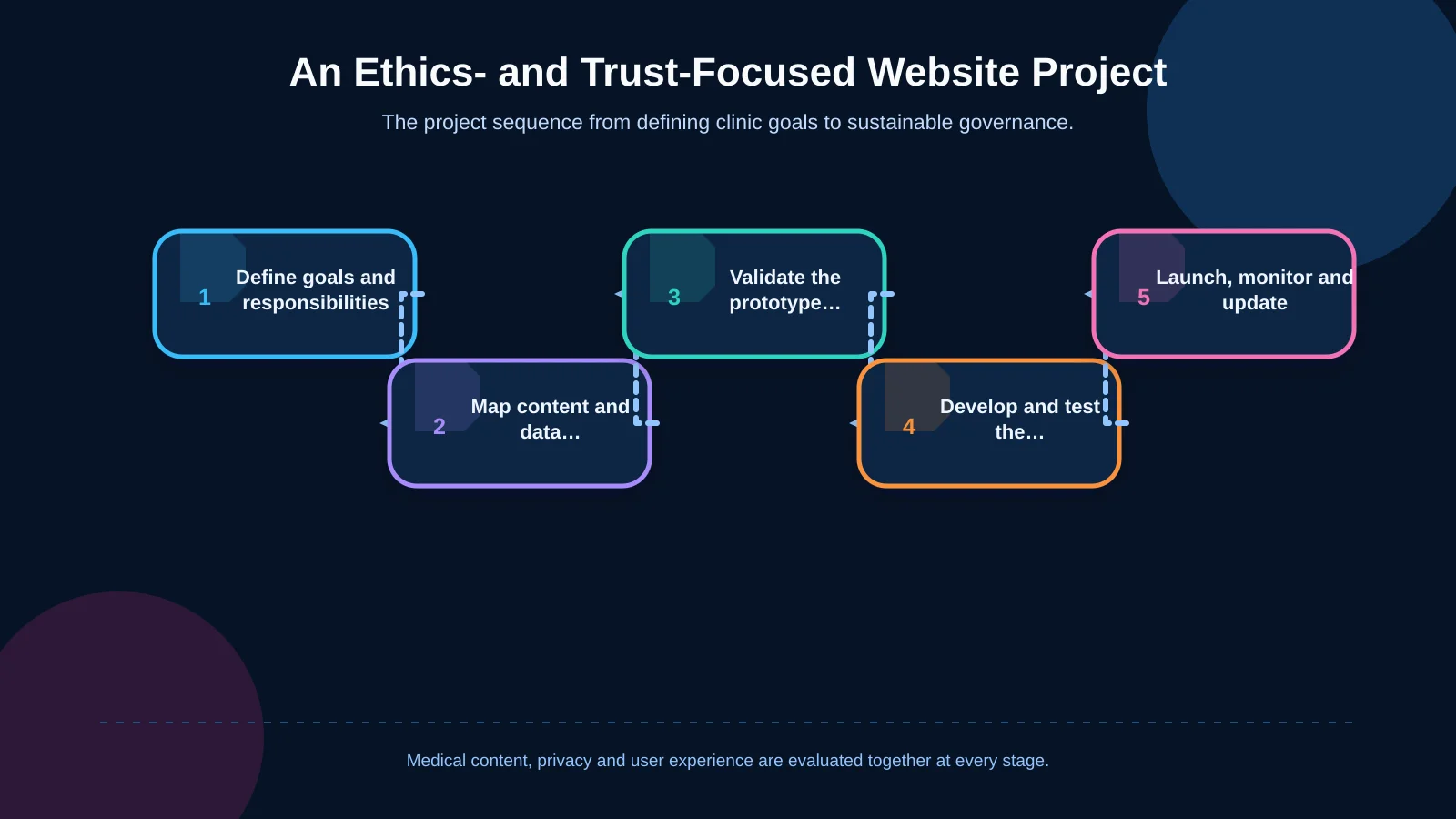
1. Discovery and responsibility mapping
Physicians, clinic management, corporate communications, IT teams and relevant advisers should be involved. Pages, forms, appointment tools, languages, integrations and post-launch duties are documented. The organisation also decides who writes medical content, who approves it and how frequently it will be reviewed.
2. Content inventory and information architecture
Existing content is assessed for accuracy, freshness, duplication and ownership. User needs and search intent inform the sitemap. Each page receives a defined question to answer, a core message, a responsible editor and an appropriate next step.
3. Prototyping, design and content production
Prototypes first demonstrate essential user journeys. Once the structure is approved, the team develops a brand-specific visual concept using realistic content lengths. Informational copy, photography, physician profiles and legal notices are produced as parts of the same system rather than separate additions at the end.
4. Development, integration and testing
The content management system, forms and integrations are developed around authorisation and data-minimisation principles. Testing covers mobile devices, common browsers, keyboard use, screen-reader behaviour, form errors, performance and security controls. Analytics tools should also be checked to ensure that sensitive form content or URL parameters are not recorded unintentionally.
5. Launch and continuous governance
Launch begins the operational phase; it does not end the project. The clinic needs an update schedule, controlled access, backup procedures, security-patch ownership and feedback channels. Assigning responsibility for changes to physicians, hours or regulations helps the website remain dependable over time.
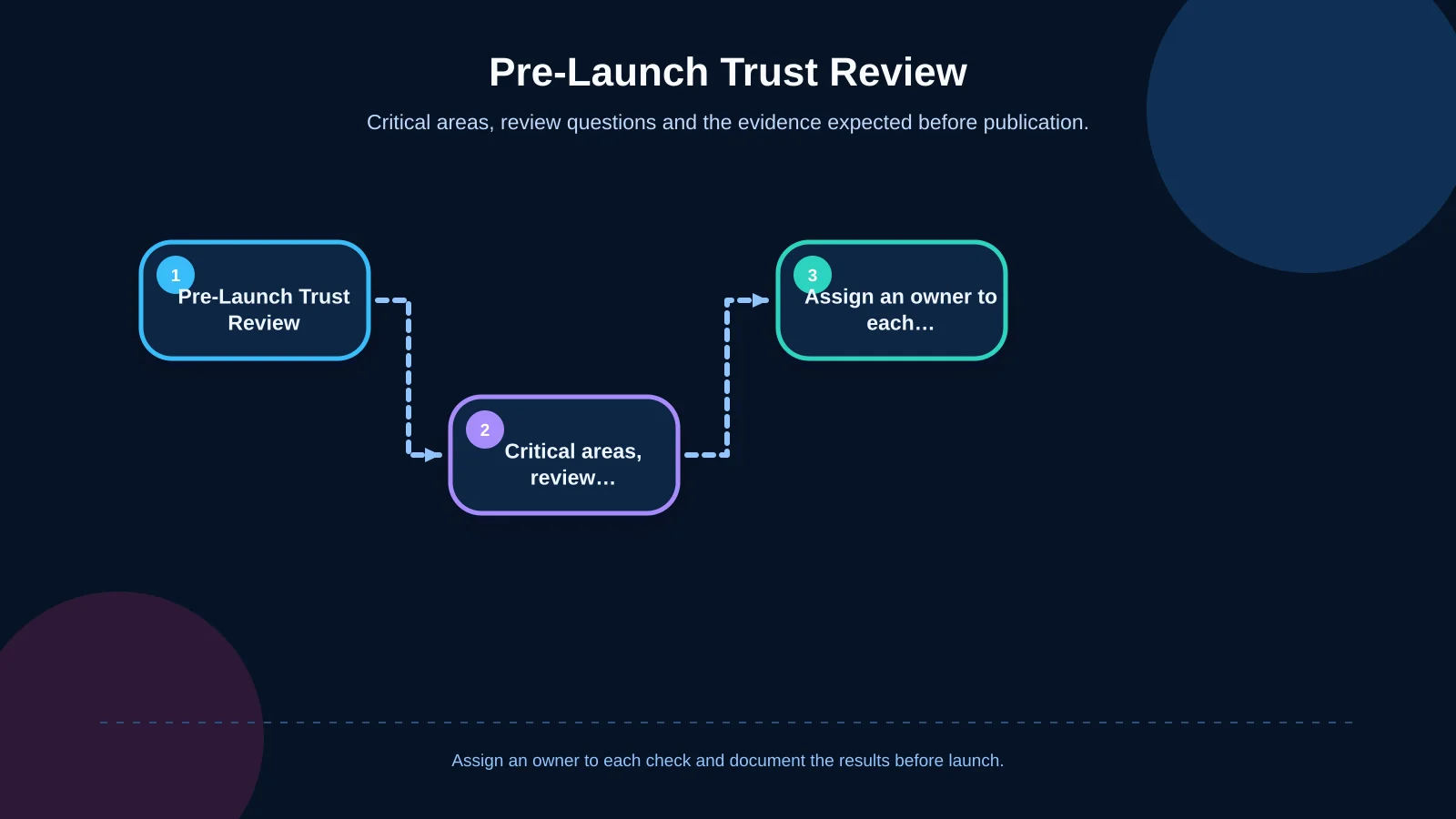
Pre-Launch Ethics and Trust Review
The final review should go beyond spelling and broken links. Content, user experience, privacy and technical operations must be checked together. The following questions provide a practical publication gate:
- Have professional titles, specialties, addresses and opening hours been verified?
- Does any copy contain guarantees, superiority claims or fear-based language?
- Does each form collect only necessary data and provide the appropriate notice?
- Can mobile users complete contact and appointment tasks easily?
- Have keyboard access, contrast, alternative text and error messages been tested?
- Are owners assigned for content, integrations, security and ongoing updates?
Lasting trust in a doctor or clinic website is built through accuracy, transparency and a carefully managed digital experience—not exaggerated promises. As an Istanbul-based digital agency, Kumsal Agency brings together creative direction, user experience, custom web software, management panels, integrations and research-led digital brand consulting.
To clarify your clinic’s goals, user needs, content responsibilities and technical requirements, contact Kumsal Agency and plan an ethical, trust-focused website project together.
| Review area | Question to ask | Expected evidence |
|---|---|---|
| Content ethics | Are all claims measured and verifiable? | Approved content record |
| Privacy | Is only necessary data being collected? | Documented data flow and privacy notice |
| Accessibility | Can everyone complete essential tasks? | Keyboard, contrast and form test results |
| Sustainability | Are update responsibilities clearly assigned? | Editor, schedule and permissions list |