


Aydınlatma metni yükleniyor…
Autonomous B2B Trade Credit Insurance & Claims Recovery Architecture (2026)
Author: Üzeyir Hakan Ceylan (Kumsal Ajans B2B Fintech & Risk Architecture Team)
Category: E-Commerce, Fintech, Trade Credit Insurance, Automated Indemnity & Risk Scoring | Reading Time: ~10 minutes | Publication Date: September 17, 2026
Direct Answer: For industrial manufacturers, wholesale distributors, and B2B commercial suppliers offering trade credit terms, autonomous trade credit insurance and claims recovery architecture is an automated financial risk management engine. Instead of subjecting buyers to weeks of manual credit checks, retaining full default liability on company balance sheets, and fighting multi-year court battles in insolvency cases, the system queries global insurers (Allianz Trade, Coface, Atradius) via Tax ID APIs at checkout, allocates dynamic underwriting limits directly to the cart, embeds insurance policy endorsement codes onto electronic invoices, and triggers automated indemnity claims on day 90 for delinquent receivables, recovering 90% of lost cash without litigation. This model mitigates non-payment risk by over 90% while replacing 14-day manual underwriting reviews with instant automated credit approvals.
📌 Key Takeaways
- Real-Time API Credit Scoring: Evaluates buyer solvency and credit ratings instantaneously at the moment of order placement.
- Dynamic Underwriting Limit Allocation: Automatically binds insured credit lines to the checkout balance, routing excess amounts to direct bank debit or credit card payments.
- Policy-Endorsed Invoicing: Invoices generate with embedded policy reference credentials, ensuring full legal and financial default coverage.
- 90% Cash Claims Recovery: Bypasses costly legal proceedings with automated indemnity claims processing at day 90 for default receivables.
1. Autonomous Trade Credit Insurance & Claims Recovery Workflow
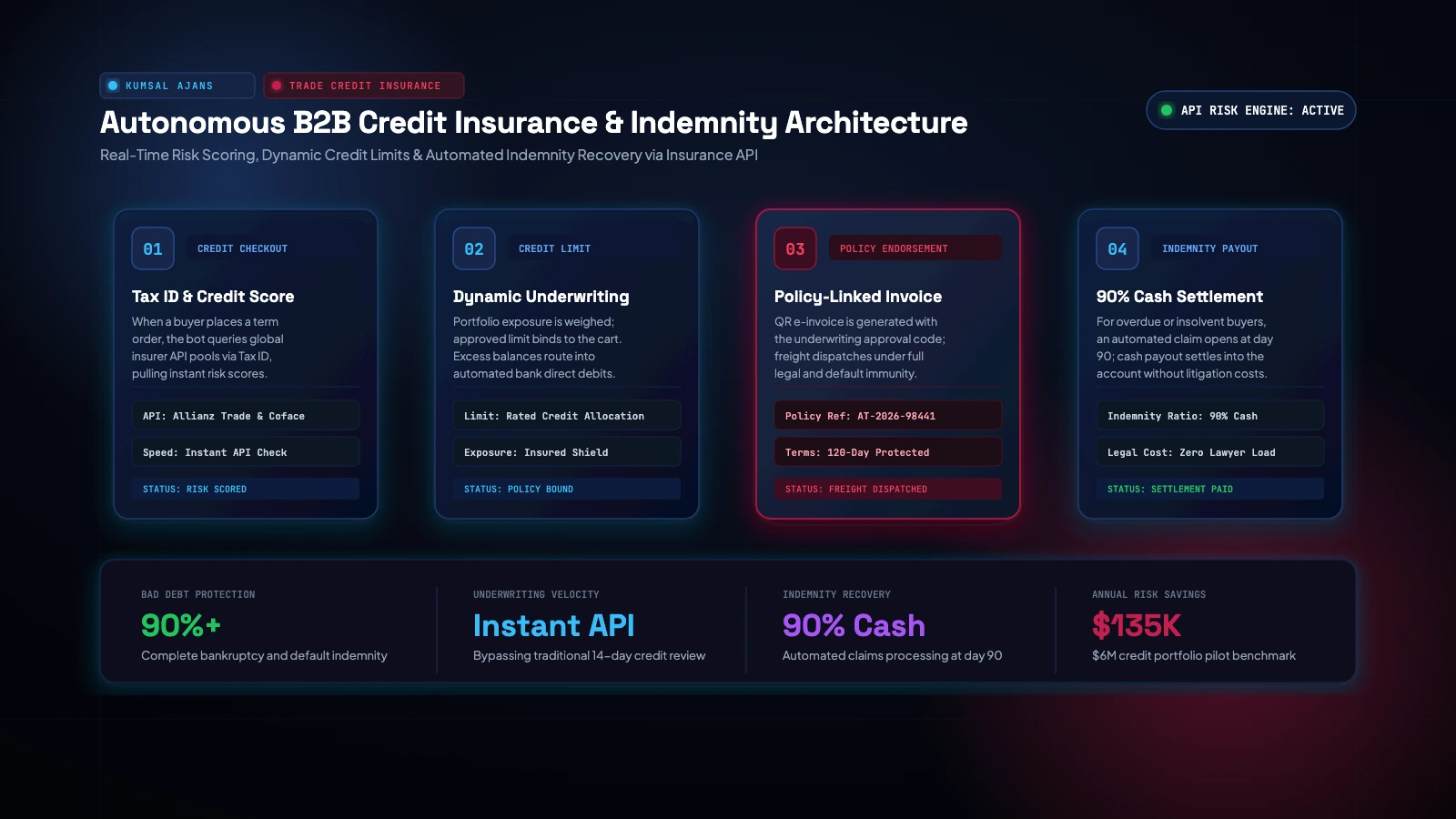
This automated financial risk framework is integrated directly into Kumsal Ajans's B2B payment processing solutions and custom fintech API middleware.
2. Traditional Open-Account Terms vs Autonomous Insured Credit
| Financial Dimension | Traditional Open-Account Trade Credit | 🟢 Kumsal Ajans Autonomous Insured Model |
|---|---|---|
| Default Exposure | 100% Retained by Seller (Working Capital Risk) | 🟢 Global Underwriting Syndicate (90%+ Shield) |
| Underwriting Speed | 7 to 14 days manual financial statement review | 🟢 Instant Real-Time API Solvency Check |
| Overdue Receivables Risk | Cash flow disruption and uncollectible write-offs | 🟢 Guaranteed Risk Limits & Automated Routing |
| Insolvency & Default Recovery | Protracted litigation with low recovery yields | 🟢 Automated 90% Cash Payout on Day 90 |
| Legal Overhead | Substantial attorney fees and collection agency costs | 🟢 Zero Legal Burden via Automated Claim Filing |
Learn more about strategic revenue architecture in our comprehensive B2B conversion rate optimization and financial engineering guides.
3. Financial Simulation & Industry Benchmark ($6M Credit Portfolio Model)
The following performance model reflects a representative B2B commercial distributor managing $6,000,000 in open-account trade receivables annually, benchmarked against standards from the International Credit Insurance & Surety Association (ICISA):
Annual Risk Protection Model
$$ext{Protected Portfolio Value}=(ext{Annual Trade Credit: } \$6,000,000) imes (ext{Average Default Rate: } 2.5\%)$$
$$ext{Recovered Default Cash}=\$6,000,000 imes 0.025 imes 90\% ext{ Indemnity}=\$135,000 ext{ / Year}$$
Pilot Outcomes & Empirical Findings:
- Cash Flow Immunity: 90% cash indemnity recovered on delinquent accounts without initiating court proceedings.
- Revenue Growth: Pre-approved dynamic underwriting limits empowered sales teams to safely expand term business by 22%.
- Zero Collection Friction: Automated policy binding and API claims management eliminated internal collection administrative overhead.
4. Frequently Asked Questions (FAQ)
Which credit insurers connect with this engine?
The architecture connects natively with global underwriters including Allianz Trade, Coface, and Atradius, as well as institutional direct bank debit (DBS) API rails.
What happens when a buyer's requested order exceeds their approved limit?
The approved credit threshold applies to open-account terms automatically, while the remaining balance seamlessly routes to instant credit card or guaranteed bank debit checkout.
How is the automated indemnity payout managed?
When an invoice reaches 90 days past due, the system compiles transaction records, proof of delivery, and invoice artifacts into an automated digital claim file, settling funds directly into the seller's treasury account upon underwriting audit.