


Aydınlatma metni yükleniyor…
A travel-size perfume bottle is more than a scaled-down version of a full-size product. People carry it in a pocket, an everyday bag or cabin luggage, then retrieve it in a busy setting, use it—sometimes with one hand—and put it away with confidence. Its perceived value therefore depends not only on the fragrance, but also on portability, clarity and ease of use.
The physical bottle’s industrial design involves specialist decisions about materials, pump mechanisms, seals, caps, manufacturing tolerances and durability. A digital brand team has a different responsibility: making verified product features understandable through realistic carrying and use scenarios. This guide does not claim to explain how to engineer the bottle itself. Instead, it shows perfume, cosmetics and packaging teams how user insights can inform positioning, art direction, content production, product pages and the wider sales experience.
Pocket, bag and travel: Three different carrying contexts
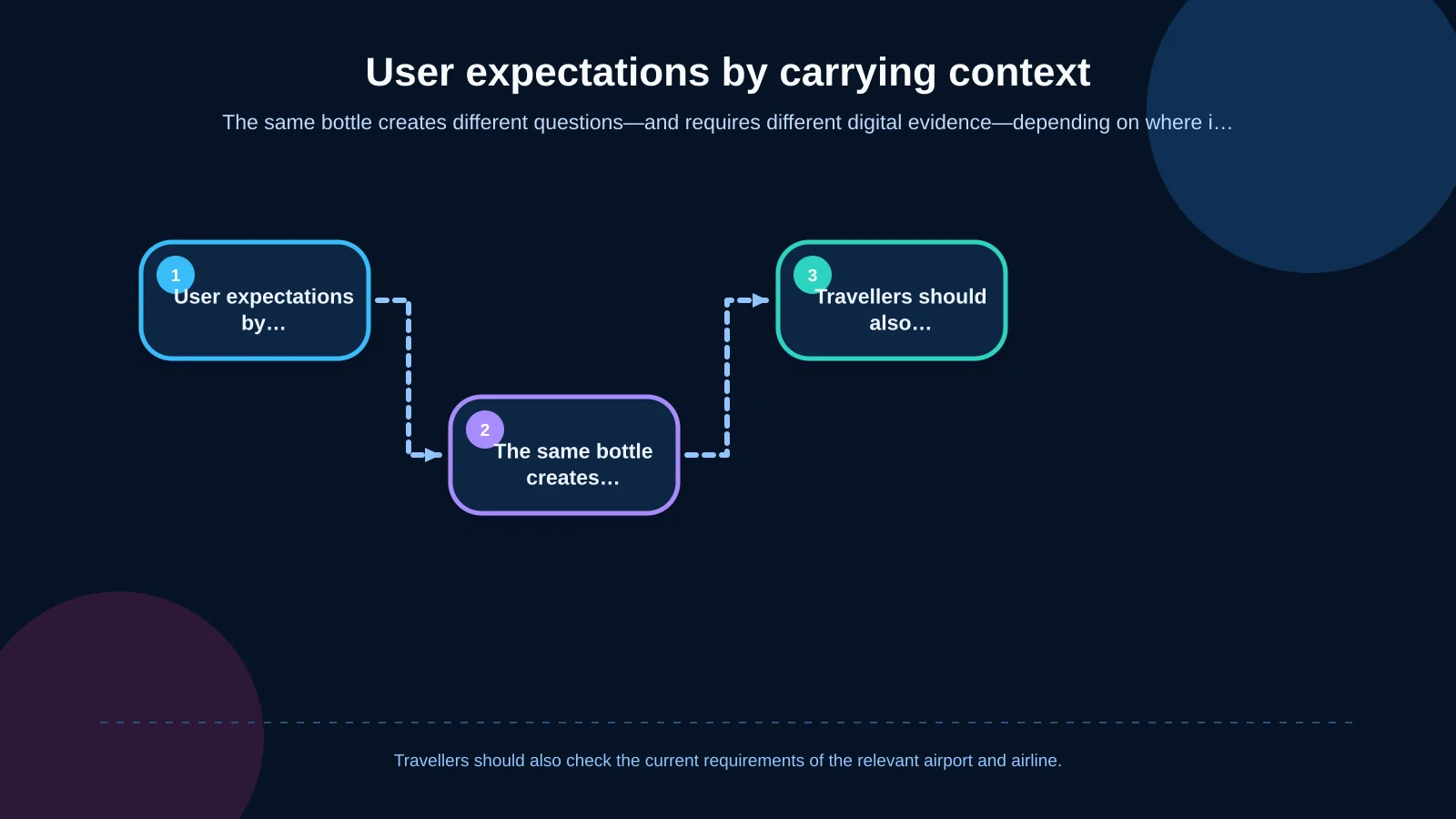
“Portable” is too broad to be meaningful on its own. Where someone carries the bottle changes their questions about size, access, leakage and operation. Separating these contexts across the product page and campaign content replaces vague promises with evidence that shoppers can interpret.
| Carrying context | Primary expectation | Evidence to show | Content approach |
|---|---|---|---|
| Slim proportions and secure closure | Dimensions and cap detail | One-handed use video | |
| Everyday bag | Findability and protection | True-to-scale in-bag view | Complete use cycle |
| Cabin luggage | Clear capacity information | Millilitre detail and liquids-bag scene | Packing demonstration |
| After arrival | Quick, controlled use | Close-up of the spray action | Short routine content |
Pocket carry: Slim proportions, surface contact and accidental spraying
A pocket-size perfume bottle may sit beside keys, a phone or a card holder. The buyer is not only asking, “How many millilitres is it?” They may also want to know how much room it takes up, whether the cap can come loose and whether pressure could activate the atomiser accidentally.
Dimensions belong in the specifications, but numbers alone do not communicate scale. Show the bottle in a hand and beside a real pocket, using consistent angles that make its width and height easy to judge. A close-up photograph or short video can demonstrate how the cap closes, how the spray mechanism is protected and how the surface is held during everyday use.
Claims such as “leakproof”, “unbreakable” or “scratch-proof” should appear only when appropriate testing supports them. Visual storytelling must not turn an unverified assumption about physical performance into a product promise.
Everyday bags: Findability and protection for other belongings
Cosmetics, cables, glasses and fabric items often share the same bag. In this context, users want to retrieve the bottle quickly and feel confident putting it back near other belongings. Showing it in a small compartment, protective sleeve or personal-care kit helps customers picture it in their own routine.
Isolated studio photography alone leaves this experience unexplained. Alongside the hero image, include an in-bag scale view, a cap detail and the moment the user returns the bottle after spraying. This gives aesthetic presentation and practical explanation a shared visual language.
Cabin luggage: Clear capacity and easier packing
For air travel, customers need to understand the bottle’s capacity and whether it can fit comfortably inside their liquids bag. IATA’s overview of passenger baggage rules states that, in many countries, containers for liquids in cabin baggage must not exceed 100 ml and should be placed in a transparent, resealable bag. Requirements can vary by country, airport and airline, so a brand should never promise that a product will be accepted on every flight.
Display the net volume consistently in the product name, imagery, specifications and packaging view. A travel scene can show the bottle’s scale inside a transparent liquids bag without implying universal approval. Remind customers to check the current requirements of their departure airport and carrier before travelling.
What design questions emerge from the moment of use?
Carrying is only the first part of the experience. The user must find the bottle, remove it, open it, orient it correctly, spray and close it again. Observing this sequence helps digital teams identify which details require explanation and which product assumptions should be referred to engineering or development teams.
Removing, opening and spraying with one hand
At an airport, beside a car, near a lift or at an event entrance, one hand may already be occupied. Content production should therefore explore natural one-handed use as well as controlled tabletop compositions. A short, continuous clip can show the correct orientation, cap removal and spraying motion within seconds.
This scenario also has implications for the interface. On a mobile product page, the initial viewport should communicate the product type, net volume, essential carrying benefit and primary purchasing action. Critical information should not be buried inside a long description.
Public use and social context
Applying perfume is personal, but it also affects the surrounding environment. In an enclosed or crowded space, users may prefer a quick and controlled action that respects other people. Brand communication can reflect this with measured, context-aware scenes instead of exaggerated clouds of spray. This gives an “always with you” proposition a more responsible tone.
Closing the bottle and putting it away
Many advertisements end at the spray. Yet the user’s confidence is often tested when the bottle goes back into a pocket or bag. Content can show the cap being replaced, the bottle being stored upright or in the recommended position, and any protective accessory being used. The narrative then presents a complete use cycle rather than a single attractive moment.
Build the scenario before the content: A five-step approach
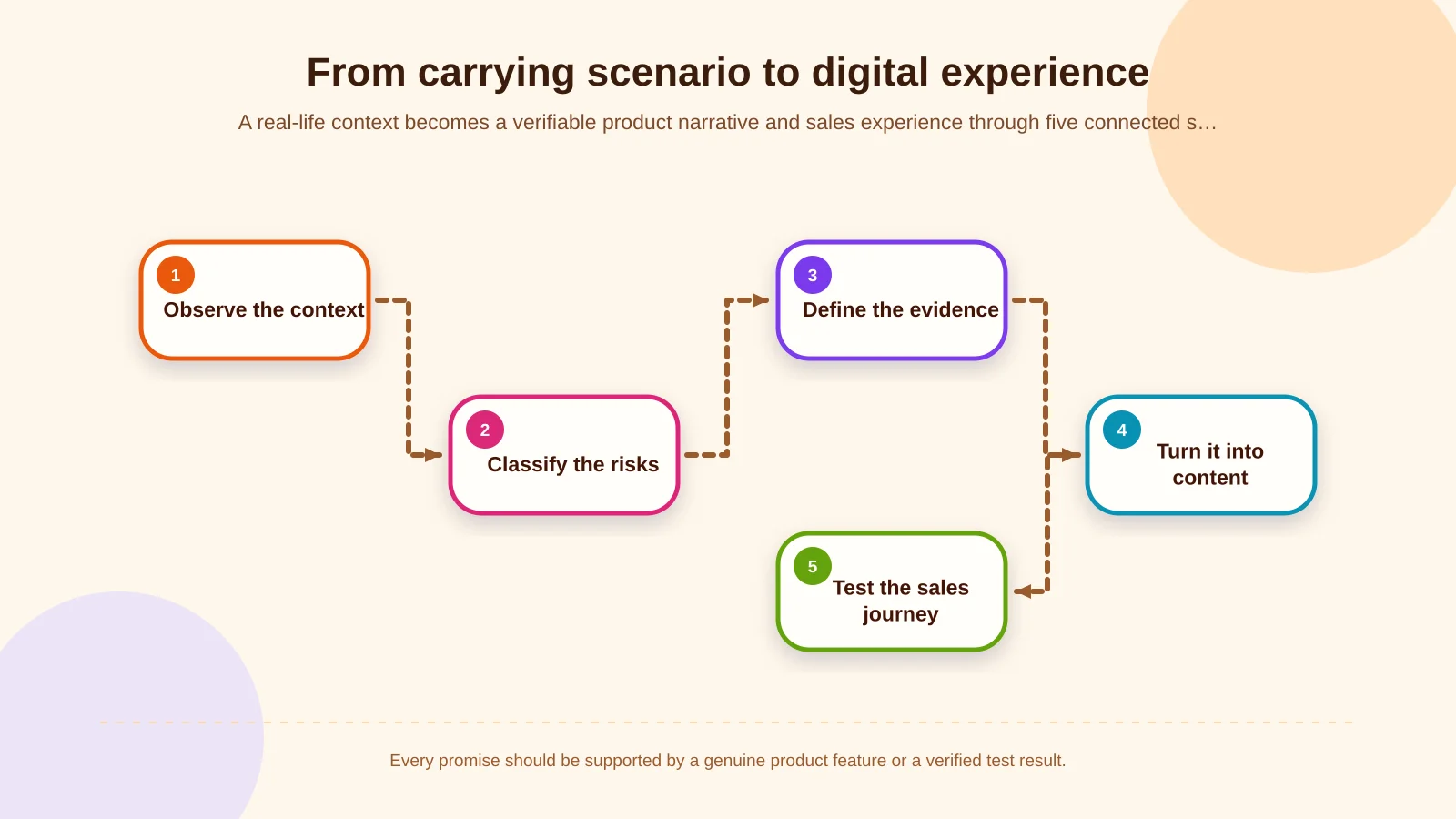
An effective digital experience for travel-size perfume begins with structured scenario planning, not a collection of unrelated lifestyle images. Research separates internal assumptions from observed behaviour and verified product characteristics.
1. Observe the context
Identify the bag or pocket in which the product is carried, the moment when it is retrieved and the information needed at that point. Interviews, contextual observation, customer-service records, product reviews and on-site search data can be considered together. The goal is not to invent one universal persona, but to uncover repeated tasks, concerns and decision barriers.
2. Classify risks and expectations
Record concerns such as leakage, unclear capacity, a loose or misplaced cap, difficulty finding the bottle and contact with delicate surfaces. Not every issue requires an industrial-design change. Some can be reduced through accurate specifications, scale photography, a use video or a clear explanation of what is included. Findings that indicate a physical product problem should be escalated to the relevant development specialists.
3. Choose evidence instead of claims
Pair every marketing statement with something the customer can see or verify. Support “bag-friendly” with a true-to-scale scene, “easy to use” with an uninterrupted demonstration, and a capacity statement with clearly legible millilitre information. For aviation messaging, consult current references such as IATA’s dangerous goods guidance for passengers, while still directing travellers to their carrier’s specific conditions.
4. Turn scenarios into a content system
Approved scenarios can become product photography, short-form video, animation, product cards, social cuts and usage instructions. An Art Director-led production process helps the same message retain a consistent approach to framing, motion, materials and colour across channels. Plan crops and durations early so each asset works in a product gallery, campaign landing page and vertical social format without losing essential evidence.
5. Test the sales journey
Attractive content is not enough. Measure whether visitors can find capacity and dimensions, which gallery images they inspect, whether they understand variants, and where they hesitate before checkout. Research-led digital brand consulting can connect these findings to positioning, experience principles and an actionable content roadmap.
How can a product page build trust?
A travel-size perfume product page should answer customer questions in order of importance. The product name, net quantity, fragrance family, method of use, package contents and delivery information must remain consistent across every component. On mobile, essential information should appear early, with supporting details organised under descriptive headings.
- Use scale images showing the bottle in a hand, beside a pocket and inside an everyday bag.
- State the net quantity consistently in the title, specifications and packaging imagery.
- Show the cap, atomiser and any protective sleeve in separate close-up views.
- Avoid unverified claims about leakage, impact resistance or surface durability.
- Explain that airport and airline requirements must be checked for the specific journey.
- Keep returns, delivery and customer-support information easy to reach.
The portability message should not obscure information required for the cosmetic product itself. The European Commission’s explanation of fragrance allergen labelling notes that certain fragrance allergens must be individually identified in ingredient lists under specified conditions. Packaging and digital information requirements should be checked against current regulations in each target market and reviewed by qualified legal or compliance teams.
How should content and campaign language vary?
A travel perfume campaign does not need to depend entirely on airport imagery. An after-work meeting, weekend bag, post-workout refresh or short city break can broaden the product’s relevance. Each scene should answer a different customer question instead of repeating the same portability line.
Photography is effective for scale, finish and material cues. Video can demonstrate the opening, spraying and reclosing sequence. Animation can clarify capacity, package contents or differences between variants. When users move from social content to the product page, the colour palette, framing and claims should remain recognisable. A consistent digital identity helps them identify the advertised product quickly and reduces the gap between campaign interest and purchase evaluation.
Channel consistency does not require publishing the same asset everywhere. It means preserving the same evidence hierarchy: what the bottle is, how large it is, how it fits into a routine and which claims have been verified. Formats can change while the underlying product story remains stable.
How can Kumsal Agency support this process?
Kumsal Agency does not position itself as the industrial designer of the physical perfume bottle. As an Istanbul-based digital agency, it translates insights from carrying and use scenarios into a research-led brand roadmap and a coherent digital experience. The scope can include audience research, digital positioning, visual direction, campaign concepts, social content, motion design, photography and video, corporate websites and e-commerce journeys.
For e-commerce, the goal is to carry the brand’s visual world from product discovery through checkout in a fast, clear and manageable system. Product-information architecture, mobile galleries, variant presentation, trust elements, content management and measurement requirements can be planned as one connected experience. Portability then becomes more than an advertising phrase: it becomes a benefit customers can see, understand and weigh in their purchase decision.
Conclusion: A small bottle needs a complete experience
A credible travel-size perfume experience begins in the pocket, continues in the everyday bag and extends into travel preparation. Accurate scale imagery, verified claims, clear capacity information, context-sensitive content and a straightforward mobile sales journey work together to build trust.
To plan the brand story, digital design, content and sales experience for your travel-size perfume product, contact Kumsal Agency.