


Aydınlatma metni yükleniyor…
The useful way to compare digital agency pricing is not to place headline totals side by side. Put the scope, labour, media, production, tools and responsibilities behind each figure into the same table. Two proposals that appear to answer the same request may include different deliverables and create very different workloads for the client.
This guide does not publish a market rate or declare a universally “correct” fee. It provides a total-commitment table, a weighted proposal scorecard and questions for unclear quotes so that the decision is not based only on the lowest number or the most polished presentation.
Why Is Agency Pricing More Than One Number?
The total cost of an agency engagement is wider than the service fee on the invoice. Media, photography or video, licences, measurement setup, landing-page development and client-team time may sit with different parties.
One proposal may include content and paid-media management while another covers campaign optimisation only. The second can look cheaper even though creative, reporting and implementation must be purchased elsewhere. The totals are not equivalent until those boundaries are visible.
| Cost area | Control question | What the proposal should show |
|---|---|---|
| Agency service | Which people and tasks are included? | Fixed or variable service fee |
| Media | What goes to advertising platforms? | Media spend separate from the agency fee |
| Production | Who creates copy, design, photography and video? | Volume, format, revisions and unit scope |
| Tools and licences | Which tools are required and who owns the account? | Licence owner, term and renewal cost |
| Implementation | Who handles tags, pages and integrations? | Setup separated from ongoing support |
| Client time | Which inputs and approvals are required? | Owner, frequency and expected workload |
Why Do Proposals Need the Same Brief?
If one agency proposes paid-media management and another adds strategy, content and landing pages, their prices answer different problems. Before requesting proposals, put the objective, audience, current channels, intended scope, budget boundary, timing and measurement needs into one brief.
If the brief is incomplete, require every agency to state its assumptions. Replace labels such as “monthly social management” with platforms, content formats, production volume, community response, paid activity and reporting. Agencies should be free to recommend a different solution, but the proposal must show what that recommendation assumes.
Separate Agency Fees, Media Spend and Third-Party Costs
“Total budget” can mean different things. One proposal may include media while another shows only the agency fee. Separate at least four areas:
- Agency fee: Strategy, management, production, meetings and reporting.
- Media spend: Budget paid to advertising platforms.
- Production and implementation: Shoots, animation, specialist design, landing pages, tagging or integrations.
- Third-party cost: Tools, stock assets, data, email, hosting or other licences.
Also record tax treatment, the method for updating foreign-currency services and the company account used to pay platforms. The goal is not to predict every cost perfectly; it is to identify who owns each uncertainty.
Scope, Volume, Speed and Specialist Input Change the Cost
The same service label does not imply the same workload. Proposal feasibility and price can change with:
- The number of channels and markets
- Content formats, production volume and approval rounds
- The number of campaigns, products or landing pages
- The condition of existing accounts and data
- Required strategy, design, software and analytics specialists
- Urgent delivery or out-of-hours response
- The number of meetings, reports and stakeholders
- Legal, sector or brand-safety controls
Start by defining the necessary digital marketing agency service scope. A long list is less useful than a clear connection between the objective, work and responsibility.
How Should You Read Agency Charging Models?
| Model | Where it may fit | What to inspect |
|---|---|---|
| Project fee | Work with a defined start and finish | Deliverables, acceptance, revisions and change fees |
| Retainer | Continuous content, campaigns and improvement | Monthly capacity, carry-over and termination |
| Time-based | Variable demand, advice or specialist support | Estimate, cap, time records and approval |
| Percentage of media | Advertising work that changes with spend | Minimum fee, percentage base and whether production is included |
| Hybrid | A fixed core team plus variable media or production | The rule that changes each component |
Do not treat one model as inherently good or bad. Ask how it reflects workload, whether deliverables change as budget grows and what happens when scope reduces.
Build a Total-Commitment Comparison Table
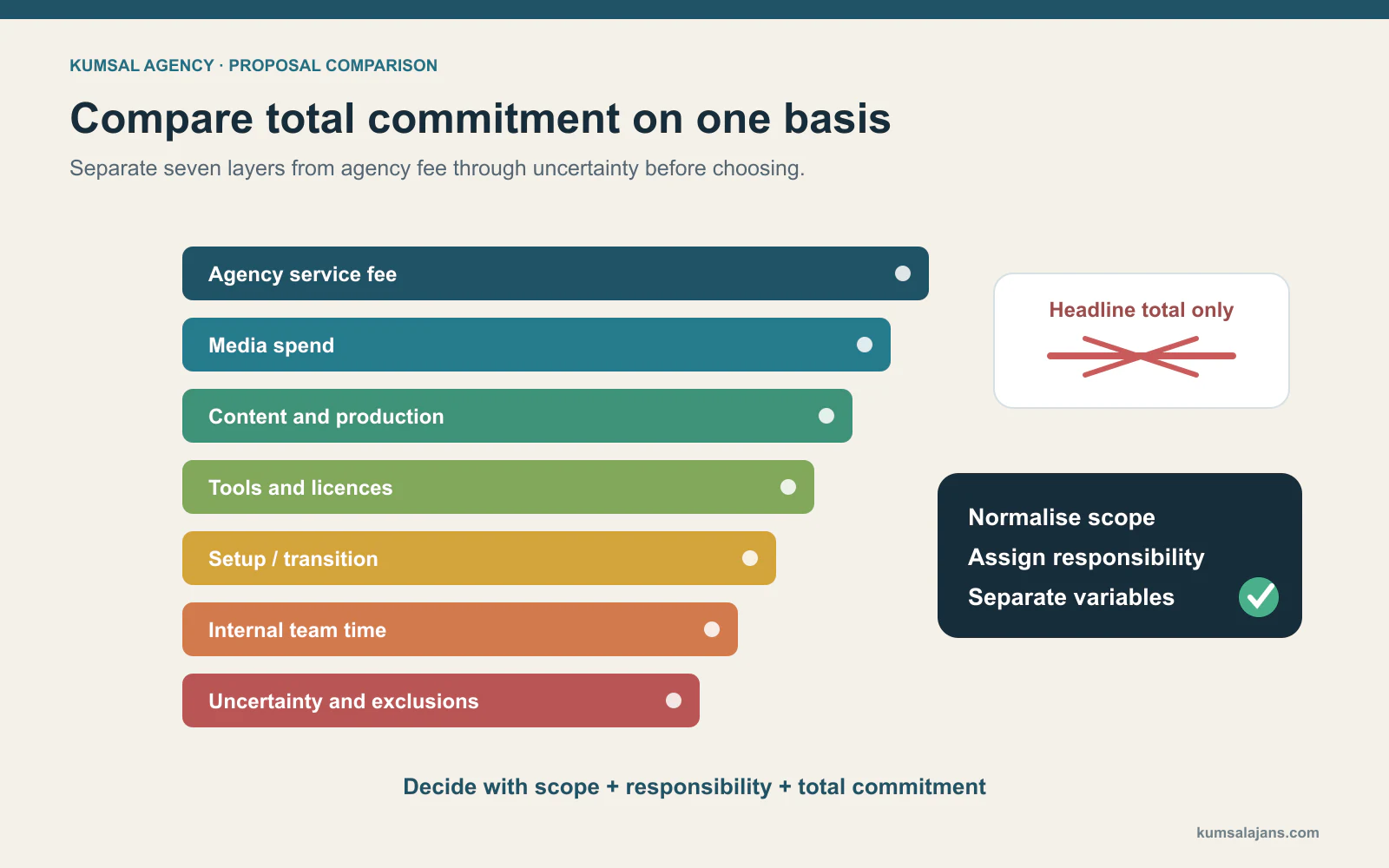
Break every proposal into the same rows. Where no amount is stated, use “included”, “excluded”, “client supplied”, “priced when required” or “unclear” rather than entering zero.
| Comparison row | Agency A | Agency B | Agency C |
|---|---|---|---|
| Agency service fee | |||
| Media spend | |||
| Content and creative | |||
| Setup and implementation | |||
| Tools and licences | |||
| Client-team workload | |||
| Variable and out-of-scope work | |||
| Term and exit cost |
Attach evidence to each row: the proposal page, scope appendix, meeting note or written clarification. Do not treat a verbal “we can handle that” as included when the proposal does not say so.
Compare Deliverables, Responsibilities and Exclusions Together
A price table is incomplete when it does not show who performs the work. For each deliverable, name the producer, input owner, approver, implementer and person responsible for checking completion.
- Is strategy a one-off presentation or an ongoing decision process?
- Who owns the idea, copy, design and publishing workflow?
- Are paid-media assets and landing pages included?
- Does the agency fix technical issues or brief another supplier?
- How many revision rounds and what feedback time are assumed?
- How are accounts, data and source files handed over?
Use the digital agency selection guide to examine team evidence, communication and realistic promises separately from scope.
Create a Weighted Proposal Scorecard
Assign a percentage to each decision criterion; the weights must total 100. Score every proposal on the same 1–5 scale and record the evidence behind the score. The example below is illustrative, not a universal formula.
| Criterion | Illustrative weight | Evidence |
|---|---|---|
| Understanding of the problem | 20% | Approach and questions |
| Scope and deliverable clarity | 20% | Itemised proposal |
| Team and feasibility | 15% | Roles and capacity plan |
| Measurement and data | 15% | KPI and quality controls |
| Total commitment | 20% | Normalised cost table |
| Ownership and exit | 10% | Contract and handover terms |
The scorecard does not make the decision automatically. It exposes why a proposal scored poorly and which uncertainty should be resolved in negotiation.
Questions for an Unusually Low or Unclear Proposal
- Which deliverable volumes and team roles does the fee cover?
- Are media, production, tools and implementation included?
- Which unit or threshold applies when work volume increases?
- What are the limits on meetings, reporting and revisions?
- Which tasks remain with the client or another supplier?
- What continues after initial setup?
- How are accounts, data and source files handed over?
- What review and improvement process applies when expected outcomes do not appear?
Illustrative Example: Normalise Three Proposals
This is not a real client, price or proposal. Agency A charges a low fixed fee for paid-media management while the client supplies creative and landing pages. Agency B charges a higher fixed fee covering strategy, paid media, creative and monthly reporting. Agency C combines a fixed advisory fee with a percentage of media and per-item production charges.
Agency A looks lowest when only fixed fees are compared. A total-commitment table adds the creative, implementation and coordination the client must source. That does not automatically make A unsuitable or B and C better. It reveals the operating difference so the company can choose according to its internal capability and the responsibility it wants to transfer.
Final Checks Before Selection and Contract
- Confirm every agency received the same brief and question set.
- Break totals into common cost rows.
- Put included, excluded and unclear areas in writing.
- Compare owner, volume, frequency and acceptance for each deliverable.
- Complete the weighted scorecard with the decision team.
- Carry account, data, file and exit conditions into contract review.
To normalise your proposals or define a scope that agencies can price consistently, contact Kumsal Agency.
Related guides: For the next decision steps, review the digital agency brief guide and the digital agency contract and handover checklist.