


Aydınlatma metni yükleniyor…
PIM stands for Product Information Management. A PIM system organises the codes, names, descriptions, technical attributes, variants, relationships, images, documents and translations required to prepare a product for sale. It helps distribute controlled product information to websites, mobile applications, dealer portals, marketplaces, advertising feeds and print catalogues.
PIM is not mandatory for every business. Catalogue size matters less than the combination of attribute diversity, channel count, localisation, update frequency and approval responsibility. When teams repeatedly edit the same product facts in spreadsheets and channel panels, a managed product-information layer becomes worth evaluating. This guide does not recommend a particular platform. It offers an original framework for scoping data ownership, quality and publication workflows.
Which problem does a PIM system solve?
Product information rarely originates in one place. A product code may live in ERP, dimensions in an engineering file, marketing copy in a document, imagery in an agency folder and marketplace categories in a separate spreadsheet. Manual assembly makes it difficult to identify the current version, locate missing attributes or prove which channels received a change.
A PIM should not absorb every kind of enterprise data. Its role is to model, enrich and govern sales-ready product information, coordinate contributions and distribute suitable output to each channel. Microsoft's product information overview treats shared definitions, categories, identifiers, variants, images, attachments, units and translations as connected parts of the product structure.
How does PIM differ from ERP, DAM and a commerce platform?
Define boundaries by field rather than by product. Assumptions such as “ERP owns every product field” or “PIM also controls inventory” can create conflicting updates during integration.
| System | Typical responsibility | Question it does not answer alone |
|---|---|---|
| ERP | Product and commercial codes, units, cost, price, inventory and logistics records | Is rich content, media and localisation ready for every channel? |
| PIM | Product model, attributes, variants, descriptions, translations, relationships and channel mapping | What is the financial record or currently available stock? |
| DAM | Versions, rights and renditions of photographs, video, drawings and documents | Which product, variant, locale and channel should use the asset? |
| Commerce/marketplace | Customer display, search, basket, pricing and transaction | Where is the information's source and approval history? |
DAM may be a separate system or the media functions inside PIM may be sufficient. A small catalogue may likewise remain manageable in the commerce platform. Base the boundary on real data and workflow rather than the name of a software category. For the wider transaction boundary, use our guide to planning ecommerce–ERP integration.
The Kumsal Product Field Ownership Matrix
This original framework takes “single source of truth” from system level down to individual fields. For each row, record the source, editing authority, validation, publication target and return path. It is a reproducible discovery tool, not a software prescription or client result.
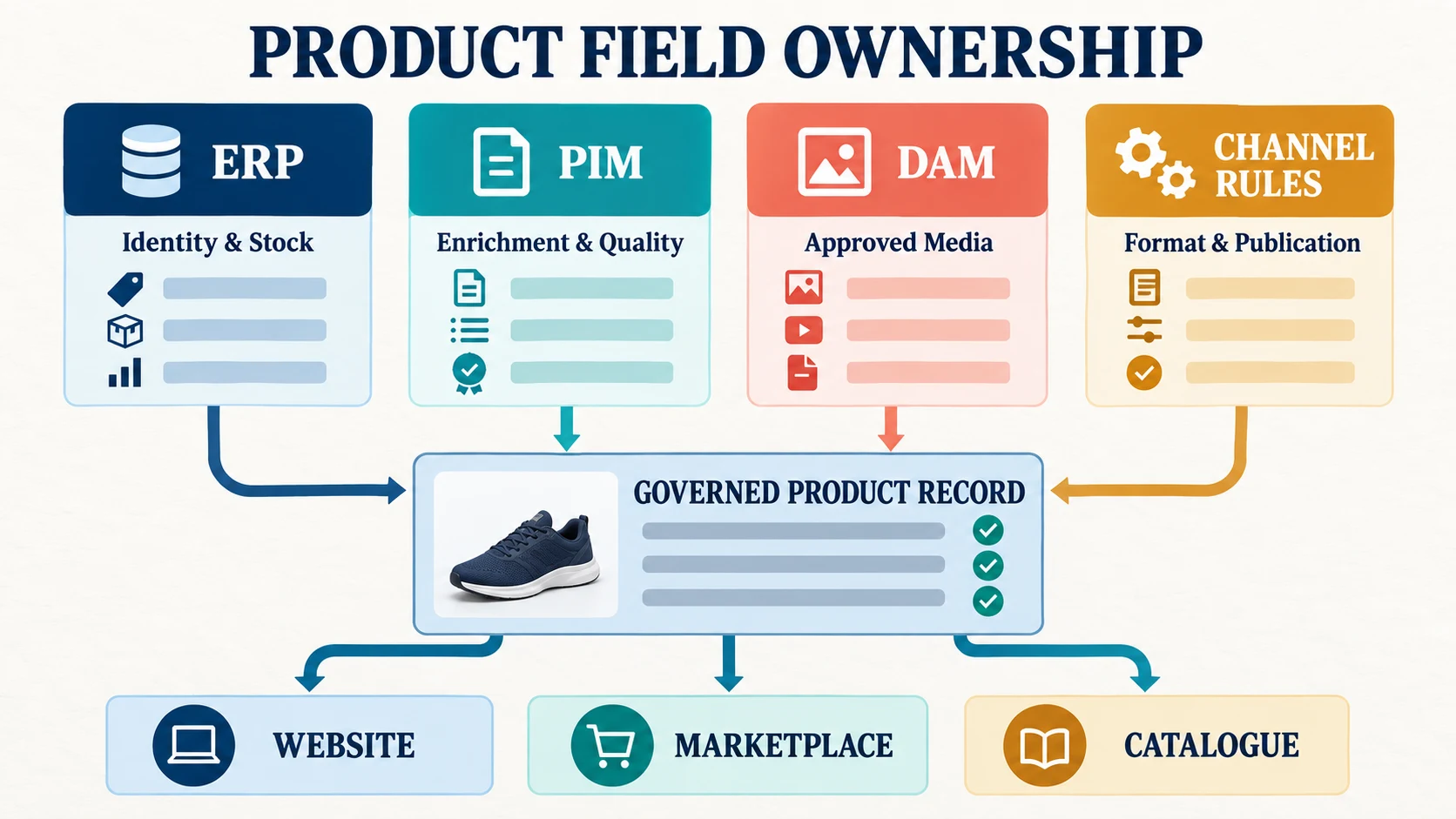
| Data field | Possible source | Quality rule | Channel behaviour |
|---|---|---|---|
| Product and variant identity | ERP, PLM or PIM | Unique code, parent-variant link and GTIN format | Identity remains stable; channel code is mapped |
| Technical attributes | PLM, engineering or PIM | Data type, unit, allowed values and provenance | Label and conversion follow target category |
| Name and description | PIM | Locale, required sections, approval and revision | Derive output for channel length and tone |
| Image and document | DAM or PIM | Product link, rights, aspect ratio, format and currency | Send suitable rendition and order |
| Price and inventory | ERP, WMS or pricing engine | Currency, effective period, warehouse and available quantity | Controlled feed rather than content enrichment |
| Category and channel attribute | PIM/mapping layer | Internal-to-target taxonomy relationship | Publication gate follows destination requirements |
The GS1 Global Data Model organises attributes used to list, order, store, move and sell products across global, category, regional and local layers. This does not mean every organisation needs identical attributes. It demonstrates why the data dictionary must reflect product category and target market.
Build the product model before modelling variants
Define product families, categories, attributes and variant relationships before designing screens. A shirt may vary by size and colour; a pump by connection diameter, power and material; a spare part by compatible model and production year. Storing every value as free text makes filtering, comparison, translation and channel mapping unreliable.
For each attribute, record its label, definition, data type, unit, allowed values, cardinality, locale dependence, variant level and requirement rule. Schema.org's ProductGroup definition similarly represents products that vary in explicitly described dimensions such as size, colour or material. A PIM model does not need to mirror Schema.org internally, but the website output can map product and variant relationships consistently.
Do not confuse completeness with correctness
Filling every mandatory field does not prove that the information is correct. A weight value may have the wrong unit, a description may come from an obsolete revision, or an image may belong to another variant. Track at least four quality dimensions:
- Completeness: Are the required values present?
- Validity: Does each value meet its type, unit and allowed-range rule?
- Consistency: Do parent, variant, asset and channel values agree?
- Currency: Was published information reviewed after the source changed?
Akeneo's completeness documentation shows that completeness can depend on family, locale and channel. A product may be ready for a Turkish website but incomplete for an English catalogue. Replace one global score with the more useful question: ready for which family, locale and destination?
How should multilingual product content be governed?
Localisation is more than translating a master description. Units, regulatory notices, certificates, technical terminology, context and channel limits may vary by market. Store the source locale, target locale, terminology, translator, technical approver and final approval time separately.
Machine translation can prepare a draft but does not automatically replace technical or commercial review. Decide which locales return to review when source copy changes. Text embedded in images, PDF manuals and downloadable technical documents also belongs in the locale inventory.
A website and marketplace should not receive identical output
Central management does not mean sending an identical record everywhere. A website may support long technical copy and detailed comparison. A marketplace can require specific categories, titles, images, identifiers and variant attributes. A print catalogue needs a date-bound snapshot while a mobile application may need smaller renditions.
The Google Merchant Center product data specification defines conditions and formats for identity, title, description, link, image, price, availability, category, identifiers and variants. Missing or conflicting data can restrict eligibility or produce display problems. Define required values, transformations, defaults, character limits, taxonomy mappings and a rejection queue for every destination.
Which states belong in a product publication workflow?
A saved product is not automatically ready to publish. A useful initial workflow can separate:
- Imported: Source identity and base fields were received.
- Classifying: Family, category and attribute template are assigned.
- Enriching: Copy, specifications, relationships, media and documents are prepared.
- Locale/technical review: Specialists review only the fields they own.
- Channel ready: Destination completeness and validity rules pass.
- Published: Channel result and external identifier are recorded.
- Failed or withdrawn: Reason, owner and reprocessing path are known.
Pimcore's product workflow tutorial demonstrates states, transitions, role guards and history in a concrete product scenario. This is not a product recommendation; it is a practical example of advancing information through tasks, authority and evidence.
How should ERP–PIM–channel integration be planned?
Begin with field ownership, not “does it have an API?”. For every field, document the source, destination, direction, trigger, transformation, validation, error class, retry behaviour and reconciliation. If ERP owns the code, PIM owns marketing copy and WMS owns availability, PIM should not independently overwrite all three.
Separate initial migration from daily change processing. Cleaning thousands of existing records, linking media and merging variants produces different failure and performance conditions from later incremental updates. A destination rejection is also different from successful technical delivery. Return the reason and correction owner to the workflow.
In which order should a PIM project proceed?
- Source inventory: List product fields in ERP, PLM, spreadsheets, folders and channel panels.
- Representative sample: Select simple, variant-rich, multilingual and exceptional products.
- Data dictionary: Define every field's meaning, type, unit, owner and conditional requirement.
- Product model: Build families, categories, variants, packs, relationships and destination mappings.
- Workflow: Separate editing, translation, validation, approval and publication roles.
- Quality rules: Configure completeness, validity, consistency and currency checks.
- Pilot destination: Verify end-to-end publication and feedback for one family and channel.
- Phased rollout: Expand channel and family coverage in measurable waves.
A whole-catalogue migration can copy legacy errors into the new platform at speed. A pilot should test more than the interface. Use real examples to validate the model, role boundaries, error return and proof of publication.
How can you recognise a genuine PIM need?
A PIM or disciplined product-information layer becomes worth evaluating when several of these conditions are persistent:
- The same product field is repeatedly edited in multiple sheets and panels.
- Variants, technical attributes or category mappings diverge by channel.
- Translation currency and technical approval ownership cannot be traced.
- Images, documents or descriptions are attached to the wrong variant.
- Channel rejections remain in batch files without a correction owner.
- Product launch depends on one person's private spreadsheet or memory.
For one destination, a small set of simple products and one responsible team, the commerce platform plus a clear data dictionary may be sufficient. Buying PIM does not automatically repair poor definitions. Without ownership and workflow, it can become another data silo.
What should a PIM proposal include?
- Product, family, category, attribute, variant and relationship model
- Source systems and field-level ownership matrix
- Cleaning, deduplication, code mapping and media-linking method
- Locale, country, channel and category quality rules
- Roles, permissions, approval, revision history and audit trail
- ERP, PLM, DAM, website, marketplace and catalogue integrations
- Batch load, incremental update, error queue and authorised reprocessing
- Pilot, acceptance scenarios, training, documentation and operating ownership
- Licence, infrastructure, development, maintenance, channel-change and data-export terms
Do not measure the project only by product count. Channel-ready rate, rejection reasons and resolution time, source-to-publication time, reopened quality issues and fields without an owner are more informative operating measures. They are not outcome guarantees; each organisation must compare them with its own baseline.
Conclusion: choose ownership before choosing a tool
PIM does more than centralise scattered product copy. It makes the product model, field ownership, locale and destination requirements, quality rules and publication workflow visible. It does not need to replace ERP, DAM, commerce or marketplace responsibilities.
Start with representative products, a field ownership matrix and destination acceptance rules instead of selecting software by SKU count alone. If you would like to scope product information management, catalogue integration and multichannel commerce together, explore the Kumsal Agency ecommerce service.
PIM stands for Product Information Management. A PIM system organises the codes, names, descriptions, technical attributes, variants, relationships, images, documents and translations required to prepare a product for sale. It helps distribute controlled product information to websites, mobile applications, dealer portals, marketplaces, advertising feeds and print catalogues.
PIM is not mandatory for every business. Catalogue size matters less than the combination of attribute diversity, channel count, localisation, update frequency and approval responsibility. When teams repeatedly edit the same product facts in spreadsheets and channel panels, a managed product-information layer becomes worth evaluating. This guide does not recommend a particular platform. It offers an original framework for scoping data ownership, quality and publication workflows.
Which problem does a PIM system solve?
Product information rarely originates in one place. A product code may live in ERP, dimensions in an engineering file, marketing copy in a document, imagery in an agency folder and marketplace categories in a separate spreadsheet. Manual assembly makes it difficult to identify the current version, locate missing attributes or prove which channels received a change.
A PIM should not absorb every kind of enterprise data. Its role is to model, enrich and govern sales-ready product information, coordinate contributions and distribute suitable output to each channel. Microsoft's product information overview treats shared definitions, categories, identifiers, variants, images, attachments, units and translations as connected parts of the product structure.
How does PIM differ from ERP, DAM and a commerce platform?
Define boundaries by field rather than by product. Assumptions such as “ERP owns every product field” or “PIM also controls inventory” can create conflicting updates during integration.
| System | Typical responsibility | Question it does not answer alone |
|---|---|---|
| ERP | Product and commercial codes, units, cost, price, inventory and logistics records | Is rich content, media and localisation ready for every channel? |
| PIM | Product model, attributes, variants, descriptions, translations, relationships and channel mapping | What is the financial record or currently available stock? |
| DAM | Versions, rights and renditions of photographs, video, drawings and documents | Which product, variant, locale and channel should use the asset? |
| Commerce/marketplace | Customer display, search, basket, pricing and transaction | Where is the information's source and approval history? |
DAM may be a separate system or the media functions inside PIM may be sufficient. A small catalogue may likewise remain manageable in the commerce platform. Base the boundary on real data and workflow rather than the name of a software category. For the wider transaction boundary, use our guide to planning ecommerce–ERP integration.
The Kumsal Product Field Ownership Matrix
This original framework takes “single source of truth” from system level down to individual fields. For each row, record the source, editing authority, validation, publication target and return path. It is a reproducible discovery tool, not a software prescription or client result.

| Data field | Possible source | Quality rule | Channel behaviour |
|---|---|---|---|
| Product and variant identity | ERP, PLM or PIM | Unique code, parent-variant link and GTIN format | Identity remains stable; channel code is mapped |
| Technical attributes | PLM, engineering or PIM | Data type, unit, allowed values and provenance | Label and conversion follow target category |
| Name and description | PIM | Locale, required sections, approval and revision | Derive output for channel length and tone |
| Image and document | DAM or PIM | Product link, rights, aspect ratio, format and currency | Send suitable rendition and order |
| Price and inventory | ERP, WMS or pricing engine | Currency, effective period, warehouse and available quantity | Controlled feed rather than content enrichment |
| Category and channel attribute | PIM/mapping layer | Internal-to-target taxonomy relationship | Publication gate follows destination requirements |
The GS1 Global Data Model organises attributes used to list, order, store, move and sell products across global, category, regional and local layers. This does not mean every organisation needs identical attributes. It demonstrates why the data dictionary must reflect product category and target market.
Build the product model before modelling variants
Define product families, categories, attributes and variant relationships before designing screens. A shirt may vary by size and colour; a pump by connection diameter, power and material; a spare part by compatible model and production year. Storing every value as free text makes filtering, comparison, translation and channel mapping unreliable.
For each attribute, record its label, definition, data type, unit, allowed values, cardinality, locale dependence, variant level and requirement rule. Schema.org's ProductGroup definition similarly represents products that vary in explicitly described dimensions such as size, colour or material. A PIM model does not need to mirror Schema.org internally, but the website output can map product and variant relationships consistently.
Do not confuse completeness with correctness
Filling every mandatory field does not prove that the information is correct. A weight value may have the wrong unit, a description may come from an obsolete revision, or an image may belong to another variant. Track at least four quality dimensions:
- Completeness: Are the required values present?
- Validity: Does each value meet its type, unit and allowed-range rule?
- Consistency: Do parent, variant, asset and channel values agree?
- Currency: Was published information reviewed after the source changed?
Akeneo's completeness documentation shows that completeness can depend on family, locale and channel. A product may be ready for a Turkish website but incomplete for an English catalogue. Replace one global score with the more useful question: ready for which family, locale and destination?
How should multilingual product content be governed?
Localisation is more than translating a master description. Units, regulatory notices, certificates, technical terminology, context and channel limits may vary by market. Store the source locale, target locale, terminology, translator, technical approver and final approval time separately.
Machine translation can prepare a draft but does not automatically replace technical or commercial review. Decide which locales return to review when source copy changes. Text embedded in images, PDF manuals and downloadable technical documents also belongs in the locale inventory.
A website and marketplace should not receive identical output
Central management does not mean sending an identical record everywhere. A website may support long technical copy and detailed comparison. A marketplace can require specific categories, titles, images, identifiers and variant attributes. A print catalogue needs a date-bound snapshot while a mobile application may need smaller renditions.
The Google Merchant Center product data specification defines conditions and formats for identity, title, description, link, image, price, availability, category, identifiers and variants. Missing or conflicting data can restrict eligibility or produce display problems. Define required values, transformations, defaults, character limits, taxonomy mappings and a rejection queue for every destination.
Which states belong in a product publication workflow?
A saved product is not automatically ready to publish. A useful initial workflow can separate:
- Imported: Source identity and base fields were received.
- Classifying: Family, category and attribute template are assigned.
- Enriching: Copy, specifications, relationships, media and documents are prepared.
- Locale/technical review: Specialists review only the fields they own.
- Channel ready: Destination completeness and validity rules pass.
- Published: Channel result and external identifier are recorded.
- Failed or withdrawn: Reason, owner and reprocessing path are known.
Pimcore's product workflow tutorial demonstrates states, transitions, role guards and history in a concrete product scenario. This is not a product recommendation; it is a practical example of advancing information through tasks, authority and evidence.
How should ERP–PIM–channel integration be planned?
Begin with field ownership, not “does it have an API?”. For every field, document the source, destination, direction, trigger, transformation, validation, error class, retry behaviour and reconciliation. If ERP owns the code, PIM owns marketing copy and WMS owns availability, PIM should not independently overwrite all three.
Separate initial migration from daily change processing. Cleaning thousands of existing records, linking media and merging variants produces different failure and performance conditions from later incremental updates. A destination rejection is also different from successful technical delivery. Return the reason and correction owner to the workflow.
In which order should a PIM project proceed?
- Source inventory: List product fields in ERP, PLM, spreadsheets, folders and channel panels.
- Representative sample: Select simple, variant-rich, multilingual and exceptional products.
- Data dictionary: Define every field's meaning, type, unit, owner and conditional requirement.
- Product model: Build families, categories, variants, packs, relationships and destination mappings.
- Workflow: Separate editing, translation, validation, approval and publication roles.
- Quality rules: Configure completeness, validity, consistency and currency checks.
- Pilot destination: Verify end-to-end publication and feedback for one family and channel.
- Phased rollout: Expand channel and family coverage in measurable waves.
A whole-catalogue migration can copy legacy errors into the new platform at speed. A pilot should test more than the interface. Use real examples to validate the model, role boundaries, error return and proof of publication.
How can you recognise a genuine PIM need?
A PIM or disciplined product-information layer becomes worth evaluating when several of these conditions are persistent:
- The same product field is repeatedly edited in multiple sheets and panels.
- Variants, technical attributes or category mappings diverge by channel.
- Translation currency and technical approval ownership cannot be traced.
- Images, documents or descriptions are attached to the wrong variant.
- Channel rejections remain in batch files without a correction owner.
- Product launch depends on one person's private spreadsheet or memory.
For one destination, a small set of simple products and one responsible team, the commerce platform plus a clear data dictionary may be sufficient. Buying PIM does not automatically repair poor definitions. Without ownership and workflow, it can become another data silo.
What should a PIM proposal include?
- Product, family, category, attribute, variant and relationship model
- Source systems and field-level ownership matrix
- Cleaning, deduplication, code mapping and media-linking method
- Locale, country, channel and category quality rules
- Roles, permissions, approval, revision history and audit trail
- ERP, PLM, DAM, website, marketplace and catalogue integrations
- Batch load, incremental update, error queue and authorised reprocessing
- Pilot, acceptance scenarios, training, documentation and operating ownership
- Licence, infrastructure, development, maintenance, channel-change and data-export terms
Do not measure the project only by product count. Channel-ready rate, rejection reasons and resolution time, source-to-publication time, reopened quality issues and fields without an owner are more informative operating measures. They are not outcome guarantees; each organisation must compare them with its own baseline.
Conclusion: choose ownership before choosing a tool
PIM does more than centralise scattered product copy. It makes the product model, field ownership, locale and destination requirements, quality rules and publication workflow visible. It does not need to replace ERP, DAM, commerce or marketplace responsibilities.
Start with representative products, a field ownership matrix and destination acceptance rules instead of selecting software by SKU count alone. If you would like to scope product information management, catalogue integration and multichannel commerce together, explore the Kumsal Agency ecommerce service.