


Aydınlatma metni yükleniyor…
Social media consulting is not limited to publishing more posts every day. A sound engagement translates the business goal into social decisions, defines audience context, connects production to an editorial system, manages community and crisis communication, and carries measurement into the next decision.
\n
Consulting and agency services are not identical. A consultant may provide the existing team with a decision framework, process, review and specialist support; an agency may also take on content, design, moderation or campaign production. The proposal should make scope, ownership and approvals visible.
\n
What is social media consulting?
\n
Social media consulting reviews business goals and existing accounts, sets channel and audience priorities, designs a content system, defines community and risk rules, establishes measurement and regularly reviews team decisions.
\n
Instagram professional accounts include built-in insights for performance and content engagement, so account type, permissions and data ownership should be clarified at the start (Instagram professional accounts and insights). These tools do not replace strategy; they help answer the questions the team has already chosen to measure.
\n
What should the scope include?
\n
1. Goal and audience frame
\n
“Grow on social media” is not a measurable objective by itself. Prioritise awareness, qualified demand, customer support, recruitment or community trust. Audience context includes questions, objections, decision time, language and the proof people expect from the brand.
\n
2. Content operating system
\n
Design content pillars, formats, publishing rhythm, owners and approvals together. A calendar should not be only a list of dates. Each item should state the question it answers, the evidence it uses and the behaviour it invites. Education, product use, case evidence, behind-the-scenes and objection handling can have distinct roles.
\n
3. Brand voice and editorial quality
\n
Short copy, imagery and video should carry a consistent voice. Exaggerated promises, unsupported percentages, generic clichés and controversy created only for engagement erode trust. Use a pre-publication review for language, accuracy, accessibility, rights and calls to action.
\n
4. Community and moderation
\n
Define who answers comments and messages, within what time and with which authority. Record common questions, qualified-lead criteria, sensitive topics and escalation owners. Moderation is not simply deleting negative comments; it also means surfacing useful questions, routing people correctly and turning recurring issues into content ideas.
\n
5. Risk and crisis readiness
\n
Review account access, two-factor authentication, backup administrators, usage permissions and offboarding. A crisis plan should cover verification, ownership, the first response, legal or technical review and post-event learning. Do not use the same automatic reply for every risk level.
\n
6. Measurement and learning
\n
Follower count is not a business outcome by itself. Depending on the content goal, read reach, qualified engagement, profile visits, website behaviour, messages, forms and customer feedback together. A report should explain the tested hypothesis, what was learned and what will change next month, not only list the highest numbers.
\n
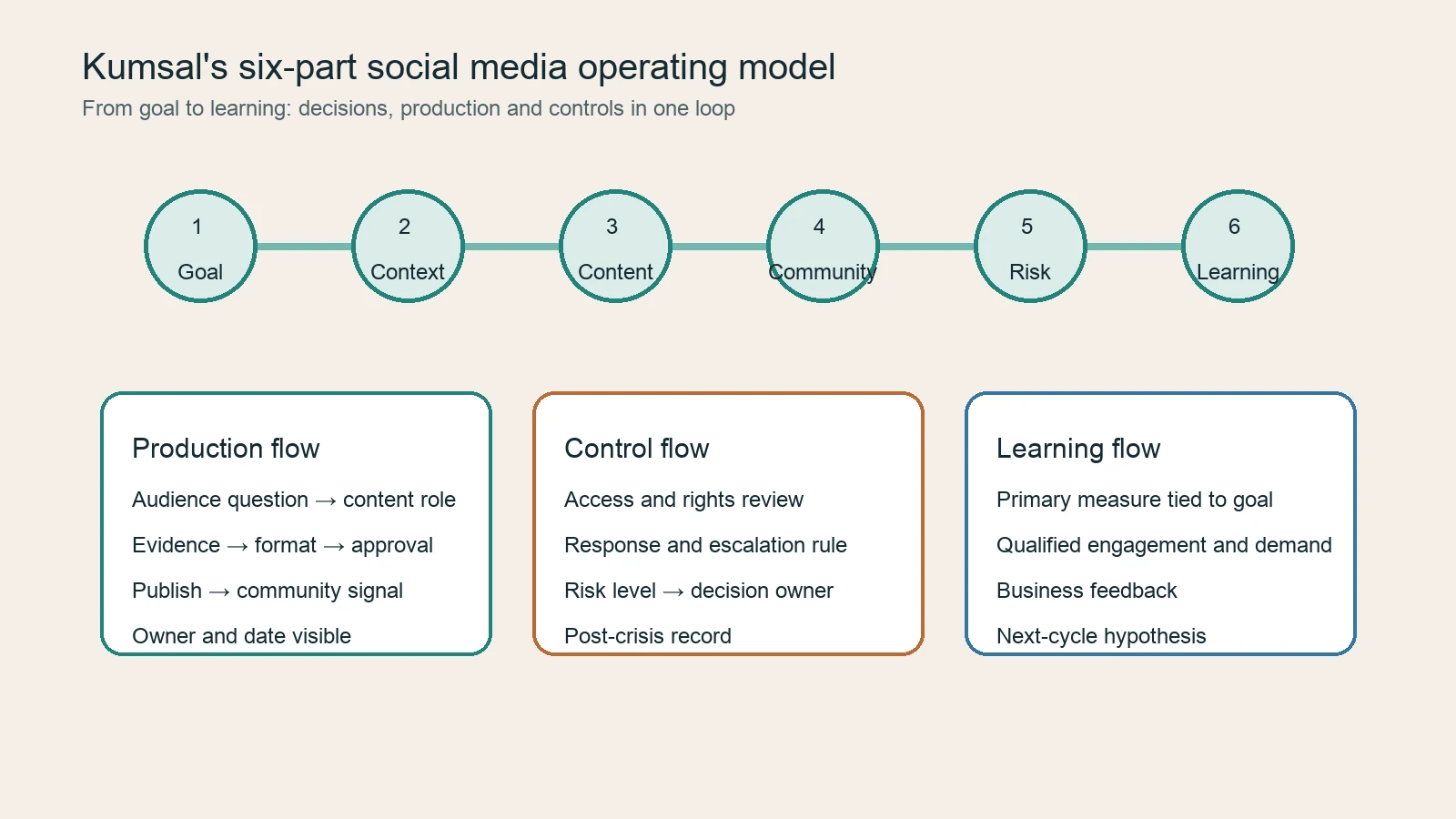
The Kumsal six-part social media operating model
\n
- \n
- Goal: Translate the business objective into one social decision.
- \n
- Context: Record audience questions, objections and decision moments.
- \n
- Content: Define each format’s role, evidence and owner.
- \n
- Community: Write comment, message, moderation and escalation rules.
- \n
- Risk: Put access, rights, crisis and data controls into the publishing flow.
- \n
- Learning: Connect the report to the next content and budget decision.
- \n
This model turns social media management from disconnected posts into a repeatable operating rhythm.
\n
\n
How is consulting different from advertising management?
\n
Organic consulting works on content, community, voice and account operations. Paid advertising consulting focuses on campaign objectives, media budget, targeting, creative variations and conversion measurement. They can share a calendar, but budgets, access, KPIs and deliverables should remain separate. See the Instagram advertising consulting scope for the paid side.
\n
Agency selection is a separate decision involving proposals, production and account ownership. Use the social media agency scope and selection frame rather than merging the two intents.
\n
Questions to ask before requesting a proposal
\n
- \n
- Which business outcome defines the primary measure?
- \n
- Who owns content, design, video, moderation and reporting?
- \n
- Who owns the accounts, archives, ad assets and source files?
- \n
- How do approvals, revision rounds and crisis escalation work?
- \n
- Which decision will the monthly report change?
- \n
- How will access and file handover work when the engagement ends?
- \n
\n
Conclusion
\n
Social media consulting is not a promise to produce more posts. It is a decision system connecting goals, content, community, risk and measurement. With explicit scope, the business can see what it is buying, the team can see its responsibilities and the next month can be changed for a reason. Explore the digital marketing library for related topics.