


Aydınlatma metni yükleniyor…
Virtual POS integration involves much more than connecting a checkout form to a bank service. It spans a chain of dependent steps: creating the basket, validating the amount, authenticating the cardholder, requesting authorisation, updating the order and reconciling the financial result. A reliable architecture must make payment easy for the customer while protecting sensitive data and giving operations teams the tools to manage failed, delayed or uncertain transactions safely.
For that reason, virtual POS integration should not be treated as an isolated API task. Checkout experience, 3D Secure 2.0 flows, error handling, traceability, privacy, performance and long-term operations must be designed as one system. This becomes especially important for businesses working with multiple banks or payment service providers, where a shared payment-state model can prevent provider-specific differences from spreading across the commerce platform.
What is virtual POS integration?
Virtual POS integration enables an e-commerce platform to communicate with a bank or payment provider to initiate, authenticate, authorise and record card payments. Depending on the commercial and technical model, it may also cover payment-session creation, cancellation, full or partial refunds, settlement reporting and reconciliation.
The customer may be redirected to a hosted payment page, enter details through a secure embedded component or use a checkout interface managed more extensively by the merchant. This decision should not be based on visual flexibility alone. Teams must assess where card data travels, the resulting PCI DSS scope, provider capabilities, mobile usability and operational requirements.
A strong e-commerce experience should carry the brand’s visual language consistently from product discovery to basket and checkout. The payment screen should not feel disconnected from the rest of the journey, but aesthetic choices must never weaken security controls or make important payment states difficult to understand.
How does 3D Secure 2.0 work?
3D Secure 2.0 supports cardholder authentication by the issuing bank in card-not-present transactions. The term “3D Secure 2.0” is commonly used as an umbrella label; the actual protocol version depends on the card scheme, issuer, provider and technical compatibility of the participating systems.
According to EMVCo’s explanation of EMV 3-D Secure, transaction, device and cardholder context can contribute to risk assessment. This allows the authentication request to follow either a frictionless path or a challenge flow instead of forcing every customer through the same additional verification step.
Frictionless authentication
After evaluating risk, the issuer may decide that no further customer interaction is required. Authentication can then be completed without presenting a separate password or approval screen. This does not mean the 3D Secure check was skipped; it means the available contextual data allowed the authentication process to finish in the background.
For frictionless authentication to work reliably, the fields requested by the provider must be supplied accurately, consistently and within the permitted scope. Missing device or transaction context may affect risk assessment. Sending more data, however, is not automatically better. Data minimisation, defined purposes and appropriate retention periods should still govern the integration.
Challenge authentication
If the issuer requires further verification, the customer may encounter a one-time password, mobile banking approval, biometric confirmation or another supported method. EMVCo’s technical description of the challenge flow explains how the cardholder interacts with the issuer over a secure connection and how the outcome is communicated through protocol messages.
Teams should test the size and placement of the challenge window, mobile rendering, app switching, back-button behaviour and timeouts. The interface should clearly explain that verification is taking place with the customer’s bank. Refreshing the page or pressing the payment button again must not create a second charge.
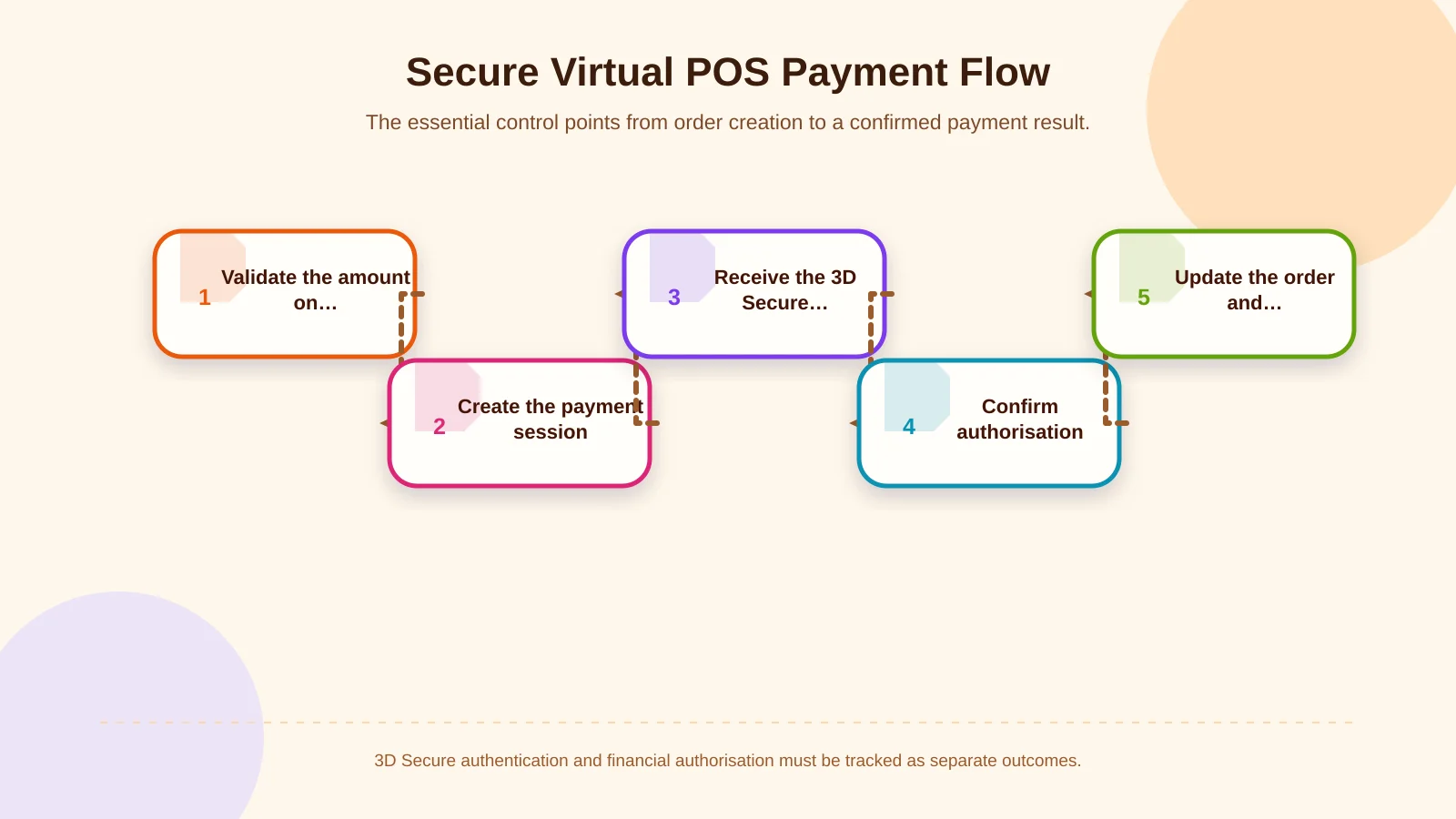
How should the end-to-end payment flow be designed?
1. Validate the order and payable amount on the server
Product prices, discounts, shipping, taxes, currency and the final total should be recalculated using trusted server-side data before payment begins. A total submitted by the browser must not be accepted without verification. Every attempt should be linked to unique order, payment and attempt identifiers.
2. Create the payment session securely
Communication with the bank or payment provider should use credentials protected on the server. Secret keys must not be embedded in browser code, mobile application packages or public repositories. Development, test and production environments should have separate credentials, endpoints and return URLs.
3. Keep authentication separate from authorisation
Successful cardholder authentication does not necessarily mean that funds have been authorised. The system should store the 3D Secure result, authorisation response and order state as separate but related records. Collapsing “authenticated,” “awaiting authorisation” and “paid” into one label can cause fulfilment and accounting errors.
4. Confirm the result through trusted server channels
Arrival at a browser success page is not proof of payment. Return parameters must be validated, server-to-server notifications verified and, when necessary, the provider’s status API queried. The order should be confirmed only after a trustworthy final result has been obtained.
5. Update order and financial records safely
After a successful payment, inventory, invoicing, notifications and ERP processes should be triggered in a controlled sequence. A failure in one downstream task must not erase or invalidate the payment record. Queues and bounded retry policies can help work resume after temporary service disruptions. Financial records should later be checked through a defined reconciliation process; the related guide to account reconciliation software discusses matching, exception ownership and auditable approval in more detail.
How should failed and pending payments be managed?
Not every payment request immediately becomes successful or failed. A customer may close the authentication screen, the issuer may respond late, a callback may not arrive or the browser connection may be interrupted. The system must distinguish an unknown result from a confirmed decline.
- Failed: The bank or provider has issued a definitive decline. Show a clear message without exposing sensitive technical details.
- Pending: No final result is available. Keep the order in a temporary state and activate status polling or another verification mechanism.
- Timed out: The request exceeded its time limit, but a charge may still have occurred at the bank. Investigate the existing transaction before initiating another payment.
- Cancelled: The customer or issuer did not complete authentication. Preserve the basket and provide a safe route back to checkout.
- Inconsistent: Notifications, provider queries and local records disagree. Route the transaction to automated checks or authorised manual review.
The operations panel should show the order number, provider transaction ID, amount, currency, timestamps, current state and state history. Raw bank messages should not be displayed directly to customers. Instead, provider responses should map to explainable error categories that customer service and finance teams can use consistently.
Safe retries and duplicate-charge prevention
A customer who receives no response may press the payment button again, while an infrastructure component may retry a timed-out request automatically. If every repetition creates a fresh charge request, the same order may receive multiple authorisations. Idempotency controls should therefore cover both payment initiation and result processing.
Duplicate requests carrying the same order, amount and attempt key should resolve to the previously established safe result. Retry decisions must not rely on a generic error code alone. Definitive declines, temporary service failures and uncertain outcomes require different rules. An uncertain transaction should be queried before any new collection attempt. The same safeguards should apply to cancellations and refunds.
| Status | System action | Customer experience | Operational control |
|---|---|---|---|
| Successful | Confirm the order | Confirmation and order summary | Reconciliation record |
| Definitive decline | Allow a new attempt | Clear error message | Monitor the decline category |
| Pending | Query the status | Payment in progress message | Timeout alert |
| Uncertain result | Block a new charge | Controlled status notice | Manual or automated review |
| Customer cancellation | Preserve the basket | Safe return to checkout | Record the cancellation reason |
Payment security and customer privacy
Using 3D Secure does not protect the entire payment environment by itself. Teams must also address card-data exposure, payment-page scripts, access permissions, credential management, patching and logging. Where appropriate, hosted payment methods or secure components that keep card data away from merchant systems can reduce exposure and simplify parts of the architecture.
The PCI Security Standards Council describes expectations for protecting embedded payment forms against script-based attacks. Its guidance on SAQ A eligibility and payment-page scripts illustrates how the integration model can affect security and compliance scope. The applicable PCI DSS validation method must still be assessed against the organisation’s real data flow, service providers and acquiring relationship.
- Never write card numbers, security codes, passwords, access keys or unnecessary personal data to application logs.
- Use current TLS configurations, secure cookie settings and suitable browser security headers.
- Minimise third-party scripts on payment pages, authorise changes and monitor deployed resources.
- Protect administration tools with role-based access, strong authentication and auditable activity records.
- Retain personal data only for documented purposes and defined retention periods.
These controls are most effective when payment is treated as part of the wider web-software architecture. User roles, order data, integrations and operational workflows can then follow the same security and governance model.
Logging, traceability and the operations panel
A useful payment record contains more than a successful or failed label. Teams should be able to determine which provider and integration version initiated the transaction, the general result returned during 3D Secure, when authorisation was requested, when notifications were processed and which service or authorised user changed the order state.
Events should share a correlation identifier, use consistent timestamps and mask sensitive fields. An operations panel may support state-based filtering, secure provider queries, controlled reprocessing, cancellation and refunds. Every manual intervention should add the responsible user, time and reason to the audit trail.
Alerts should reflect business impact. A rising decline rate, payments remaining pending for too long, a growing notification queue or deteriorating provider response times can all justify early warnings. This allows teams to investigate before the issue becomes visible only through customer complaints.
Testing and production-readiness checks
A virtual POS integration cannot be validated with one successful test card. Across relevant devices, browsers and screen sizes, teams should test frictionless authentication, challenges, incorrect verification, customer cancellation, timeouts, definitive declines, delayed notifications and repeated requests.
- Test successful payment separately from successful 3D Secure followed by declined authorisation.
- Simulate refreshes, back navigation, double-clicks and interrupted connections.
- Verify behaviour when notifications arrive late, out of order or more than once.
- Check cancellation, full refund, partial refund and reconciliation records.
- Confirm that logs, analytics tools and error screens contain no sensitive payment data.
- Measure provider latency, queue behaviour and timeout limits under expected peak traffic.
Before launch, verify domain and callback addresses, firewall rules, certificates, secure key storage, access roles, alert channels and support ownership. The customer-facing message and the operational response for a provider outage should be agreed in advance.
Building a sustainable payment platform
The success of a virtual POS integration is not measured only at launch. Bank services, 3D Secure versions, security requirements and business rules change over time. Separating provider-specific adapters from business logic, establishing shared payment states, versioning integrations and maintaining automated tests can substantially reduce the cost and risk of change.
Kumsal Agency designs and develops custom e-commerce platforms and web software around business processes, user roles, data and integration requirements. Payment user experience, virtual POS connections, mobile-responsive interfaces, operational controls, testing, performance and data security are planned together rather than added as disconnected features.
Plan a fast, clear, manageable and security-focused payment experience tailored to your virtual POS and 3D Secure 2.0 requirements with Kumsal Agency.