


Aydınlatma metni yükleniyor…
For an appointment-led service brand serving Etiler, Nisbetiye or Akatlar, a website is more than a polished shop window. It should help visitors understand the right service, evaluate credible evidence and move to an appropriate contact step without surrendering unnecessary data. Scope therefore needs to begin with user tasks, trust evidence, appointment rules and acceptance tests—not colours and page counts.
This guide does not use a neighbourhood name as evidence of a physical office or local results. It turns a high-consideration service journey into a practical website brief so decision-makers can compare proposals against the same content, delivery and measurement requirements.
Which visitor decisions must the website support?
Segment visitors by the task they need to complete. A first-time visitor wants to understand whether a service is relevant. A comparison-stage visitor looks for process, expertise, limitations and proof. Someone closer to action checks the pricing model, eligibility, location and appointment method. An existing customer may need a separate support or repeat-booking route.
The homepage should not force all of these people into one call to action. Define an understandable service path, expected next step and recovery option for each important task. A visitor who is still evaluating should not be pushed into “Book now”, while a ready visitor should not have to search through generic brand pages.
The seven-gate decision system for an Etiler service website
Kumsal Ajans developed this seven-gate framework to turn design choices into testable scope. Skipping a gate can produce an attractive website whose commercial task and operating requirements remain unclear.
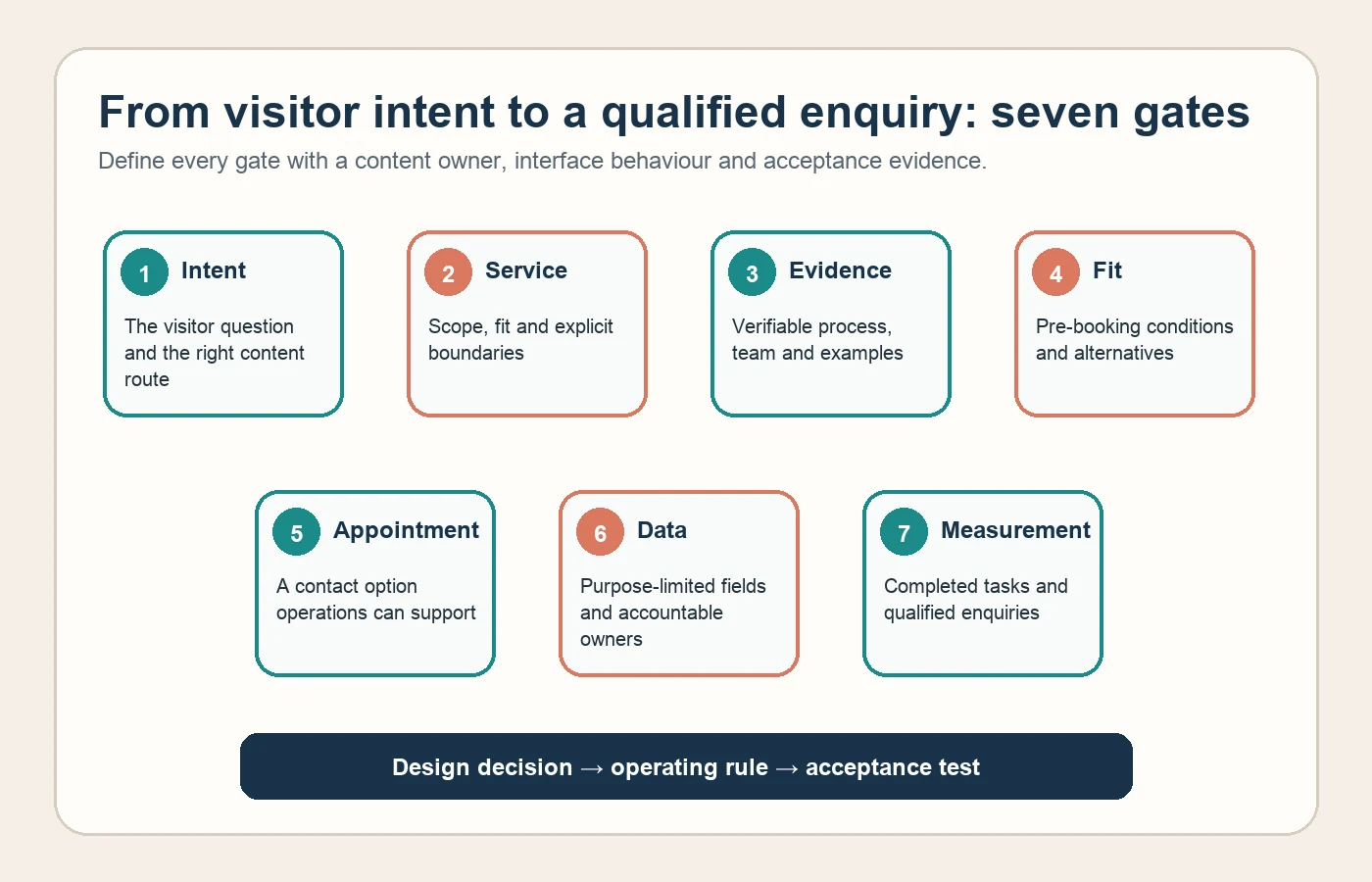
- Intent: Identify the visitor's question and the page responsible for answering it.
- Service: Explain what the service includes, who it suits and where its boundaries sit.
- Evidence: Use only verifiable team information, processes, project examples, certifications or methods.
- Fit: Show conditions visitors need to understand before requesting an appointment.
- Appointment: Select a form, calendar, phone or callback flow that matches real operations.
- Data: Define why each field is collected, who can access it and where it is transferred.
- Measurement: Track completed user tasks and qualified enquiries rather than page views alone.
Build a trust architecture, not a luxury veneer
Visual refinement cannot create trust on its own. Trust develops when a visitor can verify a claim, anticipate the process and understand the limits of a decision. Separate the problem, approach, scope, eligibility, expected process and next step on each service page. Team details should match current responsibilities; client logos and testimonials require permission; location information must reflect real operations.
If the business uses before-and-after media, performance rates or strong outcome statements, obtain the relevant sector and brand approval. A web team should not invent these claims. Record the evidence owner, approval date and update responsibility in the content inventory.
An appointment journey should be appropriate, not merely short
The shortest form is not automatically the best, but unnecessary questions increase friction and data responsibility. Turkey's data protection authority states that personal data processing should serve specified, explicit and legitimate purposes and remain relevant, limited and proportionate (KVKK general principles). Ask whether every field is necessary to provide the first response at that moment.
A complete booking scope covers service selection, contact preference, suitable time, consent copy, success feedback, errors, cancellation and rescheduling. When no slots remain, provide an operationally supported alternative such as a callback or waiting list. If submissions flow into a CRM or notification system, test field mappings, duplicate behaviour and failed-transfer alerts.
Accept mobile experience, accessibility and speed together
Completing the journey one-handed on a mobile device requires real-device testing of touch targets, fields, error feedback and fixed actions. W3C's WCAG 2.2 includes requirements concerning visible keyboard focus, descriptive headings and labels, minimum target size and reduced redundant entry (WCAG 2.2). Put these into component acceptance criteria rather than a post-design checklist.
Image- and video-led presentation also needs a performance budget. Google's current Web Vitals model evaluates loading, responsiveness and visual stability through LCP, INP and CLS and recommends field measurement across mobile and desktop (Web Vitals). Set limits for hero assets, video delivery, font families and third-party scripts in the proposal.
Use neighbourhood context accurately
Repeating Etiler, Nisbetiye or Akatlar in every heading does not create local trust. If the brand has a real location, keep its address, access details, opening hours, accessibility information and appointment conditions consistent. If it only serves an area, do not imply that a branch exists. Google's LocalBusiness documentation likewise calls for each real location to be described accurately and separately (Google LocalBusiness documentation).
A local landing page should not be a copy of a generic service page. When there is no genuinely location-specific access, service, visit-preparation or contact information, the main service page may be the more honest and useful destination.
Add content operations to the project scope
Trust content does not become maintenance-free after launch. Assign an owner and review cycle to services, team details, hours, forms, legal copy and campaign messages. Use role-based permissions, approval flows, version history and media rules in the management platform. This protects the design system and reduces uncontrolled changes to material claims.
Deliverables to require in proposals and acceptance
- Information architecture mapped to visitor tasks and service routes
- Content models for the homepage, services, evidence, team, location and appointments
- Desktop and mobile prototypes including errors and empty states
- Form fields, consent copy, integration and notification mapping
- Accessibility, performance and browser acceptance scenarios
- Analytics events, the definition of a qualified enquiry and reporting ownership
- Handover for source files, accounts, domain, data, documentation and maintenance
Compare suppliers against these deliverables instead of page counts and visual references alone. Use the website requirements guide to develop the brief and review the Kumsal Ajans web design service for the implementation approach.
Which indicators should measure success?
Do not limit the first-month measurement plan to traffic and total form submissions. Track service-route selection, evidence interaction, booking starts, successful submissions, error rates, cancellations, phone actions and the qualified-enquiry rate separately. Define each event name, trigger, data owner and report recipient before implementation.
The right website combines refined presentation with credible content and workable operations. Etiler-related search visibility is useful only when it reflects a real location or distinctive local value. The core objective is to help visitors reach the right service with confidence and enable the brand to manage that demand sustainably.