


Aydınlatma metni yükleniyor…
Strong manufacturing capacity alone is not enough to earn the confidence of international buyers in the textile and apparel industry. If fabric constructions, yarn types, collections, production capabilities, certifications and delivery capacity are not presented within a clear digital structure, a company’s real strengths may remain invisible. Web design for textile companies is therefore about more than creating a corporate showcase. It should provide a digital export platform that helps buyers discover products, review technical information and contact the sales team efficiently.
A well-planned textile website brings the brand story, product catalogue and enquiry process into one consistent experience. The content model will vary between fabric mills, yarn manufacturers, ready-to-wear brands, uniform suppliers and contract manufacturers. The commercial goal, however, remains the same: delivering reliable, relevant and manageable product information to the right decision-makers in each target market.
Why is a corporate textile website a sales tool?
International procurement teams often begin their assessment of a manufacturer online. Within a few minutes, they should be able to understand the company’s specialist product groups, production methods, custom-manufacturing options and approach to quality. Confusing navigation, weak imagery or pages filled with generic claims can make even an experienced manufacturer appear less capable than it really is.
The corporate website consequently becomes a digital representative of the sales team. Brand positioning, manufacturing facilities, export regions, certifications, sustainability policies and product range must be communicated as parts of one credible story. Textile-sector work such as Kumsal Agency’s uniform web design project illustrates how product presentation and corporate trust signals can be handled within the same experience.
The site should also support different levels of buyer intent. A visitor making an initial supplier comparison may need a concise overview of capabilities, while a technical buyer may want construction details, test documents and downloadable specifications. Clear pathways between these layers reduce friction without overwhelming users at the beginning of their research.
How does a digital export catalogue differ from a printed catalogue?
Printed and PDF catalogues can still be useful for meetings and trade fairs, but they quickly become outdated when products, colours or collections change. In a digital export catalogue, authorised teams can update technical values, product variants, documents and new ranges through a content management system. Visitors do not need to browse the entire catalogue from beginning to end; they can move directly to relevant products by category, application, material or technical property.
A digital catalogue does not necessarily mean online purchasing. In B2B textile sales, samples, lead times, minimum order quantities, customisation and production conditions may need to be discussed before an order is possible. The main conversion is therefore often a qualified quotation or contact request rather than an add-to-cart action. A product page should establish context, provide sufficient technical information and guide the buyer to the appropriate sales channel.
Building the right product data model
Catalogue performance depends not only on photography but also on how product information is structured. Categories, collections, product families, variants and technical attributes should be treated as distinct concepts. For a fabric manufacturer, fibre composition, weight, width, knit or weave, colour, finish and end use may be essential. Apparel businesses may prioritise size, fit, material, season and style, while uniform manufacturers may organise information by industry, job role, climate and personalisation option.
GS1 standards describe how information such as brand, certification, sewing pattern, material and product line can be shared consistently between trading parties. This does not impose one catalogue template on every manufacturer. It does, however, demonstrate why product data should be managed through defined fields rather than being locked inside images or disconnected documents. The GS1 General Specifications provide a useful reference when considering product identification and data structure.
Technical documents and trust signals
Depending on the product, pages may include care instructions, technical data sheets, colour cards, size charts, test reports or certificates. The content management system should track the language and current version of each document, as well as the products to which it applies. Instead of displaying certification logos without explanation, the website should clarify the certification’s scope, validity and relationship to the relevant manufacturing process.
Trust is also built through precise statements. Production capacity, delivery regions and customisation options should be described in terms the company can verify and maintain. When commercially appropriate, authentic facility photography, process explanations and quality-control information can help buyers distinguish operational evidence from promotional language.
Structure information around the buyer’s decision journey
Navigation should reflect visitor questions rather than the manufacturer’s internal departments. “What do you produce?”, “Which specifications can you manufacture?”, “How do you manage quality and sustainability?” and “How can I request a quotation?” are practical questions around which the page hierarchy can be built. The homepage should summarise the brand’s value, principal product groups and manufacturing capabilities before directing users to detailed pages.
Products may be grouped by category and collection, while manufacturing pages can explain capacity, machinery and quality processes. About, certifications, sustainability, projects and references pages add further layers of confidence. Kumsal Agency’s textile web design project for a yarn manufacturer offers a relevant example of connecting a technical product structure with a wider corporate narrative.
How should filtering and on-site search work?
For catalogues containing hundreds of products, category navigation alone is rarely sufficient. Filters should be generated from information that genuinely exists in the product data model and has decision-making value for buyers. A fabric catalogue might use material, composition, weight, application and construction. An apparel catalogue could prioritise product type, collection, target industry and season.
Combinations that cannot return results should not be presented as viable options. Active filters must remain visible and easy to remove, particularly on mobile screens. Results should update predictably, while URLs and page behaviour should be planned so that useful category pages remain shareable and discoverable without creating an uncontrolled number of low-value index pages.
On-site search should recognise commercial names, product codes and common synonyms. When no exact result is available, the interface can recommend an alternative category or provide a route to the sales team instead of showing an empty screen. Search and filter analytics can also reveal which properties buyers use most frequently, informing future catalogue improvements.
Managing a multilingual textile website
Multilingual publishing involves much more than automatically translating menus. Product names, technical terminology, units of measurement, certificate descriptions, downloadable files, metadata and form options should all be manageable for each language. Language priorities must reflect target markets and the team’s ability to maintain content. English may be the starting language for many export projects, but market-specific terminology and buyer expectations still require separate consideration.
Language versions should have distinct URLs, with their relationship defined technically. Google recommends identifying localised alternatives with hreflang annotations; each version should reference itself and its corresponding alternatives. Editorial review by someone familiar with textile terminology is equally important. Accurate language prevents misunderstandings about composition, performance, sizes or manufacturing capabilities.
Mobile usability, performance and accessibility
Procurement teams may conduct detailed comparisons on desktop computers, yet their first visit may happen on a phone during travel or at a trade fair. Mobile design cannot be treated as a reduced version of the desktop page. Navigation, filter panels, image galleries, technical tables, document downloads and quotation forms should each be tested at smaller screen sizes.
High-quality imagery is vital for communicating texture, finish and colour, but unnecessarily large files can slow down the experience. Suitable formats, responsive image sizes, controlled zoom behaviour and lazy loading should be planned together. Important information should not depend exclusively on hover interactions or imagery.
W3C explains that mobile accessibility is covered by established accessibility standards and requires consideration of small screens, touch interaction and different input methods. The W3C guidance on mobile accessibility is a dependable starting point for design and testing criteria. Clear focus states, readable contrast, descriptive alternative text and usable form labels benefit all visitors, not only users of assistive technologies.
| Component | Buyer need | Example content | Business outcome |
|---|---|---|---|
| Category structure | Discover products quickly | Fabric, yarn, uniforms | Shorter discovery path |
| Technical attributes | Assess product suitability | Weight, composition, width, size | More qualified enquiries |
| Document area | Access evidence and details | Technical data sheet, certificate | Greater buyer confidence |
| Quotation form | Reach the right team | Product code, country, quantity | Faster sales follow-up |
Quotation and contact forms should support sales
A generic contact form may not provide enough context for every enquiry. Fields such as the product or category of interest, destination country, estimated quantity, intended application and preferred contact method can help the sales team assess a request. The form should not become an interrogation, however. Required fields should be limited to information genuinely needed for the first response.
A form opened from a product page can automatically include the relevant product code. Buyers may also be allowed to add several items to an enquiry list before submitting one request. After submission, the website should display a clear confirmation and explain what will happen next. If enquiries need to be transferred systematically to a sales team, website–CRM integration should address field mapping, duplicate records, exception handling and ownership assignment.
Content management and integration requirements
A sustainable catalogue should allow marketing and product teams to maintain core content without routine developer support. Authorised users may need to manage categories, products, attributes, images, documents and translations. Draft, published and archived states should be defined, with role-based permissions and an activity history for critical changes.
If product information is held in an ERP, PIM or another central system, the authoritative source for each field must be agreed. Not every field needs real-time, two-way synchronisation. Product codes, availability indicators, documents and technical attributes may follow different update schedules. For extensive catalogues, a structured PIM and product information management approach can help distribute consistent, localised data across the website, catalogues and other sales channels.
SEO for textile and apparel websites
SEO does not mean placing as many keywords as possible on the homepage. Product categories, applications, manufacturing capabilities and market-specific search intentions should be addressed on appropriate pages. Each page’s title, description, URL, primary heading and body copy should explain the same subject naturally. Product variants should not automatically become separate pages unless they provide distinct value to users and search engines.
Original category descriptions, consistent product data, descriptive image alternative text and relevant internal links improve discoverability. Important facts buried in PDFs should also be summarised in accessible HTML. For multilingual SEO, commercial terms used in the target market should guide localisation instead of literal translation. Performance should be evaluated through search visibility, catalogue interaction, document downloads and qualified enquiries—not rankings alone.
What are the main stages of the project?
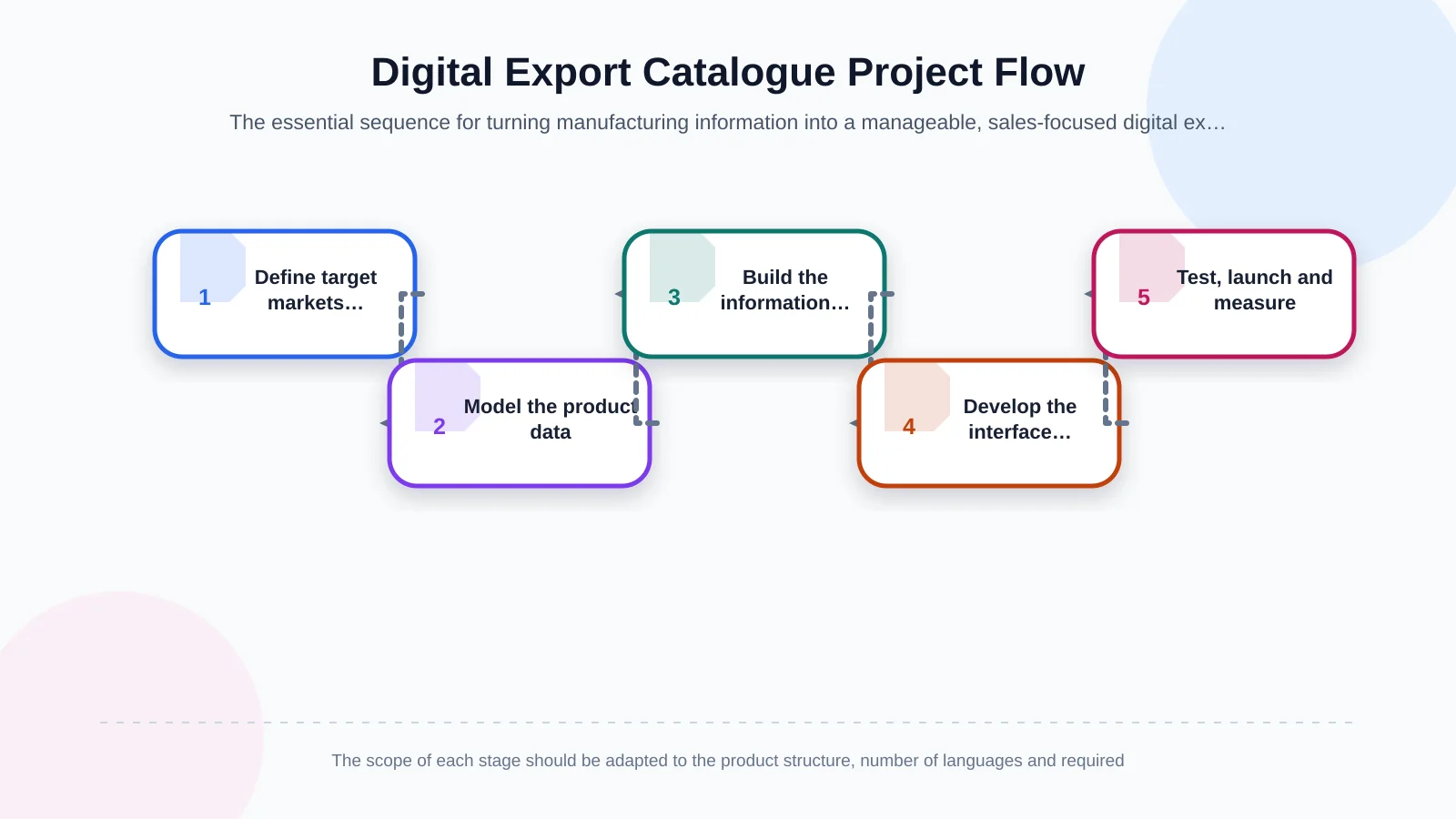
A sound project begins with discovery before interface design. The team identifies target markets, user groups, product data sources, languages, existing content and integration requirements. Information architecture, catalogue logic and core user journeys are then prepared. Once this foundation is approved, the creative concept, interface design and custom development can proceed.
Content migration often exposes incomplete or inconsistent product fields, so data cleaning should be included in the schedule. After development, the website must be tested across devices and browsers, including filters, search, forms, languages, redirects and administrative roles. Launch is not the end of the project: it begins the ongoing work of measurement, content maintenance, security updates and performance improvement.
Questions to answer before work begins
- Which countries, languages and buyer profiles have priority?
- How will products be organised into categories, collections and variants?
- Which technical attributes should be searchable or filterable?
- Who is responsible for keeping imagery, translations and documents current?
- Which team, CRM platform or workflow should receive quotation requests?
- Will success be measured through visits, product views, document downloads, qualified enquiries or a combination of these indicators?
The right digital structure makes manufacturing strength visible
An effective website for a textile or apparel company combines a distinctive creative concept with clear information architecture, manageable product data and reliable technical infrastructure. The result should not merely be an attractive corporate website. It should become a sustainable export channel through which international buyers can assess products, understand the manufacturer’s capabilities and send a well-contextualised request to the sales team.
Kumsal Agency is an Istanbul-based digital agency that brings together corporate web design, custom web development, digital design, brand consultancy and integration expertise. Its approach to textile projects focuses on presenting export capabilities clearly, making product information accessible, delivering fast experiences across devices and giving internal teams practical control over content.
To plan a multilingual corporate website and manageable digital export catalogue around your textile or apparel company’s requirements, content structure and integration needs, contact Kumsal Agency.