


Aydınlatma metni yükleniyor…
For manufacturing, wholesale or product-led businesses looking for web design in Bağcılar, the first question should not be “What should the site look like?” It should be “How will a buyer find the right product and request a quotation from the right sales owner?” A catalogue can appear organised yet fail commercially when product count, technical attributes, minimum order rules, buyer types, languages, availability and pricing policy remain undefined.
This guide does not assume that every Bağcılar business operates B2B. It offers a distinct decision model for organisations that need catalogue and quotation workflows. Local service, appointment-led or corporate communication projects require a different scope.
Why may Bağcılar require a catalogue-and-quotation approach?
The official Bağcılar District Governor profile describes textile, food, stone and soil, metal and printing industries alongside workshops, businesses and trade centres. The same official page says that İSTOÇ includes approximately 35 occupational groups (Bağcılar District Governor: Economy). These facts do not prove that every organisation follows one sales model. They explain why product classification, technical information and quotation journeys may matter more than a generic corporate brochure in some projects.
Repeating “web design in Bağcılar” does not complete that buyer task. If users cannot locate a product family, verify technical fit or understand who receives their request, the website does not support the underlying procurement journey.
A B2B catalogue is not automatically an e-commerce store
A B2B catalogue organises products, presents technical information and moves suitable demand into a sales process. It does not always require public prices and online payment. Quotations may fit better when price depends on customer type, volume, destination, currency, lead time or contract terms.
E-commerce commonly manages basket, price, stock, payment, delivery, returns and order status directly in the website journey. Some projects combine both: standard items can be purchased online while custom production or higher-volume orders move into a quotation workflow.
Answer these questions before selecting the model:
- Is the price public or dependent on customer and quantity?
- Is the item held in stock or made to order or dimension?
- Does the buyer need technical approval or a sales conversation before payment?
- Are minimum order, destination or customer-type restrictions involved?
- Is the transaction completed on the website, in a B2B portal, in ERP or through a sales representative?
How should product information architecture be built?
Categories should follow how buyers identify products, not internal department names. A product may be found by application, material, dimensions, capacity, compatibility, industry or certification. The project therefore needs a search and filter vocabulary as well as navigation.
Define a data dictionary for every product or product family:
- Product name, code and category relationships
- Concise use description
- Technical attributes and units
- Variants, dimensions, colours or materials
- Compliance, standard and certification information
- Data sheets, instructions or safety documents
- Authentic product media and usage rights
- Availability, lead time or “request a quote” status
- Related products, accessories and alternatives
- Locale-specific content and update owner
Do not import fragmented spreadsheets, ERP exports or legacy records before checking fields, units, categories, duplicates and missing data. A clean interface cannot repair unreliable source information by itself.
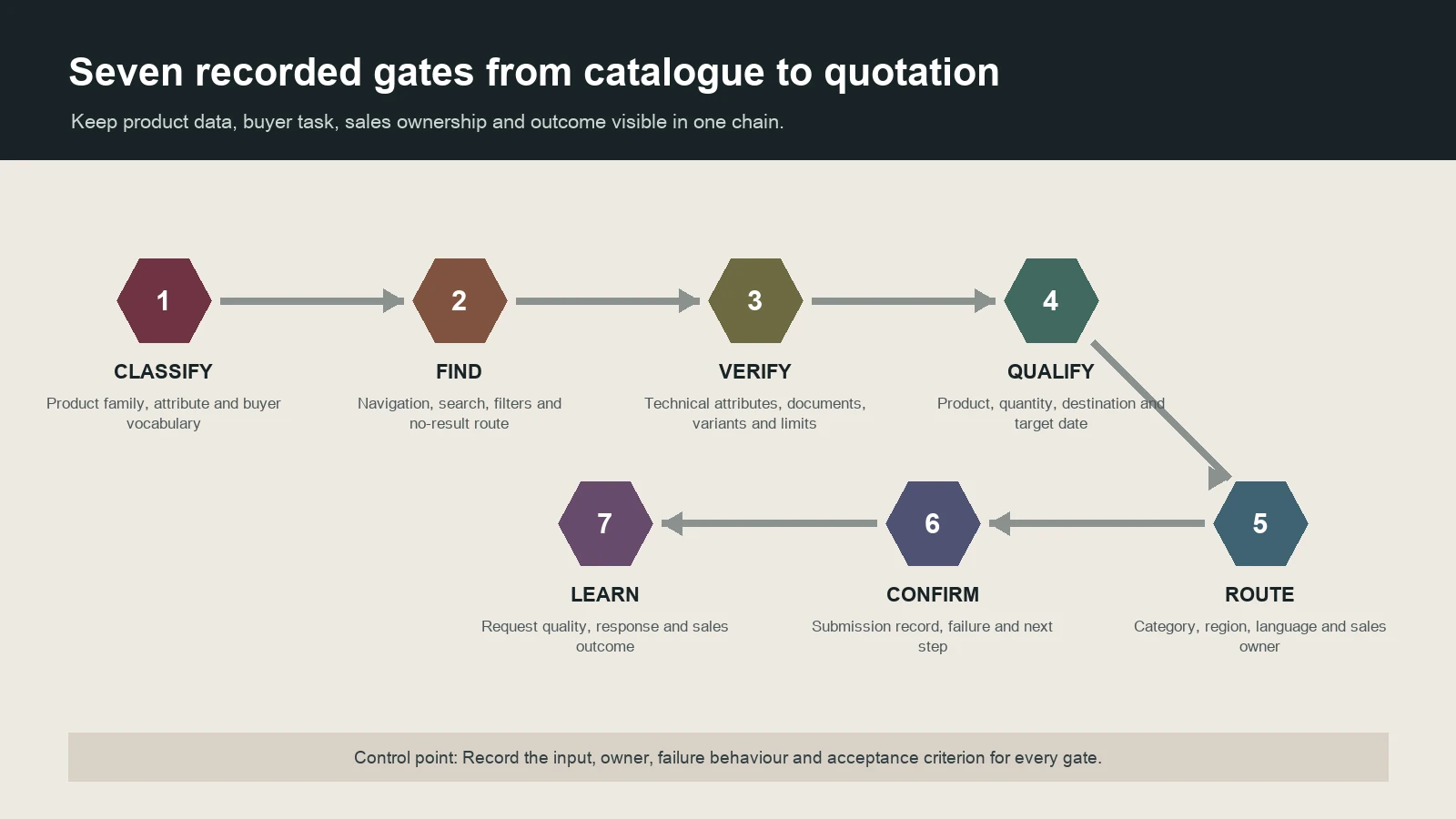
The Kumsal seven-gate catalogue-to-quotation flow
1. Classify
Map product families, attributes and the terms buyers use. Prevent the same item from being created repeatedly under different names.
2. Find
Define which queries navigation, on-site search and filters must handle. If no result exists, provide a relevant category or contact route instead of a dead end.
3. Verify
Present the technical attributes, documents, variants and limitations needed for a decision. Do not publish unverified claims about certification, stock or capacity.
4. Qualify
A quotation form may need more than name, phone and message. Product or code, quantity, unit, destination, target date, customer type and supporting files can help the sales team assess the request. Collect only data that will actually be used.
5. Route
Send the request to the correct owner by category, region, language or customer type. Provide a fallback when email notification, CRM creation or task assignment fails.
6. Confirm status
Clearly show whether submission succeeded. Explain the next step without promising a response time that has not been approved. Record repeated submissions and file errors.
7. Learn
Measure more than form count. Review product family, request quality, routing errors, response and sales outcome where records allow it. Traffic data alone does not guide improvement when it is disconnected from sales records.
The original value of this chain is to treat the website not as an isolated catalogue but as a controlled transition between product data, buyer task, sales ownership and measurement.
Which fields belong in a quotation form?
The field set depends on product and sales rules. A discovery list may include:
- Relevant product or category
- Product code or selected variant
- Quantity and unit
- Delivery country/city or service area
- Target date or lead-time expectation
- Organisation and customer type
- Contact and verifiable business email
- Drawing, list or specification upload
- Notes and special requirements
- Required notices, consent choices and retention information
A longer form does not automatically create a better lead. Do not request fields that sales will not use or personal data without a defined need. File upload also requires type and size limits, malicious-content controls, access permissions and a retention rule.
How should multilingual and international buying journeys work?
The English locale should not be a literal translation of Turkish. Product names, units, certificates, delivery terms and form options should match the target buyer's language and process. If a product does not exist in every locale, the language control should follow an intentional coverage rule rather than sending users to an unrelated home page.
Assign owners for translation and technical terminology approval. Document language-specific files, currency, country fields, phone formats, destinations and sales routing as part of scope.
When are ERP, CRM and inventory integrations needed?
When website product, customer or quotation data is managed elsewhere, identify the system of record. Integration discovery should answer:
- Which system publishes product and category information?
- Are stock, price and lead time updated in real time or periodically?
- Which CRM object does a quotation request create?
- Who is notified about missing or failed data transfer?
- How are repeated requests matched?
- What do users and sales owners see during an outage?
Not every catalogue needs integration. A controlled management panel may be simpler when the product set is limited and changes infrequently. Dealer prices, permissions, negotiated discounts and ordering workflows may require a deeper B2B software and integration guide.
How does local relevance connect with the product catalogue?
A Bağcılar page should explain genuine service and operating information instead of multiplying neighbourhood names. Physical location, delivery or service coverage, contact information and working model must remain current. Do not imply that Kumsal Ajans has a Bağcılar office, client or local project without verified first-party evidence.
Product pages should not be multiplied merely to capture query variations. When similar items do not differ materially, one family page, variant table or filter structure may be clearer. Create a separate URL only when the item has distinctive attributes, a user task and a maintainable data source.
What should a Bağcılar web design proposal include?
A proposal should specify more than “corporate site + products + form”. It should define:
- Number of categories, product families, records and unique templates
- Data cleaning, mapping, import and manual-entry scope
- Filters, search, comparison and document management
- Quotation fields, uploads, notifications and routing rules
- Turkish/English content and technical-translation responsibilities
- ERP, CRM, inventory, email or other integrations
- Administration roles, approvals and publishing workflows
- Mobile, browser, form, security and acceptance testing
- Handover of source code, data, media, accounts and documentation
- Boundaries between warranty, maintenance, data updates and new development
Use the guide to preparing a website requirements document as the starting record, then apply the website proposal comparison scorecard to every candidate.
Conclusion: Create a recorded handoff between catalogue and sales
A product, manufacturing or wholesale website serving Bağcılar operations should not stop at corporate introduction pages. Product discovery, technical verification, qualified quotation, correct sales routing and outcome measurement need one designed chain.
The existing Turkish and English slugs remain unchanged, so this refresh needs no 301 redirect. Before discussing the project, prepare category and product data, sales-routing rules, locales, integrations and the form fields the team will genuinely use. Those inputs make design and proposal decisions more concrete and comparable.