


Aydınlatma metni yükleniyor…
A career microsite is more than a place to list vacancies. It shapes a candidate’s first impression of the organisation, influences how they evaluate a role and determines whether they can complete an application without unnecessary friction. The project should therefore be planned around shared goals across human resources, employer branding, corporate communications, IT and legal teams.
An effective career site answers “Why should I work here?” with specific, credible evidence while helping candidates reach relevant opportunities quickly. It explains each role clearly, requests only necessary information, communicates application status and makes the journey measurable. Addressing design and software together prevents a disconnect between the employer promise and the experience candidates encounter when they apply.
Why should a career microsite be planned as a distinct experience?
A careers section within the corporate website may be enough for basic information. A standalone microsite becomes more manageable when the organisation serves several candidate groups, publishes many vacancies, produces regular employer-brand content or needs integration with an applicant tracking system. Built as a subdirectory or subdomain under the corporate domain, it can remain connected to the master brand while providing candidate-specific navigation and content architecture.
This structure also makes it easier to create focused landing pages for graduate programmes, internships, field teams, production roles or technology recruitment. The separation should not be purely visual. Vacancy data, application records, analytics, access permissions and content ownership must remain consistent with the organisation’s core systems and governance model.
Define success before the project begins
The objective should not simply be to collect more applications. Useful measures include the proportion of visitors who find a suitable role, the transition from vacancy detail to application, form completion, mobile abandonment points, qualified application rates and the HR team’s processing time. Reviewing these signals together reveals whether higher application volume is actually improving recruitment quality.
How does employer branding make workplace culture visible?
An employer-brand narrative built on generic claims and stock photography offers candidates little help with a real career decision. Culture should be demonstrated through everyday working practices: how teams collaborate, how managers provide feedback, which development opportunities employees can access and how different roles contribute to the organisation’s purpose. Concrete answers build more trust than unsupported statements.
The content may include employee stories, team and workplace life, career development, benefits, working models, diversity practices and recruitment stages. Whenever possible, each claim should be supported by a real person, process, environment or example. Photography, short-form video, interviews and motion graphics create a coherent brand world when developed within one creative framework. At this stage, digital brand consulting can help connect the organisation’s genuine strengths with candidate expectations and establish a consistent communication system.
One candidate persona is not enough
Graduates, experienced specialists, executives, production employees and field staff do not look for the same information in the same order. Research can combine candidate interviews, workshops with current employees, recruitment-team records and on-site search data. The resulting needs should influence the editorial tone, page sequence and calls to action. For international recruitment, plan localisation around each country and role rather than treating the work as a direct translation exercise.
What stages make up the candidate journey?
The journey should feel continuous from the first brand encounter to application confirmation. If a search result or social post makes a compelling promise but the vacancy page lacks practical information, trust declines. Likewise, strong workplace-culture content can be undermined immediately by a long, confusing form that is difficult to use on a phone.
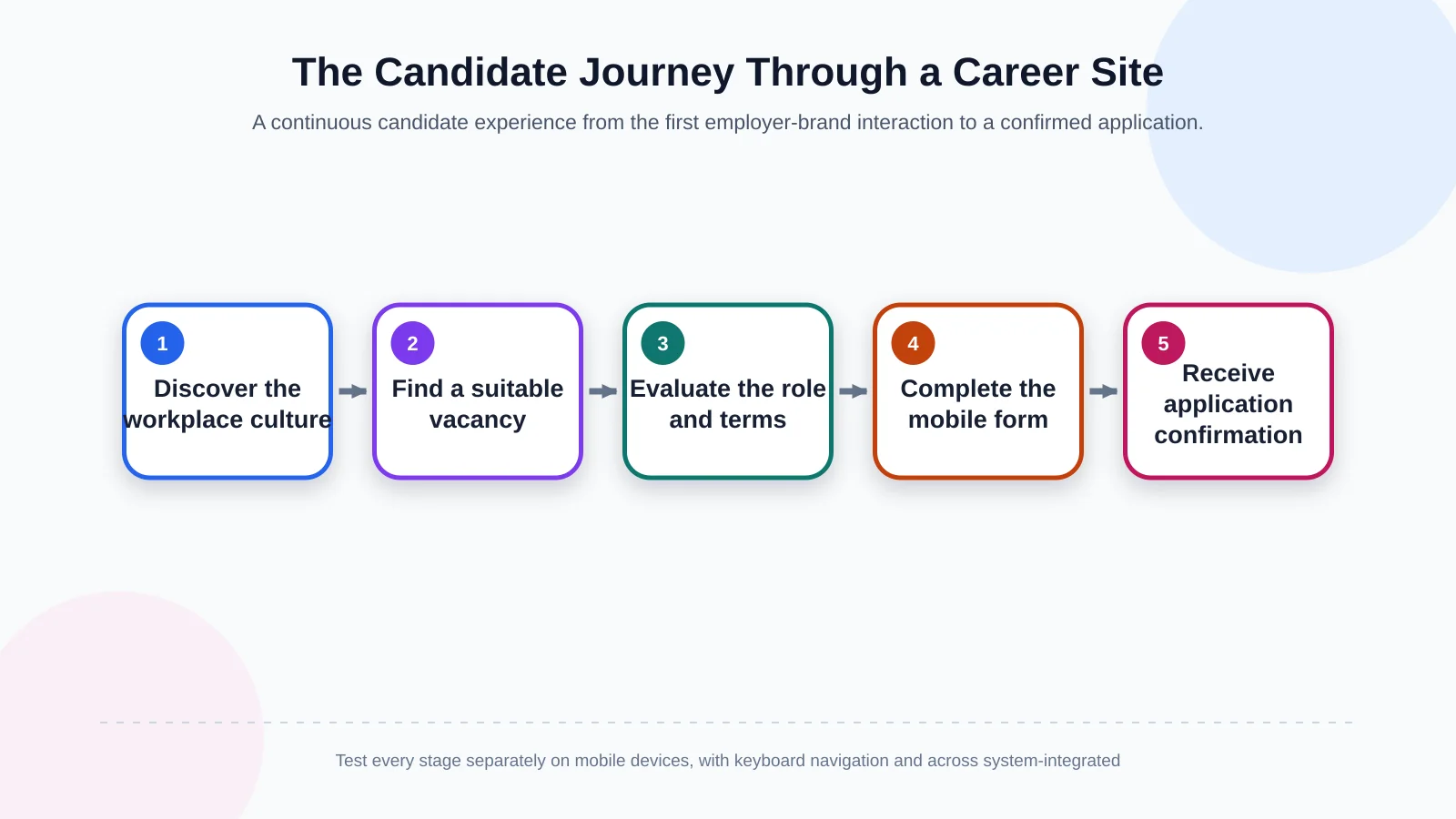
The core flow from discovery to application confirmation
The candidate first learns about the organisation’s culture and working environment. They then use relevant filters—such as discipline, location, working model and experience level—to find a suitable opening. The vacancy detail explains responsibilities, requirements, location, working arrangements and recruitment stages. After completing a concise, relevant form, the candidate receives a clear on-screen confirmation and notification.
Google recommends using JobPosting structured data that matches the visible content on an individual vacancy page. This markup can support discovery in job-search experiences, but it should be used only for genuine, open positions. Expired vacancies must be removed or updated correctly.
How should vacancy listings and job pages be designed?
The listing page should help candidates narrow their options quickly. Search and filters for department, city, working model or experience level should reflect the actual volume and variety of vacancies. Complex filtering is unnecessary when only five roles are available, while a department filter alone may be inadequate for hundreds of openings. A zero-results state should offer useful next steps, such as clearing filters or exploring related positions.
Each vacancy page needs a meaningful title, a concise explanation of the role’s purpose, key responsibilities, required and preferred qualifications, location, working model and a clear application action. Candidate-focused information is more useful than vague job titles or long passages of corporate copy. The application button should be easy to reach on mobile without being repeated so aggressively that it interrupts reading.
Manage the vacancy lifecycle
Define states such as draft, awaiting approval, published, paused and closed. Record the publication date, application deadline, responsible team and source system. If a closed vacancy continues to receive search traffic, do not send candidates to an empty page. Explain that the position has closed and present relevant current openings where appropriate.
How can friction be reduced in a mobile application form?
Ask only for information genuinely needed for the recruitment decision or subsequent communication. A name, contact details, selected role and CV may be sufficient for the first stage; role-specific questions can appear conditionally. Requiring candidates to repeat information already contained in their CV across many fields can reduce completion. If the process must be long, consider a progress indicator and secure save-and-resume functionality.
State accepted file types and size limits before upload, and make every error message explain how to resolve the problem. The form should work with a keyboard, retain visible field labels and never communicate success or failure through colour alone. The W3C’s WCAG 2.2 guidelines provide a practical foundation for keyboard access, identifying input purpose, error assistance and status messages.
The success screen is not the end of the process
After submission, candidates should see which role they applied for, confirmation that their application was received and what they can expect next. The email notification should communicate the same information, avoid unnecessary personal data and explain the appropriate response channel. If a system error occurs, provide a safe retry mechanism and technical logging rather than forcing the candidate to complete the entire form again.
Application data, user roles and integrations
A career microsite rarely operates in isolation. Vacancies may originate in an applicant tracking system, HR platform or administration panel, while applications may need to be transferred to another system. A project-specific web development solution can align field mapping, user roles, approval rules, error logging and integration responsibilities with the organisation’s actual recruitment process.
HR specialists, hiring managers, content editors, system administrators and report viewers should not have identical permissions. Under a least-privilege model, each role receives only the ability to view, export or change the data required for its work. Critical actions should produce an audit trail, while failed integrations should enter a visible exception queue instead of disappearing silently.
Define integration scope field by field
“ATS integration” is not a sufficient specification. Document where vacancies are created, which fields move in each direction, synchronisation frequency, duplicate-candidate rules, attachment storage and retry behaviour after an error. If no API is available, assess any alternative method together with its security implications and ongoing maintenance cost.
How should KVKK, GDPR and data security be addressed?
Candidate information should be assessed through a data inventory during design—not after launch. Define what is collected, why it is required, the applicable legal basis, retention period, authorised roles, service providers and deletion process. Provide the relevant privacy notice at an accessible point in the form, and do not make unnecessary consent a condition of applying. The organisation’s legal advisers should review the actual process and its legal interpretation.
The Turkish Personal Data Protection Authority’s decision concerning the unlawful sharing of personal data processed during a job application shows that transfers between data controllers within the same group of companies also require separate consideration. Shared talent pools, referrals to group companies and access by external providers should therefore not be treated as automatic defaults.
- Apply appropriate encryption in transit and at rest.
- Use role-based access and strong authentication in administration interfaces.
- Create deletion or anonymisation workflows for records reaching the end of their retention period.
- Avoid storing unnecessary candidate data in logs.
- Align backup retention and restoration rules with the main system.
Performance, accessibility and measurement should be planned together
High-resolution employee videos and animation can enrich the employer story, but they harm the candidate experience if they make pages slow on mobile connections. Serve images in appropriate formats, load video deliberately and avoid making critical content dependent on heavy client-side processing. Test page speed, form behaviour and file uploads on real devices and realistic networks.
The measurement plan should track behavioural steps without sending personal data to analytics tools. Events might include vacancy views, filter use, application starts, validation errors and successful submissions. CV filenames, email addresses, phone numbers and free-text responses must not become analytics parameters. Reports segmented by device, vacancy family and traffic source can expose genuine opportunities for improvement.
| Layer | Check | Evidence of success |
|---|---|---|
| Performance | Test vacancies and forms on a mobile network | Critical content becomes usable without delay |
| Accessibility | Verify keyboard access, labels and error messages | The application can be completed without a mouse |
| Measurement | Track start, error and success events | Funnel losses can be reported |
| Privacy | Audit analytics parameters | Personal data is not sent with events |
Career microsite project plan
A sound scope covers research, information architecture, content and production, interface design, technical development, integration, testing and post-launch improvement. Every phase needs a decision owner, deliverables, acceptance criteria and documented dependencies. The vacancy-data source and the destination system for candidate records should be confirmed before interface design begins.
Kumsal Agency combines Art Director-led creative direction, research-based consulting and bespoke software to approach a career microsite as a sustainable digital product. Its brand-specific web design process brings culture, candidate journeys, mobile applications, accessibility and technical requirements into one coherent experience.
Pre-launch acceptance criteria
- Can a candidate find a suitable role and complete an application on a mobile device?
- Are vacancy publication, updates and closure consistent with the source system?
- Are form errors understandable and accessible by keyboard?
- Does each application reach the target system with the correct role and source data?
- Are unauthorised roles prevented from viewing or exporting candidate information?
- Are measurement events reported without personal data?
Turn employer branding into an application experience that works
The value of a career microsite comes from consistency between the promise and the process, not from an attractive showcase alone. Authentic culture content brings candidates closer to the organisation; clear vacancy architecture, a concise mobile form, secure data flows and useful feedback help them complete their application. A manageable platform and considered measurement plan allow the experience to keep improving after launch.
Plan the requirements, content architecture, candidate journey and integration scope of a career microsite suited to your employer brand and recruitment process together with Kumsal Agency.