


Aydınlatma metni yükleniyor…
For an OEM or ODM manufacturer, the first stage of growth is often built on capacity, quality, lead times and cost efficiency. The rules change, however, when the company enters international markets under its own brand. Manufacturing excellence is no longer enough on its own. The business must explain why buyers should choose it, provide credible evidence that it can reduce commercial and operational risk, and create a consistent impression across every customer touchpoint.
Moving from contract manufacturing to a global brand is not simply a matter of redesigning a logo or launching an English-language website. It is a strategic transformation involving market selection, customer insight, value proposition, brand architecture, creative direction, digital experience and sales operations. When these elements are planned together, manufacturing capability can evolve from a comparable supplier service into defensible brand value.
Why is the transition from OEM and ODM to a branded business difficult?
An OEM manufactures according to specifications defined by its customer, while an ODM may assume greater responsibility for design and product development. Both models help companies develop technical knowledge, quality systems and operational discipline. Yet customer insight, channel management, brand investment and marketing communication usually remain the commissioning company’s responsibility.
A manufacturer launching its own brand is therefore doing more than opening another sales channel. It must develop new capabilities and redefine which portfolio matters to each segment, which benefits deserve emphasis, how distribution will work and who will own after-sales service. The possibility of competing with existing OEM customers should also be assessed by country, product category and channel.
A common mistake is assuming that the market will automatically recognise the factory’s strengths. High capacity, advanced machinery and decades of experience are valuable, but they do not create a clear position until buyers can connect them to their own priorities. Technical attributes must be translated into outcomes such as reliable delivery, lower total cost of ownership, regulatory compliance, faster customisation or reduced supply risk.
In what order should the transition strategy be built?
Brand development should begin with commercial choices, not creative design. Trying to reach every country and customer at once spreads the budget too thin and makes learning difficult. The management team should first agree on the priority market, ideal customer profile and product family that offer the strongest strategic fit.
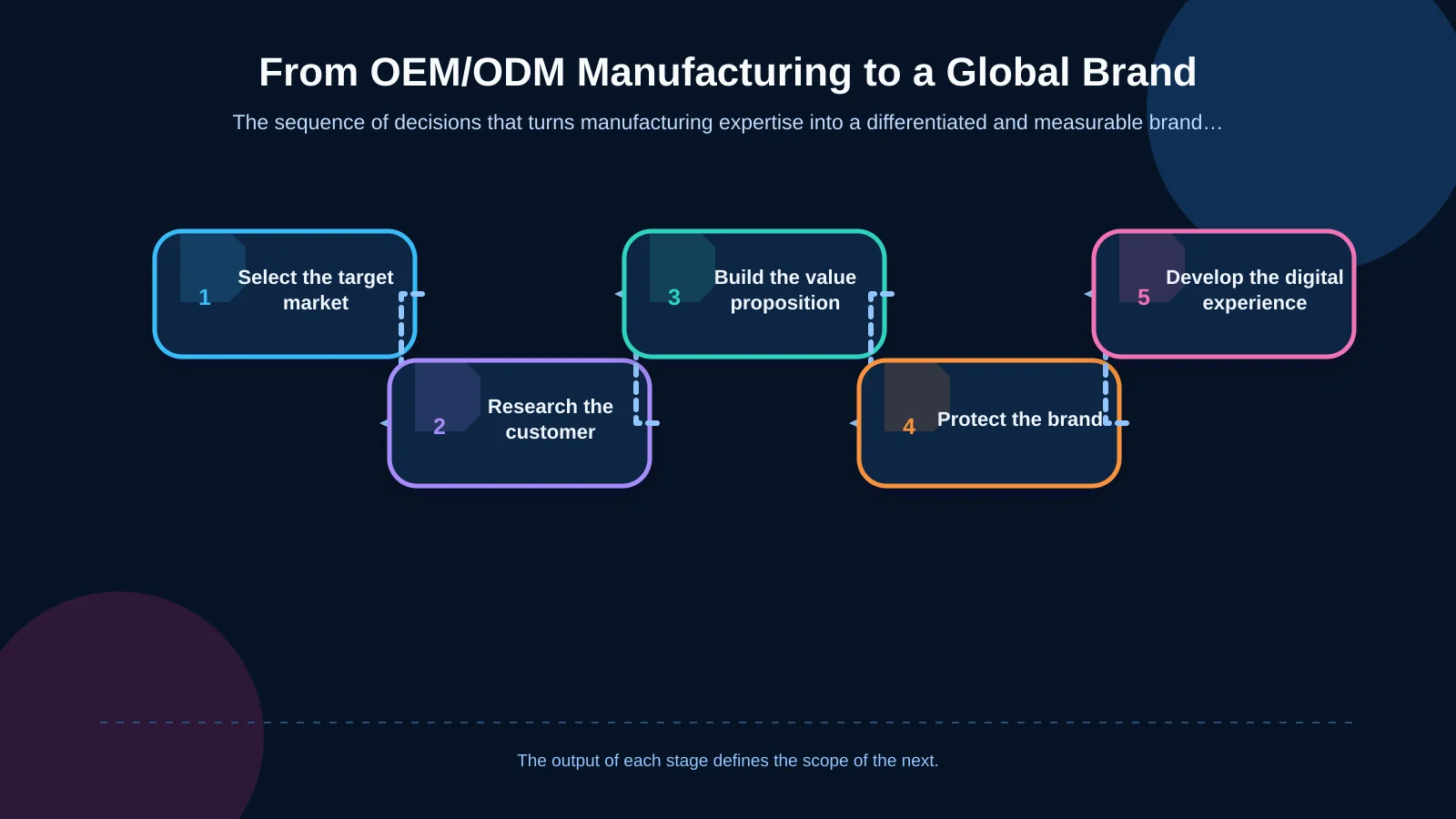
1. Define the strategic objective and boundaries
Clarify what the new brand is expected to achieve. Is the goal to improve margins, reduce dependence on OEM contracts, enter a new region or commercialise proprietary product-development expertise? Document the three-year revenue ambition, investment appetite, channel model and potential conflicts with existing customers. Brand building should be governed as part of company strategy, not as an isolated communications project.
2. Research the market and buying committee
Country selection should not depend on market size alone. Competition, logistics, customs, certification requirements, service expectations, pricing levels and channel structure must be assessed together. The US International Trade Administration’s guidance on conducting international market research also recommends evaluating whether a product remains competitive after its delivered cost is considered.
B2B purchases are rarely decided by one person. Engineers may prioritise performance and compliance; procurement may focus on cost and continuity; senior management may examine risk; and distributors may care about margins, availability and sales support. Research can combine interviews with existing customers and distributors, reviews of lost quotations, competitor analysis and workshops with sales teams. The resulting message will answer real buyer questions instead of reflecting internal assumptions.
3. Define the value proposition and brand position
A strong position explains whom the company serves, which critical problem it solves, how it differs from alternatives and what evidence supports the claim. Statements such as “high-quality, innovative products” are too generic to own. Rapid engineering adaptation for a specific industry, traceable production or scalable supply with low minimum-order quantities can provide a more concrete reason to choose the brand.
The positioning statement does not have to become a public slogan. Its primary role is to guide product decisions, content, sales presentations and the website experience. Certifications, test results, delivery data, case studies, warranties and technical expertise should form a verifiable set of reasons to believe.
4. Plan brand architecture and intellectual property
Define the relationship between the corporate name, the new product brand and individual product families before launch. A unified brand may accumulate trust more quickly, while sub-brands can separate offers aimed at distinct segments. Unnecessary proliferation, however, increases both investment and management requirements. Before selecting a name, review linguistic associations, domain availability, social handles and similar trademarks in target countries.
Brand protection should not be postponed until after launch. WIPO’s Guide to the Madrid System explains the structure of international trademark registration and the requirements affecting trademark owners. Working with a qualified trademark professional can help align the classes and territories included in an application with the commercial plan.
5. Build the digital experience, demand path and sales flow
The website must do more than act as a corporate brochure. It should help visitors navigate by industry, application or product family; examine technical documentation; understand compliance, capacity and delivery practices; and contact the sales team with sufficient context. Achieving this requires coordinated decisions about information architecture, content, user experience, mobile behaviour, performance and accessibility.
Forms should capture more than a name and email address. Country, product interest, estimated volume, intended application and communication consent can help sales teams qualify enquiries. Ownership rules, response-time tracking and duplicate management should be designed as part of website–CRM integration and sales follow-up, rather than added after launch.
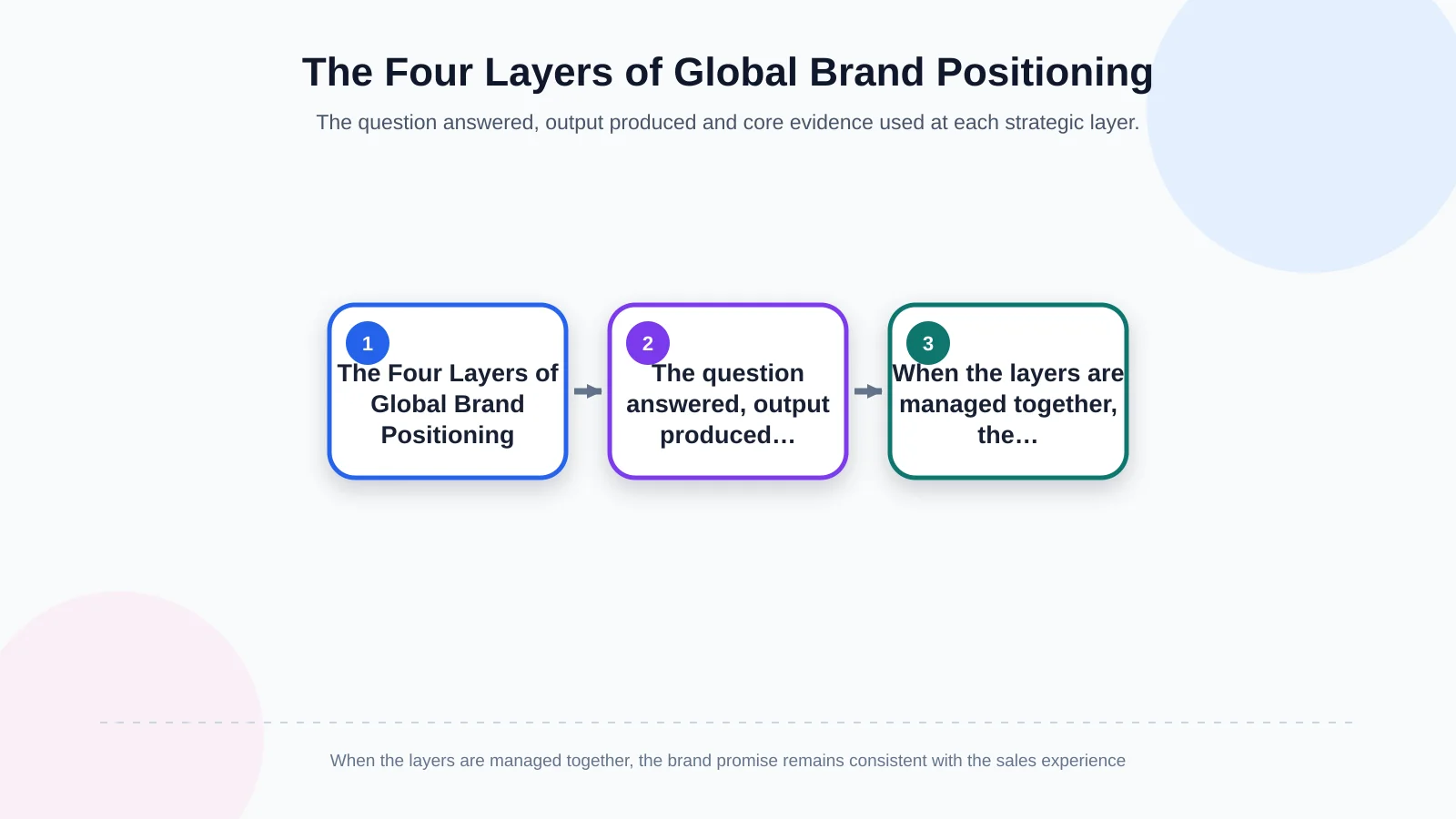
The four layers of global brand positioning
A coherent global brand is not built around a single message. It consists of four mutually reinforcing layers. If these layers conflict, even powerful advertising and polished interfaces will struggle to establish lasting trust.
| Layer | Core question | Primary output | Evidence |
|---|---|---|---|
| Market focus | Whom do we create value for? | Ideal customer and offer | Market interviews |
| Trust architecture | Why should buyers believe us? | Evidence system | Tests, certificates and cases |
| Creative direction | How will buyers recognise us? | Identity and communication system | Consistent touchpoints |
| Digital infrastructure | How will we manage demand? | Multilingual experience | Performance and conversion data |
Market focus and value proposition
The first layer determines where the brand will compete. It defines the target industries, organisation sizes, decision-making roles and high-value problems the company intends to solve. Product features are translated into outcomes that customers can recognise or measure. During localisation, the central brand promise remains consistent, while evidence, use cases and commercial messages are adapted to the market.
Evidence system and trust architecture
B2B buyers seek to reduce uncertainty. Displaying a row of certification logos is therefore insufficient. The website and sales materials should explain which product or facility each certificate covers, how quality control works, what is traceable, how testing is performed and who assumes responsibility after delivery. Whenever possible, case studies should follow a clear structure: the customer problem, the implemented solution and the verifiable outcome.
Creative direction and communication system
A visual identity should communicate more than the scale of a factory. Colour, typography, photography, technical illustration, motion and interface components must support the intended position. Under Art Director leadership, the creative concept should become a practical system that works across the website, trade-fair materials, product presentations, social content and distributor documents. The verbal tone must likewise balance technical accuracy with commercial clarity.
Digital infrastructure and governance
A multilingual presence involves far more than automatically translating text. Product availability, measurement units, regulatory documents, contact details and calls to action may need market-specific management. Google recommends using separate URLs for language versions and connecting equivalent pages with hreflang annotations. Content ownership, approval workflows, translation updates, data security, backups and integration responsibilities should also be established before publication.
What content should a global B2B website include?
The homepage should communicate who the brand is within seconds without forcing every technical detail into one screen. Industry and solution pages establish customer context; product pages support technical selection; capability pages explain manufacturing and engineering strengths; and case studies provide evidence.
Priority industries, applications and operating environments
Product families, technical specifications and downloadable documents
Research, design, prototyping and customisation capabilities
Quality-control processes, certifications and traceability practices
Production capacity, facilities and supply-continuity measures
Case studies, references and verifiable performance evidence
Dedicated distributor, project-enquiry and quotation flows
The SEO strategy should extend beyond broad product names. Topic clusters can address industry, application, material, standard, problem and solution intent. Each page should answer a distinct question and lead the visitor towards a relevant technical document, product, case study or qualified enquiry step. Product information also needs clear ownership so that specifications, documents and localised content remain consistent across channels.
Which indicators measure branding success?
Revenue alone can be misleading during the early stages because brand and channel investments may take time to influence sales. Management should monitor leading and outcome indicators together. A shared scorecard might include qualified enquiries from target markets, quotation acceptance, sales-cycle length, organic visibility, distributor applications, repeat visits, technical-document engagement and branded searches.
Measurement must lead to decisions. If traffic grows in a target market but enquiries remain poorly qualified, the team should review search intent, content or form design. If quotations stall, the cause may involve certification, delivery, service or access to the true decision-maker rather than price alone. Quarterly reviews allow messages, channels, content and product priorities to evolve in response to evidence.
A practical roadmap for management teams
Begin by bringing management, export, sales, marketing, product and production teams together. Document current capacity, the most profitable products, priority countries, customer perceptions and operational constraints. Use research findings to agree on the ideal customer profile, positioning, brand architecture and evidence system.
Next, develop the digital position, creative direction, experience principles and communication system. Build the multilingual corporate website around an original creative concept, structured content model, user journeys and necessary integrations. Before launch, test mobile use, performance, forms, analytics, redirects, accessibility and data-security responsibilities.
The final stage is continuous management. Feed objections from sales conversations into the content plan, search behaviour into product pages and distributor feedback into local messaging. The brand then becomes more than a static identity manual: it becomes a commercial system that develops through market learning.
Turn manufacturing strength into global brand value
An OEM/ODM background is not a disadvantage. Presented correctly, it provides a strong foundation of evidence. Engineering discipline, quality control, flexibility and delivery experience can become a competitive advantage when combined with a deliberately selected market, a clear value proposition and a coherent digital experience.
Based in Istanbul, Kumsal Agency brings research-led digital brand consulting, Art Director-led creative direction and project-specific technical development into one roadmap. Its work connects positioning, digital identity, multilingual corporate web design, custom software and necessary integrations around real business goals and user needs, with attention to data security, sustainable management and robust software infrastructure.
Plan the digital roadmap that will turn your OEM/ODM capabilities into strong, consistent brand value in global markets with Kumsal Agency.