


Aydınlatma metni yükleniyor…
In B2B companies, corporate culture, manifestos and brand values often remain confined to presentations, onboarding documents or a handful of generic statements on an About page. Yet customers, business partners, candidates and investors encounter the brand first through its website, social channels, email communications, campaigns, customer portals and videos. If a company claims to value transparency, innovation or people, audiences expect to see evidence of those principles in its content, design and behaviour.
Translating culture into digital experiences is therefore not a matter of copying existing values onto a webpage. The real task is to turn abstract ideas into messages, proof points, visual principles and interaction patterns that audiences can understand and test for themselves. A successful system communicates who the company is while supporting practical tasks such as evaluating a supplier, requesting a proposal, applying for a role or accessing post-sale support.
Corporate culture, manifestos and brand values are not the same thing
Although closely connected, these concepts perform different roles in a digital brand system. Corporate culture is how an organisation makes decisions and works from day to day. Brand values define the principles the company aims to protect and the way it promises to treat stakeholders. A manifesto expresses why the company exists, what change it believes in and what future it wants to help create, usually through a more narrative and aspirational voice.
Collaboration, for example, may be a brand value. Its cultural expression could be multidisciplinary teams working directly with customers. Its digital expression might include a clearly explained project process, visible specialists, accessible contact channels and transparent next steps after an enquiry. Without these connections between idea, behaviour and experience, values become interchangeable slogans.
Turn values into observable behaviours
For every value, ask: “What behaviour makes this principle visible inside the company and in customer relationships?” The next step is to identify content that proves that behaviour. Innovation should not be represented solely by futuristic technology imagery; it can be demonstrated through research methods, developed solutions, process improvements and expert perspectives. Sustainability requires verifiable targets, practices, reports and progress indicators.
- Transparency: clear processes, understandable scope, named responsibilities and accessible communication.
- Expertise: detailed case studies, visible team capabilities and useful technical content.
- Reliability: consistent information, credible evidence and content that is actively maintained.
- People-first thinking: plain language, accessible experiences and authentic employee stories.
Why culture matters strategically in the B2B digital experience
B2B purchasing decisions often involve lengthy evaluation, several decision-makers and significant perceived risk. Prospective customers assess more than a product or service: they also want to understand the organisation they may be working with. Candidates investigate the working environment, suppliers look for operational expectations, and investors consider leadership and governance. The same culture must therefore be communicated to different stakeholders through evidence relevant to their questions.
Nielsen Norman Group’s research into corporate websites found that people expect information about a company’s purpose, values and history to be easy to find, understandable and credible. Complicated corporate language and generic stock imagery can weaken trust. The research also notes that users compare a company’s own story with information from third parties. Authentic stories, real images of employees and workplaces, and consistency across channels consequently matter. Further observations are available in Nielsen Norman Group’s research on About Us information.
Trust is not simply a corporate claim; it is the accumulated result of visible actions. The Edelman Trust Barometer also draws attention to the need for organisations to understand stakeholders’ economic and social realities, create shared benefit and demonstrate results. For digital brand teams, this means connecting manifesto language to genuine stakeholder needs before making ambitious promises. The research framework is presented in the 2025 Edelman Trust Barometer.
From research to a sustainable system: implementation steps
Translating culture into digital channels should not be reduced to a one-off design exercise. It requires a research-led process involving brand, marketing, corporate communications, human resources, sales and digital transformation teams. Their combined input helps expose gaps between the values communicated externally and the experience people encounter inside the organisation.
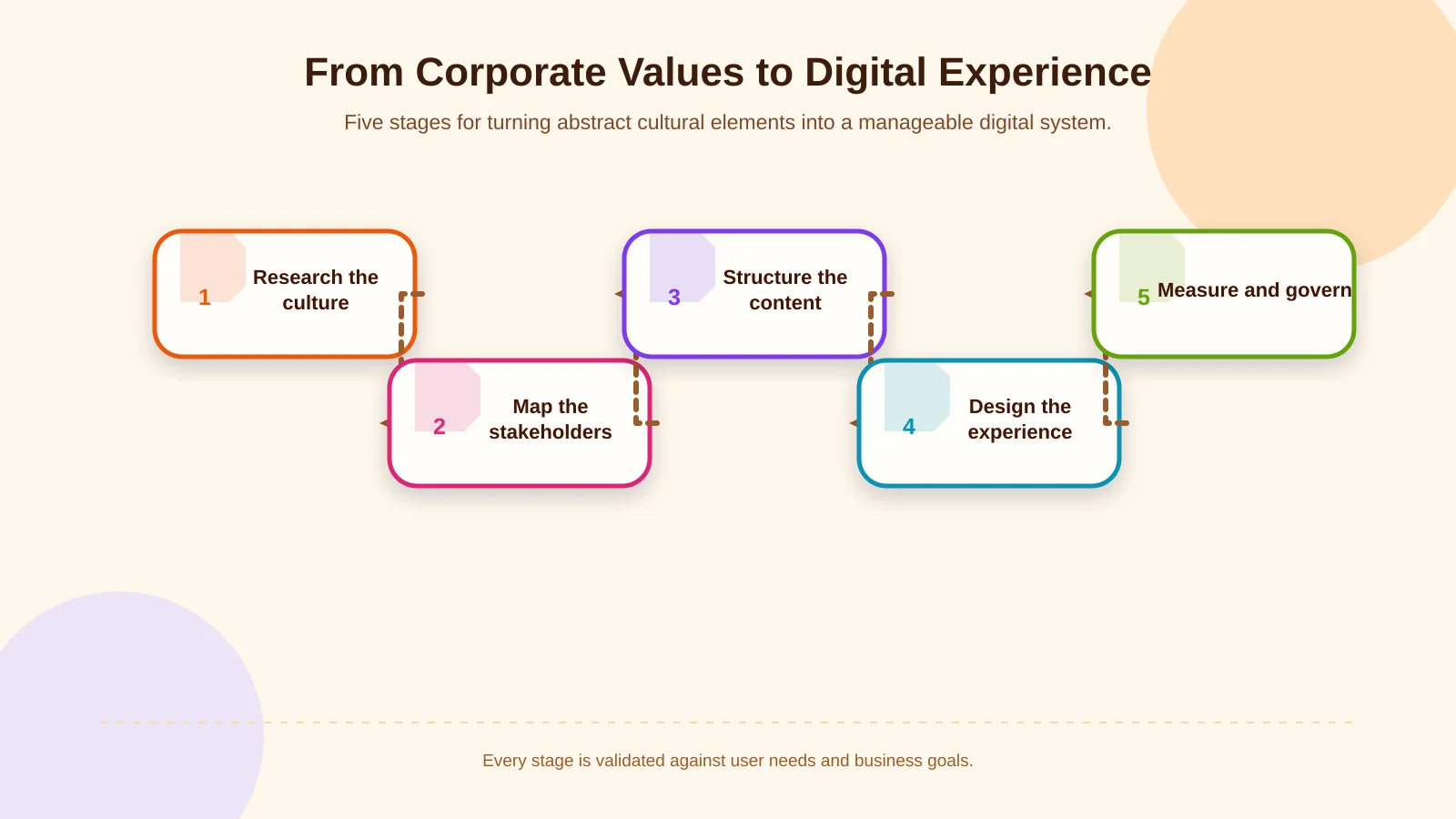
1. Investigate current perceptions and business goals
Begin by reviewing brand documents, the manifesto, value statements, previous campaigns, sales presentations, employee communications and existing digital channels. Leadership interviews reveal strategic intent; employee interviews show how culture operates in practice; customer and stakeholder research uncovers external perceptions. Competitor analysis can then identify repetitive category language and credible opportunities for differentiation.
2. Match stakeholder questions with content evidence
Each audience looks for cultural signals in a different context. A procurement manager may prioritise process reliability, a technical decision-maker may seek evidence of capability, and a candidate may focus on development opportunities. Map these questions to relevant user journeys and support every claim with an appropriate form of evidence, such as a case study, process explanation, employee account, certification, dataset or original production.
3. Build content architecture around user tasks
Do not confine culture to an Our Values page. Distribute relevant evidence across the homepage, services, projects, careers, sustainability, leadership and contact areas. Establish a clear hierarchy, contextual routes between related pages and consistent terminology. Users should encounter the right cultural proof while completing a real task, rather than having to leave their journey to decode a separate corporate statement.
4. Design the visual and interactive system
Connect colour, typography, photography, illustration, motion and interface components to the organisation’s cultural characteristics. A fast-moving B2B technology company and an engineering business built around precision and assurance should not automatically use the same animation pace or imagery. A brand-specific creative concept should establish coherent personality and behaviour, not merely decorative difference.
5. Publish, measure and govern
A system can become outdated quickly unless content ownership, approval workflows, review intervals and quality criteria are defined. After launch, assess usability, page interaction, qualified form conversions, content findability and candidate feedback. Feed the findings into a regular improvement cycle and update the cultural narrative as the organisation changes.
Value-to-digital-experience translation matrix
It is useful to examine every value through four layers: the claim, its evidence, the expected experience behaviour and the content format. This prevents a principle from remaining only a headline. It instead becomes something users can see, understand and assess.
Agility, for example, is not demonstrated through excessive animation. It can be expressed through fast access to information, clearly defined project stages and promptly updated content. Customer focus requires more than a strip of client logos; sector-specific scenarios, understandable contact options and content paths organised around customer needs offer stronger experiential proof.
The matrix should remain specific to the organisation. Teams can use it during content planning and design reviews to test whether each prominent claim is supported by evidence and whether interface decisions reinforce or contradict the intended value.
| Brand value | Evidence | Experience behaviour | Content example |
|---|---|---|---|
| Transparency | Clear processes and named owners | Predictable guidance | Process explanation |
| Expertise | Case studies and expert perspectives | Easy access to in-depth knowledge | Project story |
| People-first thinking | Authentic employee experiences | Clear and accessible interaction | Employee video |
| Reliability | Current and verifiable information | Consistent cross-channel experience | Documents and references |
How information architecture and UX make values visible
Information architecture reconciles what an organisation wants to say about itself with what users actually want to learn. Internal teams often structure websites around departments, while visitors arrive with questions such as “What does this company do?”, “Does it understand my sector?”, “How does it work?” and “Who should I contact?” Navigation, page hierarchy and calls to action should follow these questions.
User experience principles can turn values into practical standards. Clarity requires concise copy, predictable menus and explicit feedback after form submission. Inclusion becomes visible through keyboard access, sufficient contrast, descriptive links, captions and useful alternative text. W3C recommends connecting accessibility to objectives, responsibilities and monitoring from the beginning of a project, with early and regular evaluation throughout implementation. This approach is explained in the W3C Web Accessibility Initiative guidance.
Performance and mobile behaviour also communicate values. A company that speaks about efficiency but operates a slow, confusing website creates a credibility gap. Likewise, a brand that promotes openness yet hides contact options behind unclear interfaces undermines its own promise. Cultural principles should therefore inform acceptance criteria for content, design and development—not simply campaign messaging.
Why original visual language and production matter
A company claiming authenticity can weaken its cultural message if it relies entirely on generic stock photography without showing its people, environment or working practices. Original photography and video can reveal team interaction, specialist knowledge, production methods and the scale of operations. Animation and motion design can communicate the central idea of a manifesto progressively, without depending on a long block of text.
Every production should begin with a content objective. Which value does an image prove? Which audience is it addressing? Where will it be used? A carefully planned shoot can produce adaptable assets for a website, recruitment communication, social content and sales presentations, improving both consistency and long-term value. Visual selection should represent the organisation honestly and avoid a contradiction between staged behaviour and real culture.
Production choices should also account for accessibility and performance. Videos need captions and understandable controls; meaningful images require alternative text; decorative motion should not obstruct reading or navigation. Image formats, dimensions and loading behaviour must be planned so that a rich visual identity does not compromise the experience it is meant to strengthen.
A governance model for sustainable digital communication
The work does not end when a website goes live. A digital brand guide is needed so different teams can use culture and values with the same meaning. It should extend beyond logo dimensions to include the messaging framework, tone of voice, visual selection principles, motion rules, accessibility criteria and reusable content patterns.
- Assign an accountable team or person to each channel and content type.
- Define which forms of evidence can support each value claim.
- Establish shared terminology for web, social, careers and campaign content.
- Manage interface components and motion rules through a central design system.
- Audit content freshness, accessibility and brand consistency at agreed intervals.
Marketing, human resources and corporate communications should work from a shared content calendar. Claims about employee experience, corporate reputation and customer value need to reinforce one another. Digital transformation teams can support this collaboration through content management, integrations, analytics and appropriate publishing permissions.
Governance should remain practical. Define who can approve sensitive claims, how outdated evidence is flagged, when case studies are reviewed and how regional or multilingual adaptations are checked. A lightweight but explicit workflow reduces inconsistency without turning every update into a slow approval exercise.
Which indicators should be used to measure success?
Page views alone do not show whether culture has been communicated successfully. Measurement should determine whether audiences can find and understand the content and move confidently to the right next step. Usability testing can assess whether people correctly describe the company’s purpose and differentiators. Analytics can show qualified movement from cultural content to services, projects, careers or contact journeys. Candidate research can reveal whether the promised culture matches the actual recruitment experience.
- Accurate user recall of the brand’s purpose and values.
- Findability and task-completion rates for critical corporate information.
- Qualified journeys to service, project, career and contact pages.
- Application suitability and candidate-experience feedback.
- Consistency of messaging, visual language and information across channels.
- Improvement in accessibility, performance and content-quality reviews.
Compare these indicators with a baseline and do not rely only on quantitative data. Customer interviews, usability sessions, sales-team feedback and employee research explain why the numbers changed. The goal is not to prove that a values page attracted traffic, but to understand whether the wider digital experience made the organisation more credible, distinctive and easier to engage with.
Conclusion: Do not merely publish values—turn them into an experience
A strong B2B digital brand experience establishes a connection between what an organisation says and what it does. Research reveals the reality of its culture and stakeholder expectations. Content architecture places evidence in the right context. Visual language and production make personality tangible. User experience principles translate values into interaction behaviours, while governance preserves coherence as the organisation evolves.
Kumsal Agency is an Istanbul-based digital agency that combines brand strategy, design and technology. For B2B companies, it plans research-led digital brand consulting, brand-specific creative concepts and corporate web design, information architecture, user experience, content planning, digital design systems, and photography, video and animation production as connected parts of one digital narrative. To define a research-led roadmap and project scope for carrying your corporate culture, manifesto and brand values across digital touchpoints, contact Kumsal Agency.