


Aydınlatma metni yükleniyor…
A digital agency contract should define more than fees, duration and a service list. It should make ownership of accounts, data, domains, media and source files explicit, together with access, change control and the handover required when the relationship ends. Ambiguity in these areas can stop a migration or critical intervention.
This article is an operational review framework, not legal advice or a ready-to-sign contract. Use it to prepare questions for business, marketing, technical and legal reviewers. Obtain qualified advice for the applicable jurisdiction, sector and data-protection rules.
Connect the Brief, Proposal and Contractual Scope
The brief explains the need and decision conditions; the proposal explains the agency's approach and price; the contract defines the binding boundaries of the approved work. When they are disconnected, a deliverable discussed in sales may disappear or an assumption may become an unexpected client responsibility.
Name and date the approved proposal, scope appendix and technical requirements. Ask legal counsel to define which document prevails if terms conflict.
Define Deliverables, Exclusions and Change Control
Labels such as “digital marketing management” or “web support” are not sufficient deliverables. Record the input, output, volume or capacity, frequency, owner, approval time and acceptance condition for each area.
| Area | Clarity required |
|---|---|
| Content | Formats, volume, copy/design ownership, revisions and publishing |
| Paid media | Platforms, campaign scope, media, creative and optimisation |
| SEO | Review, implementation owner, content, technical change and reporting |
| Web/software | Environment, release, testing, acceptance, maintenance and exclusions |
| Reporting | Data source, period, interpretation, decision and meeting rhythm |
Define who raises a change, how impact is assessed, who approves price and timing, what qualifies as urgent and when the new scope begins.
Ownership of Accounts, Domains, DNS and Digital Assets
Inventory domains, DNS, hosting, content systems, advertising, analytics, tag management, social profiles, email, maps and third-party tools. For each item, record the commercial owner, administrator, billing owner, agency permission and emergency contact.
Google Ads explains that linking an existing client account to a manager does not automatically give the manager ownership of the client's data; ownership and elevated privileges are managed separately. (Google Ads account ownership) Existing accounts can be linked through a request and acceptance flow. (Google Ads manager linking) This does not prove that every platform works identically, so verify each service's current permission model.
Use named roles instead of shared passwords. Keeping at least one current client-side administrator makes it easier to remove only agency access when the relationship ends.
Data, Media, Creative and Source Files
“All files will be delivered” does not explain format, timing or rights. Review source code and configuration, databases and media, editable design and video projects, raw footage, published assets, brand documents, measurement plans, reporting definitions and third-party licences separately.
Distinguish an agency's reusable methods from client-specific deliverables. If a font, stock asset, plugin or tool licence cannot be transferred, state which export, replacement or continuing right the client receives.
Personal Data and Third-Party Responsibilities
If an agency handles forms, customer lists, advertising audiences, CRM or analytics data, roles and processing instructions need legal review. The UK Information Commissioner's Office describes controller-processor contract areas including instructions, confidentiality, security, subprocessors, assistance, return or deletion and audit. (ICO controller-processor contract guidance)
This source is not a compliance conclusion for Türkiye or another jurisdiction. Determine applicable law, sector duties, international transfers, retention and incident notification with qualified advisers.
Approval, Publishing and Incident Response
Name who can request work, approve content or budgets and act during an incident. Record how approval delay affects the timetable and what authority is required to change spend or remove content.
Replace broad promises such as “24/7 support” with incident classes, response targets, intervention scope, contact channels and exclusions. Mark dependencies on hosting, software or platform suppliers.
What Belongs in the Exit Plan?
- Notice period and the status of work in progress
- Outstanding and prepaid third-party costs
- Final reports, exports and campaign status
- Transfer of account roles and administrative access
- Delivery format for source, media and editable files
- Backup date, scope and restore verification
- Timing for removing agency access
- Limits on transition meetings and support
- Approved return, retention or deletion of data
Asset–Ownership–Handover Matrix
| Asset | Owner/admin | Agency permission | Backup/export | Exit acceptance |
|---|---|---|---|---|
| Domain and DNS | Client admin account | Required technical role | Records and zone export | DNS and SSL check |
| Site/application | As contracted | Development or content role | Files, code and configuration | Test and live release |
| Database | Client or service account | Restricted technical access | Restorable backup | Connection and data check |
| Advertising/analytics | Client account | Manager link or role | Reports and setup notes | Access and measurement test |
| Creative/media | According to rights | Production/publishing | Finals and agreed sources | Open-file and licence check |
Three Transition Gates: Access, Verified Backup and Acceptance
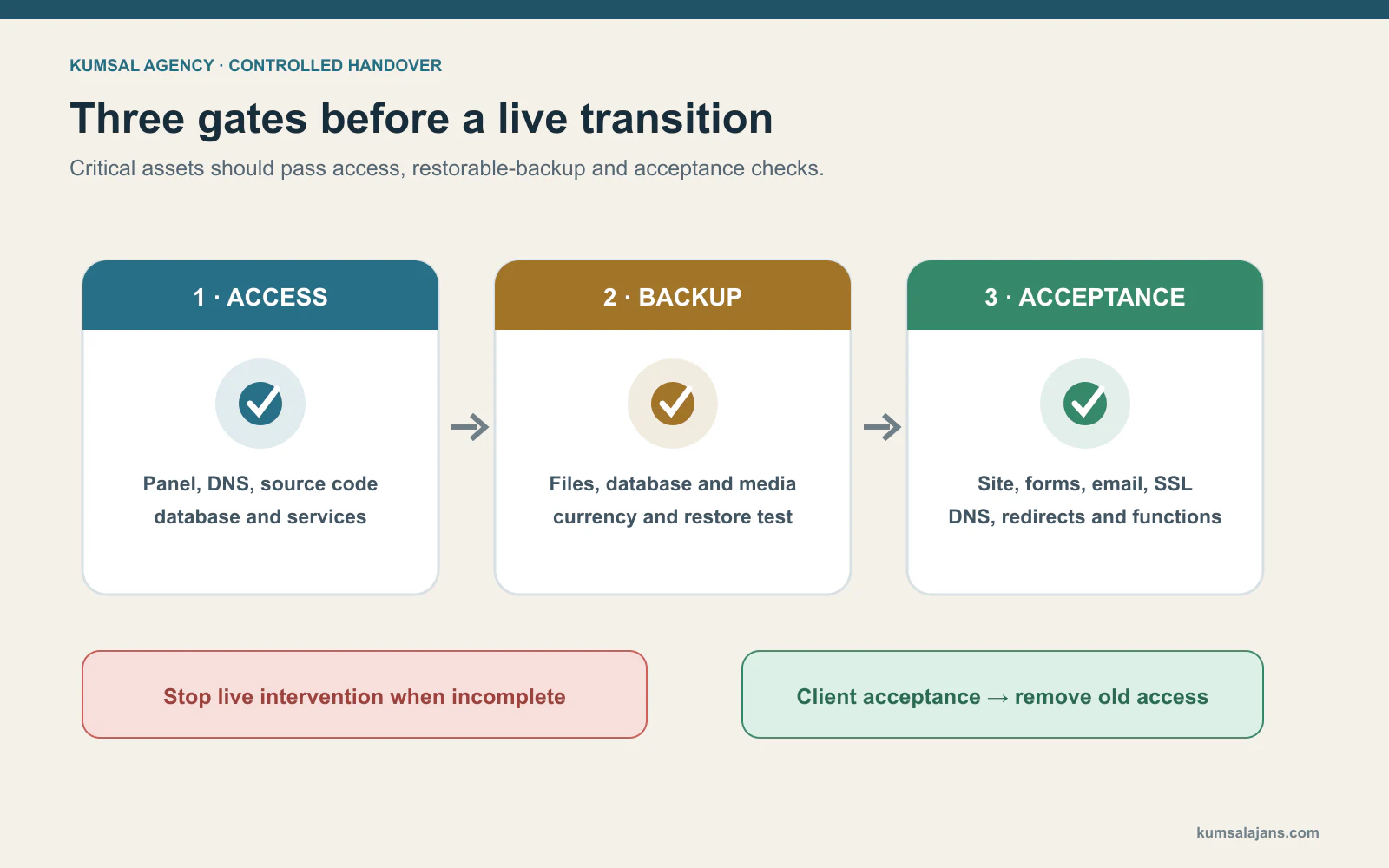
1. Access gate
Inventory hosting and panels, domains and DNS, source code, databases, FTP/SSH and third-party services. Do not start a live migration or major intervention when critical access is missing.
2. Backup gate
Take complete backups of files, databases, media and the current live release. Verify that backups open, represent the correct date and contain the information needed for restoration.
3. Acceptance gate
Check site access, forms, email, SSL, DNS, redirects, database connections and essential functions. Confirm the final transition with client approval, then remove unnecessary former-provider access.
Anonymous Example: Pause When the Backup Is Incomplete
In Kumsal Agency's transition approach, a migration is paused when an inherited project lacks a complete database and the file backup is outdated. Work resumes only after the correct backups are supplied and verified. This can delay the timetable, but it is more controlled than making an irreversible live change without a recovery path.
Where possible, run a short parallel period and freeze non-critical changes during the transition. Transfer passwords and API details securely, and remove obsolete access only after the handover checks are complete.
Final Legal and Technical Review
- Confirm the brief, proposal, scope and contract appendices refer to the same approved versions.
- Record owner, administrator, billing owner and agency role for every asset.
- Separate data, source files, licences and usage rights.
- Assign owners to changes, approvals, incidents and reporting.
- Define exit deliverables with acceptance conditions.
- Do not begin live work before critical access and backups are complete.
- Have binding terms reviewed by a qualified professional.
Use the agency brief to define the need and the proposal-comparison framework to normalise scope and cost. To discuss operational scope and transition requirements, contact Kumsal Agency.
Related guides: For the next decision steps, review the digital agency brief guide and the digital agency performance and KPI reporting guide.