


Aydınlatma metni yükleniyor…
Digital advertising management involves far more than launching campaigns on Google Ads or social platforms and assigning a budget. A system capable of producing measurable results connects the business goal, audience, channel strategy, advertising message, creative production, landing-page experience, conversion measurement and ongoing optimisation. When one of these components is weak, high impression or click volumes may still fail to generate sales, qualified enquiries or valuable customer relationships.
The first question should therefore be not “Which platform should we use?” but “Which business outcome do we want to improve, for which audience, and how will we measure it?” Marketing teams, brand managers and decision-makers responsible for corporate websites, ecommerce platforms or digital products can use this approach to allocate media budgets more deliberately and evaluate campaigns by business value rather than surface-level activity.
What is digital advertising management?
Digital advertising management covers the research, planning, setup, delivery, measurement and improvement of paid-media activity. Depending on the goal, it may include Google Search, display advertising, YouTube, Instagram, Facebook and other relevant channels. A brand does not need to appear on every platform. Each channel should earn its place through audience behaviour, commercial intent and the role it will perform in the customer journey.
A mature system does not assess the advertising account in isolation. It asks where people go after seeing an ad, whether the destination continues the same promise, whether the form or checkout works, where prospective customers leave, and whether those actions are measured accurately. Advertising performance is consequently a shared responsibility across marketing, design, content, web development, data and sales teams.
How do you manage digital advertising?
A practical advertising plan can be organised into six core stages. Although they appear sequential, they form a cycle: measurement findings should inform the next round of targeting, creative work, budget allocation and page improvements.
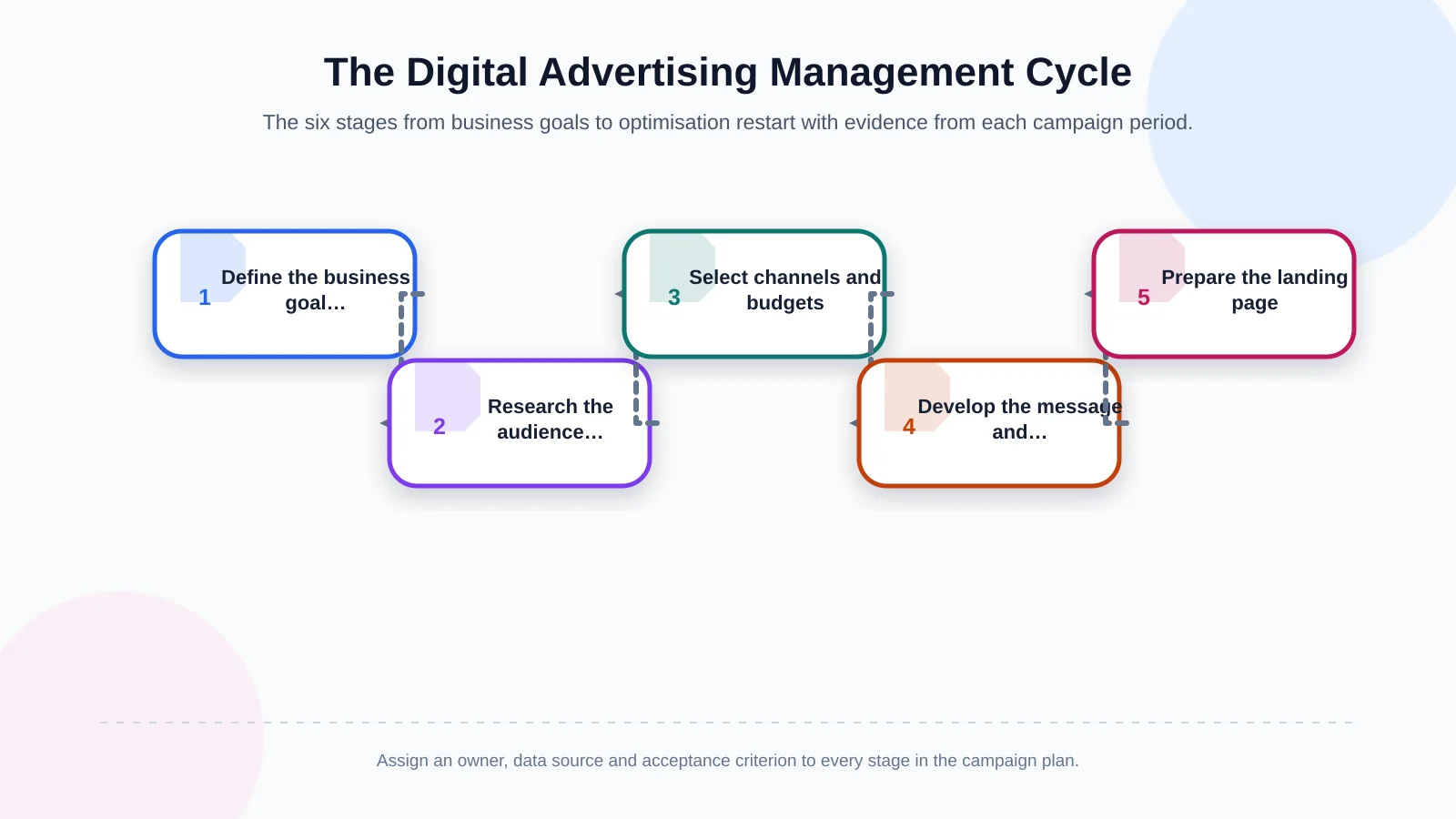
1. Define the business goal and conversion
Begin by identifying the outcome the campaign must produce for the business. For ecommerce, the primary conversion may be a completed order with recorded revenue. For a B2B company, it may be a qualified request for proposal; for a service business, a suitable appointment or verified telephone enquiry. Page views, video plays and add-to-basket events can help explain the journey, but they should not automatically be treated as final success.
Document each conversion’s name, trigger, value, source and owner. According to Google, conversion measurement reveals how advertising interactions lead to valuable actions such as purchases, registrations or calls. Implementation options are explained in the Google Ads conversion tracking guide.
2. Research the audience and buying intent
Age, location and gender rarely provide enough information to define a useful audience. Research the problem people are trying to solve, their decision stage, existing product knowledge, objections, purchasing authority and search behaviour. Customer interviews, CRM records, search terms, internal site searches and questions repeatedly heard by sales teams provide valuable evidence.
In B2B campaigns, technical users, procurement teams and final decision-makers may respond to different information. In ecommerce, someone exploring a category has different intent from a shopper searching for a specific product. Meaningful segmentation allows the message, offer and landing page to answer the audience’s actual needs.
3. Select channels, campaign types and budgets
Google Search is particularly useful for reaching people who have translated a need into a query. Social advertising can introduce a need, reach a new audience, demonstrate a product and re-engage interested users where appropriate. Video and display formats can build awareness, but broader reach does not automatically create greater commercial value.
Budget planning should cover more than daily media spend. Creative production, landing pages, measurement setup, software development and operational workload all carry costs. Allocate an initial budget that can collect enough evidence for a meaningful test without creating uncontrolled risk. Track brand and performance campaigns separately, and distinguish new-customer acquisition from remarketing activity.
4. Develop the message and creative assets
An advertisement must quickly connect the audience’s need with the brand’s value proposition. Its headline, image, video, body copy and call to action should support one coherent promise. Explain the problem a feature resolves instead of simply listing specifications, and avoid superiority, discount or performance claims that cannot be substantiated.
For social media, consider vertical videos that communicate within the opening seconds, product demonstrations, realistic use cases and multiple message angles. Search ads require headlines and descriptions aligned with query intent. An Art Director-led digital design system can preserve brand consistency while adapting campaign content for different platforms, placements and formats.
5. Prepare the landing page for conversion
Even relevant traffic becomes expensive when it reaches a slow, confusing or mismatched page. The landing page should visibly fulfil the ad’s promise and explain the offer, scope, evidence, pricing or quotation process, and next step. Forms should request only necessary information, provide understandable error messages and work reliably on mobile devices.
Before launch, test page speed, accessibility, technical security, analytics tags and conversion events. Conversion-focused web design should bring visual appeal, message clarity and usability into the same experience. The choice between a focused landing page and a comprehensive corporate website should reflect traffic source, decision complexity, trust requirements, measurement needs and content maintenance.
6. Measure, learn and optimise
Once the campaign is live, review both measurement quality and business performance. Spend, impressions, click-through rate and cost per click are useful diagnostic metrics. Decisions should ultimately rely on conversion rate, cost per acquisition, qualified opportunities, revenue and return on ad spend. In B2B campaigns, inexpensive but poor-quality leads can appear successful unless CRM outcomes and sales quality are connected to advertising data.
Optimisation does not mean making random changes every day. Form a hypothesis, test one or a limited number of variables, wait for sufficient evidence and document the result. Review search terms, negative keywords, audience segments, placements, devices, creative fatigue, frequency and landing-page drop-off. Interpret the findings across the customer journey instead of viewing each channel as a separate world.
How do Google Ads and social media advertising work together?
Google and social media are often complementary touchpoints rather than competing choices. Social content may make a new need visible; the user may later research the brand or solution on Google. Search advertising can capture high-intent demand, while social platforms can demonstrate how a product works, communicate visually and support responsible re-engagement.
Meta’s campaign structure asks advertisers to select an objective that corresponds with the desired outcome. The current framework is described in Meta’s advertising objectives guidance. A platform objective should not be confused with the company’s real KPI: clicks generated under a traffic objective do not, by themselves, demonstrate sales success.
- For search campaigns, review query intent, keyword structure, advertising copy and landing-page alignment.
- For social campaigns, monitor audience signals, creative variety, placement, frequency and video performance.
- Report every channel through a shared campaign-naming and UTM convention.
- Compare platform reports with analytics, ecommerce, CRM and verified sales data.
| Area | Google Ads | Social media | Shared control |
|---|---|---|---|
| Primary role | Capture existing demand | Create demand and interest | Contribution to the business goal |
| Main signal | Search query and intent | Audience, engagement and content | Qualified conversion |
| Content focus | Copy aligned with the query | Visual and video storytelling | Consistent value proposition |
| Monitoring | Search terms and conversions | Frequency and creative fatigue | Analytics, CRM and revenue |
How should you plan budgets and KPIs?
Set budgets according to the goal, expected sales cycle, likely conversion volume, unit economics and testing capacity. First calculate an acceptable customer acquisition cost or qualified-lead cost. Gross revenue alone can be misleading: product margin, returns, sales costs and repeat-purchase behaviour may materially change the amount the business can afford to spend.
A useful KPI framework has three levels. Business metrics include revenue, profitability, sales opportunities and customer acquisition cost. Conversion metrics include orders, quote requests, appointments and qualification rates. Media metrics include reach, clicks, costs and video views that help diagnose performance. Management reporting should connect these levels, explain significant variance and assign a next action with a clear owner.
Conversion tracking, data security and GDPR compliance
Design the measurement architecture before launching the campaign. Define events for form submissions, calls, purchases, registrations, quotation requests and meaningful intermediate steps. When assessing browser-side and server-side measurement, check for duplicate records, internal or test traffic, payment outcomes and CRM matching. Ownership of advertising accounts, analytics properties, tag managers and domains should remain with the business, with role-based access for partners.
Using personal data for advertising or measurement is not automatically compliant. Processing purpose, legal basis, retention, transfers and user rights require assessment with appropriately qualified specialists. Where processing relies on consent, the choice must be freely given, specific, informed and unambiguous. The European Data Protection Board’s guidelines on consent under the GDPR explain these conditions in detail.
- Do not activate non-essential tracking technologies before obtaining a valid preference.
- Keep refusal and withdrawal mechanisms accessible and understandable.
- Collect only necessary data and never place sensitive information in advertising parameters.
- Maintain records of access and responsibility for agencies, platforms and technology providers.
- Audit tags, integrations and data flows at regular intervals.
These controls are not merely legal risk measures. They also influence measurement quality, operational resilience and user trust. Cookie preferences, data security and web infrastructure should be planned as one system, with CRM, forms, ecommerce and reporting integrations tested against real workflows and failure scenarios.
Common digital advertising management mistakes
- Treating traffic or engagement as success without defining a business outcome.
- Using exactly the same message and format across Google and social media.
- Committing the full budget to one campaign without reserving test capacity.
- Reporting branded searches as though they were entirely new demand.
- Counting leads without checking form quality, qualification or sales outcomes.
- Separating the landing page, mobile experience and page speed from media management.
- Making frequent, substantial changes before enough evidence has accumulated.
- Leaving account ownership, data access and campaign history solely with a service provider.
Sustainable advertising performance requires an integrated system
Sustainable digital advertising performance does not come from one channel setting or a creative idea that happens to perform well. Research-led positioning creates the right message; creative production earns attention; a user-centred web experience supports conversion; and trustworthy measurement creates the learning loop. Media spending is the distribution layer of this wider system.
Kumsal Agency approaches Google and social campaigns together with digital brand strategy, Art Director-led creative production, conversion-focused web experiences and project-specific software requirements. To plan your advertising goals, creative needs, landing pages and measurement architecture as one connected programme, contact Kumsal Agency.