


Aydınlatma metni yükleniyor…
For B2B export companies, managing international Google Ads involves much more than activating ads in several countries and increasing form submissions. A manufacturer looking for distributors has different decision-makers, sales cycles and success criteria from a company selling directly to corporate buyers. The account must therefore reveal which markets and products generate commercially qualified demand—not merely the greatest volume of inexpensive leads.
A sound architecture connects the explicit demand captured by Search campaigns, the cross-channel reach of Performance Max and the commercial outcomes recorded in the CRM. Separating countries, languages, product groups and types of intent improves budget control, but excessive fragmentation can deprive campaigns of useful learning data. The objective is to find a level of detail that supports business decisions while preserving sufficient conversion volume.
Define the market and demand model before building campaigns
The first decision should not be the campaign type. Begin by defining the commercial model. Is the company seeking distributors in the target country, expecting quotation requests from importers or trying to reach procurement teams at production facilities? A submission becomes valuable only when the company profile, requirement, purchasing potential, authority and target-market fit are credible.
Document the product–market fit, buying roles, expected sales cycle, minimum order quantity, certification requirements and languages supported by the sales team for each country. Keyword tools alone can be misleading for specialised industrial products with limited search volume. Sales conversations, trade-fair notes, CRM records, competitor websites and local industry terminology should inform the demand model together.
Success metrics must go beyond form volume
Separate primary and secondary conversions from the outset. A quotation request, distributor application or qualified meeting may be a primary objective. A catalogue download, detailed product-page visit or click on contact information can remain a secondary indicator of interest. Treating every micro-action as an equally valuable primary conversion may teach automated bidding to pursue low-quality behaviour.
- Raw inquiry: A form submission or telephone conversation occurred.
- Marketing-qualified lead: The country, company and requirement meet the agreed criteria.
- Sales-qualified lead: A genuine opportunity has been confirmed with an authorised contact.
- Quotation: Product, quantity, delivery and pricing requirements have been established.
- Won sale: The order or contract has been closed in the CRM.
How should countries, languages and product groups be separated?
Markets that require different budgets, objectives, bidding strategies or messages should usually be separated at campaign level. If Germany and the United Arab Emirates are handled by different sales teams and have different languages or profitability targets, combining them may allow the easier market to consume most of the budget. Low-volume countries with similar commercial conditions can instead be tested in a controlled regional cluster.
Geographic targeting is not a perfect location-verification system. Google uses signals including user settings, devices and platform behaviour. Targeting options, location reports and excluded regions therefore require regular review. Google’s location-targeting guidance also explains that location targeting is based on multiple signals and cannot guarantee complete accuracy.
Language should not be treated as a simple interface setting. Keywords, advertisements, landing pages, forms, validation messages and the sales team’s response must provide a consistent experience. Because multilingual users may search in one language while understanding another, performance should be checked against actual search terms. If English and the local language require substantially different offers or content within one country, consider separate campaigns—or at least distinct ad groups and landing pages.
Product groups should be separated when the distinction has economic value. Placing machines with different margins, sales cycles, audiences and conversion values in one budget weakens control. Dividing closely related variants into dozens of small campaigns creates the opposite problem: insufficient data. A useful boundary is a product family with its own budget decision, recognisable search intent and relevant destination page.
Search campaigns should capture strong commercial intent
Search campaigns form the core layer for reaching prospective buyers who can already express a requirement. The structure can follow market or country cluster, language, product family and intent. Terms such as “manufacturer,” “supplier,” “wholesale,” “distributor,” “quotation” and “technical specifications” express different commercial contexts even when paired with the same product. Tracking brand, competitor, broad category and high-intent product queries separately shows where the budget is producing meaningful demand.
Keyword and ad-group logic
An ad group should contain closely related searches that can be answered by the same advertisement and landing page. Match types should reflect the account’s need for initial control and the quality of its existing conversion data. Broad match can support discovery, but without reliable conversion signals, sufficient budget and frequent search-term reviews, it may expand irrelevant traffic.
- Brand campaigns measure branded demand and interest across different countries.
- Product campaigns focus on defined product families and technical solution searches.
- Supplier or manufacturer intent reaches buyers looking for a commercial source.
- Distributor intent addresses potential dealers and importers with a dedicated message.
- Competitor campaigns require separate legal, trademark and policy assessment.
Negative keywords should be managed through both account-wide and campaign-specific controls. Jobs, training, free resources, used products, consumer use and products the company does not supply are common filtering candidates, but exclusions must evolve from real search terms. A word may carry a different meaning in another market, so central governance should be combined with local review.
What role should Performance Max play?
Performance Max should not be treated as an unrestricted traffic pool replacing Search. It is better used as a complementary layer that expands reach across Google channels around measurable conversion goals. In B2B businesses with long sales cycles, the algorithm should receive qualified-lead and sales outcomes from the CRM rather than learning solely from form submissions.
Create separate campaigns when country budgets, languages, product economics or conversion objectives differ. Asset groups can then be organised around product families, target sectors, use cases or audience themes. Google’s Performance Max asset-group recommendations explain that groups can be organised by theme, audience, language or content category.
Asset groups and signals
Each asset group should contain mutually supportive headlines, descriptions, product or facility images, suitable video, a clear value proposition and a relevant final URL. An industrial pump for food manufacturing and one promoted for mining applications may belong to the same product family, yet require different language, evidence and imagery. Sending buyers to a page that directly addresses their use case creates stronger message continuity than directing everyone to the homepage.
Search themes provide signals about the phrases customers use; they are not equivalent to the keyword controls in a Search campaign. Negative keywords and applicable exclusions remain important. Evaluate Performance Max through search insights, destination pages, placements and CRM quality rather than its headline conversion total alone.
First-party lists, existing-customer characteristics and relevant custom segments can provide an initial direction. Audience signals are not a rigid targeting boundary, however: the system can expand beyond them when it predicts a conversion. This discovery capability increases the importance of sales feedback that distinguishes genuine business opportunities from low-quality submissions.
Landing pages must match the country and commercial intent
Even relevant traffic can be lost on an inadequate page. A campaign landing page should present the target industry, product benefit, technical scope, certifications, delivery or export capabilities, trust evidence and next action in one coherent flow. It should answer the buyer’s immediate questions without forcing them to navigate a generic corporate site.
Localisation should go beyond literal translation. Adapt measurement units, technical terminology, telephone formats, privacy notices and sales expectations. Ask for enough information to identify purchasing intent without burdening the first interaction. Business email, country, company, product interest, approximate quantity and a message field are often a useful starting point.
Performance, mobile compatibility, accessibility and security are also part of media performance. When multilingual websites, campaign pages and forms share one management environment, custom web development should consider data flows, user roles, integrations and maintainability together.
Measurement architecture from form submission to CRM and sale
In B2B exports, the real outcome may occur days or months after the advertising click. Instead of treating form completion as the final success, establish common identifiers and lifecycle stages across advertising, the website, CRM and sales process. UTM parameters, click identifiers, campaign, country, language, product interest and form source should accompany the CRM record.
Google’s offline conversion import documentation explains how outcomes completed away from the website can be connected to the original ad interaction. Enhanced conversions may help match consented first-party data more reliably. Current Google requirements and applicable data-protection obligations must be checked during implementation.
Maintain distinct CRM stages for qualified leads, quotations and won sales, then return appropriate events to Google Ads as separate conversion actions with meaningful values. Automated bidding can consequently learn which inquiries are likely to produce commercial outcomes. For practical planning of field mapping, duplicate handling, ownership and feedback, see How to Plan Website–CRM Integration: From Form to Sales Follow-up.
Budgeting, bidding and optimisation cadence
Initial budgets do not need to be distributed equally across countries. Market potential, click costs, sales capacity, margin and strategic priority should be considered together. In a new market, validate measurement reliability and search quality before imposing aggressive target CPA or target ROAS constraints without adequate data.
Optimisation does not mean changing settings every week. Budget shifts, search terms, geographic distribution, devices, landing-page behaviour, form quality and CRM stages belong in the same review cycle. Keep a change log for major structural, budget or target adjustments, and allow an evaluation period appropriate to the sales cycle.
- Weekly: Review search terms, spend anomalies, technical failures and spam submissions.
- Monthly: Compare countries, products, campaigns and cost per qualified lead.
- Quarterly: Reassess sales value, win rate, market priorities and budget allocation.
- Continuously: Monitor forms, CRM flows, analytics and conversion-import health.
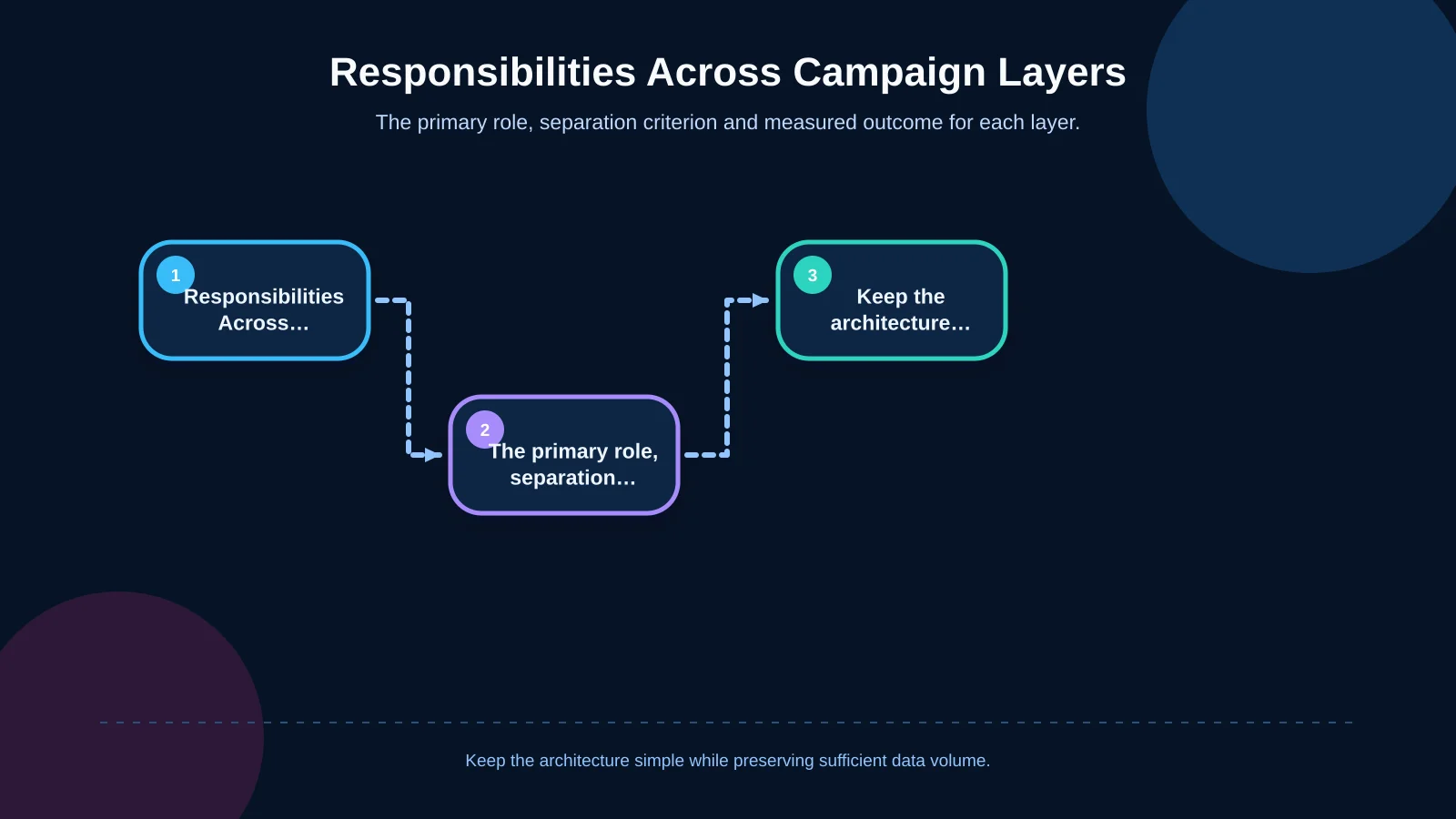
| Layer | Primary role | Separation criterion | Core metric |
|---|---|---|---|
| Search | Capture explicit demand | Country, language, product and intent | Cost per qualified lead |
| Performance Max | Expand reach in a controlled way | Budget, language and product economics | Qualified opportunity value |
| Landing page | Convert the message into demand | Industry and use case | Valid form rate |
| CRM and sales | Verify commercial quality | Lead, quotation and sales stages | Won sales value |
Practical campaign architecture steps
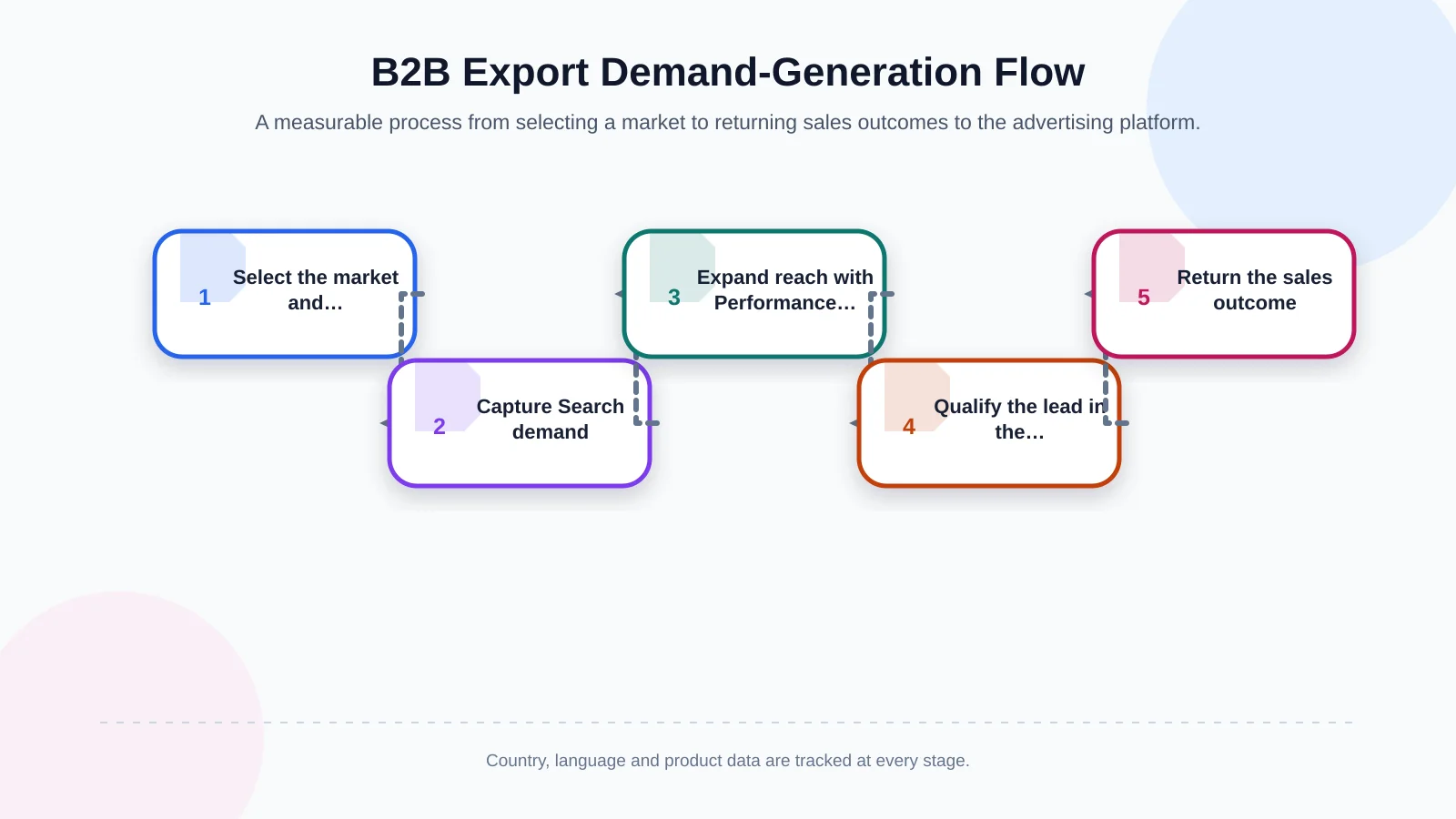
Start with a verifiable pilot instead of activating every market and product simultaneously. Select two or three priority countries, the strongest product families and languages the sales team can support properly. Search campaigns can capture explicit commercial demand while Performance Max provides complementary reach through its own budget and suitable conversion data.
During the initial period, judge success through measurement integrity, relevant queries and qualified conversations—not merely low click costs. As sales feedback accumulates, separate country clusters, mature bidding strategies and expand creative assets by industry. Every expansion should remain aligned with the sales team’s capacity to follow up.
Common campaign architecture mistakes
- Combining every country, language and product in one campaign and losing budget visibility.
- Splitting a low-volume account into too many campaigns and ad groups.
- Counting every form as qualified without returning sales outcomes to the advertising platform.
- Advertising in a local language but sending users to a generic page in another language.
- Treating Performance Max audience signals as strict targeting or search themes as keywords.
- Counting spam, student requests, job applications and consumer inquiries as B2B opportunities.
- Treating privacy, consent and data-retention requirements as separate from implementation.
Conclusion: Build the advertising account as part of the sales system
A strong Google Ads and Performance Max architecture for B2B exports uses country, language, product and intent distinctions to support commercial decisions. Search captures existing demand, Performance Max provides controlled expansion, multilingual landing pages maintain message continuity and CRM feedback reveals genuine sales value.
Without this connection, a high form count can be deceptive. With it, the business can measure more reliably which markets, products and messages create qualified opportunities. Plan a measurable international demand-generation system with Kumsal Agency for your target countries, product groups and existing digital infrastructure.