


Aydınlatma metni yükleniyor…
In B2B sales, weeks or even months may pass between the first interaction and a purchasing decision. Someone who submits a form, attends an event or downloads a resource will not necessarily be ready to request a proposal. The real challenge is to develop that initial interest with relevant content and well-timed follow-up without overwhelming the prospect or losing context.
Email automation and lead nurturing help teams treat cold leads as developing relationships rather than as entries in a list that should all receive the same message. A lead’s priorities, level of intent and commercial potential can change over time. An effective system identifies those changes and determines what should happen next.
This system cannot consist of an email platform alone. The website, CRM, forms, consent records, integrations, user roles, content production and sales team workflow must operate within one coherent architecture. Otherwise, automation merely sends irrelevant messages faster while giving sales representatives little reliable information.
What is the difference between email automation and lead nurturing?
Email automation is the technical mechanism that generates a message or operational action when a defined condition is met. Examples include sending a confirmation after a form submission, sharing a case study three days later or assigning a high-scoring lead to a sales representative.
Lead nurturing is the broader practice of developing a relationship. Its purpose is not simply to deliver emails. It aims to understand a lead’s needs, buying stage and role in the decision process, then guide that person towards an appropriate next step.
Automation provides the infrastructure for this strategy. A time-based sequence created without a nurturing strategy forces every recipient through the same journey. A well-designed nurturing workflow branches according to segment, behaviour and readiness to buy.
Start the workflow with consent and data provenance
The presence of a contact in a CRM does not automatically mean that marketing emails can be sent in every circumstance. Teams should define how data obtained from forms, events, sales conversations, partners or third-party providers may be used. The consent statement and its version, acquisition date, source, channel preferences and opt-out status should be attached to the record.
B2B communication requirements may vary according to the country, the recipient’s legal status and how the data was obtained. The ICO’s guidance on business-to-business marketing explains that requirements can differ for corporate and individual subscribers. It also covers sender identification, valid opt-out methods and the need to assess an appropriate lawful basis when personal data is processed. Activities in Türkiye should additionally be considered under the KVKK, electronic commercial communication rules and, where necessary, advice from qualified legal counsel.
When permission is withdrawn, retain a suppression record instead of deleting all history. This prevents the same person from being added to a campaign by mistake after submitting another form. Retention periods and access permissions should also form part of the organisation’s data-governance policy.
Build a reliable data flow between the website and CRM
Nurturing quality depends on the accuracy of the initial record. Website form fields should be explicitly mapped to CRM fields, while required fields, data types, controlled vocabulary and default source codes should be documented. Duplicate checks can use identifiers such as an email address, company domain or telephone number. An existing contact should be associated with the correct account rather than repeatedly created as a new lead.
Our guide to planning website–CRM integration examines field mapping, ownership, exception queues and the sales feedback loop together. Failed records must not disappear silently. An error queue, retry policy, technical alerts and a manual review interface help maintain operational continuity.
The integration should also return useful status information to the website and marketing systems. CRM acceptance, assignment, qualification and suppression events should be traceable so teams can distinguish a genuine lack of engagement from a technical failure.
How do you build a cold lead nurturing workflow?
An end-to-end workflow includes more than a sequence of emails. Every stage needs an entry condition, an accountable owner, data outputs and a clear exit rule.
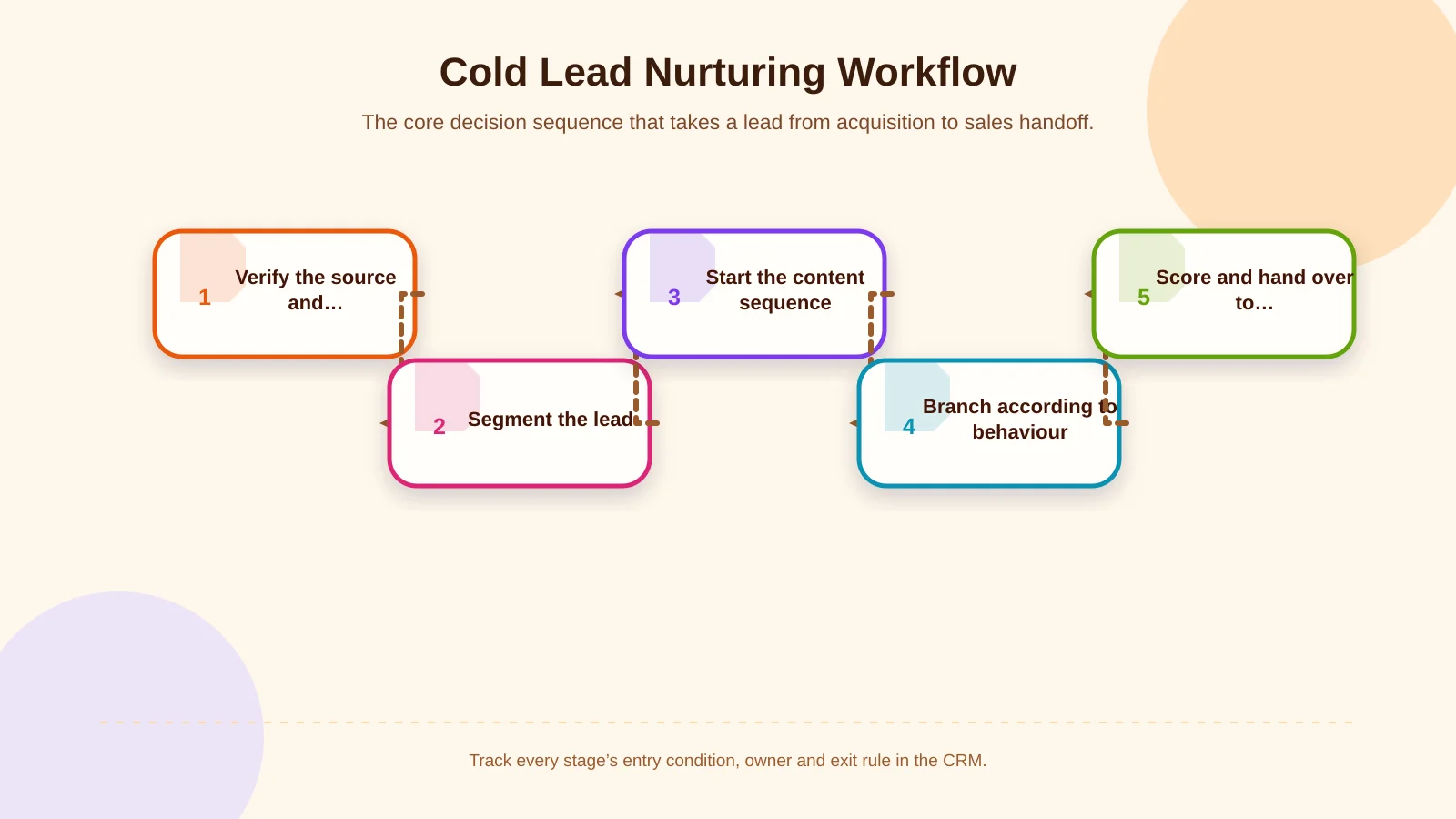
1. Verify the source and communication eligibility
Record where the lead came from, which content attracted their attention and what communication preferences apply. Do not enrol invalid or suppressed records, or contacts whose permitted use is unclear. If company domain, country or organisation type matters, define an appropriate verification or enrichment step.
2. Create meaningful segments
Segmentation should not rely solely on industry or company size. Role, area of interest, downloaded content, visited solution pages, customer status and sales territory can all provide useful context. A finance leader and a technical decision-maker may assess the same solution for very different reasons.
3. Match the content sequence to the buying stage
The first message might frame the business problem rather than immediately promoting a product. Later touchpoints can offer a checklist, practical guide, implementation example, integration approach or case study. A technical meeting, needs assessment or demo becomes more relevant as the lead approaches a decision. Each message should have one primary purpose and a clear next step.
4. Branch according to behavioural signals
An email click, important page visit, event registration, completed form and meeting request represent different levels of intent. A person displaying strong buying signals should not have to wait until the end of a standard sequence. Repeated inactivity, by contrast, can trigger a lower frequency or move the contact into a rest segment.
5. Score and hand the lead to sales
Lead scoring should combine profile fit with behavioural intent. Microsoft’s lead-scoring model documentation shows how demographic attributes can be used alongside interactions such as emails, downloads, website visits and events. A score should not become an unquestioned decision, however. Thresholds, time windows and sales-acceptance criteria must be tested against the organisation’s actual conversion data.
6. Write the outcome back to the CRM
When a lead is handed over, the CRM should automatically create an owner, response deadline and follow-up task. Representatives should be able to select standard outcomes such as “not a fit”, “timing too early” or “unable to reach”. That result must return to the nurturing workflow so the next contact date and content reflect sales feedback.
How should a lead scoring model be balanced?
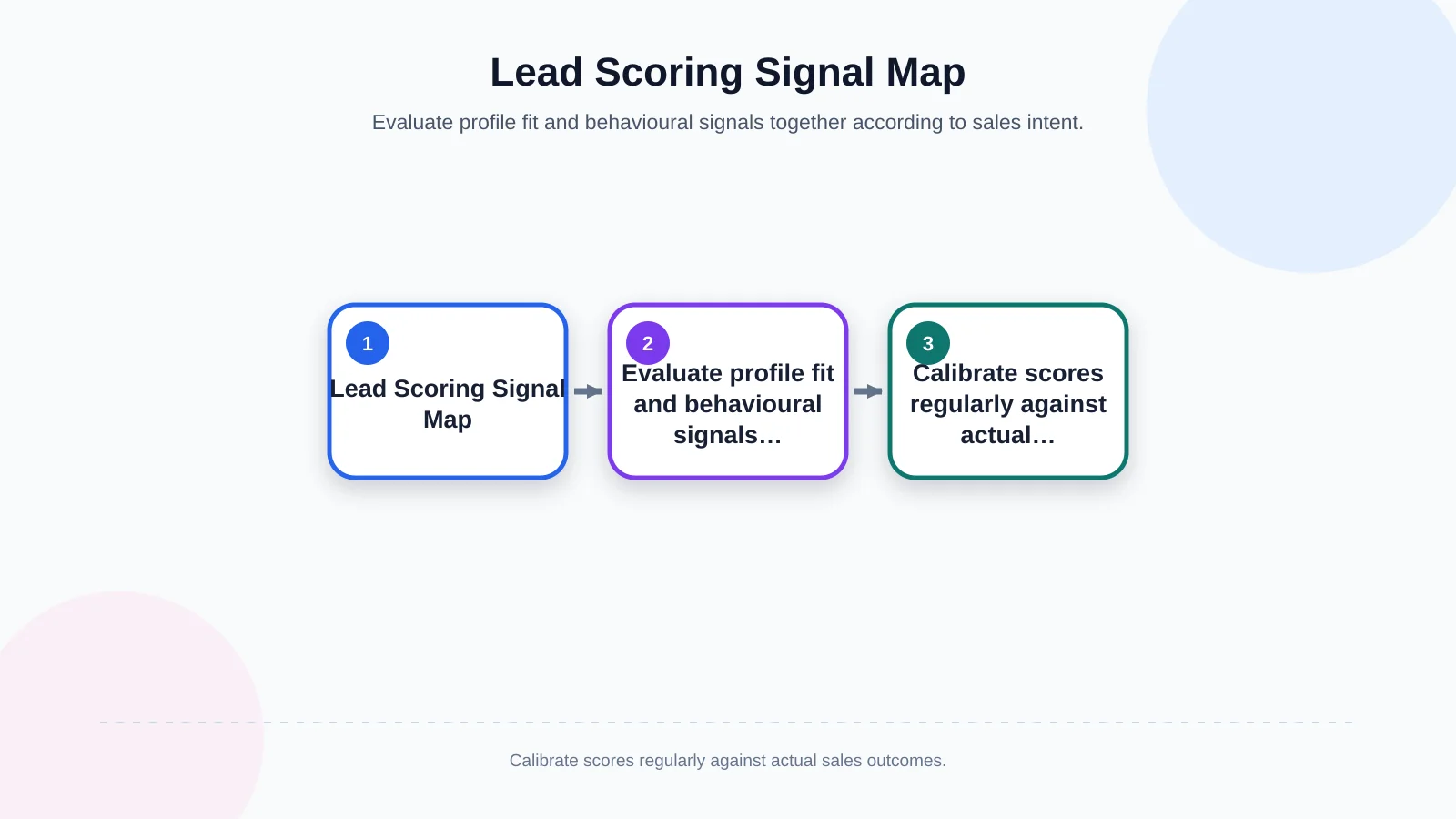
A practical model can begin with two dimensions. A fit score assesses relatively stable information such as industry, company size, geography, job role and existing technology. An intent score measures behaviours such as visits to pricing or solution pages, content downloads, event participation and meeting requests.
Scores should not only increase. Time decay can reduce the value of old engagement. Job applications, student addresses, competitor domains or repeated delivery failures may generate negative points. An email open is a weak signal and can be distorted by technical factors, so it should be supported by clicks or visits to high-intent pages.
Do not finalise thresholds through assumptions alone. Regularly compare handed-over leads with sales acceptance, meetings created and opportunity conversion. This allows marketing to learn which patterns contribute to revenue instead of optimising for a high score that sales teams do not trust.
| Signal group | Example | Scoring effect | Control |
|---|---|---|---|
| Profile fit | Industry, company size, role | Positive | Ideal customer profile |
| High intent | Meeting request, solution-page visit | Strong positive | Recency |
| Low intent | Email open | Limited positive | Look for another signal |
| Negative signal | Invalid address, continued inactivity | Negative | Suppression or score decay |
How should content, timing and frequency be planned?
Enterprise purchases are rarely decided by one person. Technical teams may investigate integration, finance may assess total cost, and executives may focus on risk and business outcomes. The content map should address these roles while keeping the brand voice, visual hierarchy and call-to-action system consistent across touchpoints.
Kumsal Agency’s digital brand consulting and digital design capabilities support a connected communication system in which automated emails still feel like part of the brand. Templates, landing experiences, supporting resources and sales materials should use the same message architecture rather than appearing as disconnected assets.
There is no universal timing formula. Consider the time required to consume the content, the length of the sales cycle and the lead’s latest behaviour. Several messages on the same day may feel intrusive, while months of silence can remove all context. Frequency caps, cross-campaign conflict checks, time zones and quiet periods should therefore be managed centrally.
Deliverability is the technical foundation of automation
A nurturing journey cannot work if its messages never reach the inbox. Sending-domain configuration, SPF, DKIM and DMARC should be maintained alongside bounce handling and spam-complaint monitoring. Google’s email sender guidelines recommend domain authentication and define additional expectations for high-volume senders, including SPF, DKIM, DMARC, low spam rates and straightforward unsubscribe options.
Buying lists, sending in bulk to addresses that have not been validated for a long time or hiding the unsubscribe link may increase short-term volume but will damage reputation and data quality. Hard bounces should be suppressed, temporary failures retried only within defined limits, and delivery events made visible in the CRM.
A sales handoff is more than a scoring threshold
Marketing and sales should share a definition of when a marketing-qualified lead becomes sales-qualified. Suitable criteria might combine a target-company fit, a recent high-intent action and valid contact information.
At handoff, the representative needs more than a name and score. Provide the source, segment, content history, latest interactions and a suggested conversation context. Ownership can be assigned according to territory, industry, product expertise or an existing customer relationship. Records left untouched beyond the agreed response period should move to a manager’s queue or be reassigned.
The learning loop remains incomplete unless sales decisions return to the CRM through consistent reason codes. Those outcomes reveal whether the problem lies in targeting, timing, qualification or follow-up.
Which metrics should measure success?
Open and click rates help evaluate content, but they do not demonstrate B2B sales results on their own. Measure progression from form submission to qualified lead by segment, sales acceptance, time to first contact, meeting rate, opportunity conversion, sales-cycle length and revenue influence by source.
Operational health matters as well. Track duplicate records, integration failures, unassigned leads, bounce rates, unsubscribes and spam complaints. Reporting should show the contribution of the wider nurturing journey, not only the final interaction.
Avoid firm conclusions from small samples. Subject lines, content order and calls to action need sufficient time, representative audiences and appropriate control groups. Results should be reviewed alongside sales feedback so local improvements do not undermine overall opportunity quality.
Why does a project-specific system approach matter?
Off-the-shelf automation platforms can provide message delivery and basic triggers, but they do not automatically fit a company’s CRM model, products, user roles or approval processes. Kumsal Agency approaches custom web software and website–CRM integration as one system shaped by data security, exception handling, sustainable management and the overall brand experience.
The work can begin with an inventory of data sources, a field dictionary, segment rules, an event model, a content map, scoring logic, sales-handoff criteria and reporting requirements. The workflow can then be implemented for a pilot segment, validated against real outcomes and expanded in controlled stages. This turns email automation from an isolated marketing tool into a measurable part of the sales process.
Turn cold leads into sustainable sales opportunities
The value of B2B lead nurturing does not come from sending more email. It comes from operating reliable data through the right content, timing and chain of responsibility. When consent records, CRM integration, meaningful segmentation, behavioural branching, explainable scoring and a closed feedback loop work together, teams know which lead to approach, when to act and what context to use.
Contact Kumsal Agency to analyse your existing lead sources, CRM structure and B2B sales cycle, then plan a project-specific email automation and lead nurturing workflow for your brand.