


Aydınlatma metni yükleniyor…
Social media advertising management involves far more than launching a campaign and setting a daily budget. An efficient advertising programme brings business goals, genuine audience needs, creative communication, measurement infrastructure and the post-click experience into one connected system. When these elements are managed separately, a campaign may generate reach or clicks without producing qualified demand, revenue or sustainable growth.
A sound approach begins by defining the business outcome the advertising should support. Audience assumptions are then tested against behavioural evidence, budgets are assigned to controlled experiments, and performance is evaluated using website, e-commerce and sales results—not platform metrics alone. This turns social media spend from a speculative expense into a measurable investment that can learn and improve over time.
Why should social media advertising be managed holistically?
Advertising performance is the combined result of targeting, bidding, creative content, frequency, the landing page and the conversion process. An ad may reach the right person but still fail if its promise does not match the landing page. Likewise, a strong offer cannot demonstrate its true contribution when it is delivered under the wrong campaign objective or without reliable measurement.
Brand positioning and user expectations should therefore be clarified before campaign production begins. Teams need to establish which problem the brand solves, how its approach differs from competing alternatives and what evidence people require before taking action. Research-led positioning creates consistency across ad copy, visual direction, landing pages and the language used by sales teams.
This integrated perspective is especially important when advertising supports a longer customer journey. Digital brand consultancy can shape positioning and communication principles, while digital design provides campaign, social-content and motion systems suited to the brand. Corporate web design, e-commerce and custom web development then create the infrastructure required to turn paid traffic into useful business outcomes.
How to identify the right target audience
An audience should not be defined only as “people aged 25–45 who live in Istanbul.” Effective segmentation considers the user’s need, stage in the buying journey, behaviour, relationship with the brand and role in the decision. In B2B marketing, decision-makers, technical evaluators and end users may need different messages. In e-commerce, someone researching a category for the first time does not have the same purchase intent as a visitor who has already added a product to their basket.
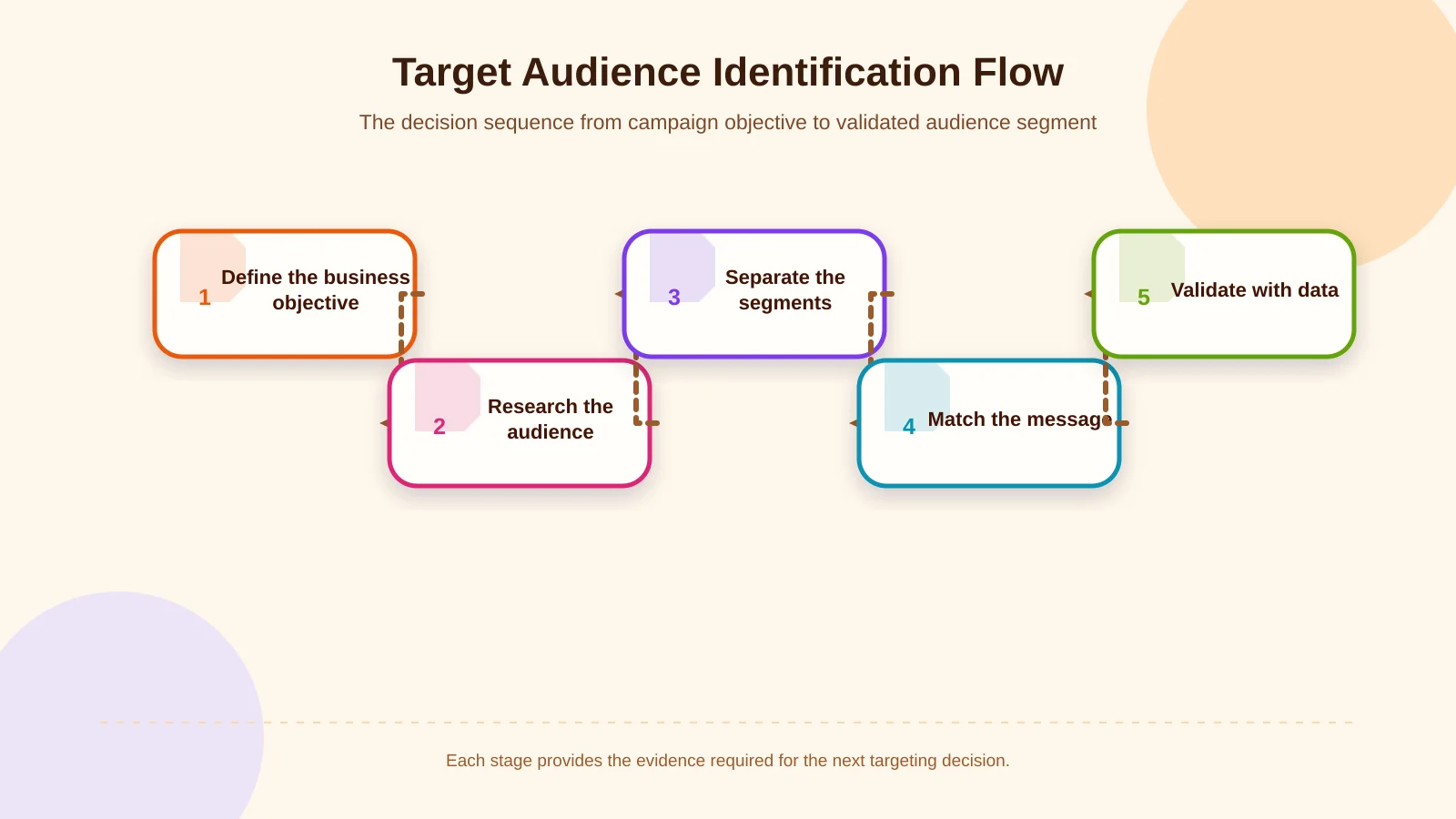
1. Define the business goal and conversion
Decide whether the campaign is intended to build awareness, attract qualified traffic, generate enquiries, secure quotation requests, encourage app use or produce sales. The action labelled as a conversion must also carry genuine business value. Tracking a completed form, qualified conversation, purchase or repeat order leads to better budget decisions than optimising solely for page views.
Agree on the primary outcome before choosing the platform objective. Supporting indicators can help diagnose performance, but they should not replace the result the business actually needs. For example, a lead-generation campaign may monitor clicks and form starts while still treating sales-qualified enquiries as its principal success measure.
2. Research user needs and decision context
Customer interviews, sales notes, search queries, support requests, web analytics and existing customer data can reveal shared needs. Research should answer more than “Who is the user?” It should examine which problem they are trying to solve, what objections they have, when they begin researching and which evidence they trust when making a decision.
These findings should be translated into practical audience hypotheses rather than broad personas that never influence campaign decisions. A useful hypothesis connects a recognisable need or behaviour to an appropriate message, offer and next step.
3. Segment by intent and behaviour
Cold audiences have not encountered the brand but may display interests or behaviours connected to the problem. People who have engaged with content or visited the website may be closer to consideration. Existing customers should be treated separately for cross-selling, repeat purchasing and loyalty communication. This separation prevents every user from receiving the same generic message.
Platform interests are not the only source of targeting data. Consented first-party customer lists, website activity and content engagement can support more meaningful segments. Google Ads guidance on audience segments explains how audiences can be structured around interests, intent, demographics and previous interactions with a business. The same underlying logic can help social media teams distinguish different stages of the decision journey.
4. Plan exclusions
Targeting is also about deciding who should not see a campaign. Depending on the objective, exclusions may include existing customers, employees, recent converters, unsuitable locations or users being addressed by another stage of the campaign. Thoughtful exclusions reduce unnecessary competition between campaigns and limit spending on low-value impressions.
Aligning audiences, messages and landing pages
Segmentation creates value only when each audience receives a relevant proposition. Someone who has just recognised a problem may benefit more from educational content than a list of product features. A user comparing alternatives may want a case study, proof of expertise or a clear comparison. Near the point of purchase, price, delivery information, a demonstration, a quotation form or trust signals can become decisive.
A creative system should maintain a consistent brand character while adapting to different segments and platform formats. Vertical video, motion design, a short product demonstration, a customer scenario and a static visual can all express the same campaign idea. Each variation should nevertheless communicate one principal message and one understandable next step.
Review visual density, mobile legibility and the opening seconds of video, as well as the consistency between the ad and its destination. Creative testing should investigate meaningful differences in message angle, proof, format or offer—not merely cosmetic changes that provide little strategic learning.
The landing page is a continuation of the advertisement. Visitors should encounter the same promise, offer and visual direction after clicking. Mobile performance, scannable content, clear form fields, trust evidence and visible calls to action all support conversion. Corporate web design, e-commerce or custom web software is therefore not simply an aesthetic consideration; it is part of the infrastructure that turns paid traffic into business results.
How should a social media advertising budget be planned?
Budget planning is not a matter of dividing the total amount equally among campaigns. Consider the economic value of the intended result, an acceptable acquisition cost, the sales cycle, the estimated conversion rate and the data volume required for credible measurement. The budget should be sufficient both to produce outcomes and to reduce uncertainty through learning.
Separate testing, validation and scaling budgets
During the initial period, allocate part of the budget to testing audience, offer, creative and landing-page assumptions. Give a larger share to combinations that demonstrate value while retaining a controlled allocation for new experiments. This prevents the entire budget from being committed to a single unproven approach.
A test should not change too many variables simultaneously. If the audience, visual, offer and landing page all change together, the reason for any performance difference becomes unclear. Google Ads guidance on experiments similarly recommends starting with a clear hypothesis connected to a business objective and applying the result according to what the experiment reveals. That discipline is equally useful for A/B tests on social platforms.
Allow time for learning
Frequently pausing campaigns, continually changing targeting or making sharp budget adjustments in response to daily results can undermine comparison. The appropriate evaluation window depends on conversion volume and the sales cycle. A low-volume B2B campaign, for example, should be assessed through lead quality and progress through the sales process rather than daily form totals alone.
Scale according to marginal efficiency
Increasing investment in a successful campaign may be reasonable, but efficiency should not be assumed to remain constant. Audience saturation, rising frequency, creative fatigue and expansion towards lower-intent users can increase acquisition costs. Scale gradually while monitoring result volume, cost, conversion quality and overall revenue contribution together.
Key metrics for measuring budget efficiency
No single metric explains the performance of an entire campaign. Measurement should cover several stages of the conversion funnel. Reach and frequency describe distribution; click-through rate indicates whether the message attracts attention; landing-page conversion rate reflects the fit between traffic and experience; cost per acquisition shows the spend required for a result; and return on ad spend connects measurable revenue to advertising cost.
- Reach and frequency: Show how many distinct people received the ad and how often they saw it on average.
- Click-through rate and cost per click: Provide early signals about the creative message’s ability to generate interest.
- Conversion rate: Indicates whether the post-click experience meets the expectations established by the advertisement.
- Cost per acquisition or qualified lead: Connects spending to an outcome that matters to the business.
- Conversion value and ROAS: Relate measurable revenue to advertising spend, although neither metric is the same as profitability.
- Customer quality and lifetime value: Help determine whether apparently inexpensive conversions create lasting business value.
Consistent campaign parameters make it easier to analyse sessions and conversions outside the advertising platform. Google Analytics documentation on campaigns and traffic sources explains the role of custom campaign parameters and advertising click identifiers in traffic classification. Differences among advertising platforms, analytics tools, CRM records and e-commerce data should also be reviewed regularly.
| Stage | Primary metric | Question answered | Decision |
|---|---|---|---|
| Distribution | Reach and frequency | Is the campaign visible at the right scale? | Adjust the audience and delivery |
| Interest | Click-through rate | Does the message attract attention? | Test the creative content |
| Conversion | Conversion rate | Does the page meet expectations? | Improve the experience |
| Business outcome | Acquisition cost and ROAS | Does the spending create value? | Scale or reallocate the budget |
How to build an optimisation cycle
Optimisation involves more than switching off underperforming ads. First validate the business objective and measurement setup. Then test hypotheses concerning audiences, creative content, offers and landing pages under controlled conditions. Compare results after sufficient data has accumulated, scale the stronger approach gradually and begin the next cycle with a new question.
For each experiment, record the hypothesis, changed element, primary success metric, supporting metrics, date range and conclusion. “A video showing the outcome of using the product will reduce the cost of qualified forms among consideration-stage visitors compared with feature-led creative” is a measurable hypothesis. Even an unsuccessful test creates value by showing which assumption was not supported.
Creative fatigue should be monitored separately. Rising frequency accompanied by a falling click-through rate, higher costs or declining comment quality may indicate that a new narrative is needed. The answer is not always a different colour or image. Teams may need to revisit the customer insight, message angle, format, proof or offer.
Common mistakes and how to prevent them
- Defining audiences only by age, gender and location while ignoring need, intent and behavioural signals.
- Serving the same advertisement to every segment regardless of its decision stage.
- Using platform automation before validating the business objective and measurement infrastructure.
- Splitting a limited budget across too many campaigns and ad sets to gather meaningful data.
- Optimising for clicks or inexpensive forms without tracking lead quality and sales outcomes.
- Allowing the landing page to contradict the advertising promise or neglecting the mobile experience.
- Reacting constantly to short-term fluctuations and making experiments difficult to interpret.
These mistakes share a common cause: treating advertising as an isolated media-buying activity. Brand positioning supports the right message, digital design creates attention and consistency, web experience supports conversion, and analytics enables learning. When these elements operate together, budget efficiency means more than cheaper clicks; it means producing stronger business outcomes.
Build a measurable social media advertising strategy
Effective social media advertising is not based on claiming to find the perfect audience immediately. It is a structured learning system that improves audience assumptions with evidence. When business goals, user needs, campaign creativity, budget discipline and conversion infrastructure belong to one plan, teams can understand more clearly which spending produces results and why.
Istanbul-based Kumsal Agency combines digital brand consultancy, brand-specific campaign and motion-design systems, corporate web design, e-commerce and custom web development within an integrated process. To build a measurable social media advertising strategy suited to your brand, audience and conversion journey, contact Kumsal Agency.