


Aydınlatma metni yükleniyor…
Increasing your advertising budget does not guarantee a proportional increase in sales. A campaign may reach the right people, yet potential revenue can still be lost because of a slow website, an unclear offer, a complicated checkout or leads that reach the sales team too late. Performance marketing should therefore involve more than launching campaigns on advertising platforms and reducing cost per click.
An effective performance system covers the entire journey: from audience targeting and creative to the landing page, form or checkout; and from measurement to CRM records and sales follow-up. A performance marketing agency brings these elements together around shared commercial goals, making it possible to see which campaigns, audiences and touchpoints contribute to revenue. Decisions can then be based on qualified demand, sales and profitability—not traffic alone.
What does a performance marketing agency do?
A performance marketing agency combines strategy, campaign management, data analysis and conversion optimisation to connect advertising investment with defined, measurable business outcomes. Paid search, social media, display advertising and remarketing are only the traffic-generating parts of this system. The broader objective is to match the right user with the right message and offer, increasing the likelihood of a purchase or qualified enquiry.
The agency’s responsibility should not end with reporting impressions, clicks and click-through rates. For e-commerce, meaningful indicators include order revenue, average order value, customer acquisition cost and return on ad spend. In B2B, the focus may shift to qualified leads, proposals, sales-cycle length and won revenue. Google describes conversion tracking as a way to understand how interactions with ads lead to valuable actions such as purchases, sign-ups or calls. Its technical principles are explained in the Google Ads guide to website conversion tracking.
Campaign activity should also support the brand’s wider positioning. Users expect consistency between the promise in an advertisement and the messaging, visual language and offer on the destination page. A research-led digital brand approach helps align immediate conversion targets with long-term credibility rather than allowing short-term campaign decisions to weaken the brand experience.
The end-to-end process for turning ad spend into sales
A sales-focused performance system has five connected stages. Weakness at one stage directly affects everything that follows. Poor targeting can limit conversions even when the landing page is excellent, while accurate targeting can appear ineffective when measurement is incomplete.
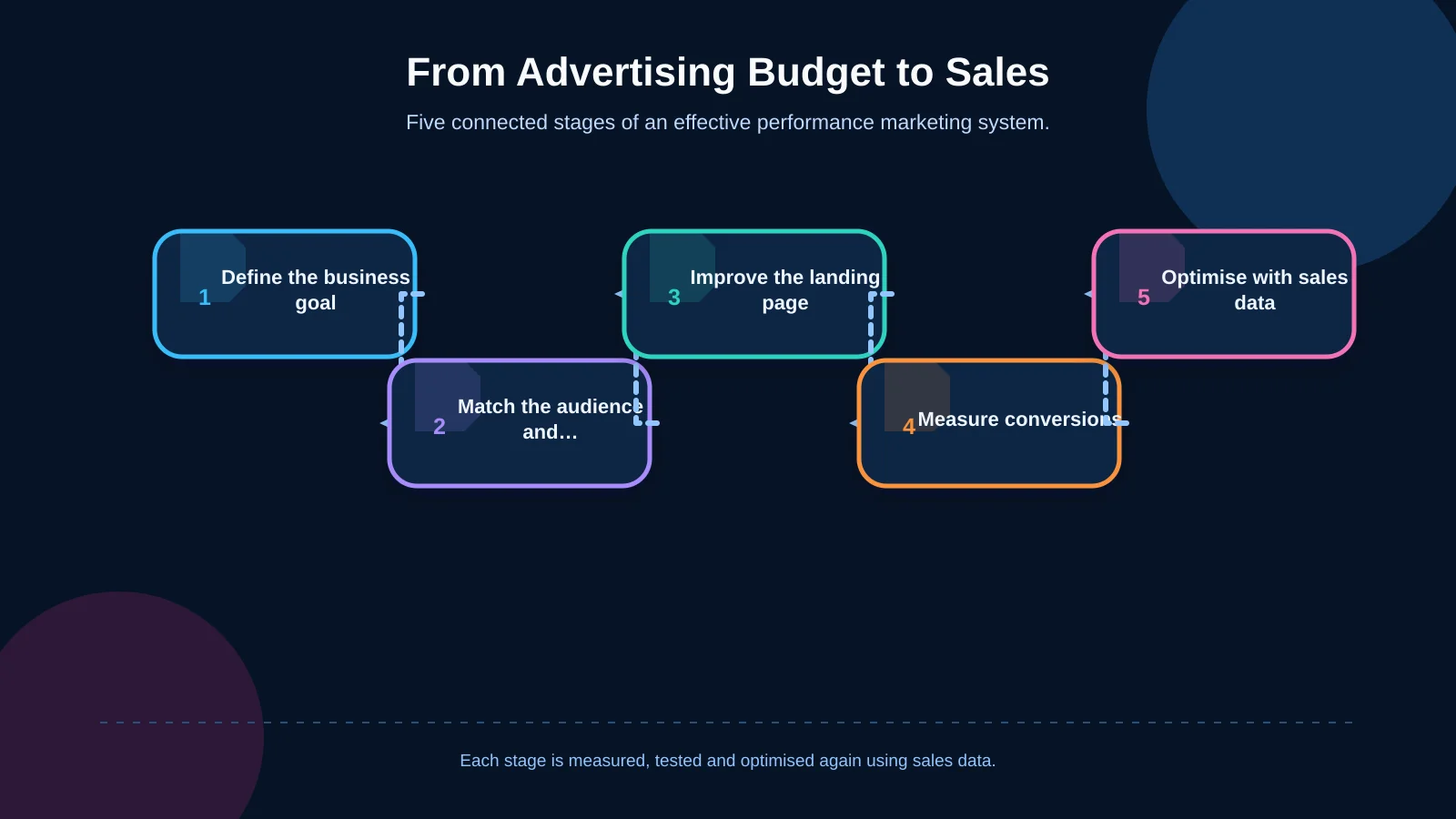
1. Define business goals and economic limits
Begin with financially meaningful targets rather than a broad ambition to “generate more sales.” Calculate gross profit by product or service, acceptable acquisition cost, repeat-purchase potential, sales-cycle length and operational capacity. An e-commerce brand may prioritise order revenue and contribution margin, while a B2B company may care more about sales-accepted opportunities than the total number of form submissions.
These boundaries help determine how much the business can invest to acquire a customer and where growth remains sustainable. They also prevent campaign teams from optimising toward inexpensive actions that have little commercial value.
2. Match the right audience with the right message
Targeting is not limited to age, location or interests. The team must understand the user’s problem, purchase intent, decision stage and likely objections. A user ready to buy may respond to product advantages, availability and price. Someone still researching may need comparisons, use cases, demonstrations or evidence of trust.
Advertising copy, creative and offers should reflect these different levels of intent. Segmenting messages in this way also produces more useful learning: the business can identify whether performance is being limited by audience selection, the proposition or the way value is communicated.
3. Maintain continuity between the ad and landing page
The destination page must clearly fulfil the promise made in the advertisement. Instead of sending every visitor to a general homepage, a campaign can use a landing page designed around its search intent or audience. The headline, benefits, trust signals, product or service details and call to action should support one coherent decision path.
Unnecessary navigation and distracting content should be reduced where appropriate. The form, purchase option or next step must remain visible, understandable and easy to use on mobile devices as well as larger screens.
4. Measure conversions and sales outcomes
Primary conversions may include purchases, form submissions and phone calls. Supporting events such as adding an item to the basket, starting checkout or viewing a quotation page can help reveal where users leave the journey. These intermediate actions are useful diagnostic signals, but they should not be presented as completed sales.
Campaign parameters, advertising click identifiers, platform tags and analytics events must be tested. Teams should also check whether data is lost when users move between domains, payment providers or embedded form systems. A technically valid tag is not enough if the event fires twice, misses consent states or records the wrong value.
5. Optimise through structured learning
Optimisation involves more than switching off an underperforming advertisement. Channel, campaign, audience, device, creative, landing page and eventual sales quality should be examined together. Frequent, large changes before sufficient data has accumulated can interrupt learning and make results difficult to interpret.
A better process prioritises hypotheses, runs controlled tests and assesses outcomes against revenue or qualified opportunities. Findings should be documented so future decisions build on evidence rather than repeating earlier experiments.
Why landing pages and e-commerce experience determine results
Advertising brings the user to the website, but the page experience often determines whether that visit becomes a sale. The page needs to load quickly, work comfortably on mobile, explain the offer and make the next step feel trustworthy. If visitors cannot find essential information or complete the form, adding more media budget simply sends more people into the same broken journey.
In e-commerce, product discovery, stock and delivery information, the basket, payment choices, validation messages and order confirmation should be treated as one connected sales flow. The Baymard Institute’s cart and checkout usability research shows how design and flow problems can contribute directly to checkout abandonment. Campaign optimisation may therefore require redesigning parts of the e-commerce experience—not merely changing bids or creative.
For B2B companies, conversion commonly begins with a form. Too many fields can create unnecessary friction, while collecting too little information can make prioritisation difficult for the sales team. The form should request the minimum information required to understand and route the enquiry. Successful submissions, validation errors, failed deliveries and retry states should all be measured.
How should measurement, CRM and sales follow-up work together?
A conversion shown in an advertising dashboard is not always a completed sale. One person may submit several forms, enter invalid contact information or fail to meet the company’s qualification criteria. Website analytics and CRM records must therefore be connected through traceable identifiers and consistent definitions.
When a form is submitted, its source, campaign and relevant page details can be transferred into the CRM record. The lead can then be assigned to a responsible salesperson, with first contact, qualification, proposal and won or lost stages recorded. Field mapping, duplicate handling, error queues and assignment rules should be addressed during implementation. Kumsal Agency’s guide to planning website–CRM integration from form submission to sales follow-up explores these operational requirements in greater detail.
When sales outcomes are returned to the advertising system, optimisation can move beyond total form volume and towards qualified or won opportunities. This feedback is particularly valuable for B2B organisations with long decision cycles. Consent, data minimisation, access permissions and retention periods should nevertheless be designed into the system from the start.
A customer journey may include several interactions, so the last click does not necessarily explain every contribution. Google Analytics defines attribution as assigning credit to the ads, clicks and other factors along a user’s path to a meaningful action. Channel performance should therefore be evaluated with an understanding of how attribution models work, rather than through one report or touchpoint alone.
Which performance indicators should be monitored together?
There is no single ideal metric set for every organisation. Media performance, website behaviour, sales quality and financial results should be read in the same framework. Click-through rate can indicate whether a message resonates with its intended audience, while landing-page conversion rate shows how effectively the experience supports action. Acquisition cost and revenue reveal whether that activity creates sustainable business value.
- Media efficiency: Impressions, click-through rate, cost per click, reach and frequency.
- Conversion efficiency: Form or purchase conversion rate, cost per conversion and checkout completion rate.
- Sales quality: Qualified-opportunity rate, proposal rate, win rate and sales-cycle length.
- Financial outcome: Customer acquisition cost, order revenue, return on ad spend and, where appropriate, customer lifetime value.
- Technical health: Page performance, mobile usability, tag accuracy and integration error rate.
Every indicator requires context. A high return on ad spend may occur at a volume too small to support growth, while a low cost per lead may reflect poor-quality enquiries. A useful report allows senior management to see commercial outcomes while giving marketing, sales and technical teams enough detail to locate the stage causing the problem.
| Stage | Core indicators | Question answered | Possible action |
|---|---|---|---|
| Advertising | CTR, CPC, reach | Is the message attracting the right audience? | Test targeting and creative |
| Web experience | Conversion rate, checkout completion | Can users complete the intended action? | Improve the page and form |
| Sales | Qualified opportunities, win rate | Do enquiries have commercial value? | Use CRM feedback |
| Finance | Acquisition cost, revenue, ROAS | Is the investment sustainable? | Allocate budget by profitability |
| Technical infrastructure | Speed, mobile usability, data errors | Are the experience and measurement reliable? | Correct tags and integrations |
What should you consider when choosing a performance marketing agency?
Advertising-platform certifications and example click costs are not sufficient selection criteria. Look for a team that understands the business model, questions sales economics and can address website experience and technical infrastructure when needed. Early discussions should clarify which conversions will guide optimisation, who owns the data, how account access is managed, how frequently reporting occurs and where responsibilities sit.
- Does the agency connect its targets to revenue, profit and qualified leads?
- Is measurement tested before and after campaigns go live?
- Are landing pages, mobile experience, checkout and form flows reviewed?
- Can the team plan data flows between CRM, e-commerce, analytics and advertising platforms?
- Do reports explain likely causes and recommended actions as well as results?
- Are experiments, budget changes and lessons documented?
Kumsal Agency connects digital marketing and digital brand consulting with custom web design, e-commerce platforms, web development, CRM and the integrations each project requires. This allows the full journey—from advertisement and landing page to form or checkout, and onward to sales follow-up—to be planned around performance, mobile usability, reliable data flow, security and sustainable management.
Where should sustainable growth begin?
The first step is not necessarily to spend more. It is to make the existing conversion chain visible: which campaigns send traffic to which pages, where users leave, whether measurement works correctly and what happens to enquiries after they reach the sales team. This assessment separates media problems from website, checkout and sales-process problems.
The highest-impact bottlenecks can then be prioritised. The right investment might be a dedicated landing page, a simpler checkout or CRM feedback returned to the advertising platform. The central value of working with a performance marketing agency is that these decisions can be guided by measurable evidence and controlled learning.
Contact Kumsal Agency to plan the digital infrastructure that connects your advertising budget with measurable conversions and sales processes.