


Aydınlatma metni yükleniyor…
Increasing the number of form submissions is not, by itself, a meaningful measure of digital marketing success. For B2B companies in particular, the real objective is to generate qualified quote requests that reveal a genuine need, an understandable project scope, a realistic timeline and a credible decision process. A smaller number of prospects who are actively seeking the right service and are ready for structured follow-up can be far more valuable than hundreds of records the sales team cannot evaluate.
Lead-focused digital marketing is therefore much more than an advertising campaign. Brand positioning, content strategy, corporate web design, user experience, form design, CRM integration and analytics must work as one connected system. Instead of sending every visitor directly to a generic contact page, the website should help people identify their needs, explore the relevant solution and understand the next step. Marketing can then attract better-fit enquiries while sales can see why each request may be valuable.
What is a qualified lead or quote request?
A qualified lead is not simply someone who has shared a name and phone number. It is a potential customer whose needs meaningfully align with the company’s services and who provides useful signals about the project type, priority, approximate scope or buying stage. Every detail does not need to be collected during the first interaction. However, the sales team should be able to answer two basic questions: “Which service does this enquiry concern?” and “What should happen next?”
Qualification criteria vary by business. For a company developing custom web software, integration requirements, user roles, existing systems and the intended launch date may be decisive. For a corporate web design project, the current website’s problems, content scope, language requirements and approval timeline may matter more. Lead qualification should therefore be an operational definition agreed by marketing and sales—not a generic label created by one department.
Why can form submission volume be misleading?
If “form submitted” is tracked as the only conversion, enquiries with very different commercial value are treated as equal. Job applications, supplier messages, support requests and genuine project opportunities may all appear in the same report. Optimising campaigns around that raw total can increase submissions while reducing the proportion that becomes a sales opportunity. Enquiry type, qualification status, sales acceptance, meeting completion, proposal and opportunity outcome should be measured separately.
How do you build a lead flow that generates qualified quote requests?
A healthy lead-generation system does not begin with an advertisement click. It begins by defining the target customer and the problem that customer is trying to solve. The value proposition, content, landing experience and form are then shaped around that need. Form data flows into the CRM, while sales outcomes are fed back into marketing. This makes it possible to identify not only which channel produces forms, but which channel produces opportunities worth pursuing.
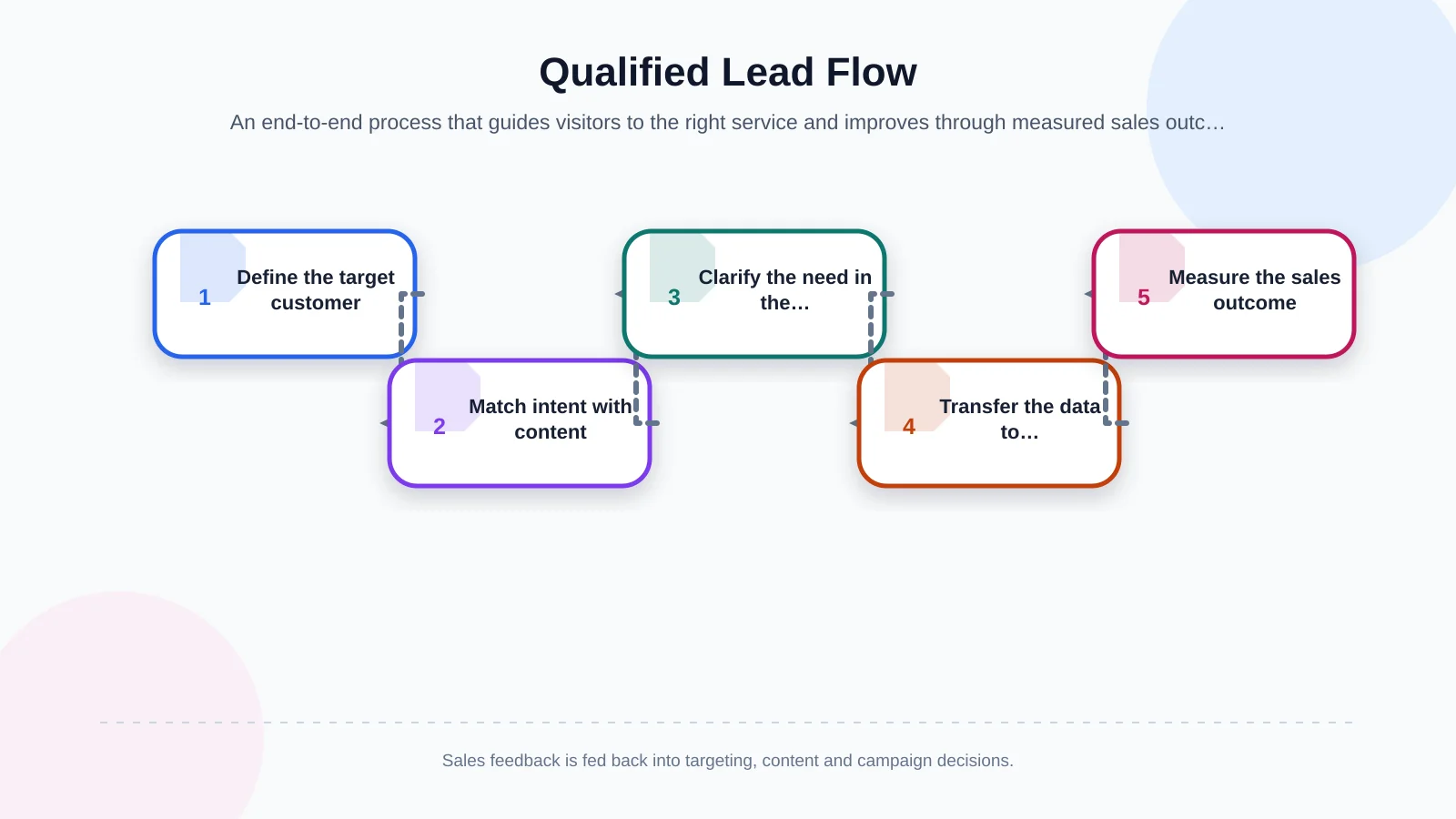
1. Define the ideal customer profile and qualification criteria
Decide which characteristics genuinely help sales distinguish a promising opportunity: industry, company size, service region, type of need, technical requirements, budget approach or decision timeline. Treating everyone as the target audience usually produces vague messaging and poorly matched enquiries. At the same time, defining the ideal customer too narrowly may hide emerging opportunities. Use criteria to guide prioritisation without turning reasonable exceptions into automatic rejection.
2. Match search intent to the right service
Someone searching for a “corporate website redesign,” “dealer portal development” or “digital brand consultancy” does not have the same expectations. Each journey should clearly explain the problem addressed, the proposed approach, likely scope, supporting evidence and next action. Avoid sending distinct search intents to one generic page. A relevant landing experience makes it easier for visitors to self-select and helps prevent enquiries based on an incorrect understanding of the service.
3. Publish content that supports a decision
A B2B visitor is rarely ready to request a quote immediately. They may first need to understand the agency’s approach, the likely project scope, possible integrations and the capabilities of the team. Service explanations, project examples, process pages, scope guides and FAQs reduce uncertainty. Content should not exist only to attract traffic; it should help visitors describe their problem, compare possible approaches and decide whether there is a credible fit.
4. Design a quote form that adapts to the need
Rather than presenting every visitor with the same long form, begin by asking which service or need applies and adjust the following questions accordingly. Google Ads’ lead form best practices highlight the value of relevant questions, a clear call to action and more responsive form experiences. The principle applies beyond advertising platforms: ask questions that clarify intent, but remember that every additional field creates effort and may reduce completion.
5. Connect the form to CRM and sales operations
An enquiry should not remain unstructured in an email inbox. Its source, campaign, landing page, service interest, answers and consent records should enter the CRM through consistent fields. Ownership rules, notifications, duplicate handling, validation and an exception queue should also be defined. Kumsal Agency’s guide to website–CRM integration explains how to plan the operational path from form submission to sales follow-up.
6. Feed sales outcomes back into campaigns
Qualification, contact, meeting, proposal, win and loss outcomes should return to the measurement system. Google’s guidance on qualifying lead-form responses shows how eligible answers can support lead labels and qualified-lead reporting. A comparable model can be created for website forms through CRM stages and offline conversion imports. Marketing can then optimise for meaningful outcomes rather than the cheapest form submission.
What information should a quote request form collect?
The purpose of a form is not to conduct the entire sales discovery meeting online. It is to collect enough initial context to route and assess the enquiry. Alongside a name, business email address, company and preferred contact method, useful fields may include service type, a short needs summary, current situation and target timeframe. If budget is relevant, realistic ranges are usually more helpful than using one rigid threshold as an immediate exclusion rule.
A free-text field is valuable, but an unsupported box often produces vague responses such as “I would like more information.” Prompt the visitor with a specific request: “Briefly describe your current situation, the problem you want to solve and the outcome you expect.” File uploads, technical documentation and detailed company data should only be requested when they are genuinely required for the initial assessment.
Progressive profiling and data minimisation
Collect only the information required for the first interaction, then complete the detail during a discovery call or through a secure client environment. The European Commission’s overview of GDPR data-processing principles states that personal data should be collected for specified purposes and limited to what is necessary. Privacy notices, appropriate consent management, retention periods and access controls should be designed into the form workflow from the beginning.
How do the website and content improve lead quality?
To generate qualified enquiries, a website should quickly answer three questions: “Does this company understand my problem?”, “Does it have a credible approach to work of this scope?” and “What happens if I proceed?” A strong digital brand position, clear service architecture and consistent visual language all reinforce trust. Replace broad claims with audience-specific problems, a tangible working method and evidence that helps buyers evaluate suitability.
User experience is also part of lead quality. Mobile compatibility, fast pages, understandable navigation and visible calls to action help visitors reach the information relevant to them. Instead of repeating the same “Get a Quote” button everywhere, use contextual actions such as “Share your project scope,” “Let’s assess your integration requirements” or “Review your website with our team.” A precise CTA sets expectations before a form is opened.
Project references should do more than provide an image gallery. Explain the original challenge, the approach taken, the functions delivered and, where available, verifiable outcomes. Visitors can then compare the example with their own situation. Poor-fit enquiries tend to decline naturally, while prospects with realistic expectations arrive better prepared for discussion.
Lead scoring and the sales handoff model
Lead scoring is more useful when it separates profile fit from behavioural intent instead of producing one unexplained “good” or “bad” decision. Company size, industry and type of need may indicate fit. Viewing specific service pages, reading a relevant case study or completing a detailed form may signal intent. Scores are not facts; they are structured signals that help sales teams decide where to focus first.
Automatic rejection should be reserved for clear rules, such as a request from an unsupported region, an entirely unrelated enquiry or unusable contact information. Borderline cases should remain available for human review. Lower-scoring prospects that may become valuable later can enter an educational content journey, provided that consent, relevance and communication preferences are respected.
The handoff itself needs an agreed service level. Define who owns a new lead, how quickly the first response should occur, what information sales must record and when the record returns to marketing for further nurturing. Without these rules, even a well-qualified enquiry can lose value through delayed or inconsistent follow-up.
Which metrics should lead-focused marketing track?
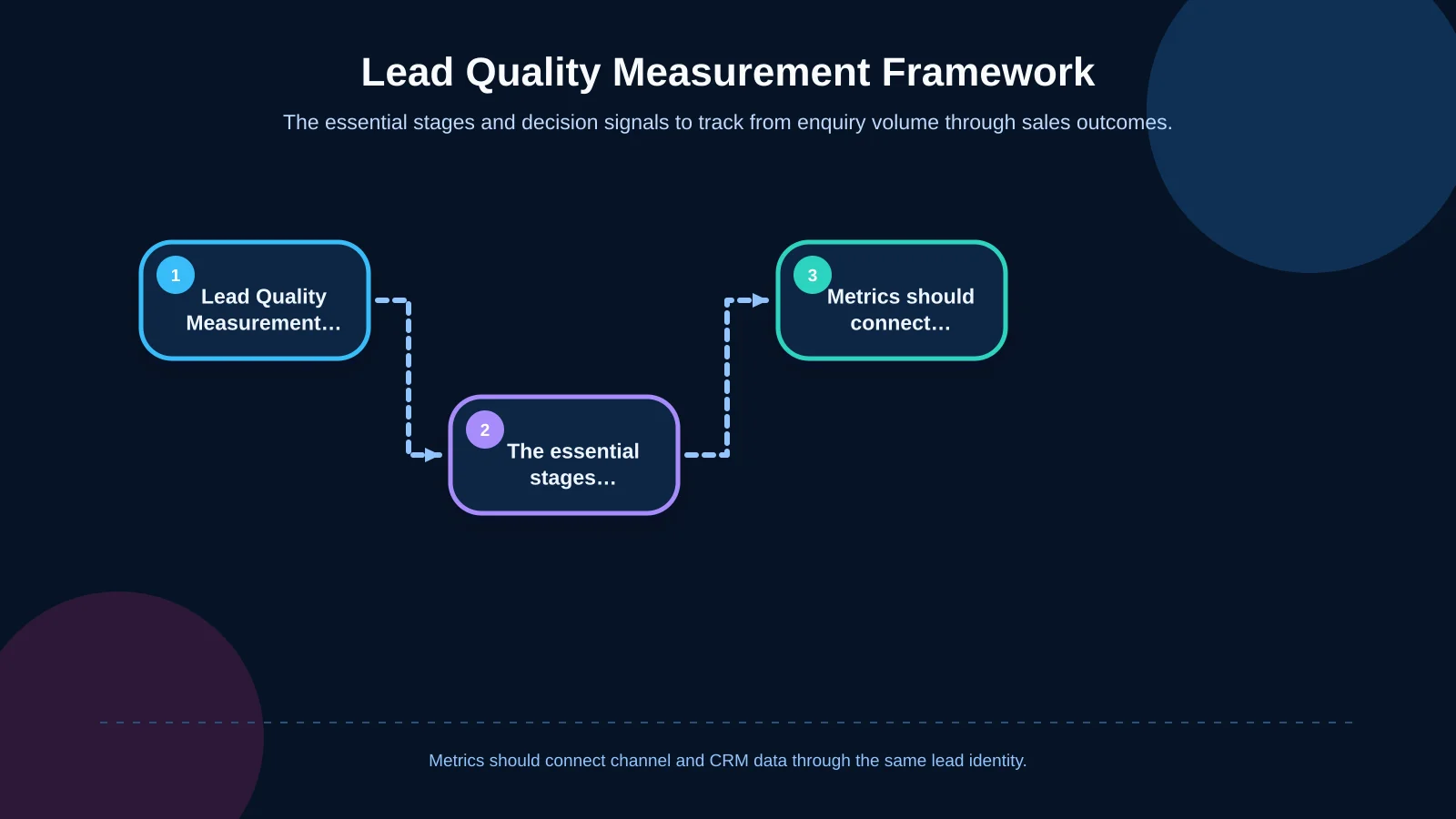
Raw lead volume and form conversion rate are useful starting indicators, but neither explains the business result. Track qualified lead rate, sales acceptance rate, first-response time, meeting conversion, proposal rate, opportunity win rate and cost per qualified lead together. If the sales cycle is long, cohort reporting can compare how enquiries acquired in different months progress and how long they take to mature.
UTM data, landing page, service interest and CRM outcome should be associated with the same lead identity in channel and campaign reports. Review form abandonment by field, while ensuring that behavioural analytics tools comply with privacy and consent requirements. The dashboard should give marketing and sales a shared view based on the same definitions rather than competing versions of performance.
Interpret the metrics as a connected sequence. A high form conversion rate paired with low sales acceptance may indicate overly broad targeting or insufficient qualification. A strong qualified-lead rate with slow first responses may reveal an ownership problem. A high proposal rate with few wins may point to expectation, scope, pricing or discovery issues rather than a campaign problem.
| Stage | Primary metric | Question answered | Possible action |
|---|---|---|---|
| Enquiry capture | Form conversion rate | Are visitors submitting an enquiry? | Test the page and form |
| Qualification | Qualified lead rate | Are the right enquiries arriving? | Refine targeting and questions |
| Sales acceptance | Acceptance rate and response time | Are leads processed promptly? | Improve assignment workflows |
| Proposal | Meeting and proposal rates | Does the need become an opportunity? | Strengthen content and discovery |
| Acquisition | Win rate and cost | Which channel generates revenue? | Allocate budget by outcome |
Practical tests for improving the system
Testing should extend beyond button colours. Compare service-specific value propositions, page hierarchy, the position of case studies, the order of form questions, single-step versus multi-step forms and the next action offered on the thank-you page. Define the primary metric before each experiment and check whether an increase in form submissions is accompanied by a decline in qualified-lead rate.
Regular sales feedback is one of the most valuable optimisation inputs. Replace broad labels such as “insufficient budget” with standard reasons: needs mismatch, lack of decision authority, poor timing, incomplete technical scope or unreachable contact. These signals can reveal content gaps, improve form questions and sharpen campaign targeting. Review them on a consistent schedule so that isolated opinions do not become permanent rules.
Plan an end-to-end lead-generation system with Kumsal Agency
A system that produces qualified quote requests requires strategy, design, software and measurement to work together. Kumsal Agency is an Istanbul-based digital agency that approaches this system around business goals and real user needs—from research-led digital brand consultancy and information architecture to corporate web design and custom web software. Depending on the project, structured quote forms, CRM and business-process integrations can be planned alongside mobile compatibility, performance, security, privacy and analytics.
The objective is not to push every visitor into a form at any cost. It is to help the right visitor understand their need, reach the relevant service and take a well-informed next step. Contact Kumsal Agency to evaluate your audience, current enquiry points and sales process, and to plan a website and digital marketing structure designed to generate qualified, assessable and trackable quote requests.