


Aydınlatma metni yükleniyor…
E-commerce SEO success requires much more than publishing a few category descriptions or adding keywords to product titles. Organic sales happen when the right customer reaches the right category, can compare relevant products and completes the buying journey without technical or usability barriers. Category architecture, filters, content, page performance, product data and analytics must therefore support the same commercial goals.
An e-commerce SEO agency treats these areas as parts of one growth system rather than unrelated tasks. The objective is not simply to rank for a collection of keywords. A store must earn visibility for commercially valuable searches, attract qualified visits and provide an experience capable of converting that demand into revenue. The agency’s contribution becomes meaningful when rankings, traffic, customer behaviour and sales are evaluated together.
Which problems does an e-commerce SEO agency solve?
SEO challenges in e-commerce commonly cross team boundaries. Marketing may request a new category while developers manage filter URLs, content specialists prepare descriptions and the product team updates prices and availability. Without a shared roadmap, pages aimed at the same search intent can compete against one another. Important products may also become difficult to crawl, or visitors may reach a well-ranking page that does not meet their needs.
An agency’s central responsibility is to bring SEO, user experience, development and measurement requirements into a prioritised programme. This begins with an assessment of existing visibility, category revenue, index coverage, site architecture, filter behaviour, page templates and the conversion funnel. Quick opportunities can then be separated from longer-term improvements that depend on design or development work.
- Identify categories and search queries with strong commercial potential.
- Define distinct roles for category, subcategory, product and editorial pages.
- Audit URLs created by filters, sorting, variants and pagination.
- Improve category templates for both product discovery and search relevance.
- Connect organic visits with product views, basket activity and completed sales.
A working model for improving category rankings
A sound project does not begin with a keyword list and end with a ranking report. It starts by establishing commercial priorities and a reliable baseline. Architecture, content and technical changes are then implemented in a controlled sequence. Their impact is assessed through organic visibility, user behaviour and revenue rather than rankings alone.
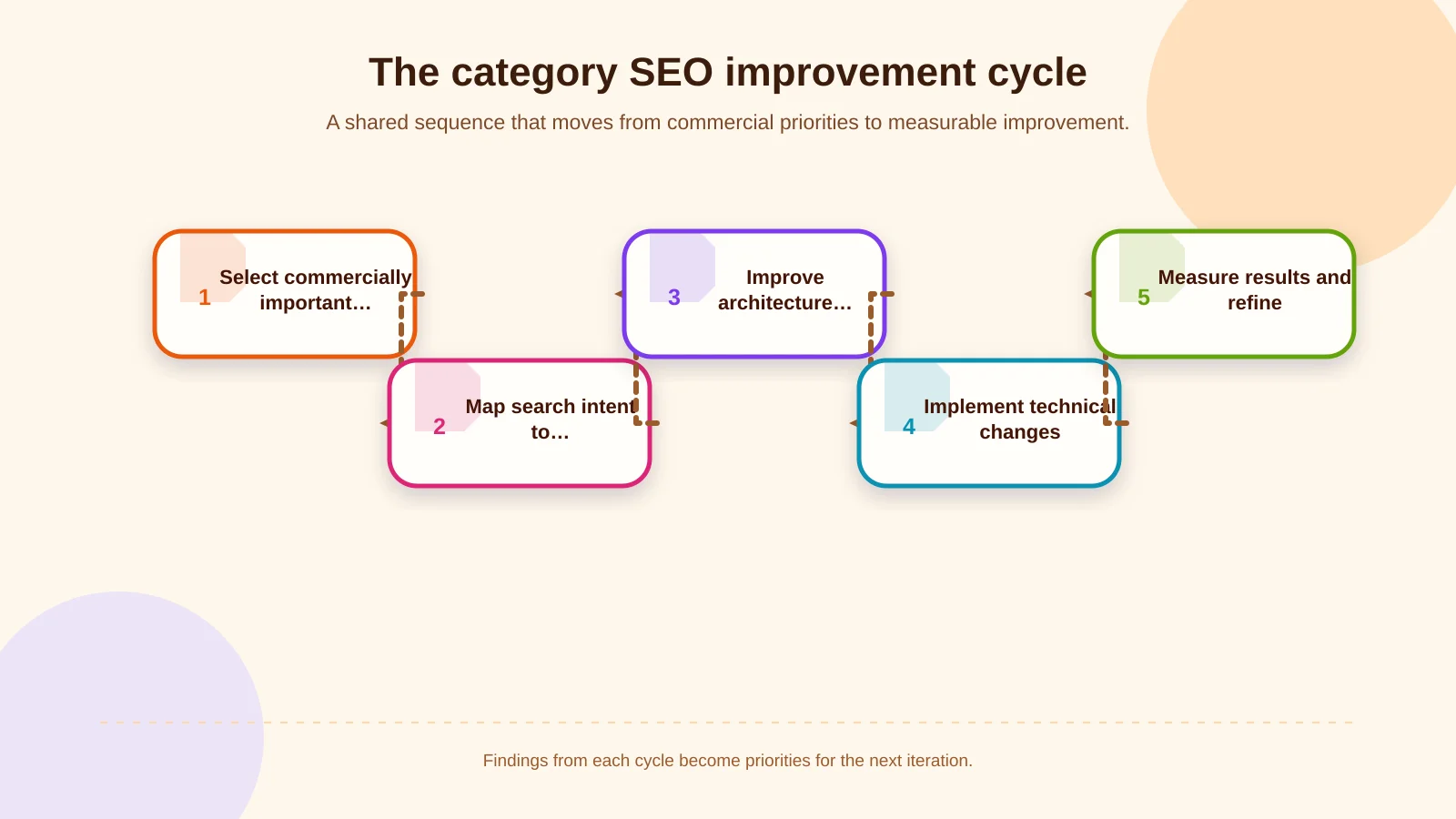
1. Define commercial goals and establish a baseline
Not every category has equal value. Some generate substantial revenue, while others play a strategic role in acquiring new customers. An agency evaluates revenue, margin, inventory, seasonality, competition and search demand together. This prevents the roadmap from favouring high-volume phrases that attract attention but contribute little commercial value.
The baseline should record impressions, clicks, average position, organic sessions, product views, add-to-basket events and revenue by category. These measurements make it possible to compare performance after changes are released. They also help teams distinguish real improvement from seasonal demand, promotional activity or changes in stock.
2. Match search intent to the right page type
“Running shoes,” “waterproof men’s running shoes” and the name of a particular model represent different intentions. The first may belong to a main category. The second may justify a subcategory if demand is durable and the product range is sufficiently broad. A model search will usually be best served by its product page, while research-led queries may require a guide or editorial article.
Without this mapping, similar pages can compete for the same query. The agency assigns one primary destination to each significant query cluster, then aligns headings, core copy, internal links and the product assortment with that role. The resulting category page makes a clear promise to customers and search engines.
3. Implement architectural and template improvements
SEO recommendations affect sales only when they are implemented correctly in design and software. Teams must consider where introductory copy appears, how mobile filters behave, which details product cards display, how images load and how stock status is communicated. SEO, e-commerce design and development therefore need to share one roadmap.
Product information must also remain consistent enough to support useful filters, comparisons and landing pages. A structured approach to attributes and channel-ready data is explored further in this guide to product information management.
4. Test, measure and improve
After implementation, the team should not monitor total organic traffic alone. For every changed URL group, it should compare indexation, query coverage, ranking distribution and commercial behaviour. Seasonal demand, campaigns, pricing and stock movements must be documented because they can influence the outcome. If the evidence does not match expectations, the page’s role, content coverage, internal links or technical implementation should be reviewed.
How category and product architecture affects organic visibility
The category hierarchy is the backbone of product discovery and crawlability. Main categories, subcategories and products need clear relationships, while important pages should be accessible through navigation and relevant contextual links. Google’s guidance on e-commerce site structure explains that Google uses the relationships between linked pages to understand a site’s structure and their relative importance.
Products accessible only through an internal search box are therefore not enough. Category pages, pagination and crawlable links should give search engines and customers dependable routes to the catalogue. Priority categories can receive support from the main navigation, home page, related categories and buying guides. Links should reflect genuine customer journeys instead of sending every page to every category.
Good architecture reduces unnecessary depth and limits the creation of nearly identical categories. Before launching a new category, teams should confirm that it has independent search demand, a distinct assortment, a useful proposition and sustainable inventory. Without these conditions, another page may divide existing authority rather than create additional visibility.
Why filter and URL management is critical
Filters for colour, size, brand, price, intended use and technical features help shoppers find suitable products. However, allowing every combination to produce an indexable URL can create a large number of low-value or near-duplicate pages. An agency distinguishes between filters required for the customer experience and permanent landing pages worth presenting to search engines.
Google’s recommendations for e-commerce URL structures advise reducing alternative URLs that return the same content, using persistent and descriptive addresses, and maintaining consistency across internal links, sitemaps and canonical signals. Parameter order, canonical rules, robots directives, sitemap coverage, pagination and product variants must consequently be reviewed as one system.
- Filter combinations with lasting demand may become curated subcategories.
- Sorting, session and temporary campaign parameters may be kept out of the index.
- Indexable pages should have distinct titles, useful copy, an appropriate product set and internal links.
- Empty combinations and pages containing too few products should be checked regularly.
One universal rule rarely works for every filter. A brand filter may satisfy a separate pattern of demand, whereas changing the price order generally does not justify another landing page. Search intent, assortment depth and the technical cost of maintaining the page should guide each decision.
How to create category content aligned with search intent
The purpose of category copy is not to repeat keywords. It should help customers make a confident choice. Visitors need to understand which product type suits their requirements, why key features matter, how the alternatives differ and what relevant delivery or return conditions apply. A concise category introduction can appear near the product list, with selection criteria, use cases and frequently asked questions placed further down the page.
Content planning should draw on search results, internal search data, customer-service questions and real product attributes. Copy must not push the product range out of view or interrupt the mobile shopping journey. When content strategy is planned alongside interface decisions and product data, the page becomes a practical selection tool instead of a block of generic SEO text.
How technical performance supports the buying journey
Slow images, delayed filter responses and shifting buttons weaken both product discovery and customer confidence. The web.dev guide to Web Vitals defines LCP for loading performance, INP for responsiveness and CLS for visual stability. The recommended thresholds should be evaluated at the 75th percentile of real-user data across mobile and desktop.
An agency should not treat these metrics as an isolated ranking formula. Heavy category imagery, third-party scripts, tag-manager load, client-side filtering, caching and server response times all require investigation. The objective is a store that search engines can access and customers can use quickly. Performance work should also be compared with behaviour across product listings, baskets and checkout so that technical gains remain connected to business outcomes.
Which metrics measure the impact on organic sales?
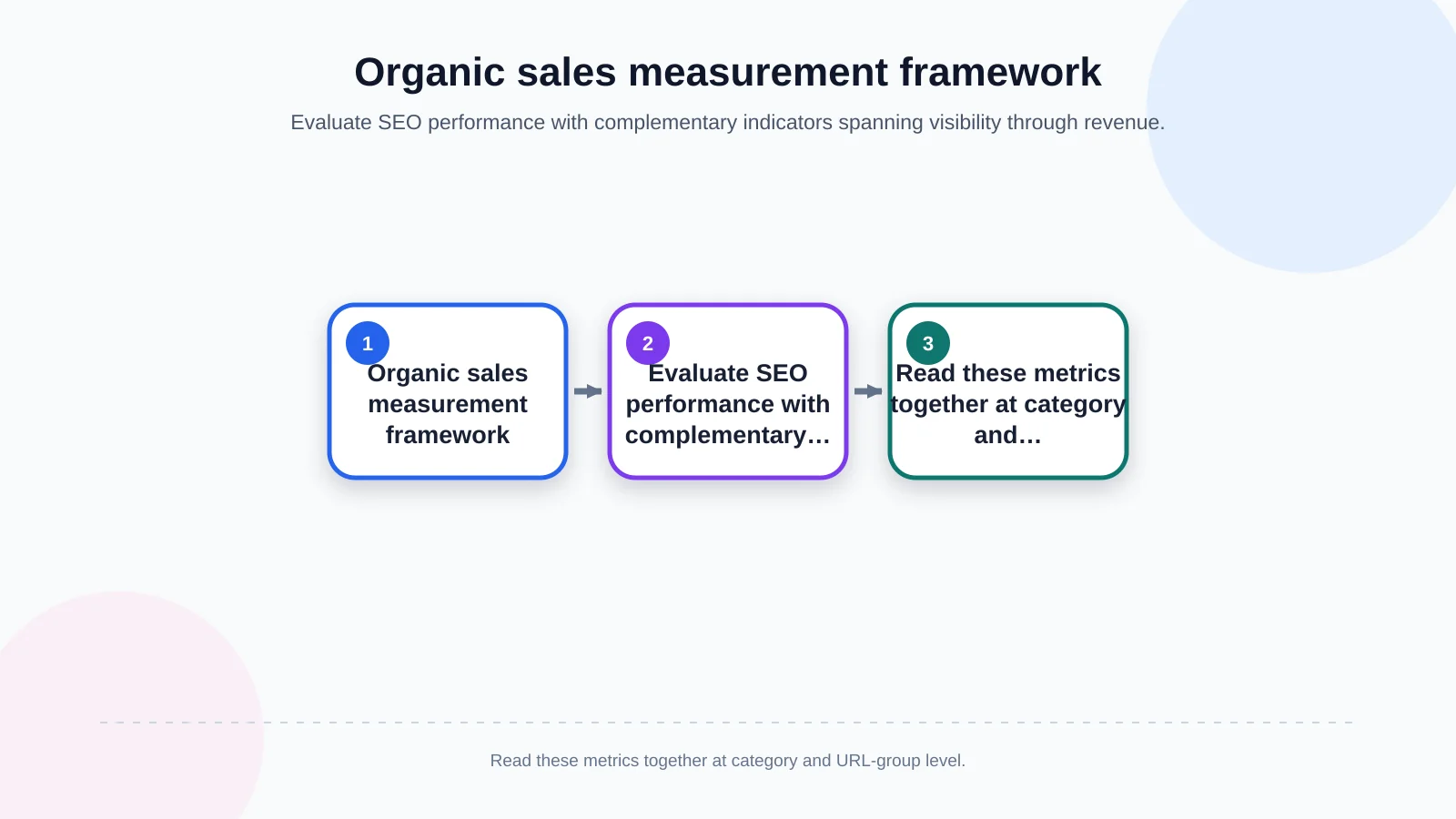
Judging SEO through total sessions or the positions of a few keywords can be misleading. Branded demand, seasonality and promotions may improve visibility without proving that the category strategy is working. Measurement should instead follow a layered path from search demand to revenue.
- Visibility: non-brand impressions and clicks, ranking distribution and the number of relevant visible queries.
- Page quality: indexed target URLs, duplicate pages and crawl or rendering issues.
- Behaviour: product views, filter usage, listing clicks and add-to-basket activity.
- Commercial results: organic conversion rate, transactions, revenue and, where available, profit contribution.
Category-level dashboards reveal which pages gain traffic without producing sales and which create significant value from limited demand. Analytics events, revenue and search performance should use the same URL classification. Results should also be segmented by release date, device, new or returning visitor and non-brand searches whenever the data permits.
| Layer | Core metric | Question answered |
|---|---|---|
| Visibility | Non-brand clicks | Are we reaching the right demand? |
| Technical quality | Target URL indexation rate | Can search engines access important pages? |
| Behaviour | Product and basket interactions | Are visitors progressing towards a purchase? |
| Commercial result | Organic transactions and revenue | Is visibility converting into sales? |
How to choose the right e-commerce SEO agency
The right partner should do more than deliver an audit document. It must explain how recommendations can be implemented across design, software, content and commercial operations. Ask how the team prioritises categories, handles filter scenarios, collaborates with developers and connects organic performance to revenue.
Kumsal Agency is an Istanbul-based digital agency combining e-commerce platform design and development, SEO, digital marketing, custom web software and research-led digital brand consulting. Its approach focuses on creating fast, clear and manageable shopping experiences from product discovery through checkout, supported by strong software architecture, data security and sustainable user experience. This integrated capability helps turn recommendations into functional category templates and measurable customer journeys.
No agency can guarantee a particular ranking or increase in sales. Competition, demand, prices, inventory, brand strength and changes to search systems all affect performance. A responsible programme records its assumptions, introduces controlled improvements to priority URL groups and updates the roadmap according to evidence.
Turn SEO into an organic sales system
Sustainable gains in category rankings depend on page architecture, controlled filters, intent-led content, technical performance and dependable measurement working together. An e-commerce SEO agency connects these disciplines to commercial priorities, giving marketing, product, design and development teams a shared direction.
Contact Kumsal Agency to assess your e-commerce site’s category structure, technical foundation, user experience and organic sales opportunities as one connected system.