


Aydınlatma metni yükleniyor…
Off-the-shelf e-commerce platforms can be an effective way to launch a standard sales model quickly while keeping initial costs under control. When products, pricing, customer roles, order workflows or data exchanges with enterprise systems become more specialised, however, the platform’s limitations may become increasingly visible. Teams can find themselves adapting business processes to the software, transferring data manually between tools or relying on temporary plug-ins that add complexity without resolving the underlying problem.
Custom e-commerce software is not automatically a better alternative to every packaged platform. Its value becomes clearer when requirements that standard features cannot support begin to cause lost revenue, operational workload or barriers to growth. A well-planned custom platform can shape the experience from product discovery to payment around the company’s actual sales model, while bringing inventory, pricing, orders and financial processes into a manageable operational system.
What is custom e-commerce software?
Custom e-commerce software is a digital commerce platform whose catalogue, search, customer accounts, pricing, promotions, basket, payment, order and administration capabilities are designed around the needs of a specific brand. “Custom” does not mean that every component must be built from scratch. Reliable payment providers, logistics services and existing enterprise systems can still be connected through appropriate APIs. The difference is that these components are assembled around a defined customer journey and operating model instead of being added without a coherent product strategy.
The scope extends beyond the storefront interface. The administration panel, user permissions, data model, integrations, performance, security and maintenance responsibilities are also treated as parts of the product. The result should be more than a website that accepts orders: it should be a measurable and extensible sales channel through which different teams can work with consistent data.
When is a packaged platform enough, and when does custom software make sense?
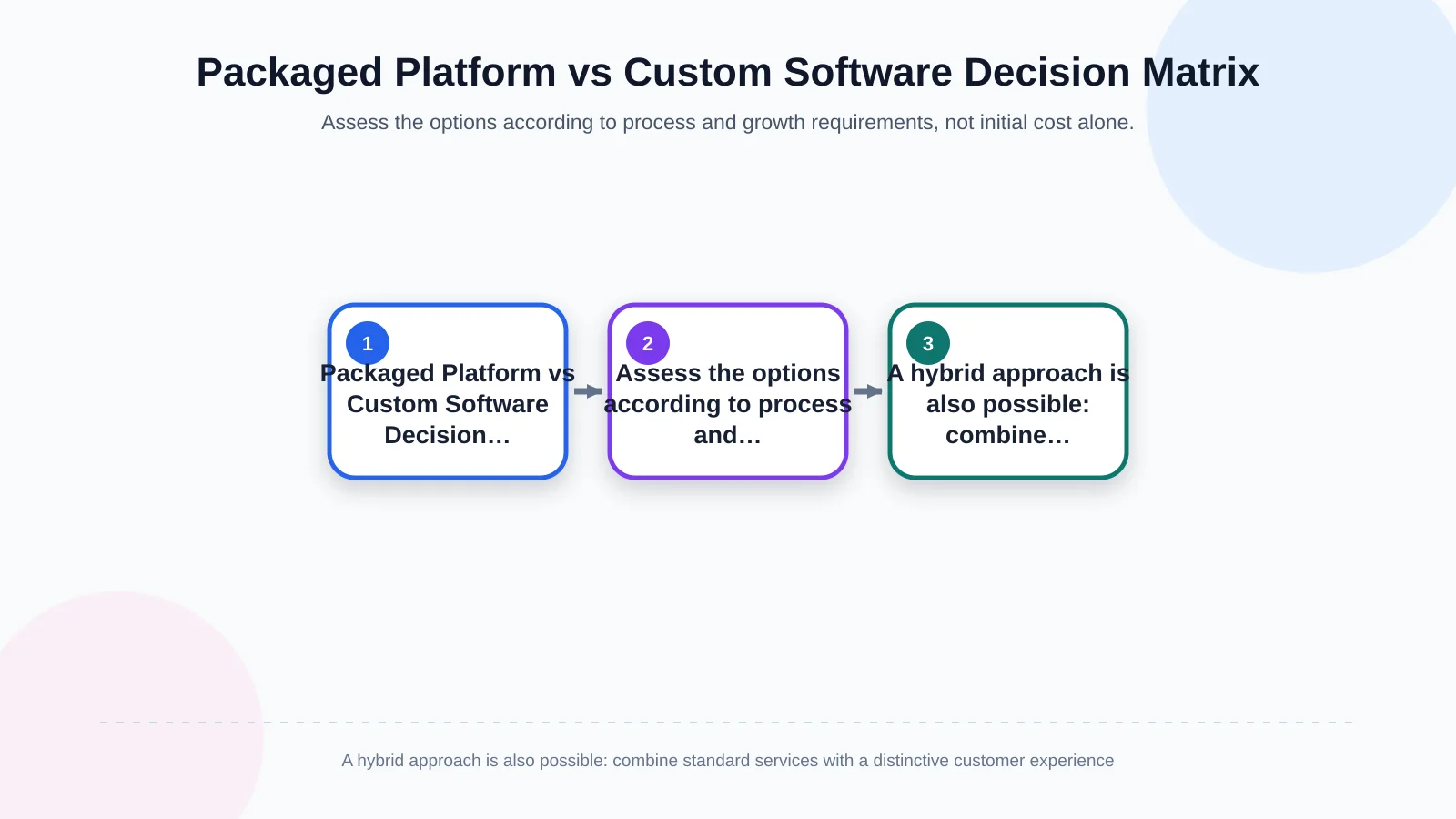
A packaged platform is often the faster and more economical choice for a business with a limited catalogue, straightforward pricing, few integrations and a standard purchase flow. Custom development should address a demonstrated business requirement, not merely create visual differentiation. A feasibility assessment may be appropriate when several of the following conditions persist:
- Prices or discounts vary by customer group, contract, region, quantity or sales channel.
- Products require configuration or quotation, or involve complex compatibility rules.
- Bidirectional data flows are needed between ERP, PIM, CRM, warehouse, marketplace or multiple payment systems.
- Standard themes and plug-ins restrict product discovery or checkout.
- Manual entry, duplicate records and inconsistencies between systems increase operating costs.
- Performance or manageability deteriorates as traffic, catalogue size or order volume grows.
If product information must be managed across several channels, redesigning the storefront alone may not solve the problem. A product information management strategy may also need to be included so data ownership, content quality, localisation and channel distribution are clearly governed.
Key benefits of custom e-commerce software
A customer experience aligned with the sales model
A packaged theme is designed for common requirements. A custom experience can instead reflect how the brand’s customers research, compare and purchase products. Search and filters can follow meaningful product attributes, comparison tools can support technical catalogues, and repeat buyers can access faster ordering paths. B2B commerce may prioritise account balances, contract pricing, bulk entry and approval rules, while B2C commerce may focus on personalised discovery, campaigns and a frictionless checkout.
Checkout deserves particular attention. Baymard Institute’s extensive checkout usability research shows that even major e-commerce sites have many opportunities for improvement. The advantage of custom software is therefore not the ability to add more fields or features. It is the ability to remove unnecessary effort, present the right information at the right moment and provide clear feedback when a payment or validation error occurs.
A distinctive and consistent brand interface
A brand experience involves more than replacing colours and a logo. It is shaped by content hierarchy, product presentation, microcopy, interactions and the trust signals shown during checkout. Planning user experience and interface design together with development reduces the gap between a marketing promise and the actual purchasing process.
Mobile support should also be treated as a primary usage scenario rather than a desktop interface reduced to a smaller screen. Navigation, touch targets, forms, product media, payment methods and performance can all be designed around the constraints and expectations of mobile customers.
Operational efficiency and manageability
A significant share of ROI can come from reducing hidden operating costs, not only from increasing conversion. Manually transferring orders into an ERP, checking inventory across channels, updating price lists in spreadsheets and correcting inconsistent records all consume employee time and create opportunities for error. When integrations define authoritative data sources, processing order and failure handling, repetitive work can be automated more reliably.
A brand-specific administration panel can support real business roles rather than exposing every function to every user. Content teams can manage product presentation, sales teams can handle pricing and order exceptions, and operations teams can control fulfilment statuses within their permissions. Approval records and activity histories make it possible to see who changed an item, what changed and when.
For organisations with complex purchasing controls, an auditable B2B order approval workflow can also connect roles, spending limits, delegation and exceptions to the wider commerce lifecycle.
ERP, inventory, sales and payment integrations
Integration involves more than sending data between two applications. The team must determine which system owns product, price, stock and customer records; how frequently updates should occur; how failed transactions will be retried; and when people should be alerted. Website order creation, payment confirmation, ERP posting, stock reservation and shipment notification should be designed as one end-to-end process.
Custom development allows this flow to reflect the company’s existing structure, but every connection does not need to operate in real time. Critical stock and payment events may require immediate processing, while some reporting data can be transferred on a schedule. The right architecture is not the most technically elaborate one; it is the one that matches business risk, volume and required data freshness.
Performance and scalability
A custom architecture can account for catalogue size, traffic patterns, campaign peaks and integration load. Measurable performance targets can be established for image optimisation, caching, search infrastructure, database queries and third-party scripts. A Rakuten 24 case study published on web.dev demonstrates how the relationship between web performance, conversion and revenue per visitor can be monitored through real-user data. Its results should not be applied directly to every company; each brand should validate the commercial effect of performance improvements through its own analytics.
Data security and sustainable development
Custom software provides greater control, but it also creates greater responsibility for security and maintenance. Authentication, role-based authorisation, encryption, logging, backups, dependency updates and incident response should be planned from the start. The OWASP Application Security Verification Standard offers an open framework for defining secure-development requirements and testing technical security controls in web applications.
Testing should cover integrations, permissions, load, mobile devices and common browsers as well as functional scenarios. After launch, a clear support plan should define monitoring, issue ownership, security updates and the development roadmap. These practices help preserve the value of the initial investment as technology, traffic and business requirements change.
How is ROI calculated for custom e-commerce software?
ROI should not be reduced to the question, “Did sales increase after launch?” Revenue growth, cost savings, avoided losses and total cost of ownership should be evaluated together. In a simplified model, additional gross profit and operational savings generated during a defined period are added together. Development, licences, infrastructure, maintenance and internal team costs are then deducted. The resulting net benefit is divided by the total investment cost to calculate ROI.
For example, a higher conversion rate may generate additional revenue, but an evaluation based on revenue alone is misleading if product margins are excluded. Similarly, saving 100 staff hours per month creates economic value only when the saved capacity is genuinely removed from cost or redirected towards more valuable work. The measurement model should therefore use assumptions agreed by finance, operations, e-commerce and technology teams.
Core metrics to monitor
- Conversion rate, add-to-basket rate and checkout completion rate.
- Mobile and desktop revenue, average order value and gross profit per customer.
- Product-finding and purchase success among visitors who use search.
- Manual processing time and operating cost per order.
- Error and cancellation rates caused by inventory, pricing or customer data.
- Integration success rate, incident resolution time and system availability.
- Page performance, technical error rates at critical steps and support request volume.
- Total cost of ownership, including licences, plug-ins, infrastructure, maintenance and development.
These metrics should be recorded before development begins to establish a credible baseline. The same definitions can then be used for reviews 30, 90 and 180 days after launch. Before-and-after comparisons may produce misleading conclusions if campaign intensity, seasonality, price changes and traffic sources are not considered.
| Assessment area | Packaged platform is more suitable | Custom software is more suitable |
|---|---|---|
| Sales model | Standard catalogue and checkout | Special pricing, quotations or approvals |
| Integration | Few, simple connections | ERP, PIM, CRM and warehouse workflows |
| Experience | Theme adaptation is sufficient | Distinctive discovery and checkout journey |
| Scale | Predictable volume | High volume and complex operations |
| Cost priority | Lower initial investment | Long-term efficiency and control |
What should total cost of ownership include?
Comparing proposals solely by their initial development fee provides an incomplete picture. Discovery, analysis, UX/UI design, software development, data migration, integrations, testing, cloud infrastructure, monitoring, security, maintenance and future releases all contribute to total cost. The time internal teams spend on analysis, content, product-data cleaning and acceptance testing should also be made visible.
Packaged systems may have a lower entry cost, while growing subscription fees, transaction commissions, paid extensions, external automation services and manual labour can alter their long-term economics. A custom system requires a larger initial investment and an ongoing maintenance commitment. A sound decision compares the costs and business value of both approaches across three- to five-year scenarios.
How should the project scope be defined?
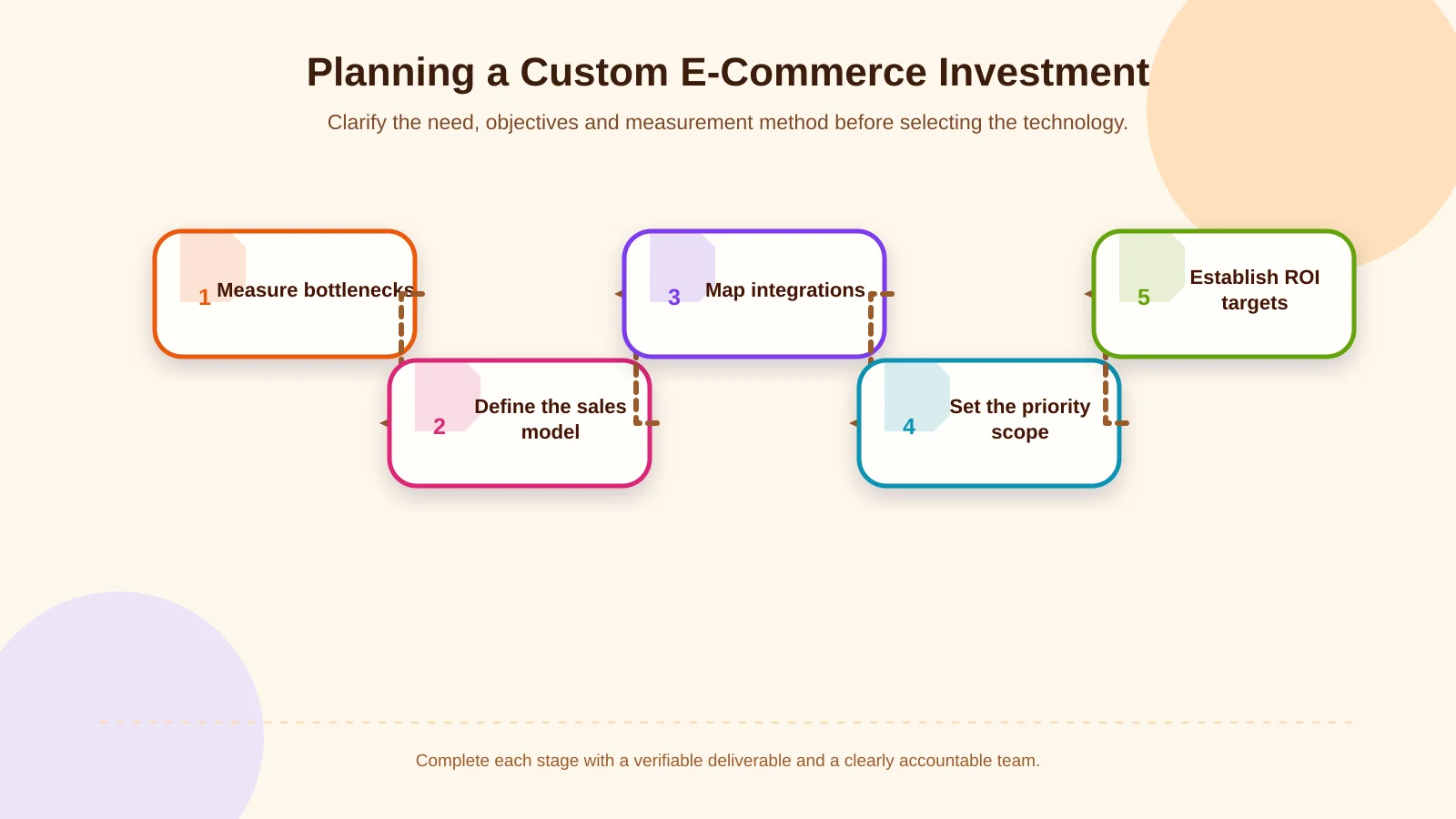
The starting point should be the business problem, not a feature list. Teams should investigate customer segments, purchase scenarios, existing applications, data ownership and operational bottlenecks. Requirements can then be prioritised according to revenue impact, operational benefit, risk and implementation effort.
The first release does not need to include every conceivable function. It can focus on a dependable core customer journey and the integrations essential to fulfilling orders. Later improvements can then be guided by real usage data. Defining acceptance criteria, performance budgets, security controls and integration-failure scenarios during contracting also reduces ambiguity about scope.
Kumsal Agency approaches e-commerce platforms as manageable digital products that bring together brand identity, user experience, custom software, data and business processes—not simply as visual storefronts. The agency plans project-specific web software, responsive interfaces, administration panels and enterprise integrations around the same target operating model.
How should you choose a technology partner?
A technology partner should not be assessed only by the programming languages it uses. The team should be able to analyse business processes, connect user research to technical architecture and define integration responsibilities clearly. Proposals should explain deliverables, exclusions, source-code and intellectual-property terms, testing methods, documentation, infrastructure ownership, support periods and service levels.
Code quality, version control, deployment practices and technical documentation should also be evaluated so another qualified team could maintain the platform if necessary. Sustainable custom software should not be a closed system that creates avoidable supplier dependency. Its decisions should be documented, its components observable and its architecture capable of controlled evolution.
Conclusion: Custom software should be a measurable business investment
The value of custom e-commerce software is measured by the business problems it solves, not by the number of features it contains. Clearer product discovery and checkout can support conversion; automation and integrations can improve operational efficiency; and an appropriate architecture, security model and support plan can strengthen long-term sustainability. For a business with standard requirements, however, a packaged platform may remain the better choice. The decision should be based on measurable needs and total cost of ownership rather than technology trends.
Evaluate your sales model, user needs, operational processes and integration requirements with Kumsal Agency to define the scope and investment objectives of a custom e-commerce project.