


Aydınlatma metni yükleniyor…
For heavy machinery, commercial vehicles and automotive spare parts, the central challenge of digital sales is not simply displaying products online. It is matching the correct part with the correct vehicle or machine—and with the right business customer. Components that look identical may differ by model year, engine option, production series, axle type or equipment variant. Conventional category navigation and product-name searches are therefore rarely sufficient for professional procurement.
A B2B platform that places the vehicle identification number (VIN), OEM code and technical product attributes at the centre of the ordering experience can help buyers avoid irrelevant choices. When designed correctly, it allows dealers, service organisations and fleet customers to find suitable parts faster. It can also reduce the sales team’s repetitive compatibility checks and lower the risk of incorrect orders and returns. Achieving these outcomes requires the search experience, data model, pricing logic and ERP integration to be designed as one connected system.
What is VIN- and OEM-coded B2B e-commerce?
A VIN is a structured identifier used for road vehicles. The ISO 3779 standard defines VIN content and structure with the aim of supporting a common vehicle identification system worldwide. The US National Highway Traffic Safety Administration also explains that vehicles covered by its regulations use a 17-character VIN that encodes specific information. However, the fields available from a VIN may vary by market, manufacturer and data source. A platform should not imply that every character can automatically produce a definitive spare-part match.
An OEM code helps identify a component within the manufacturer’s parts ecosystem. Code lookup alone is not dependable unless the system also manages superseded numbers, replacement parts, kit-to-component relationships, cross-references between brands and variations in formatting. VIN- and OEM-coded B2B e-commerce combines these identifiers with product attributes, compatibility records, commercial rules and enterprise workflows.
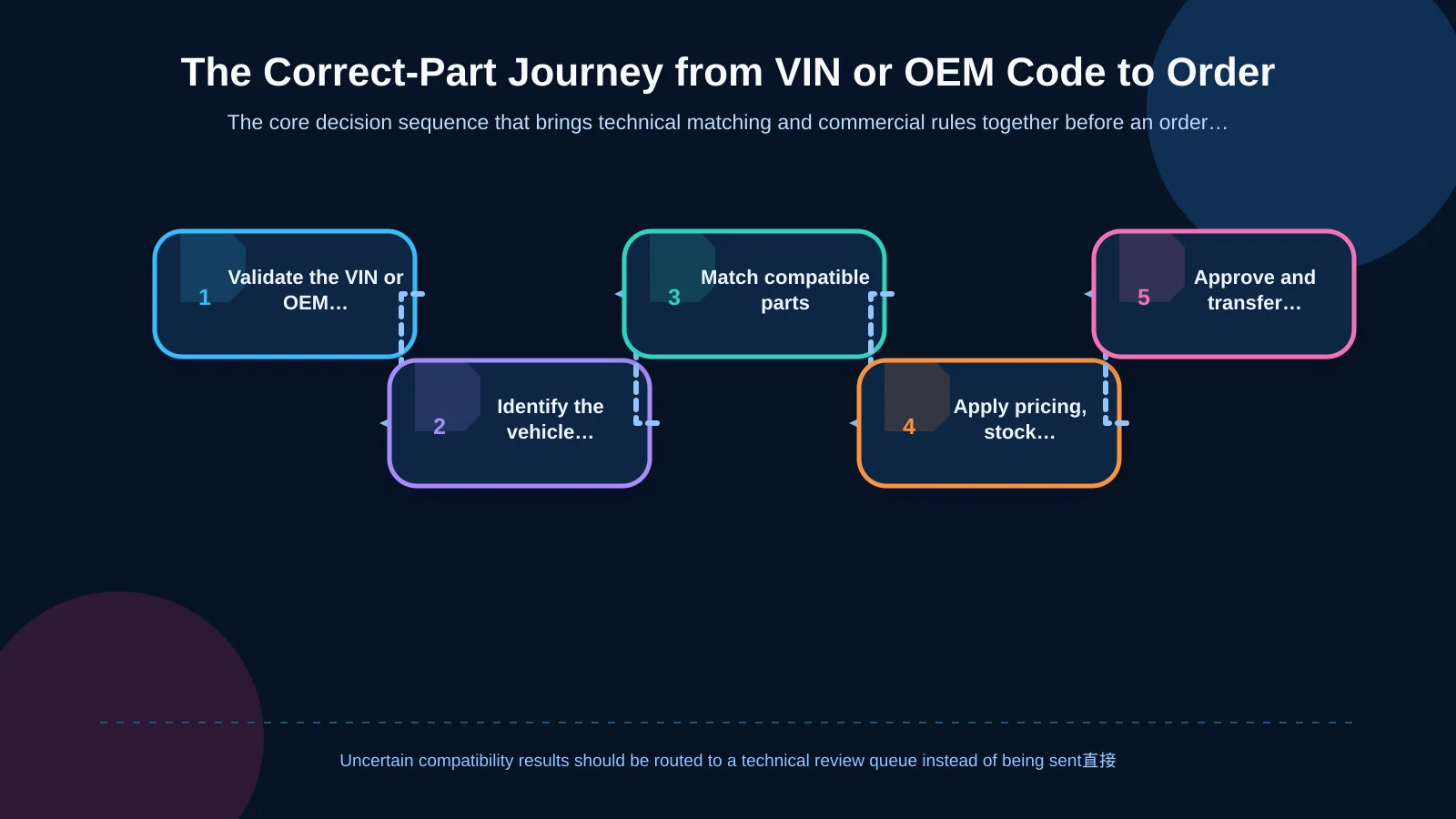
How should the correct-part discovery experience work?
1. Validate and normalise the input
A buyer may search with a VIN, OEM code, stock-keeping unit, manufacturer reference or free text. The platform should normalise spaces, hyphens, letter case and common formatting variations while flagging invalid inputs early. When a VIN is entered, the interface should create a visible vehicle or machine profile containing the available make, model, production period, engine, transmission, chassis type and other relevant attributes.
The NHTSA VIN Decoder, for example, states that its results are based on information reported by manufacturers. This illustrates why a commercial platform should record the source, coverage and latest update date of its identification data rather than presenting all decoded information as universally complete.
2. Explain why a part matches
Showing a product in the results is not enough. Buyers should be able to understand why it is considered compatible. Supporting evidence might include an engine-code match, production-date range, axle or cab variant, serial-number threshold or OEM cross-reference. If the result is not definitive, the system can use levels such as “compatible,” “conditionally compatible” and “technical verification required.” This prevents uncertainty from being presented as false confidence.
3. Manage alternatives and superseded parts
A requested code may have been discontinued, replaced by a newer number or associated with an equivalent aftermarket product. The platform should explain old-to-new code relationships, distinguish genuine from equivalent parts, list kit contents and identify required complementary components. Alternatives should be ranked according to technical compatibility and the customer’s contracted product policy—not merely according to commercial priority.
Why product information architecture is the foundation
On an effective spare-parts platform, a product record contains far more than a name, price and image. OEM and brand codes, dimensions, material, installation orientation, vehicle or machine compatibility, production ranges, documents, images, pack quantity and logistics data should all be held in structured fields. Modelling parts, assets and compatibility relationships as separate entities prevents the same information from being repeated—and potentially contradicted—across thousands of products.
Data ownership must also be explicit. Which attributes come from the ERP, which originate in manufacturer catalogues, and which are managed in a product information layer? Who approves a change, and how is the previous value retained? A search engine introduced before these questions are resolved will only expose incomplete data more quickly. The broader governance and distribution of product content can be assessed through a product information management strategy.
Customer-specific pricing, stock and permissions
Offering every user the same terms does not reflect B2B commerce. The applicable price may depend on the customer account, dealer group, contract, currency, quantity tier, campaign, payment terms or delivery location. The platform must define the order of precedence for these rules and, within the user’s permissions, explain how the displayed price was determined. A structured decision model for conflicting conditions is explored further in the guide to special pricing and discount rules in dealer portals.
Stock visibility is also more complex than one number. Central and regional warehouses, goods in transit, reserved quantities, supplier lead time and estimated dispatch dates should be distinguished. A dealer may be allowed to see its own location and selected central inventory, while a service manager may compare availability across several sites. Permissions to view prices, create quotations, place orders, request discounts, download documents and initiate returns should be controlled at both role and customer-account level.
From quick entry to purchase approval
Professional buyers often order dozens or hundreds of lines at once. In addition to adding products from individual pages, they need quick entry by OEM or stock code, copy-and-paste support, saved lists and Excel or CSV uploads. Every imported line should be validated for code, quantity, unit, compatibility, sale status, minimum pack, price and stock. Invalid lines should be isolated with understandable explanations instead of causing the entire file to fail. These requirements are covered in more detail in the guide to B2B bulk ordering, Excel uploads and quick order.
Once the basket is ready, the customer’s organisational rules come into effect. Order value, product group, budget, branch, credit exposure or a special discount request may require approval. The people who create the request, verify technical suitability, approve the budget and release the final order may all be different. Delegation, expiry rules, rejection reasons and an audit trail help move this process out of untraceable email chains.
| Stage | Required data | System control | User output |
|---|---|---|---|
| Part search | VIN, OEM code, technical attributes | Format and code validation | Relevant results |
| Compatibility | Model, engine, production range | Rule and exception matching | Compatibility level |
| Commercial terms | Account, contract, inventory | Pricing and permission precedence | Net price and lead time |
| Order | Quantity, credit limit, delivery | Approval and ERP acceptance | Order status |
| After-sales | Shipment, documents, return | Status reconciliation | Traceable process |
How should ERP and external-system integration be designed?
The source of truth for each dataset must be clearly assigned between the B2B platform, ERP and any other connected systems. A data-ownership matrix should cover product master data, customer accounts, credit limits, prices, inventory, orders, dispatch notes, invoices and return statuses. It is not enough for the ERP to generate a document number after submission. Acceptance, partial acceptance, rejection, pending and error states must also be returned to the user.
The choice between real-time, event-driven and scheduled integration should be made for each data type. Prices and available stock may require rapid updates, while technical documents can often be transferred less frequently. Idempotent submission to prevent duplicate orders after a network interruption, along with queues, error logs, retry rules and reconciliation screens, is essential for reliable operations.
After ordering, partial shipments, carrier information, dispatch documents, invoices and proof of delivery should appear in one lifecycle. Returns should connect the VIN or machine record, original order line, return reason, images, serial or lot number and warehouse inspection outcome. This continuity gives sales, service, warehouse teams and customers a shared operational view.
How should the VIN approach adapt to heavy machinery?
Not every piece of heavy equipment uses the same VIN structure or offers the same data coverage as a road vehicle. The chassis number may need to be supplemented by the machine serial number, engine serial number, equipment model, year of manufacture and attachment code. Instead of forcing one vehicle schema on every brand, the platform should use an extensible asset model that can adapt by manufacturer and product family.
A common identification method is a strong starting point for road vehicles, but the compatibility dataset should still be supported by manufacturer catalogues and authorised data sources. The European Union’s Regulation (EU) 2018/858 includes a framework concerning access to vehicle repair and maintenance information. Nevertheless, a legal right of access does not mean that a particular platform automatically possesses every compatibility record. Licensing, permitted uses and contractual terms must be assessed separately.
Security, performance and manageability
Price lists, commercial terms, customer accounts and vehicle records contain sensitive business data. Role-based access, strong authentication, transaction logs, encryption, backups and secure storage of integration credentials should be included in the project scope. Users must never be able to view the prices, documents or orders of a customer account to which they are not assigned.
In catalogues containing tens of thousands of OEM references and compatibility records, search performance directly affects the purchasing experience. Indexing, filtering, caching and update strategies should be planned together. Performance testing must cover VIN decoding, bulk validation and peak ordering periods—not just the home page. The administration interface should also let authorised data teams manage matching rules, code relationships and publishing statuses without depending on developers for routine changes.
Questions to answer when defining the project scope
- Which vehicles, machines, brands and markets will the platform serve?
- Which sources will supply VIN, serial-number and OEM matching data?
- How will compatibility confidence be graded, and who will approve it?
- Which system will be authoritative for pricing, discounts, stock and credit rules?
- Which roles may create quotations, order, approve, access documents or open returns?
- Are integrations required with PIM, CRM, payments, carriers or manufacturer catalogues in addition to ERP?
- Will success be measured through search time, match rate, incorrect orders, returns or manual processing time?
The answers define the true scope of custom B2B e-commerce and web software, which is significantly different from deploying a standard online catalogue. A manageable first release usually concentrates on the most frequently used brands, product groups and ordering scenarios. Scope can then expand as product-data quality, compatibility outcomes and integration reliability are measured.
From a digital catalogue to an integrated sales system
VIN- and OEM-coded B2B e-commerce is not a matter of adding two fields to a search box. Its value emerges when identity checks, explainable compatibility, structured product information, customer-specific commercial rules, quick ordering, approvals, dispatches and returns operate within the same architecture. Reliable data exchange with the ERP and other required systems can create shared visibility across sales, service, warehouse and customer operations.
Kumsal Agency approaches B2B e-commerce for heavy industry and automotive spare parts as an integrated digital sales system adapted to the organisation’s real processes—not merely as an online catalogue. Contact Kumsal Agency to analyse your VIN- and OEM-based parts sales processes, user roles, product data and ERP integration requirements, and to define the scope of a custom B2B e-commerce platform for your organisation.