


Aydınlatma metni yükleniyor…
When planning an e-commerce investment, two of the most important decisions are which platform will power the store and which software company will deliver it. These choices affect far more than how products appear online. They influence how quickly customers can find what they need, how smoothly they can pay, how orders reach operational teams and how effectively the store can be managed as the business grows.
E-commerce software companies may offer hosted packages, modular and customisable platforms, or solutions built specifically for one organisation. Each approach is strong in different circumstances. The useful question is therefore not “What is the best e-commerce platform?” but “Which approach offers the best fit for our business model, operations and growth plans?”
Where should an e-commerce platform comparison begin?
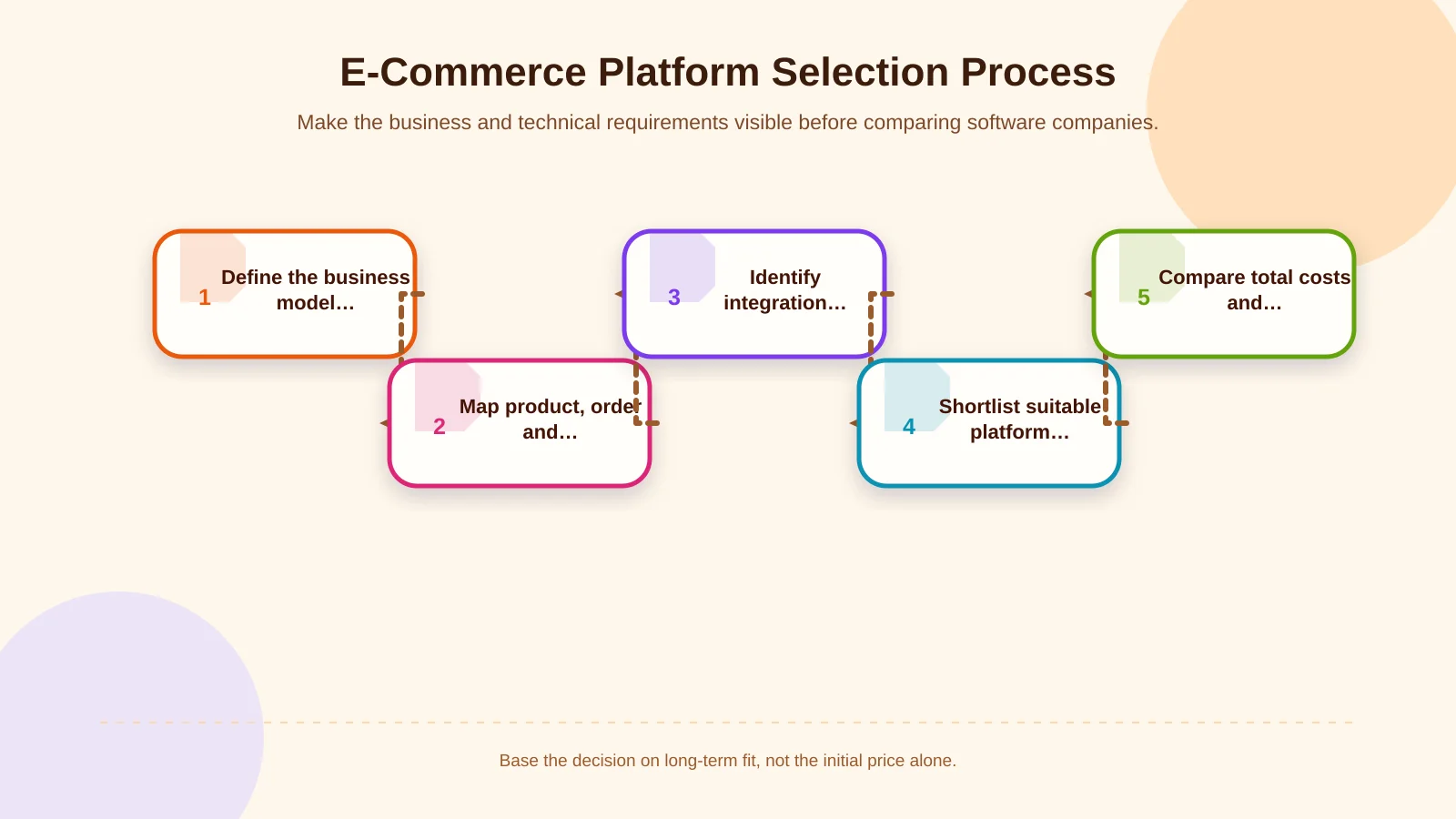
Starting with vendor names or package prices can lead the evaluation in the wrong direction. First document how the business operates today and what it expects to achieve over the next three years. Once product volume, sales models, target markets, order volumes, campaign structures, user roles and integration requirements are visible, the right category of solution becomes easier to identify.
A company with a limited catalogue, standard pricing and a need to launch quickly may be well served by a hosted platform. The same package may soon become restrictive for a business with customer-specific prices, multiple warehouses, unusual ordering rules or an ERP connection. A more customisable platform or bespoke solution may provide a healthier foundation in that case.
Questions to answer before choosing a platform
- Will the business use B2C, B2B, marketplace or subscription models?
- How many products, categories, price lists, languages and currencies must be managed?
- Are connections to ERP, CRM, PIM, accounting, carriers or marketplaces required?
- How specialised are the campaign, payment, return and delivery rules?
- How important is a completely distinctive, brand-led customer experience?
- What technical and content-management capabilities exist in-house?
- How much traffic, order and channel growth is expected within three years?
Who should choose a hosted e-commerce platform?
Hosted platforms bundle common capabilities such as catalogue management, baskets, checkout, basic promotions and delivery integrations. Implementation is usually quicker, while initial costs are relatively predictable. This can make them accessible to businesses that want to begin selling online without first assembling a technical team.
The main advantage is that frequently needed functionality already exists. Hosting, updates and some security responsibilities are generally managed by the provider. However, themes, data models, checkout flows and administration screens can only be changed within the platform’s boundaries. Meeting requirements through numerous extensions may increase licensing costs, dependencies and maintenance work.
Do not assess a hosted platform by its monthly subscription alone. Calculate transaction charges, themes, extensions, integrations, development support, data exports and pricing at higher traffic levels. Establish which formats can be used to export products, customers, orders and content if the agreement ends. This helps prevent a convenient launch from becoming an expensive lock-in later.
What does a customisable platform offer?
Customisable platforms aim to combine a ready-made commerce core with broader development possibilities. The storefront, integrations and selected business rules can be adapted while standard capabilities remain available. This can be a balanced choice for medium-sized or larger businesses with conventional sales processes that still want a distinctive customer experience.
The limits of “customisable” must be defined precisely. Source-code access, API coverage, control over checkout, database flexibility and the survival of custom work through platform updates vary considerably between vendors. Design flexibility demonstrated in a polished sample store does not prove that complex operational rules can be implemented just as easily.
Ask shortlisted providers to configure a representative product, campaign and order scenario. The exercise should cover not only the storefront but also bulk operations, permissions, reporting, error messages and administration. This reveals how daily work will feel after the launch presentation is over.
When is bespoke e-commerce software necessary?
Bespoke development becomes relevant when core processes do not fit standard platform assumptions. Examples include dealer- or customer-specific pricing, quotation-to-order conversion, product configuration, multi-stage approvals, several inventory sources or industry-specific fulfilment rules. Software can then be designed to remove unnecessary steps instead of merely reproducing an awkward existing process.
This approach requires more disciplined discovery, time and investment. In return, its data model, user experience, integration architecture and administration tools can reflect the actual business. When product information is distributed to many channels, commerce planning should also cover PIM and product information management. Otherwise, even an advanced storefront may depend on fragmented or outdated product data.
Bespoke does not mean rebuilding every capability from scratch. Trusted payment, search, notification and analytics services can remain specialist components, while the processes that create competitive value are developed specifically for the brand. A hybrid architecture can direct investment towards meaningful differentiation, although it also requires clear ownership of vendors, interfaces and failures.
How should e-commerce software companies be compared?
Fit with the business model and processes
A provider’s discovery process should examine pricing, stock, orders, returns and customer-service workflows—not just count pages. Its proposal should identify exclusions, assumptions and the treatment of exceptions. A strong solution creates a consistent link between the customer-facing experience and the work that actually happens in the back office.
User experience and original design
Design evaluation should extend beyond the homepage. Search, filtering, comparison, variant selection, account creation, baskets, checkout and order tracking form one connected journey. On mobile screens, suitable touch targets, simple forms and a clear content hierarchy reduce friction and help customers complete purchases.
Brands seeking an original experience should distinguish between recolouring a standard theme and designing around their products, audiences and commercial objectives. Decisions should be informed by research and the catalogue structure, with visual and interaction consistency maintained from discovery through payment and post-purchase communication.
Integration capacity and data ownership
Connections among ERP, CRM, accounting, logistics and marketplace systems are the largely invisible backbone of commerce. Review API documentation, data direction, synchronisation frequency, error logs and retry mechanisms. If enquiries or account requests must reach sales teams, the guide to website–CRM integration and sales follow-up explains relevant questions about field mapping, ownership and exception handling.
The business should retain ownership of its product, customer and order data. Export options, retention and deletion rules, backup responsibilities and the migration plan for changing providers should be documented contractually. Also clarify which system is authoritative for every important field; simply connecting two applications does not resolve conflicting records.
Performance and scalability
Performance is not just a fast server. Image weight, third-party scripts, caching, search architecture and database queries all contribute to the experience. Google’s Web Vitals guidance recommends evaluating real user experience through loading, responsiveness and visual stability. Providers should define measurable targets and explain their load-testing approach for campaigns or seasonal peaks.
Scalability should be considered in operational as well as technical terms. Ask what happens when catalogue size, languages, warehouses, permissions and daily exceptions multiply. A platform that handles more traffic but forces teams into manual work is not scaling effectively.
Security and payment responsibilities
E-commerce security involves more than an SSL certificate or firewall. Access control, patching, logging, backups, vulnerability management and incident response must work together. The OWASP Authentication Cheat Sheet provides a technical reference for practices around sign-in, passwords and account recovery.
Responsibilities require additional scrutiny wherever cardholder data is stored, processed or transmitted. The PCI Security Standards Council defines PCI DSS as a baseline of technical and operational requirements for protecting payment account data. Using a payment provider may reduce scope, but it does not eliminate the store operator’s security and third-party management responsibilities.
Manageability and post-launch support
A good store should not depend on developers for every routine change. Product and commerce teams should be able to manage content, campaigns, categories and redirects safely. Role-based permissions, audit histories, bulk editing and preview functions directly affect operational speed and control.
The support agreement should define service hours, response targets, critical incidents, updates and pricing for new development. Technical documentation, test scenarios, access handover and a responsibility matrix should be explicit deliverables rather than informal promises.
| Approach | Strength | Limitation | Best suited to |
|---|---|---|---|
| Hosted platform | Fast implementation and predictable entry costs | Platform and extension constraints | New stores with standard processes |
| Customisable platform | Ready-made core with design flexibility | Scope for changes depends on the provider | Growing brands seeking differentiation |
| Bespoke software | Close alignment with the business model and greater control | Requires more discovery, time and investment | Integration-heavy projects with distinctive processes |
| Hybrid approach | Combines specialist services with bespoke processes | Requires architectural and vendor management | Projects balancing rapid delivery with differentiation |
Compare proposals through total cost of ownership
The lowest initial price is not necessarily the most economical choice. A three-year total-cost model should include licences, implementation, integrations, hosting, maintenance, extensions, transaction charges, internal team time and eventual migration. It should also model how these figures change as revenue, traffic and order volumes grow.
Likewise, a higher initial investment in bespoke software is not automatically a disadvantage. If it reduces manual work, prevents order errors or enables new sales models, its business impact should be considered alongside cost. Weighting the decision criteria prevents an impressive feature list from obscuring mandatory requirements.
A practical selection method
Separate non-negotiable requirements from preferred features and work that can wait for a later phase. Send every candidate the same scenarios and representative data. Request not only a price but also the proposed architecture, delivery team, timetable, assumptions, exclusions and support model.
Test shortlisted solutions with real tasks. A customer should find and buy a product while an operational user updates it and resolves an order problem. During reference conversations, ask about change management, problem-solving and post-launch collaboration—not only whether the original deadline was met.
How Kumsal Agency approaches e-commerce projects
Kumsal Agency does not treat e-commerce as a basic store installation. As an Istanbul-based digital agency, it considers the brand’s visual world, customer expectations, product discovery, checkout, management needs and back-office systems within one project framework. Research-led digital brand consulting, Art Director-led creative design and strong software infrastructure are aligned around the same commercial goal.
Depending on the project, Kumsal Agency can plan brand-specific web design, bespoke web software, ERP connections and other necessary integrations. The objective is not merely a store that works on launch day, but a secure and scalable sales platform that teams can manage, customers can use confidently and the business does not need to rebuild whenever it grows.
Conclusion: Choose a platform that can grow with the business
There is no single winner among hosted, customisable and bespoke e-commerce platforms. Standard requirements and a rapid launch may favour a hosted service. A differentiated experience with moderate integration needs may suit a customisable platform. Unusual processes, intensive integrations and ambitious scale may justify bespoke software or a carefully governed hybrid architecture.
The right decision brings business fit, user experience, operations, integrations, performance, security, manageability and total cost into the same evaluation. To assess the e-commerce approach that fits your business model, operations and growth plans—and turn it into a clear project scope—contact Kumsal Agency.