


Aydınlatma metni yükleniyor…
For an export company, inventory is more than the total quantity of a product. The same item may be held at a central warehouse, production facility, bonded location, consignment point or regional warehouse in another country. Yet not every unit is necessarily available to every customer or order. A gap between the stock shown to the sales team and the quantity that can actually be shipped can lead to inaccurate delivery promises, expensive transfers and dissatisfied customers.
The purpose of multi-warehouse inventory management is not to merge every quantity into one total. It is to show reliably where each unit is located, who owns it, whether it has been allocated and under which conditions it can be shipped. A well-designed regional inventory management system directs demand to the source that can fulfil the order under the most suitable conditions—not simply to a warehouse where stock happens to exist.
What is multi-warehouse and regional inventory management?
Multi-warehouse management tracks products, facilities, locations, countries, customers, ownership and inventory statuses through a shared data model. Regional inventory management connects this view with demand areas, delivery targets, commercial restrictions and operational capacity. The question “How many units do we have?” becomes “How many units can we ship to this customer in Germany, by the requested date, and from which warehouse?”
This approach is not merely another ERP screen. ERP or SAP may remain the system of record for core inventory transactions, while custom web or mobile software gives each team authorised access to current data, exception workflows and controlled write-back operations. Kumsal Agency brings custom web software, ERP services and SAP consulting together around the organisation’s actual operating model rather than forcing processes into a generic interface.
Why is a single stock field insufficient?
Physical inventory is the quantity counted at a location. Reserved inventory may already be allocated to an open order, production requirement or work order. Available inventory is often calculated by subtracting valid reservations from the physical quantity, but quality holds, safety stock, expiry dates and serial or lot requirements can change that calculation. Shippable inventory adds another layer: whether the item is eligible for the selected country, customer, date and delivery scenario.
In SAP’s availability approach, the ATP quantity is assessed by considering stock and planned receipts together with planned requirements such as sales orders, deliveries and reservations. Checks can be performed at product and location level. This demonstrates why an inventory promise must consider time-dependent supply and demand rather than displaying only the current on-hand figure. The underlying framework is described in the SAP Product Availability Check documentation.
Core fields for a reliable inventory view
- Product, variant, unit of measure, serial number and lot information
- Company, plant, warehouse, region, country and physical location
- Physical, blocked, reserved, available and shippable quantities
- Inventory owner, consignment party and customer allocation
- Expected receipts, open transfers and estimated readiness dates
- Source system, last update time, synchronisation status and transaction history
These terms must not change from one department to another. If sales, warehouse operations and finance calculate “available inventory” differently, a shared dashboard merely makes the inconsistency more visible. Calculation rules, data ownership and exception responsibilities should therefore be agreed before interface development begins.
How should the warehouse and region model be structured?
A central warehouse, production store, bonded area, third-party logistics facility and consignment point should not be treated as identical records. Each facility needs attributes such as country, company code, inventory ownership, time zone, working calendar, order cut-off time, transit times, supported shipment methods and integration source. The regional model should reflect the hierarchy the business actually uses, whether that is based on sales organisations, country groups, customer segments or service areas.
Physical presence in a bonded location does not automatically mean that goods are freely available for sale or shipment. The European Commission explains that non-Union goods held in customs warehousing remain under customs supervision and must complete the relevant procedure before entering free circulation. Customs status should therefore be modelled separately from operational availability. Applicable country-specific requirements should also be verified with authorised specialists. The general framework is available in the European Commission’s guidance on storage.
Product–warehouse eligibility and visibility rules
Not every product can be stored in every warehouse or shipped to every region. Product–warehouse eligibility should be determined by company-verified parameters such as storage conditions, dimensions, hazard classification, shelf life, handling capability, packaging format and commercial policy. The rules engine should prevent an invalid match during product selection or source recommendation, rather than revealing the problem only after the order has been completed.
Country- and customer-level visibility also requires role management. A global sales manager may need access to all regions, while a country team should see only its service area. A customer might see only allocated inventory or quantities released for sale. Finance focuses on ownership and value; warehouse teams need locations, picking status and operational tasks. Role-based interfaces should not create separate copies of the data. They should present the task-relevant part of the same trusted source.
How reservation rules protect inventory promises
A reservation is not simply a label attached to a quantity. It is a record with its own lifecycle. The system must define which event creates it, when it expires, whether part of the quantity can be released and how inventory is reopened after cancellation. A confirmed sales order, draft quotation and forecast should not consume inventory with the same priority.
Allocation rules may consider customer priority, contractual commitments, order date, requested delivery date, channel or region. When manual intervention is permitted, the user, reason, previous value and resulting quantity should be recorded in the audit trail. If an order also requires commercial or managerial control, the reservation lifecycle can be coordinated with a structured B2B order approval workflow.
| Inventory type | What does it show? | How is it used? | Primary control |
|---|---|---|---|
| Physical | Quantity counted in the warehouse | Starting inventory view | Location and count |
| Reserved | Quantity allocated to an order or work requirement | Prevents conflicting promises | Order and expiry |
| Available | Quantity open to new demand | Determines sales availability | Holds and safety stock |
| Shippable | Quantity that passes all relevant conditions | Confirms source selection | Country, customer and date |
Order fulfilment and source-warehouse selection
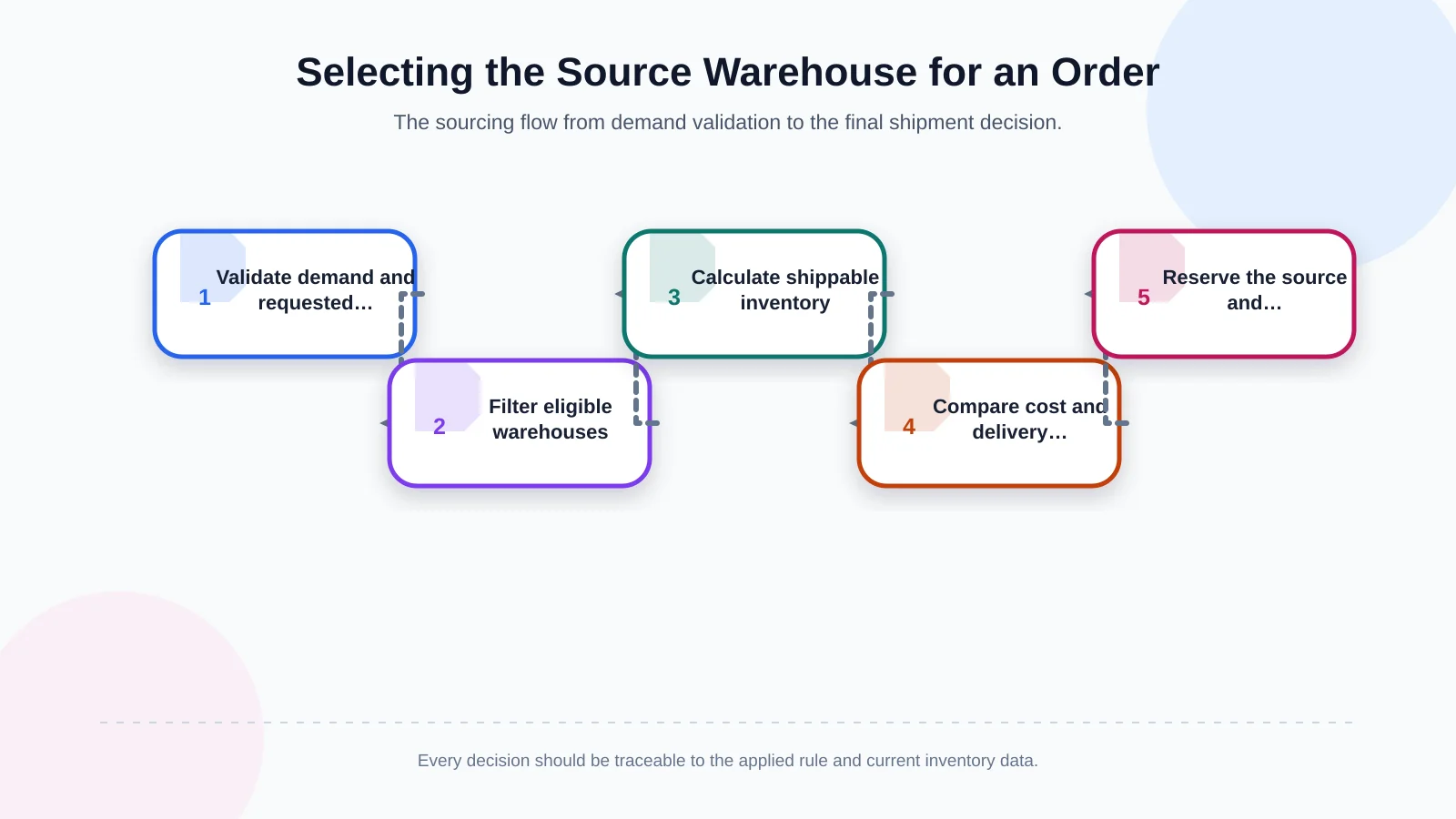
The nearest warehouse is not always the best source. A sourcing decision should consider shippable quantity, requested delivery date, warehouse capacity, cut-off time, transport duration, customer priority, safety stock and the cost of splitting the order. The system should also explain its recommendation. A message such as “The central warehouse was selected because the regional facility would fall below safety stock” helps operational teams understand and trust the decision.
Microsoft’s fulfilment model similarly shows that inventory conditions, safety stock, warehouse operating times and limits on the number of fulfilment sources can influence source selection. When one source is insufficient, multiple warehouses may be used, while the permitted number of splits can still be constrained. Further details appear in the Microsoft Learn fulfilment optimisation documentation.
Deciding whether to use partial shipments
If one warehouse cannot fulfil an entire order, the system should evaluate holding the order, shipping part of it, sourcing from several warehouses or initiating an inter-warehouse transfer. It should record whether the customer accepts partial delivery, the minimum shipment quantity, the freight impact and the estimated date for the remaining items.
Customer-facing statuses must be based on reconciled ERP, warehouse and carrier events. A planned shipment should not appear as dispatched merely because inventory has been reserved. This visibility can be designed alongside a B2B order-tracking portal that presents partial shipments, documents, exceptions and estimated dates in terms the buyer can understand.
How should inter-warehouse transfers be managed?
A transfer is not a simple adjustment that decreases one location and increases another. It includes request, approval, outbound reservation, picking, loading, in-transit inventory, destination receipt and discrepancy closure. Quantity removed from the source but not yet accepted at the destination must be tracked separately as inventory in transit. Otherwise, the same units may appear to exist in both warehouses—or disappear from the network entirely.
A transfer recommendation should be justified by regional demand, target safety stock, transit time and open orders. The system should warn users when solving an urgent order in one region would compromise an existing commitment elsewhere. Physical activities involving barcodes, serial numbers and lots can be taken into the warehouse through a purpose-built warehouse mobile application, including controlled offline queues and later ERP reconciliation.
ERP/SAP and custom web software architecture
The solution must clearly establish which system owns each type of data. Products, warehouses, customers and core inventory movements may remain in ERP or SAP, while custom web software provides role-based views, sourcing recommendations, exception queues and operational workspaces. Integration must cover more than scheduled data extraction. Identity mapping, unit conversion, transaction order, idempotent processing, retries and error handling are all essential.
Update frequency can vary by data type. Order reservations and shipment confirmations may require near-real-time processing, while analytical data can be transferred on a schedule. Every record should show its source, update time and synchronisation state. Failed messages must not disappear silently: they should enter an exception queue, be assigned to an authorised owner and be written back safely after successful reprocessing.
How should success be measured?
Project success should be measured through operational outcomes, not the number of screens delivered. Useful indicators include orders rejected because inventory could not be located, inaccurate stock promises, on-time and in-full delivery, fulfilment sources per order, emergency transfers, reservation age, transfer cycle time and inventory-data latency. The owner, calculation method and source of every metric should be recorded in a shared business glossary.
The organisation does not need to transform every warehouse at once. A pilot can begin with one representative region, a limited product group and a defined order type. Data mappings and inventory equations are validated first; reservations, sourcing, transfers and customer visibility can then be introduced in stages. Throughout the pilot, the application view should be regularly reconciled with ERP totals and transaction-level evidence.
Why does a custom solution matter?
Exporters differ in corporate structure, warehouse ownership, delivery models and existing systems. The warehouse model, regional hierarchy, business rules, roles and integration responsibilities must therefore be designed together. Kumsal Agency approaches multi-warehouse and regional inventory management around real operations rather than a fixed template, connecting ERP/SAP data with custom web and mobile software. Reliable data, role-based authority, traceable operations and sustainable software architecture come before visual embellishment.
To analyse your multi-warehouse and regional inventory processes alongside your current ERP/SAP environment, export operations, user roles and integration requirements—and define the scope of a solution tailored to your organisation—contact Kumsal Agency.