


Aydınlatma metni yükleniyor…
Ecommerce website cost is not determined by page count or a package label alone. Catalogue structure, pricing and promotion rules, search and filtering, basket and payment journeys, delivery and returns, ERP/CRM/marketplace integrations, migration, security, verification and continuing operations all shape the budget.
This guide avoids market price ranges that date quickly. Instead, it helps buyers compare equivalent scope and expose recurring licensing, infrastructure, service, maintenance and operational responsibilities alongside initial delivery.
What Determines Ecommerce Website Cost?
- Platform, custom or hybrid delivery model
- Products, variants, categories, attributes, media and languages
- Pricing, discount, coupon, promotion and tax rules
- Search, filtering, comparison and recommendation requirements
- Basket, account, payment, delivery, cancellation and return journeys
- ERP, CRM, accounting, warehouse, carrier and marketplace connections
- Migration of product, customer and order data
- Design, accessibility, performance, security and verification
- Release, training, documentation and account ownership
- Licensing, infrastructure, maintenance, support and change
Setup Price Is Not Total Cost of Ownership
Initial delivery may include discovery, design, engineering, data preparation, integrations, testing and release. Total ownership adds licensing, hosting, transaction or usage charges, messaging, maintenance, support, content operations and change over a defined period.
Two similar setup prices can hide very different exclusions. One may omit integration work, data cleansing or post-launch support. Separate one-off and recurring lines, then state when each charge occurs, which volume drives it and who owns the activity.
The Kumsal Ecommerce Total-Cost Map
This original framework equalises proposals across seven areas. For every row, record quantity, deliverable, assumption, client responsibility, third-party charge and acceptance condition.
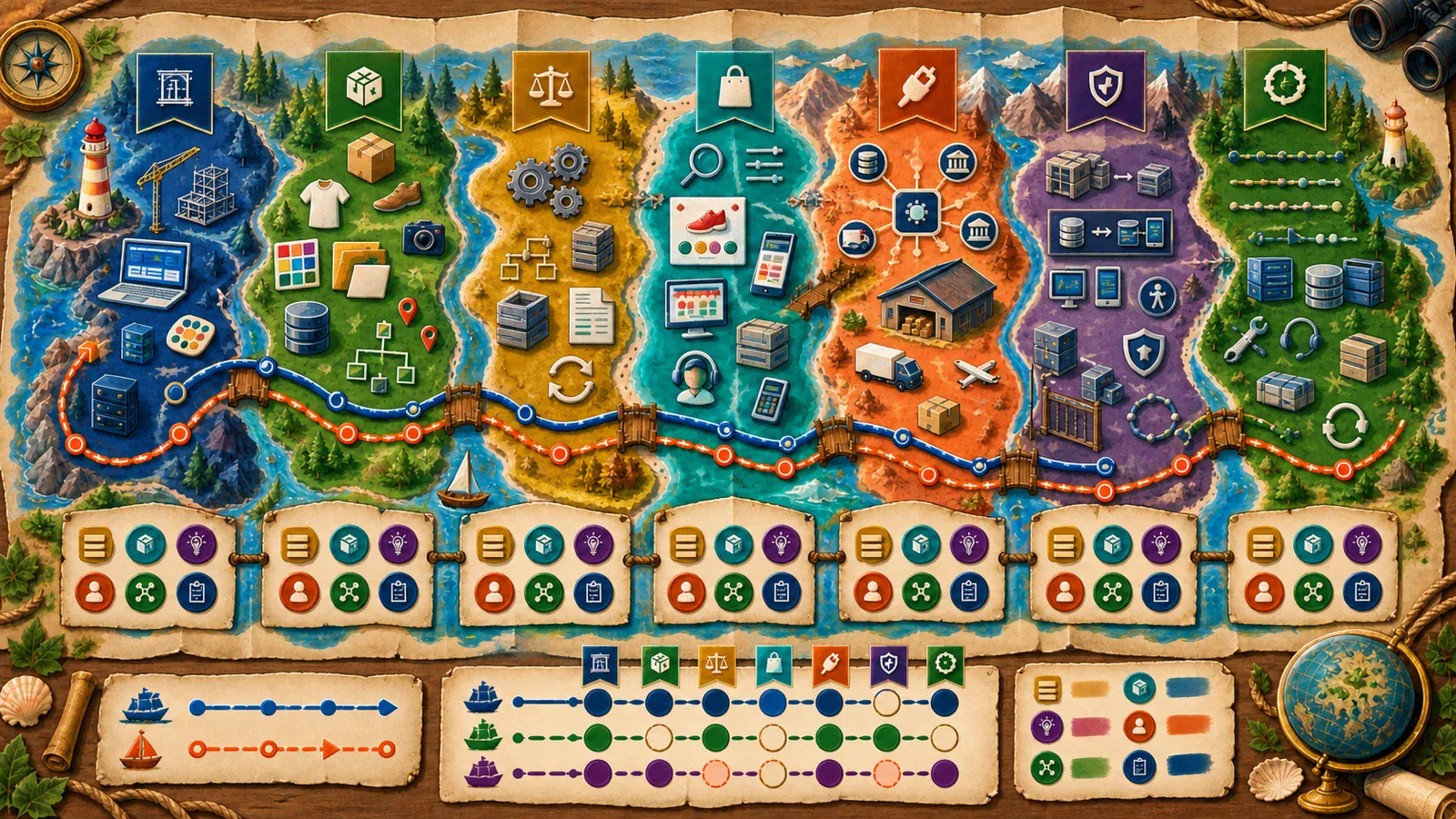
| Area | Scope measure | Evidence to request | Often omitted |
|---|---|---|---|
| Foundation | Platform, store, environments, theme/design | Deliverable and environment inventory | Licence, app and theme renewals |
| Catalogue and data | Product, variant, category, attribute, language | Data model and migration sample | Cleansing, media work and repeat imports |
| Commercial rules | Price, promotion, tax, coupon, inventory | Rule and exception matrix | Conflict and channel reconciliation |
| Customer journey | Search, basket, payment, delivery, return | End-to-end acceptance scenario | Failed and partial transactions |
| Integration | System, field, direction, timing, failure | Data and responsibility map | API changes and usage charges |
| Quality and release | Tests, security, performance, enablement | Test evidence and release plan | Pilot, rollback and content checks |
| Operations | Monitoring, support, maintenance, change | Service level and ownership | Peak capacity and version adaptation |
1. Platform, Custom and Hybrid Approaches
A platform can accelerate standard catalogue, ordering and administration needs. Custom software can support differentiated journeys, complex rules or extensive integration. A hybrid approach can retain a commerce core while customising selected experiences and connections.
Do not compare initial schedule alone. Assess licences, app dependencies, transaction limits, data export, theme and API flexibility, update ownership and a possible future migration over the same ownership period.
2. Catalogue and Data Preparation
A thousand simple products and hundreds of complex variants are not equivalent. Identify the source for codes, titles, descriptions, attributes, categories, variants, dimensions, prices, inventory, media, documents and languages. Search and filtering quality also depend on this model.
Duplicates, missing attributes, inconsistent categories and inadequate imagery turn migration into a separate workstream. The proposal should cover a sample audit, field mapping, trial import, exception report and final reconciliation.
3. Pricing, Promotions, Tax and Inventory Rules
Beyond list and sale price, rules may use coupons, basket thresholds, bundles, customer groups, periods, channels or quantities. Define priority when rules conflict, behaviour during cancellation and returns, and reporting expectations.
Inventory may be shared across stores, warehouses and marketplaces. Reservation, safety stock, out-of-stock behaviour, preorders and partial fulfilment affect data and operations as well as the interface.
4. Search, Product, Basket and Payment Experience
Category navigation, tolerant search, filters, sorting, comparison, variant selection and delivery information should each solve a known customer task. Every additional component creates design, data, analytics, engineering and verification work.
Checkout scope includes guest or account use, addresses, delivery, coupons, payment choice, failure and retry, order confirmation and notifications. “Payment integration” alone does not define refunds, cancellation, reconciliation or failure ownership.
5. ERP, CRM, Warehouse, Carrier and Marketplace Integrations
Start by naming the system of record for every material field. Turkey's Ministry of Trade ETBIS Ecommerce Academy explains that ERP connections can involve product, price, promotion, category, customer, order, inventory, fulfilment, finance and accounting data, and that source, destination and update frequency must be identified. (ETBIS ERP integration guide)
For every connection, define fields, direction, trigger, timing, authentication, timeout, retries, duplicate prevention, logs, alerts and the accountable team. The existence of an API does not prove that a connection is ready or inexpensive.
6. Payment Security, Quality and Acceptance
Using a payment provider does not remove every responsibility. PCI Security Standards Council states that even when payment processing is outsourced, merchants retain duties such as confirming provider compliance, documenting responsibilities and understanding shared ownership. (PCI SSC outsourcing guidance) Confirm the requirements for the specific implementation with the acquirer and qualified specialists.
Define functional, integration, browser/device, accessibility, performance and security checks. Acceptance scenarios should cover finding a product, variants, coupons, payment failure, inventory change, cancellation, returns and split fulfilment.
7. Release and Continuing Operations
Release can include final migration, domains and redirects, production payment and carrier accounts, analytics, email/SMS, indexing checks, trial orders, training and rollback. Source code, domains, data, analytics, advertising, service and store account ownership belongs in the handover inventory.
Separate defect correction, maintenance, content operations, campaign support and new development. Agree peak-period capacity and monitoring, and name who adapts the system when a platform, payment provider, carrier or ERP changes.
Twelve Questions for Comparing Ecommerce Proposals
- Did every supplier price the same product, variant and language volume?
- Who owns data cleansing and media preparation?
- Are pricing, promotion, tax and inventory exceptions explicit?
- Are search, product, basket and payment acceptance journeys documented?
- Is the system of record known for every critical field?
- Do integrations define failure and retry behaviour?
- Are payment, carrier and third-party charges separated?
- How many migration rehearsals and reconciliations are included?
- Are performance, security and accessibility checks included?
- Who owns accounts, data and source assets?
- Are maintenance, support and new development distinct?
- Is the three-year cost calculated with equivalent assumptions?
Use the website proposal scorecard to evaluate suppliers and the three-year website cost guide to separate initial and recurring ownership lines.
Conclusion
To understand ecommerce cost, measure catalogue, commercial rules, customer journeys, integrations, quality, release and operations before comparing package prices. This reveals whether apparently low and high proposals actually describe the same delivery.
To assess store scope and technical dependencies, review Kumsal Agency's ecommerce solutions and contact the team.