


Aydınlatma metni yükleniyor…
For an organisation comparing web design services in Şişli, the central problem is not merely obtaining a “modern corporate website”. The same site may serve prospective and existing customers, physical visitors, patients or clients, candidates, suppliers, investors, journalists and event attendees. These people do not arrive for the same reason, require the same evidence or need the same transaction.
A useful corporate website does more than present one homepage to everyone. It recognises distinct visit contexts and directs each person to the appropriate service, location information, document, application or accountable team. This guide replaces generic district copy with a practical method for planning multi-audience corporate architecture, governing evidence and comparing provider proposals.
Why is multi-audience corporate architecture relevant in Şişli?
The Şişli Municipality 2025–2029 Strategic Plan states that the district has 25 neighbourhoods and a multifunctional structure combining workplaces, commercial businesses, financial centres, cultural and arts areas, universities, health units, transport networks and residences. It records a night-time population of about 284,000 and a daytime population exceeding three million. The plan also describes Şişli as an important centre for finance, investment, health, trade, tourism and education (Şişli Municipality 2025–2029 Strategic Plan).
This official context does not mean that every organisation operates in all of these sectors or that its website receives millions of visitors. The narrower, supportable implication is that a district with dense daytime use and many institutional purposes makes multiple visit contexts a relevant design problem. Each organisation must still identify its real priorities through analytics, call records, form topics and staff interviews.
What is the difference between an audience and a visit context?
A broad audience label such as “professionals aged 25–45” is insufficient for information architecture. The same person may request a service proposal on one day, find an event location on another or apply for a role later. For design, the task during the current visit matters as much as identity.
Answer four questions for every important context:
- Which decision or transaction is the visitor trying to complete?
- Which information and evidence are required first?
- Which page, form, document or channel is the correct next step?
- Which team owns the information and the resulting record?
Without this distinction, navigation can mirror the organisation chart while the homepage becomes a competition between departmental messages.
The Kumsal six-context corporate entry map
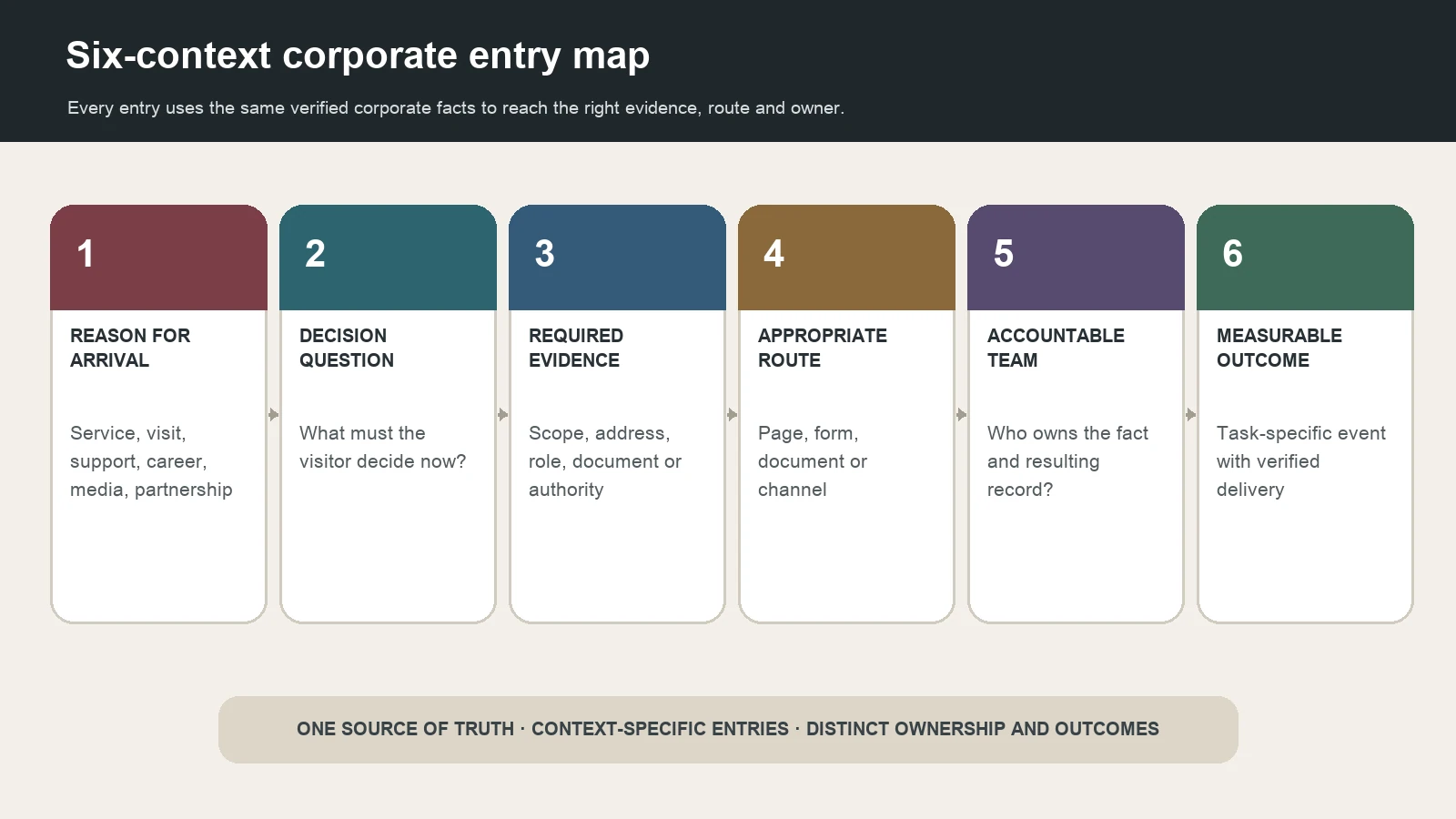
This original framework defines each visit context through six records: reason for arrival, decision question, required evidence, appropriate route, accountable team and measurable outcome. It does not require a separate website for every audience. It creates task-appropriate entrances into one verified body of corporate information.
1. Record the reason for arrival
List real tasks such as researching a service, planning an appointment or visit, obtaining existing-customer support, exploring careers, contacting media relations or proposing a partnership. Build the list from search queries, on-site search, call and email topics, reception questions and staff interviews rather than internal department names.
Not every rare task needs top-level navigation. Consider frequency, business value, user risk and time sensitivity together. Low-volume safety or arrival information, for example, can still deserve high priority.
2. State the decision question
Define the question that the page must answer. A buyer may ask whether the service fits the requirement. A physical visitor may need the correct building, time and documents. A candidate may want the role, process and working arrangement. A journalist may need verified corporate facts and the authorised contact.
When one page tries to answer too many decision questions, headings, evidence and actions compete. The homepage can introduce a context; the detailed decision belongs on the relevant destination page.
3. Match the required evidence
Different decisions need different evidence. A service decision may require scope, process, team capability and a permissioned example. A physical visit may require a verified address, access information and operating time. Careers need a real role and application process. Media use may require a current corporate profile, usage terms and approved assets.
Stock photography, unattributed numbers, logo strips or unverified testimonials are not evidence by themselves. Record the owner, review date, permission and placements of each evidence item. The corporate website content matrix provides a useful structure for this work.
4. Select the appropriate page and transaction
Do not send every person to a generic contact form. A service enquiry can use a scoped form; a physical visit can use location and access guidance; an existing customer can reach support; a candidate can use the recruitment process; and a media request can reach an authorised contact.
The route should be concise and explanatory. Before acting, the visitor should know which information will be shared, what happens next and when a response can reasonably be expected. Use the web design guide to assess page structure, user experience and actions within one scope.
5. Assign an accountable team and review rhythm
Marketing may own the corporate profile, operations may verify opening hours, human resources may own vacancies, an appropriate specialist may approve legal copy, and a product team may verify technical documents. CMS access is not the same as content accountability. Record who prepares, approves and periodically reviews each item.
When a fact appears in several languages and pages, a single source of truth reduces divergence. Translation should still be natural localisation of the same verified information for the relevant task, not mechanical sentence replacement.
6. Measure the result by context
Combining every visitor under one “conversion” can distort decisions. A qualified proposal start, successful visit preparation, suitable job application and access to approved media material are different outcomes.
Page views, context selection, document access, action start, form errors, successful submissions and delivery to the accountable team can be measured separately. Before collecting personal data, review necessity, legal basis, retention and access conditions.
The framework's original contribution is to turn an abstract audience persona into a governable content system defined by arrival, decision, evidence, route, ownership and outcome.
How can a homepage serve multiple audiences?
A homepage should not carry the complete message of every department. Its first section needs a clear account of what the organisation does, who it serves and the two or three most important entry routes. Verified corporate evidence, principal service families and context-specific next steps can follow.
A candidate structure can test:
- A clear corporate and value definition
- The most important visit contexts
- Service or solution families
- Verified organisation, team and process evidence
- Location or access information in the relevant context
- Secondary but visible routes for careers, media and support
- A distinct, understandable action label for every route
Use labels such as “review service scope”, “plan your visit” or “view open roles” instead of context-free buttons such as “learn more” and “click here”.
How should multilingual corporate architecture work?
Turkish and English sites should not become two independent sources of corporate truth. Record each page's counterpart, owner, last review date and status. If content is required in only one language, make that an explicit decision rather than linking to an unrelated substitute.
The language selector should open the matched version of the current page when it exists. Localise titles, metadata, anchors and actions naturally. Each language should use a self-referencing canonical, and hreflang should connect only genuine counterparts. If a slug changes or pages merge, add both required redirects after the new destination and language linkage have been published and verified. The current slugs remain unchanged in this refresh, so no new redirect is required.
How should corporate content governance be organised?
A page inventory can record the URL, visit context, decision question, primary evidence, content owner, approver, language counterpart, last review and next review date. When operating time, address, team, fee, application condition, legal document or contact details change, the affected pages should be discoverable.
Before procurement, use the website requirements document guide to record users, pages, content owners, languages, forms, integrations and acceptance conditions in one shared scope.
How should web design companies serving Şişli be compared?
Give every candidate the same multi-context scenario: one person compares a service, another plans a physical visit, another reviews an open position and another looks for a media contact. Ask the provider to show how each route reaches correct information, evidence, action and ownership.
Separate these deliverables in each proposal:
- User research and visit-context inventory
- Information architecture, navigation and page templates
- Content matrix, production and migration responsibilities
- Evidence types, permissions and review ownership
- TR/EN counterparts, canonicals, hreflang and redirect mapping
- Forms, applications, CRM, booking or other integrations
- Accessibility, device, browser and functional testing
- Analytics events, consent records and reporting
- CMS roles, training, access and source handover
- Release, backup, defect correction, maintenance and new-development boundaries
Ask which concrete delivery and acceptance test supports broad phrases such as “corporate”, “SEO friendly”, “high converting” or “user friendly”. A homepage visual cannot demonstrate working end-to-end routes for different contexts.
What determines web design cost in Şişli?
District name does not determine cost. Relevant factors include the number of original templates, content inventory and migration, languages, forms and integrations, search and filtering, user roles, accessibility, performance objectives, test coverage, training and maintenance responsibility.
A site with ten services, two locations, three languages and four application flows is not equivalent to a five-page brochure site even if both are described as corporate websites. Compare proposals against the same requirements, scenarios and acceptance criteria, and identify licences and third-party usage charges separately.
Conclusion: Design the corporate site as a system of contexts
For an organisation operating in Şişli, web design is more than an aesthetic refresh. Buyers, visitors, candidates, media and partners use the same corporate information with different questions. The six-context entry map makes the reason for arrival, decision, evidence, route, accountable team and measurable result visible for each journey.
The existing Turkish and English slugs remain unchanged, so this refresh needs no 301. Completed with the organisation's own evidence, the framework lets teams compare providers through information architecture, content governance and working user routes rather than general promises.