


Aydınlatma metni yükleniyor…
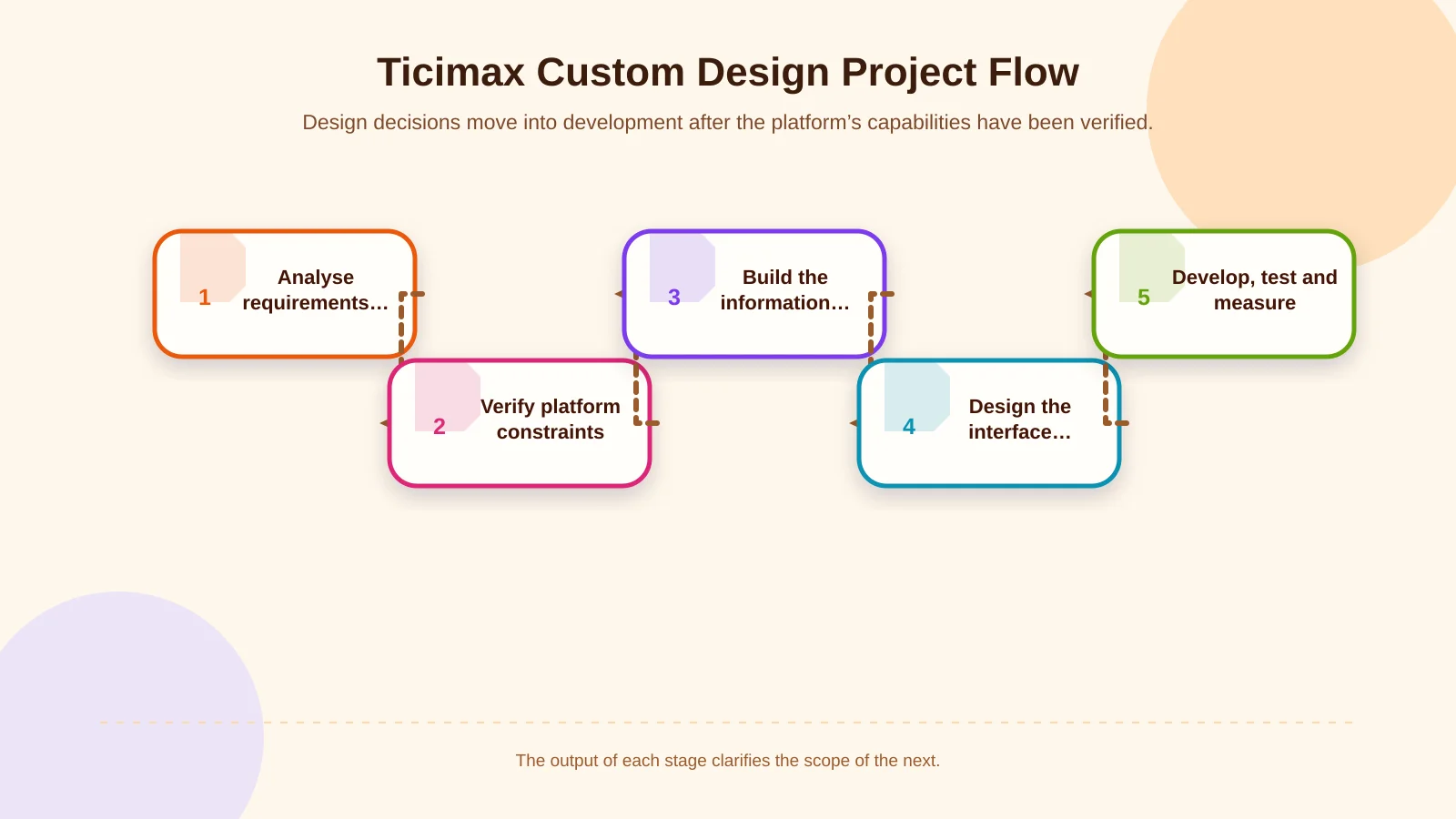
Custom design on Ticimax means more than changing the colours and typefaces of a ready-made theme. The goal is to bring the brand’s visual identity, customer shopping habits and commercial priorities into one coherent experience. Every touchpoint—from the homepage and category pages to product details, basket and checkout—contributes to that experience.
A successful Ticimax interface project begins with a realistic understanding of the platform’s tools and technical boundaries. Ticimax states that it provides responsive themes, page-design tools and options for HTML/CSS customisation. Available capabilities can nevertheless vary by package, theme, module and current platform conditions. Each requirement should therefore be verified in the store’s actual account before design begins. This prevents teams from approving impressive concepts that cannot be implemented or maintained as intended.
What should a Ticimax custom design project achieve?
Ready-made themes provide a quick starting point, but a standard scenario may not suit every product range, pricing model, campaign structure or audience. A technical-products retailer may depend on filters, specifications and comparisons, while a fashion brand may prioritise collection storytelling, size selection and strong visual pacing. Custom design should express these differences throughout the buying journey, not merely through decorative details.
The outcome should extend beyond looking distinctive. Customers must be able to find relevant products, understand price and delivery conditions, compare alternatives confidently and complete a purchase without unnecessary friction. At the same time, internal teams should be able to update campaigns, content and product presentation as part of everyday operations.
1. Discovery and technical scope
The first step is to define business objectives rather than immediately turning the brief into a list of screens. Which product groups need to grow? Which channels bring customers to the store? Is there a gap between mobile traffic and mobile sales? What questions repeatedly reach customer support? Do analytics indicate basket abandonment or difficulty finding products? The answers establish meaningful design priorities.
The existing store should then be audited. This includes its theme structure, page templates, product-data quality, category tree, filters, campaigns, payment methods, shipping rules, analytics tools and third-party integrations. The official Ticimax features page mentions HTML/CSS access, responsive themes and page-design tools. However, the current scope should still be confirmed in writing for the relevant package and account before project decisions are finalised.
What should the scope document include?
- The page types to be redesigned and the required states for each one
- Theme components that will be retained, modified or removed
- Ownership of product, category, campaign and editorial content
- Connections to ERP, shipping, payment, CRM and marketing systems
- Acceptance criteria for mobile usability, performance, accessibility and measurement
- Responsibilities for testing, content entry, training, launch and maintenance
This document turns “custom design” into a measurable project scope. It separates areas that cannot be changed in the platform core from theme-level adjustments and requirements that need external software. A design decision should become final only after its feasibility has been confirmed.
2. Information architecture and product discovery
The foundation of the interface is not the homepage but the information architecture. The category tree should use the language customers understand; internal stock or departmental classifications should not automatically become the navigation. Menu depth, category labels, search suggestions, filter order and sorting options should reflect genuine search intent.
The homepage does not need to display the entire catalogue. It should communicate the brand promise, guide visitors towards important categories and support current commercial priorities. Category pages, meanwhile, must make comparison easier. The product type should determine whether cards emphasise price, variants, promotions, availability or delivery. Too many badges and messages can create visual noise instead of supporting a decision.
Product information is central to this structure. When catalogue data is inconsistent across systems or channels, the related guide to product information management can help teams clarify models, data quality and distribution responsibilities. Zero-result searches, empty categories, filter resets and back-navigation behaviour deserve as much attention as the ideal path.
3. User experience and the buying journey
Wireframes make content order, actions and relationships between pages visible before visual styling begins. In addition to core templates such as the homepage, product listing, product detail, basket and account pages, the team should plan error, empty, loading and unmet-promotion states.
Priorities on the product detail page
The product name, price, variants, availability, expected delivery and primary purchase action should be understandable at a glance. Descriptions, specifications, usage guidance, returns information and complementary products can then be layered according to their role in the decision. If a sticky purchase area is used on mobile, it must not obscure content, bypass variant selection or interfere with keyboard operation.
Basket and checkout experience
The relationship between products, quantities, discounts, shipping and the final total must be explicit. If a customer is not eligible for a campaign, the message should explain both the reason and the possible next step. The customisation options permitted in checkout must be verified separately. Security- or function-critical controls should never become ambiguous for the sake of visual novelty.
4. Original interface design under Art Director leadership
A brand-specific interface involves more than enlarging the logo or applying corporate colours to every button. Typography hierarchy, spacing, photography, iconography, motion and component behaviour should be defined as one design system. Art Director leadership helps maintain the same creative direction across campaign imagery, editorial blocks, product cards and transactional screens.
Kumsal Agency approaches custom web design by considering business goals, user needs and visual identity together. The creative direction and representative screens are approved first; a reusable component system is then extended across the remaining templates. This reduces the inconsistency that often appears when every page is designed as an isolated composition.
The system should also account for operational reality. Marketing teams need flexible areas for routine campaigns, while core navigation, product and checkout components require stricter rules. Establishing this distinction early protects consistency without making everyday updates dependent on a developer.
| Page | Customer task | Interface priority | Key check |
|---|---|---|---|
| Homepage | Reach the right area | Clear value proposition | Visual weight and CTA |
| Category | Narrow down products | Filter and card hierarchy | Zero results and reset |
| Product detail | Make a decision | Price, variants and delivery | Stock and error states |
| Basket/checkout | Complete the purchase | Clear totals and steps | Forms, shipping and payment |
5. Mobile usability, speed and accessibility
Mobile responsiveness is not simply a narrower desktop layout. Content priorities need to be reconsidered for smaller screens, while navigation, search, filters, variant selection and purchase actions must work comfortably by touch. Testing with real product names, long prices, numerous variants and multiple campaign labels reveals issues that idealised sample content often hides.
Performance is also a design concern. Oversized images, unnecessary font files, uncontrolled third-party scripts and heavy animation can slow the store. Google’s Web Vitals guidance explains Core Web Vitals in terms of loading performance, responsiveness and visual stability. Teams should examine real-user data as well as laboratory tests, separating results by page type and device group rather than relying on one overall score.
Accessibility covers colour contrast, keyboard operation, visible focus states, form labels, meaningful alternative text and understandable errors. The W3C’s WCAG 2 overview organises accessible content around the principles of being perceivable, operable, understandable and robust. Automated checks are useful, but they do not replace manual testing with keyboards, screen readers and realistic tasks.
6. Theme and component development
The approved interface should be implemented through reusable components. Shared rules are needed for the header, navigation, product cards, filters, information bars, form fields, modals and campaign sections. A systematic approach to CSS classes, breakpoints and image dimensions makes future pages and promotions safer to produce.
Changes to theme files should be documented and versioned wherever possible. The impact of platform updates on custom code should be checked in a test environment. Content editable through the administration panel must be clearly distinguished from structures requiring developer intervention. This allows marketing teams to continue daily work without accidentally damaging critical components.
Development should also preserve graceful behaviour when content or integrations fail. Missing images, unavailable prices, delayed stock responses and unusually long text should not break layouts or hide essential actions. Component documentation should record both expected content and fallback behaviour.
7. Integrations and custom software requirements
Some requirements sit outside theme development. Stock and price data from an ERP, an advanced product finder, personalised quotations, dealer workflows or content supplied by several systems may require custom integration. The data source, update frequency, permissions, failure scenarios and responsibility boundaries between systems should be defined before implementation.
Kumsal Agency’s custom web software capabilities can support workflows that standard theme components cannot cover. That does not mean every request should become custom code. If a built-in Ticimax capability satisfies the requirement securely and sustainably, it should normally take priority. External development should be reserved for a verified business need with clear ownership and maintenance expectations.
8. Testing, launch and continuous improvement
Reviewing screenshots is not sufficient before launch. Navigation, search, filters, variant selection, add-to-basket actions, coupons, account creation, addresses, shipping and payment should be tested end to end across relevant devices. Negative conditions—including missing stock, failed payments, slow connections, long content and integration errors—must also be covered.
- Visual checks across supported browsers and screen sizes
- Form validation, error messaging and keyboard-use tests
- Verification of analytics events and conversion steps
- Redirect, metadata and indexability checks
- Performance measurement and review of critical third-party scripts
- Clear ownership of backups, rollback decisions and production launch
Launch is the start of measurement, not the end of the project. Search usage, filter interactions, product views, add-to-basket events and checkout completion should be monitored to identify bottlenecks. Changes should be assessed through a defined hypothesis, target metric and observation period rather than rushed conclusions based on a single store-wide conversion rate.
Planning Ticimax custom design with Kumsal Agency
Kumsal Agency is an Istanbul-based digital agency that can address e-commerce, Art Director-led web design, digital brand consulting and project-specific web software within one scope. Its approach does not rely on an unverified claim of being a Ticimax solution partner or offering a platform-specific product. The value lies in translating a brand’s visual world into a fast, clear, manageable and technically feasible commerce experience shaped around business goals and customer needs.
To assess your Ticimax store’s brand, user-experience and technical requirements together—and clarify the custom-design scope, theme constraints and necessary integrations—contact Kumsal Agency.