


Aydınlatma metni yükleniyor…
A surge in traffic during a promotion does more than increase page views. Product searches, variation selections, add-to-cart actions, coupon calculations, shipping requests and payment attempts all rise within the same period. Each activity places a different type of load on the database, cache, payment gateway, inventory service and ERP connection. A fast homepage therefore does not prove that checkout will remain reliable under pressure.
WooCommerce campaign performance testing evaluates the store with scenarios that reflect real behaviour from product discovery to order completion. The goal is not simply to find the maximum number of visitors the server can handle. It is to expose slow transactions, incorrect discounts, ambiguous payment outcomes and integration failures before they turn into lost sales.
Why should WooCommerce performance testing include checkout?
A conventional speed test often focuses on one page’s response time or visual loading in the browser. A purchase, however, creates connected data across the session, cart, taxes, shipping, promotion rules, inventory and payment status. A shopper may open a product page quickly but wait when applying a coupon, encounter a blank return page after payment or receive no order confirmation despite a successful charge.
The test scope should follow the store’s revenue-generating journey. Category browsing, search, filtering, variable-product selection, adding items, changing quantities, applying coupons, entering an address, selecting delivery and receiving a payment result are separate checkpoints. Performance should be considered alongside the experience principles used to design effective cart and checkout journeys.
Page speed and transaction continuity are not the same
A cached category page may stay fast under heavy traffic while personalised cart and checkout requests create queues among PHP workers, database queries or external services. Product-view traffic and checkout traffic should first be measured separately, then combined in a mixed workload. Success must not be judged by average response time alone. High-percentile latency, error rate, completed orders and consistency between payments and order records all matter.
How should business data define the test scope?
A realistic test does not begin with an arbitrary number of concurrent users. Start with traffic, order volume, product views and add-to-cart rates from previous campaigns. Then assess demand signals such as media budget, campaign launch time, influencer activity, email volume and promotion duration. These inputs help define distinct profiles for normal demand, the expected peak and a sudden spike.
Test data must also reflect production behaviour. Adding the same product to thousands of carts rarely represents a genuine customer mix. Include popular products, variations, low-stock items, free-shipping thresholds and different tax or delivery conditions. Use synthetic accounts, test addresses and payment methods explicitly supported by the provider instead of real customer information.
Campaign rules need a dedicated test area
Percentage discounts, fixed reductions, category conditions, minimum basket values, usage limits, free gifts and free shipping may work correctly in isolation but produce different results when combined. The test matrix should cover both permitted and prohibited combinations. Rounding, tax, currency, refund values and the order in which discounts apply also require explicit acceptance criteria.
- Can one customer use a coupon more times than permitted?
- Do campaign start and end times use the correct time zone?
- Are discounted products, categories and variations included as intended?
- Are discounts, shipping and totals recalculated when the cart changes?
- Can simultaneous orders exceed the campaign-wide usage limit?
Which scenarios create realistic campaign load?
A useful load profile is more than one linear ramp. Begin with a small number of transactions to confirm functional accuracy. Establish a baseline under normal traffic, increase gradually to the expected campaign peak, introduce a short spike and, where appropriate, run a longer endurance test to identify resource accumulation. Record the conditions under which the store continues to provide acceptable service at every stage.
The Grafana k6 guide to load testing websites recommends shaping load around real traffic and combining protocol- and browser-based testing where appropriate. It also warns against applying load to third-party services without permission. A live payment gateway or external ERP should therefore not be stress-tested directly without provider approval; use an authorised test environment or a controlled mock service.
The journey from product discovery to payment outcome
A core end-to-end scenario begins when a visitor lands on the campaign page. The user searches or filters, opens a product, chooses a variation, adds it to the cart and applies the relevant campaign condition. After entering delivery and billing details, the user selects a payment method. Validation must go beyond displaying a thank-you page: confirm the payment outcome, WooCommerce order status, inventory movement and ERP record.
It is rarely realistic for every virtual user to complete checkout. Use analytics to distribute traffic among visitors who browse products, search, create carts and attempt payment. Variable think times and diverse test data produce more representative results than mechanically repeating identical requests.
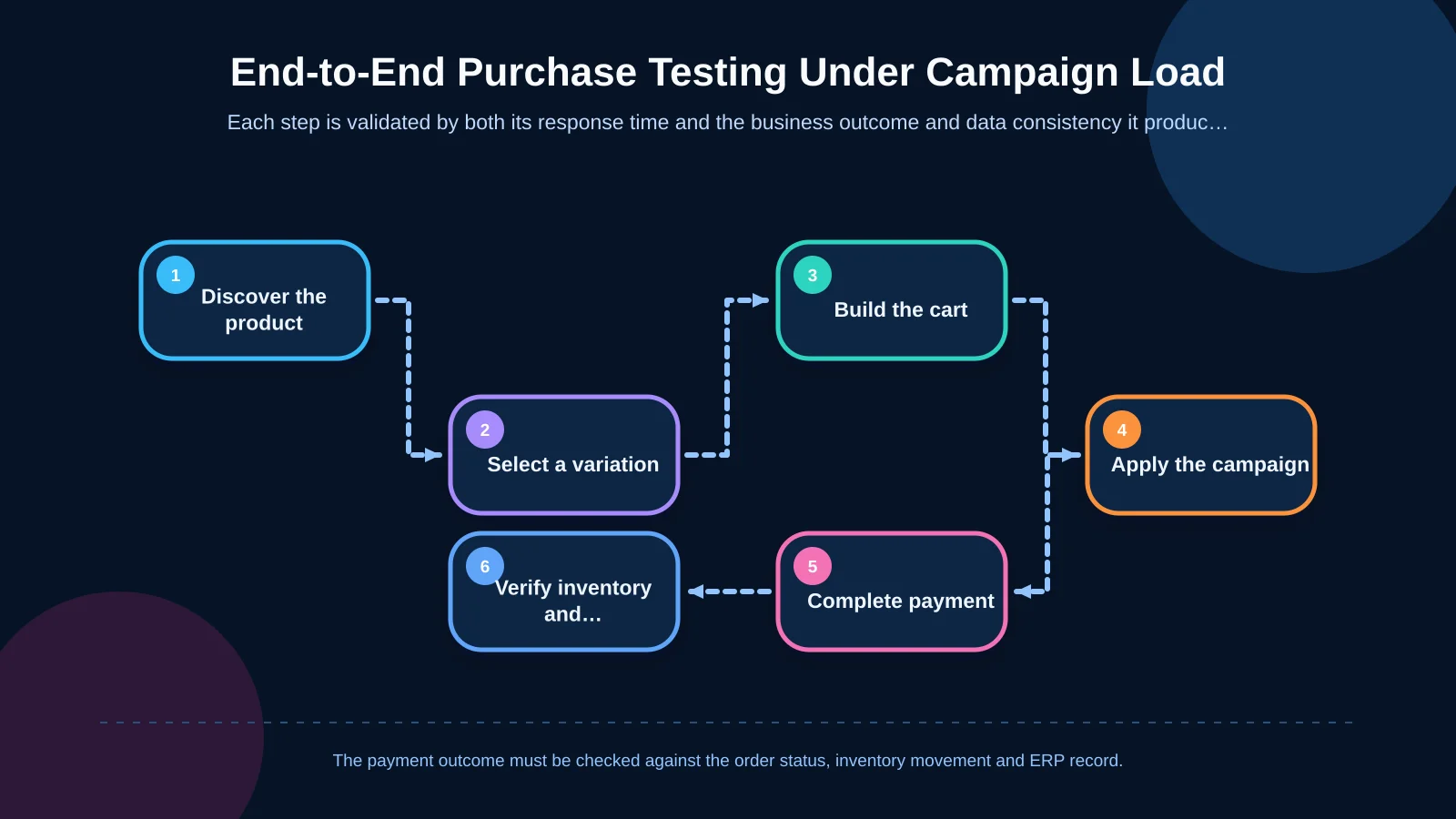
Which outcomes should be validated in the checkout flow?
Payment testing cannot be reduced to “successful” and “failed” responses. A successful charge, bank decline, customer cancellation, incomplete 3D Secure authentication, timeout, delayed notification and repeated submission are separate scenarios. For each one, verify the customer message, retry behaviour, order state, inventory movement and accounting record.
The WooCommerce order statuses documentation explains that Pending payment, Processing, On hold, Failed, Cancelled and Refunded have different operational meanings. A test report should therefore record the expected status transition as well as the HTTP response. A successful payment might need to reach Processing with the correct transaction identifier, while a declined payment must not appear as a paid order.
Test duplicate gateway notifications too. Repeated callbacks must not create a second order, reduce stock twice or generate duplicate ERP records. Refreshing the payment return page should not alter the result. If authorisation and capture are separate, document and test responsibility for both stages.
Payment data and test security
A performance test is never a reason to collect real card details or disable security controls. Document whether card data passes through the store, who hosts the payment page and which fields are retained in test logs. The PCI Security Standards Council’s e-commerce security guidance provides a useful framework for assessing payment environments and third-party components. Use masked or synthetic data and verify that logs, traces and screenshots do not expose sensitive fields.
How should inventory and ERP integrations be tested under campaign load?
During a promotion, many customers may compete for the same limited inventory. Test adding to cart, reserving stock, waiting for payment, releasing reservations after failure and processing cancellations as one connected lifecycle. For two simultaneous attempts to buy the final unit, define which transaction wins and what the other customer sees.
For ERP integration, measure when an order is transmitted, how failed delivery is retried and how duplicates are prevented. If the ERP is temporarily unavailable, a paid order must not disappear. It should remain visible in a durable queue, and the operations team should be able to identify and resolve the exception. Kumsal Agency’s enterprise resource planning approach considers finance, sales, inventory, purchasing and operations as connected processes built around shared, traceable data.
- Does the WooCommerce order number match the ERP document number?
- Can a retry finish without creating the same order twice?
- Is reserved stock released after a failed payment?
- Are partial service failures visible in the administration interface?
- Can store, gateway and ERP totals be traced for reconciliation?
How should performance results be interpreted?
One average response time can hide the experience of slower users. Separate results by page and transaction type, then review the median, high percentiles, error rate, timeouts, throughput and resource consumption. Break down payment outcomes into technical failures, bank declines and customer cancellations; otherwise, a commercial decline and a software defect appear under the same heading.
Acceptance thresholds should reflect the store’s objectives and current measurements. There is no universal number for every WooCommerce store. Category views, add-to-cart requests and order creation can each have distinct latency and error targets. Compare CPU, memory, database connections, slow queries, PHP workers, cache hit rate and queue depth on the same timeline as customer-facing metrics.
Match the evidence to locate the bottleneck
If add-to-cart latency rises alongside database query time, investigate indexes, inefficient queries or locking. If application resources remain stable while payment waits increase, inspect the network, gateway and callback path. If the ERP queue grows while checkout continues, retry design and operational visibility become as important as raw capacity. Record every finding with its timestamp, scenario, customer impact, technical evidence, owner and retest result.
| Symptom | Initial evidence | Likely focus | Validation |
|---|---|---|---|
| Add to cart is slow | Query time is rising | Database and locks | Retest with the same load |
| Payment result is delayed | Application resources are stable | Gateway and callback flow | Monitor status transitions |
| ERP queue is growing | Transmission errors are increasing | Retry design | Check for duplicate records |
| Pages are unstable | Cache hit rate is falling | Cache and worker capacity | Repeat peak load |
How should the pre-campaign testing schedule be planned?
Define the scope far enough ahead of launch to prepare the test environment before product, pricing and integration changes are frozen. Business, operations, finance and technical teams should approve the scenarios and acceptance criteria. After addressing bottlenecks from the first run, repeat the test with the same data and load profile so results remain comparable.
Near launch, conduct a limited rehearsal covering coupon timing, payment-provider settings, monitoring dashboards, alert channels and team responsibilities. Agree in advance on conditions for reducing traffic, temporarily disabling the campaign, investigating uncertain payments and communicating with customers. This turns the performance report into an operational campaign plan.
A sustainable WooCommerce infrastructure with Kumsal Agency
Campaign resilience cannot be achieved simply by adding server capacity. User experience, software architecture, checkout behaviour, campaign rules, data security and integrations must support the same commercial objective. Kumsal Agency’s e-commerce approach focuses on fast, clear and manageable platforms that carry the brand experience from product discovery through checkout.
For project-specific requirements, its web development services can address roles, data, integrations, exception behaviour and operational needs together. Testing can then lead to measurable acceptance criteria, observable integrations and sustainable development decisions instead of temporary configuration changes.
Final checks before launching the campaign
Reliable WooCommerce performance testing covers realistic traffic distribution, campaign rules, payment exceptions, inventory contention and ERP behaviour within one coordinated scope. A successful result means more than keeping the system online: the store must calculate the correct amount, create the right order status, maintain consistent inventory and leave traceable evidence whenever an exception occurs.
To evaluate your WooCommerce campaign and payment scenarios together and clarify the testing scope and technical requirements, contact Kumsal Agency.