


Aydınlatma metni yükleniyor…
A broad product range gives customers more choice, but it also creates a serious experience challenge: how can someone identify the right option among hundreds of similar products? For B2B e-commerce, manufacturing, distribution and export companies, this is more than a usability issue. A poor choice can lead to incompatible orders, unnecessary quotation traffic, repeated questions for sales teams and costly returns.
The answer is not simply to add more filters. It begins with understanding how customers actually make decisions. UX research reveals the job behind a search, the technical criteria buyers use to eliminate options, the information they compare and the point at which they need assistance. The website or commerce platform can then move beyond reflecting an internal product classification and become a practical decision tool that leads customers towards the right product, quote request or order.
Why does choosing become harder as the product range grows?
As a catalogue expands, meaningful differences between products can become less visible. Buyers may not know where to begin when product names look alike, specifications use inconsistent formats or customer terminology does not match the company’s internal product-family names. Category pages become long inventories, while filter panels turn into dense collections of unfamiliar technical fields.
B2B buyers rarely want just “a product.” They may need a component compatible with a particular machine, equipment rated for a specified pressure, certified material, stock that can meet a delivery date or an alternative within a purchasing limit. Engineers, procurement specialists, dealers and end users may use the same platform with very different levels of knowledge. A single navigation model may therefore fail to support every decision path.
Baymard Institute’s research into product lists and filtering shows how listing, sorting and filtering affect a user’s ability to find suitable products. General UX principles are useful, but they cannot determine which filters matter most to a specific market, what belongs on each product card or which terminology customers recognise. Those decisions require research with the brand’s own users.
What questions should UX research answer?
The purpose of research is not to ask users which interface they like. It is to build evidence about real selection behaviour. The GOV.UK guide to user research similarly focuses on understanding who users are, what they are trying to achieve, how they currently do it and how their circumstances shape their behaviour. For B2B product discovery, research should explore questions such as:
- Does the buyer begin with a product name, part number, application or problem?
- Which two or three criteria are non-negotiable during the first round of elimination?
- Which technical attributes are compared between otherwise similar products?
- When do stock, price, lead time, minimum order quantity or certification become relevant?
- At what point does the user consult a sales representative, technical specialist or document?
- Which product families and user roles face the greatest risk of choosing incorrectly?
These questions should not be answered solely through internal workshops. Sales teams hold valuable knowledge, but researchers must also observe customers’ routes through the interface, the words they use and the reasons they reject particular options.
How should product-selection research be conducted?
An effective programme combines behavioural evidence with operational data. Its scope should reflect priority product families, user roles, sales channels and high-risk selection scenarios. Existing evidence is reviewed first, followed by user interviews and task-based testing of possible solutions.
1. Needs and data analysis
Start by defining the business objective, priority product groups and intended conversion steps. Examine internal search terms, zero-result searches, frequently applied filters, category exits, quotation forms, support records and recurring sales questions. Review ERP and PIM fields to identify which product attributes are available, missing or inconsistent across the digital channel.
This work replaces a vague ambition such as “make the site more modern” with testable questions. It also exposes dependencies early: a promising interface cannot compensate for missing compatibility data or unreliable stock information.
2. User tasks and decision criteria
Ask participants to reconstruct a recent, genuine purchasing decision. Instead of asking “Which filters would you like?”, give them a task: “If you had to find this component again, where would you start?” Screen sharing, contextual interviews and observation can reveal the supporting tools involved, including spreadsheets, printed catalogues, competitor websites, code lists and conversations with sales representatives.
Record elimination behaviour as carefully as successful routes. A product may be rejected because of dimensions, compatibility, certification, delivery, price or absent information. These reasons become direct inputs for category structure, filter priority, result cards and product-detail content.
3. Prototype and usability testing
Before turning findings into a large software build, test low- or medium-fidelity prototypes. Give participants realistic scenarios such as: “Find a product that meets these conditions, compare two alternatives and request a quote.” Observe task success, completion time, backtracking, incorrect choices and requests for help.
Nielsen Norman Group’s research on e-commerce search and faceted filtering reinforces the need to evaluate search, filters, categories and result pages as a connected discovery experience. Findings should not remain loose interface notes. Record each one with the affected task, business risk, recommended change, data requirement and validation measure.
From research to digital experience: the decision sequence
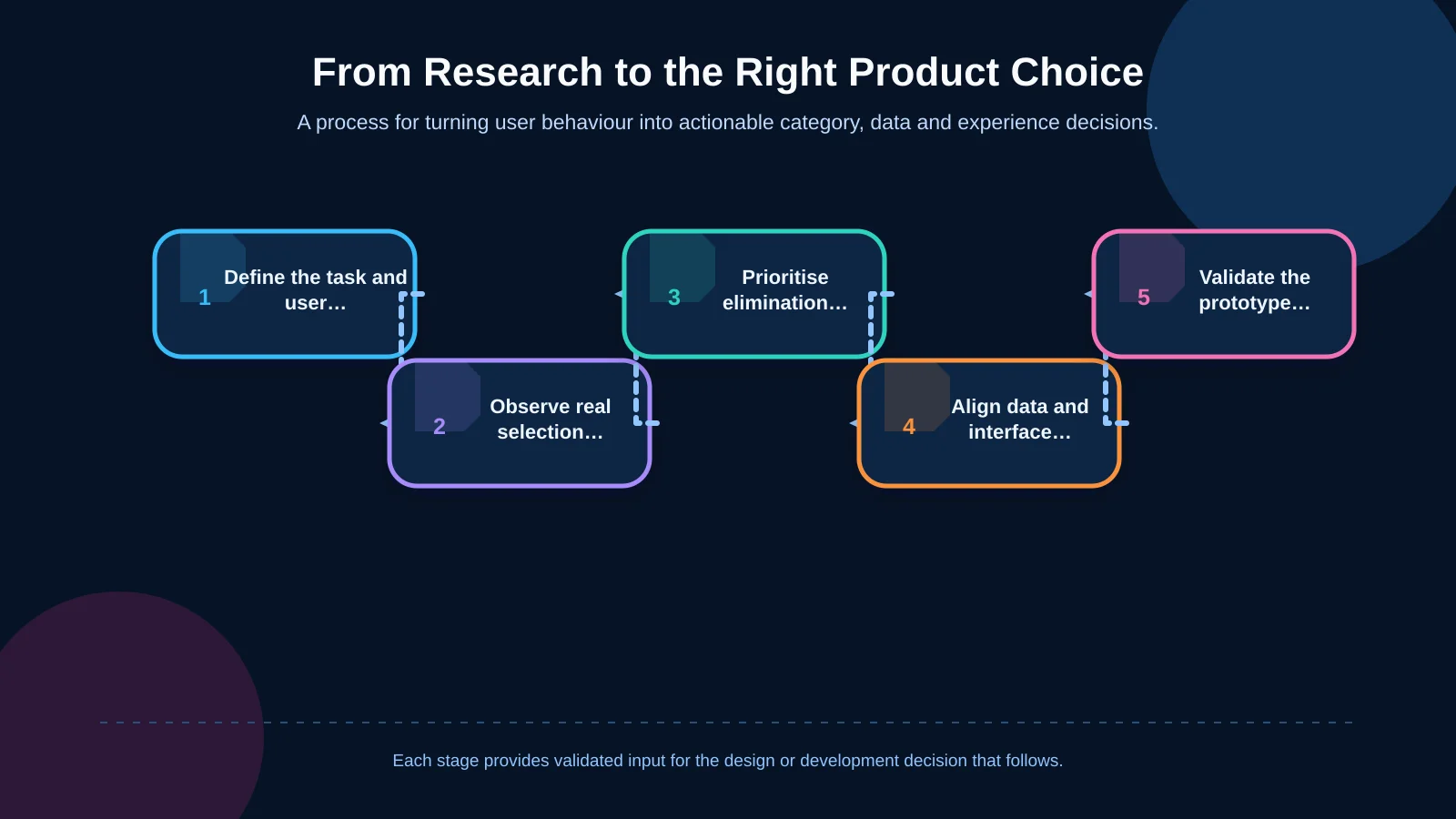
Research creates value when observations become actionable decisions. First, group evidence around user tasks. Then identify critical selection criteria, content requirements and system dependencies. This gives design and development teams a shared model of how the decision should work.
Suppose customers begin pump selection with flow rate and pressure, while the existing catalogue separates products only by series name. That is not merely a visual problem. The category model, product fields, search synonyms and filter logic must change together. If availability or customer-specific pricing influences the decision, ERP integration is also part of the user experience.
How findings shape information architecture and categories
Information architecture should reflect the user’s mental model, not the organisation chart. Card sorting and tree testing can show where customers expect to find products, how they interpret category labels and which route they follow to locate a particular item.
The primary entry point might be industry, application, product type or technical standard. Where users have several valid mental models, the experience can provide more than one route. “Browse by product,” “browse by application” and “browse by machine model” may all lead into the same structured dataset. Turning that brand-specific architecture into a clear visual hierarchy requires research and custom web design to progress together.
Categories, filters, search and comparison should work together
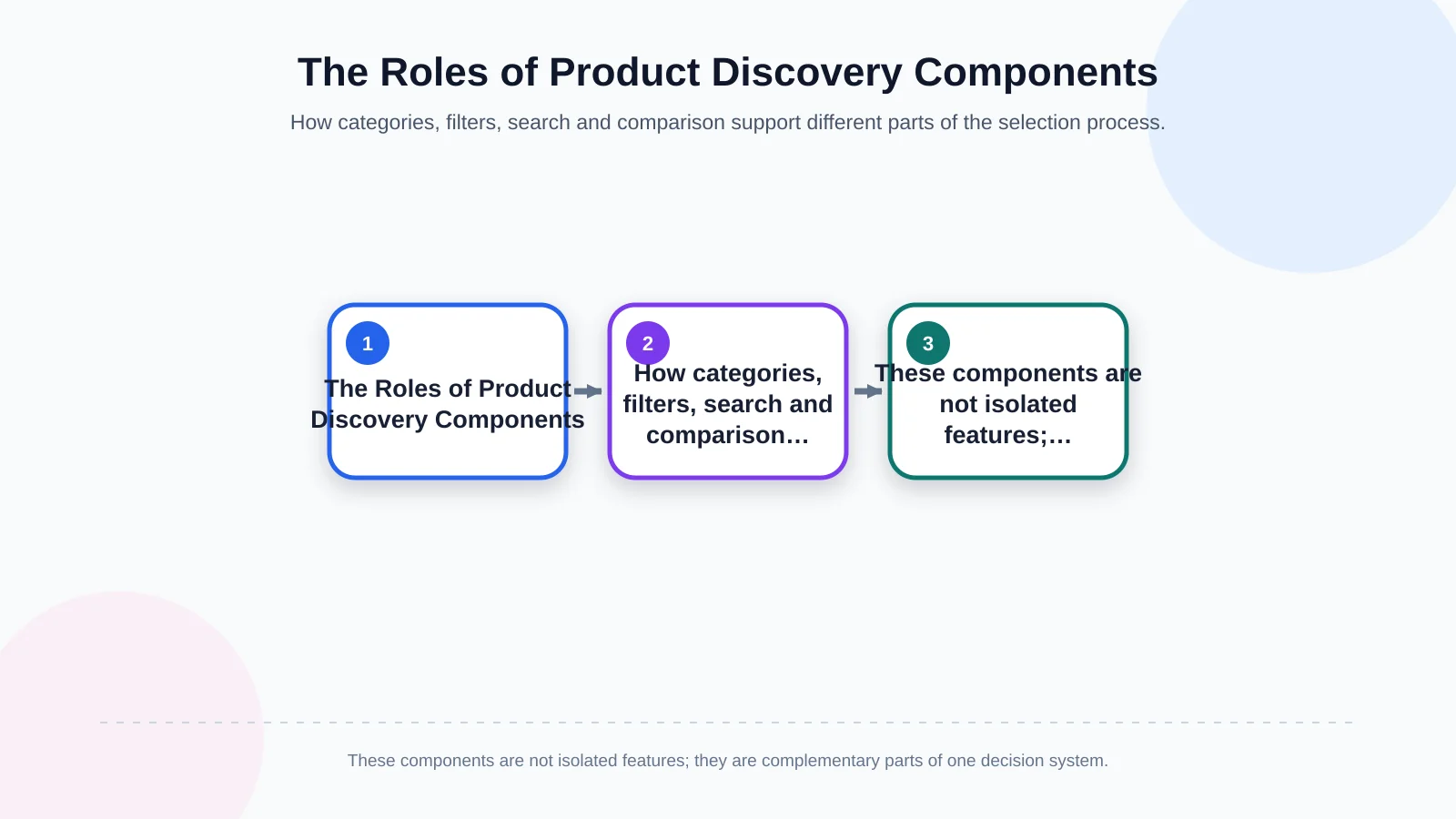
These four components are parts of one decision system. Categories explain the available scope; filters remove unsuitable options; search provides direct access through known terms or codes; and comparison makes differences within a shortlist visible. Weakness in one component creates unnecessary pressure on the others.
| Component | User need | Required data | Sign of success |
|---|---|---|---|
| Category | Understand where to begin | Product families and applications | Quick access to the right section |
| Filter | Eliminate unsuitable options | Normalised technical attributes | Meaningful reduction of results |
| Search | Find directly by code or term | Synonyms, SKUs and superseded codes | Fewer zero-result searches |
| Comparison | See differences within the shortlist | Shared decision-critical attributes | Progression to quotation or order |
Filters should follow decision criteria
Filters should not expose every database field. They should support the order in which customers eliminate options. Place commonly used criteria that meaningfully reduce the result set first. Use consistent units, display active selections clearly, update result counts and make reset controls easy to find. Technical labels may also require short explanations or examples.
Search should understand the buyer’s language
B2B search may need to recognise SKUs, OEM references, superseded codes, abbreviations, spelling errors and industry synonyms as well as official product names. Review zero-result queries regularly and expand the search dictionary. For ambiguous searches, suggest a category or relevant attribute. Product cards should also explain why a result matched, especially where the matching term appears in metadata rather than the visible title.
Comparison should expose decisive differences
A comparison screen should not place every technical field into a wall of columns. Show the attributes that can change the decision first, allow identical values to be hidden where appropriate and make differences easy to scan. For complex purchases, users may also need to save or share a shortlist, or transfer it directly into a quotation request.
UX cannot compensate for poor product data
Reliable filtering and comparison depend on consistent product data. If the same dimension is stored as “10 mm,” “10mm” and “1 cm,” the platform cannot produce a dependable filter without normalisation. Governance is needed for field names, permitted values, measurement units, required attributes, translations and product-family-specific specifications.
An ERP may remain the source for commercial and operational data, while a PIM manages enriched product information. The digital platform must present information from both systems in the context of the customer’s decision. Product models, ownership, validation rules and synchronisation should therefore be planned alongside the interface rather than treated as a later integration task.
What solutions can emerge from the research?
Not every requirement leads to a conventional online store. Research might support a content-led corporate catalogue, transactional e-commerce platform, dealer portal, technical product selector or rules-based configurator. The right solution depends on the user task, pricing model, permissions, quotation workflow and integration requirements.
If selection involves many dependent technical rules, a guided selector may work better than a conventional filter panel. Contract-specific prices require authentication and authorisation. If engineering approval is necessary before quotation, the selected configuration must be transferred to the responsible sales or technical team with its context intact. These needs may call for custom e-commerce design and development rather than the limitations of an off-the-shelf theme.
How should success be measured?
Page views alone cannot demonstrate whether product discovery has improved. Measurement should follow the tasks defined during research. Useful indicators include product-finding success, progression from search to product detail, zero-result search rate, effective filter use, movement from comparison to quotation or basket, support requests caused by incorrect selection and the quality of submitted quotations.
Quantitative data shows where behaviour changed; follow-up research explains why. If a filter is used frequently but does not contribute to conversion, investigate its labels, data quality and resulting product set. UX research is therefore not a one-off activity at the beginning of a project. It is a learning cycle that should continue as products, customer expectations and business processes change.
Turn product discovery into a business outcome
Making hundreds of products easier to navigate requires more than simplifying a catalogue. User tasks, elimination criteria, customer language, product data and the path to quotation or order must operate as one system. Research provides the evidence and sequence needed to build that system.
Kumsal Agency combines research-led digital brand consultancy with bespoke web design, user experience, custom web software and e-commerce development. This turns findings into a manageable, measurable digital experience that can integrate with ERP, PIM and CRM systems instead of remaining in a presentation deck.
Let us identify where customers struggle in your product discovery and selection journey. To turn the evidence into a website, e-commerce platform or custom software solution aligned with your brand and operations, contact Kumsal Agency.