


Aydınlatma metni yükleniyor…
Search engines can read the text on a web page, but they may not always identify whether a name refers to a brand, a product manufacturer, an author or the organisation that employs that author. Schema.org vocabulary and structured data help describe these entities and relationships through standard, machine-readable labels. A corporate website, e-commerce platform or custom web application can therefore become more than a publishing interface: it can function as a consistent information system connecting the brand, its pages and its underlying data.
Structured data is not an SEO shortcut or a guarantee of higher rankings. When implemented correctly, it helps Google understand a page’s purpose, the entities it contains and the relationships between them. It can make eligible pages suitable for certain rich-result features, but it cannot guarantee that those features will appear. Its lasting value lies in semantic consistency, scalable data management and clearer context for search engines.
What are Schema.org and structured data?
Schema.org is a shared vocabulary used to describe concepts such as organisations, people, products, services, articles and breadcrumb trails. Within this vocabulary, Organization is a type, while name and logo are properties that may be associated with it. The Schema.org schema documentation explains how types are organised into a hierarchy and connected to relevant properties.
Structured data is the application of those concepts to the real content of a specific page. On a product detail page, for example, the product name, image, availability and price can be described using the Product type. A blog post’s headline, author and publication date can be represented with Article, while its position within the website can be expressed through BreadcrumbList.
Google supports JSON-LD, Microdata and RDFa. JSON-LD is generally preferred because it is easier to implement and maintain in many projects. Although JSON-LD is not displayed in the user interface, the information it describes must match the page’s visible content. Updating a price in the markup while showing an old price to users—or marking up reviews that do not appear on the page—is unreliable even when the syntax is technically valid.
How do rich results relate to SEO authority?
Rich results are search experiences that may show additional elements beyond the standard title, URL and description, such as product prices, availability, content types or breadcrumb paths. Google states that structured data provides explicit clues about a page and may help eligible content qualify for enhanced search features. However, Google’s introduction to structured data also makes clear that not every Schema.org type or property corresponds to a Google Search feature.
“Building authority” should not be interpreted as gaining rankings automatically by adding a block of code. Technical authority becomes stronger when the brand name, corporate identity, product information, author details and page hierarchy remain consistent across templates. Supplying organised, verifiable context makes the website’s subject and ownership easier to understand. Trust also depends on alignment between what visitors see and what machines read.
Correct markup does not guarantee a rich result. The query, device, location, page quality and the result format Google considers most useful can all influence how a listing appears. Success should therefore not be reduced to a single question: “Did we get a rich result?”
How should schema types match page purpose?
Effective planning does not begin by adding as many schema types as possible to every URL. It begins by classifying page templates and identifying authoritative data sources. For each page, ask: What is its primary subject? What information can the user actually see? Which system is the reliable source of that information?
Organization and WebSite
Organization connects the brand’s name, official URL, logo and other appropriate corporate properties. The homepage, or another page that clearly represents the business, is a natural centre for this definition. WebSite represents the overall web property. Different templates should not use conflicting brand spellings, outdated logos or inconsistent contact details. Managing corporate identity data from a single source in the content management system makes the markup more sustainable.
BreadcrumbList and information architecture
BreadcrumbList describes a page’s position in the site hierarchy. It should not create an imaginary navigation structure that users cannot see. Relationships between categories, subcategories and detail pages need to be resolved in the information architecture first. Structured data planning is therefore closely connected to menu, content hierarchy and URL design.
Article and editorial content
Article, or an appropriate subtype, can describe a headline, author, publication date, modification date and featured image. The visible dates in the article template should match the JSON-LD. A modification date should not be changed merely to manufacture a freshness signal when the content has not genuinely been updated. Author pages, editorial responsibility and update policies are governance matters before they are markup fields.
Product and e-commerce data
Product can connect a product name, brand, images, identifiers and offer information. Dynamic fields such as price, currency and stock availability may originate in an ERP, PIM or commerce platform. If the displayed data and marked-up data update at different times, the result may be inaccurate or misleading. Projects involving variants, promotions and multiple currencies should define data ownership and synchronisation rules before generating markup.
When product information is managed across several channels, a PIM approach can improve consistency. Our guide to managing product information across websites, catalogues and marketplaces provides a complementary framework for separating the responsibilities of PIM, ERP, DAM and commerce systems.
Service and FAQPage
Service can describe the provider, service area and context of an offered solution. The existence of a Schema.org type does not mean Google provides a dedicated rich result for it. A service page still creates value primarily by explaining its scope, approach, deliverables and the visitor’s next step.
FAQPage should only be considered when users can genuinely see the questions and answers on the page and the content meets the type’s conditions. Ordinary copy should not be artificially divided into questions, and hidden answers should not be marked up. FAQ markup also does not guarantee an FAQ presentation in Google. Current Google support and feature-specific rules should be checked before implementation.
How do you create an implementation roadmap?
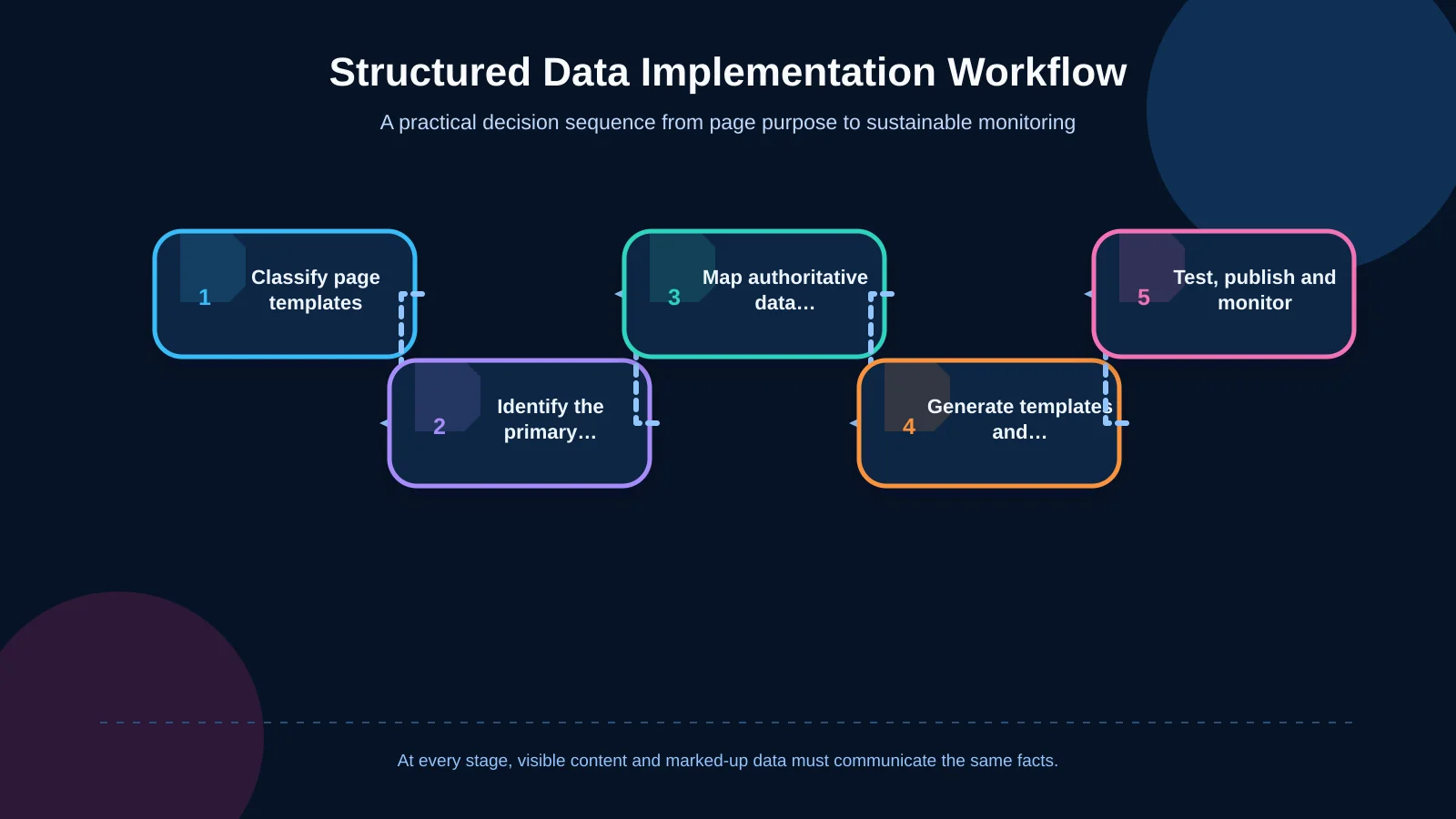
1. Audit page templates and search intent
List the homepage, corporate pages, service details, blog posts, category pages and product details as separate templates. Define the primary entity and user intent for each one. Filter pages, internal search results or account areas that should not be indexed must not be included automatically.
2. Map content to data sources
Document the source of every property. The logo might come from the media library, author details from an editorial profile, prices from the ERP and availability from the commerce service. Define what the system should do when a source field is empty. Omitting an unsupported property is usually safer than guessing or generating a placeholder.
3. Design templates and the data model
Schema markup should not be pasted manually into individual pages. Whenever possible, generate it through templates and a structured data model so every new product or article follows the same rules. If a page contains multiple entities, stable identifiers such as @id can connect them. The resulting graph should reflect genuine relationships rather than adding unnecessary nodes simply to look comprehensive.
4. Validate technically and run a pilot
Begin with a limited set of representative URLs. Use Schema Markup Validator to assess the vocabulary and Google’s Rich Results Test to review supported search features. Then use URL Inspection to examine how Google sees the published page. For markup generated through JavaScript, evaluate the server response, rendered DOM and caching behaviour separately.
5. Monitor and maintain
After launch, monitor Search Console enhancement reports, changes in valid and invalid items, and relevant performance data. Whenever a new template, campaign module or pricing service is released, include structured data in regression testing. Technical SEO is not a one-off setup; it is an ongoing quality process that must evolve with content and software.
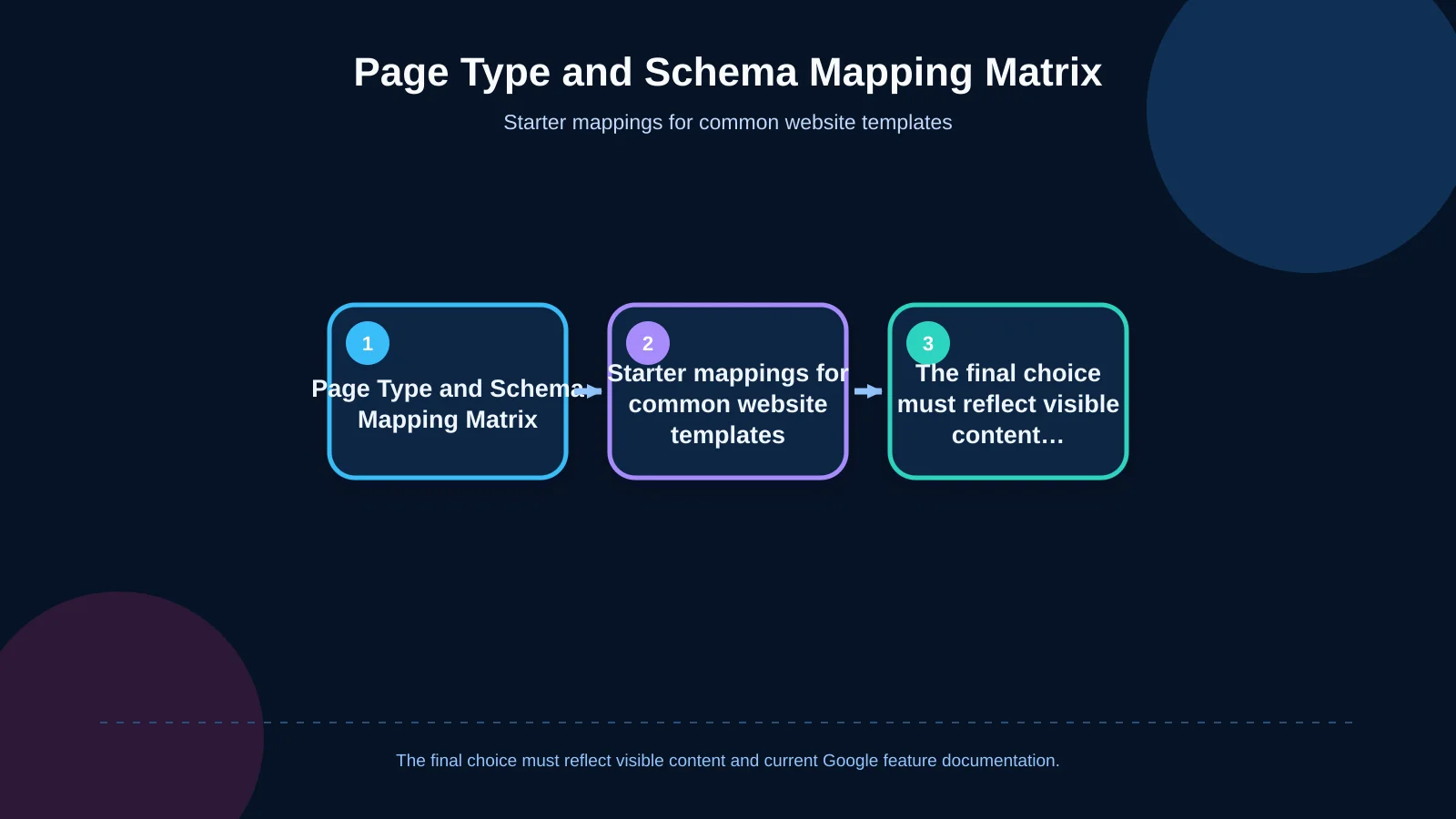
| Page type | Primary schema | Core data source | Key validation point |
|---|---|---|---|
| Corporate homepage | Organization + WebSite | Corporate profile | Consistent name, logo and URL |
| Blog article | Article + BreadcrumbList | CMS and author profile | Headline, author and dates |
| Product detail | Product | PIM, ERP or commerce platform | Current price and availability |
| Service page | Service | CMS and service catalogue | Scope matches visible content |
| Genuine FAQ content | FAQPage | CMS | Questions and answers are visible |
Common structured data mistakes and risks
- Marking up prices, ratings, questions or author details that users cannot see.
- Adding types such as
Product,ArticleandOrganizationto every URL without considering page purpose. - Generating invented or default values simply to populate required fields.
- Feeding product price and availability from a source that differs from the user interface.
- Assuming that passing a validation test guarantees a rich result.
- Failing to run large-scale URL checks after template changes.
- Treating the full Schema.org vocabulary and Google-supported search features as the same thing.
Google’s general structured data guidelines require markup to represent the page’s main content, correspond to user-visible information and avoid misleading claims. Compliance creates the necessary foundation for eligibility, not a guarantee of display. Incorrect or deceptive markup may cause a page to lose rich-result eligibility and, in some cases, lead to manual action.
Which metrics should measure success?
A measurement plan should separate technical quality from search performance. Technical indicators can include the percentage of valid items, number of affected URLs, missing recommended properties and data freshness. Performance analysis can examine impressions, clicks, click-through rate and average position for relevant search appearances. Comparisons should account for page type, date range and query intent.
The absence of a rich result does not automatically mean the implementation failed; its appearance does not prove commercial success. Search data should be evaluated alongside business metrics such as organic sessions, qualified form submissions, add-to-basket events and sales. Seasonal demand, brand campaigns, ranking changes and price movements can all affect results, so attributing every change directly to structured data would be misleading.
How does Kumsal Agency approach structured data projects?
Istanbul-based Kumsal Agency treats structured data not as an isolated SEO tag added at the end of a project, but as a layer connecting information architecture, content models, interface design and software infrastructure. During discovery, the team identifies page types, user intentions, data owners and integration requirements. Content planning then aligns visible information with the fields that machines will read.
For corporate web design projects, types such as Organization, WebSite, BreadcrumbList and Article can be planned alongside the site hierarchy. In custom web software and e-commerce projects, integration rules can help generate reliable Product or Service data from the CMS, ERP, PIM and other services. Pilot implementation, technical validation and post-launch checks create a system that remains maintainable as the website grows.
Conclusion: meaning and data consistency come before code
Schema.org and structured data provide a technical layer that explains a brand and a page’s purpose more clearly to search engines. Effective implementation requires selecting appropriate types, matching markup to visible content, using trustworthy data sources, building scalable templates and conducting regular audits. Rich results are a valuable possibility, but never a certainty. The durable benefit is a consistent, auditable model of meaning across the organisation’s digital properties.
To review your current page types, content-to-data mappings and technical implementation needs—and create a structured data roadmap suited to your brand and infrastructure—contact Kumsal Agency.