


Aydınlatma metni yükleniyor…
When comparing SEO and Generative Engine Optimization (GEO) services, do not judge proposals only by price, keyword count or a promise of “AI visibility”. A credible proposal should answer five questions in writing:
- What work will produce which deliverables?
- How will completion be verified?
- Who will control the accounts, data and access?
- How will the baseline, KPIs and reporting method be defined?
- Which assets and records will be handed over when the engagement ends?
The aim is not to select the agency making the largest promise. It is to identify a working partner that understands the commercial objective, manages uncertainty honestly and makes its changes traceable. A guarantee of rankings, traffic, conversions or AI citations cannot replace these five answers.
How should SEO and GEO fit within one service?
SEO covers the technical, content and experience work that helps a site be discovered, crawled and indexed, match relevant searches and guide visitors towards meaningful actions. GEO adds checks related to the accessibility, clarity and visibility of a brand and its services in generative AI-assisted search and answer systems.
The two disciplines are not alternatives. Google's guidance for generative AI search says that foundational SEO practices remain relevant to its generative AI features. A clear technical structure and original, useful content still matter. A proposal that says “SEO is over; only GEO matters” deserves scrutiny, as does one that dismisses AI-assisted search without assessing whether the audience uses it.
GEO scope must be made platform-specific. If crawler access will be audited, the proposal should identify which bot is being assessed and why. OpenAI's official crawler documentation, for example, distinguishes OAI-SearchBot for search from GPTBot controls associated with model development. Treating every “AI bot” as one switch is not an adequate service description, and allowing access does not guarantee visibility or citation.
Does the agency try to understand the business?
A sound proposal begins with business context, not a tool export. An agency should ask questions such as:
- Which service, product or market has priority?
- Who is the audience and decision-maker?
- What counts as a valuable conversion: an enquiry, phone call, demo, email, store visit or completed sale?
- How long is the sales cycle, and how is lead quality assessed?
- What is the current condition of the site, content operation and development capacity?
- Which search and AI platforms are genuinely important to the audience?
- How will brand, legal and subject-matter approvals work?
If an agency proposes a fixed keyword count, article quota or success date before understanding these conditions, its method may be built around selling a package rather than solving the organisation's problem. The same service label can require very different priorities and workloads in two companies.
1. Read scope as deliverables, not activities
Statements such as “technical SEO will be performed”, “content will be optimised” or “GEO work will be carried out” are not acceptance criteria. Every activity should lead to an observable deliverable.
| Vague activity | Question to ask | Example deliverable |
|---|---|---|
| Technical SEO | Which surfaces will be assessed, and how will the fix be tested? | Crawl/indexation findings for priority URLs, an implementation plan and retest evidence |
| Content optimisation | Which page will change for which user need? | Approved brief, source record, updated page and change summary |
| Keyword research | How will intent and commercial relevance be selected? | Query cluster, target-page mapping and overlap decision |
| GEO analysis | Which platform, crawler, query or prompt is in scope? | Crawler-access test, brand/service visibility record and source/competitor observation |
| Reporting | Which data period will support which decision? | Baseline, change log, observation, interpretation and next action |
Quantities are not sufficient on their own. “Four articles per month” says nothing about topic selection, expert verification, original contribution, updating or post-publication measurement. Quantity needs a quality standard and a completion condition.
2. Ask for evidence and method behind every material claim
Google's guidance on third-party SEO services and tools advises site owners to compare outside recommendations with official Google documentation and to distinguish guidance based on data or experience. Apply the same discipline when assessing a provider.
Ask:
- Which official document, measurement or verified experience supports this recommendation?
- Is it a platform rule, an agency interpretation or a hypothesis to be tested?
- What is the implementation risk, and is there a rollback method?
- Which test will show that the work is complete?
- When will it be reviewed, and against which data period?
Third-party tools can be useful for research, prioritisation and repeatable monitoring. Their scores are not an internal decision made by a search engine or AI platform. Google explicitly warns that third-party services cannot guarantee rankings. A claim such as “a GEO score of 95 will make you visible” therefore needs evidence explaining both the score and its demonstrated relationship with the target platform.
3. Keep accounts and data under company control
The organisation should retain primary control of assets such as Search Console, analytics, tag management, business profiles, advertising accounts, the domain, CDN and content management platform wherever practicable. Give the agency the role it needs, and retain the ability to revoke that access when the engagement ends.
Document these questions before signing:
- Who creates the account, and who is the primary owner?
- What role and permission level will the agency receive?
- Can the company access raw data and exports?
- Which reports or records from paid agency tools will be transferred?
- How are permissions removed after a staff change or contract ending?
- Who is notified after a security incident or incorrect change, and within what timeframe?
Prefer role-based user access to shared passwords. A measurement system visible only inside an agency-owned account creates avoidable dependency and weakens the handover.
4. Connect KPIs to a baseline and business outcome
A dashboard containing many charts does not necessarily provide a good measurement system. Each KPI needs a definition, data source, baseline period, comparison period, owner and decision rule.
The Search Console Performance report provides metrics such as clicks, impressions, CTR and average position across dimensions including query, page and date. These help explain Google Search visibility, but they do not prove qualified demand or revenue. Interpret them with site analytics, defined conversions and, where possible, sales feedback.
GEO measurement needs the same discipline. Replace “AI visibility increased” with a reproducible record containing:
- the platform and observation date;
- a version-controlled prompt or query set;
- brand or service mentions;
- visible source links;
- the context and accuracy of the answer;
- competitor visibility; and
- variation across repeated checks.
Prompt-based answers can vary. One screenshot is not evidence of permanent visibility. The proposal should explain the limits of the method, the frequency of checks and which observation would change a business decision.
5. Ask for a clear guarantee policy
A guaranteed ranking or fixed result is a serious warning sign. Search systems, competitors, user behaviour, development capacity and internal approvals are not controlled by one agency. Even satisfying minimum technical requirements does not guarantee indexing or display.
Question claims such as:
- “Number one by a specific date”
- “Guaranteed traffic or sales growth”
- “100% citation in AI answers”
- “A special method approved by Google”
- “Secret algorithm data used by competitors”
- “Guaranteed GEO through one file, schema type or tool”
An agency can commit to what it controls: audit scope, delivery dates, change records, quality checks, reporting cadence, meeting structure and escalation times for blocked work. These are service commitments. They should not be confused with promises about a third-party platform's outcome.
Is the work plan and responsibility model clear?
A useful proposal explains not only what will happen but also when, in which order and under whose ownership. Kumsal's confirmed working approach uses three broad phases:
- Days 1–30: technical, current-state and competitor analysis
- Days 31–60: technical changes and content/page optimisation
- Days 61–90: visibility monitoring, content development, new opportunities and performance improvement
This is not a guarantee that results will arrive in 90 days. Phases may overlap, and access, development or approval dependencies can change the schedule. At minimum, distinguish:
- the agency's analysis and implementation responsibilities;
- the client's decision and approval owner;
- the technical team or developer;
- content, brand or legal approval;
- the subject-matter expert; and
- the team validating conversion and sales information.
An activity report cannot solve a delay if nobody can see whose decision is pending.
How should you evaluate references and case examples?
References can be useful, but a brand name or its current ranking is not enough. Site history, brand demand, other marketing work and later changes may all contribute to the current position.
Within reasonable confidentiality limits, ask for:
- the approach used for a comparable problem;
- the starting point and measurement method;
- the work performed directly by the agency;
- dependencies owned by the client or another supplier;
- limitations and lessons, not only positive outcomes; and
- an example change log or anonymised report.
If you can speak to a reference, ask about communication, clarity of reporting, account ownership and the handover experience. “How many keywords improved?” does not reveal whether the agency's operating discipline was sustainable.
What belongs in the contract and exit plan?
SEO and GEO may be ongoing activities, but the agreement should not create indefinite dependency. Clarify:
- included and excluded work;
- deliverables and acceptance conditions;
- meeting and reporting cadence;
- content and change approvals;
- intellectual-property and asset-use rights;
- account, access and data ownership;
- third-party tool costs;
- security and confidentiality responsibilities;
- termination notice and final reporting; and
- transfer of files, briefs, change records and measurement definitions.
When the contract ends, the organisation should know why each priority page changed, which work remains open and where a new team can continue. Losing the project history when access to an agency dashboard closes is not an adequate handover.
The Proposal–Evidence–Access–Measurement–Handover scorecard
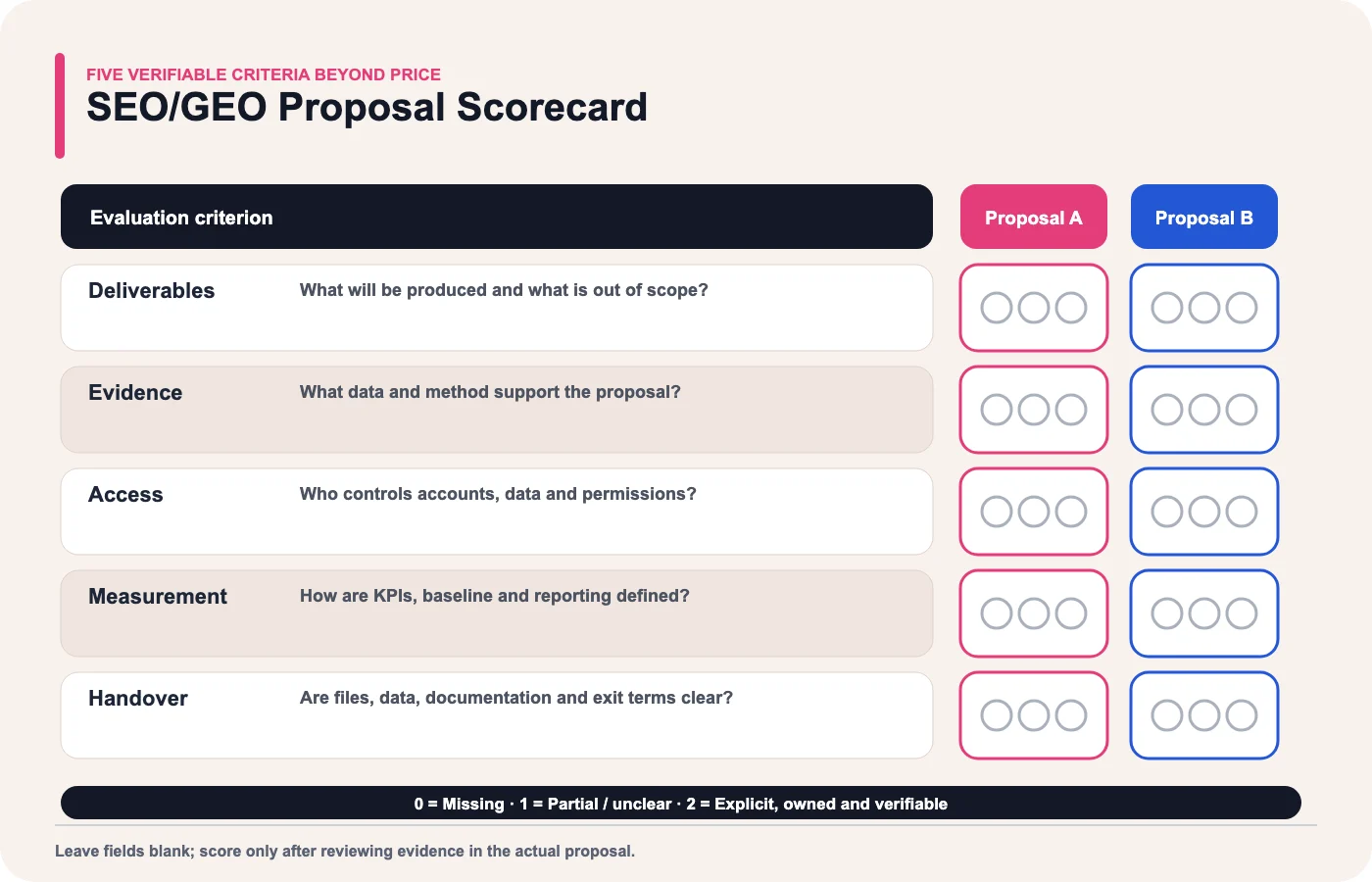
Use this scorecard to compare two or more proposals. Score each row as 0=unclear, 1=partly defined, or 2=written and verifiable.
| Evaluation area | Control question | Proposal A | Proposal B |
|---|---|---|---|
| Objective | Is the business objective and valuable conversion defined? | ||
| Scope | Are SEO and GEO activities tied to separate deliverables? | ||
| Evidence | Is the recommendation source and completion test clear? | ||
| Priority | Is work ordered by impact, risk and effort? | ||
| Access | Are account ownership and role boundaries written down? | ||
| Measurement | Are the baseline, source and reporting period defined? | ||
| Reporting | Are changes, observations, interpretation and action separated? | ||
| Guarantees | Does the provider avoid guarantees for uncontrolled outcomes? | ||
| Responsibility | Are agency and client owners assigned? | ||
| Handover | Will files, data, access and change records be transferred? |
The total does not automatically select the best agency. Some criteria will be more important to your organisation than others. The scorecard makes uncertainty visible, applies the same questions to every proposal and identifies gaps to resolve before the contract is signed.
Kumsal Ajans's confirmed SEO and GEO scope
Depending on the agreed project scope, Kumsal Ajans's GEO work can include AI crawler accessibility, technical GEO checks, brand and service visibility, observation of important AI queries, visible sources and competitor presence. Prompt-based checks may be added when they serve the project's needs; they are not presented as a universal deliverable.
Reporting may cover organic traffic, rankings, impressions and clicks, conversions, technical SEO status and GEO visibility. Search Console, analytics and relevant reporting access can be provided where appropriate. The actual scope is defined during the proposal stage according to the objectives, technical environment and approval process.
Kumsal Ajans does not guarantee rankings or fixed outcomes. The aim is to create a reliable operating system for measurable improvement and better decisions that support sustainable growth.
For more detail on the underlying activities, read our guide to effective SEO techniques. To separate technical continuity from ongoing visibility work, see the difference between website maintenance and SEO.