


Aydınlatma metni yükleniyor…
A monolithic application that has been running for years may support everything from order management and inventory to accounting and customer service. Over time, however, tightly coupled modules, outdated technologies, undocumented business rules and manual integrations can make change increasingly difficult. A seemingly minor feature may trigger unexpected defects, lengthy regression testing or service disruption.
Legacy modernisation is not simply a matter of rewriting a working system with a newer technology. Its real purpose is to preserve valuable business knowledge, critical data and operational continuity while creating software that is more secure, scalable and manageable. A Laravel-based backend and an appropriately designed headless architecture can provide a strong foundation, but technology choice alone does not determine success. Discovery, migration sequencing, data ownership and measurable acceptance criteria matter just as much.
When does monolithic software need modernisation?
A monolith is not inherently a problem. An application with a limited scope, clear boundaries and regular maintenance may remain effective for years. The need for modernisation should therefore be assessed according to how much the current system obstructs business objectives, rather than its architectural label.
A detailed assessment is usually justified when several of the following conditions appear together:
- A small change affects many modules and requires extensive regression testing.
- Releases take too long or frequently need to be rolled back.
- The framework, programming language or key packages no longer receive security support.
- The entire application must be scaled to support one heavily used function.
- ERP, CRM, payment or mobile integrations rely on direct database access.
- Critical business rules exist only in the knowledge of a few employees.
- Roles and permissions are scattered across screens and are difficult to audit.
AWS’s guidance on the Strangler Fig pattern describes how capabilities can be moved gradually instead of replacing a large monolith in one operation. This can reduce migration risk and business disruption. The first question should therefore be not “Which technology should we adopt?” but “Which business capability should we separate first, and what evidence supports that choice?”
Why legacy modernisation is not a direct rewrite
Starting again may look like the cleanest option. Yet a long-running system often contains pricing exceptions, approval rules, data corrections and integration behaviours that were never fully documented. Discarding the code can also discard part of the organisation’s operational memory.
A controlled modernisation programme first makes current behaviour visible. User interviews, code and database reviews, screen inventories, transaction logs and integration analysis should be conducted together. Business stakeholders can then decide which rules must be retained, which can be simplified and which are no longer needed. The new product becomes a sustainable implementation of verified processes rather than a cosmetic copy of old screens.
First stage: analyse the system and its business processes
A modernisation roadmap needs to extend beyond a technical inventory. Application modules, user roles, scheduled tasks, reports, file exchanges and external services should all be recorded. The team must also identify which operations are critical to revenue, customer experience, regulatory duties or day-to-day continuity.
Business rules and user roles
Rules for pricing, discounts, approvals, inventory allocation and document generation should not be inferred from code alone. The analysis must include real-world exceptions and any steps performed through spreadsheets, email or other systems. For every role, the data a person can view, the actions they can perform and their approval limits should be converted into an explicit authorisation matrix.
This is especially important where legacy screens combine visibility and authority without a consistent policy. A modern backend should enforce permissions at the operation and data-object level, rather than relying on the interface to hide unavailable actions.
Data and integration mapping
For every data domain—such as customers, products, orders and accounts—the authoritative system of record must be identified. If the ERP, CRM and legacy application can all update the same field, ownership becomes ambiguous and reconciliation problems follow. The website–CRM integration planning guide provides a useful framework for field mapping, duplicate resolution, exception handling and feedback between web and sales systems.
How should Laravel be positioned in the new system?
Laravel supports a structured backend layer through routing, validation, authorisation, queues, caching, data access and testing tools. A framework does not create good architecture automatically, however. Domain boundaries, dependencies and data-access responsibilities still need to be designed deliberately.
The new application can begin as a modular monolith. Domains such as ordering, identity, catalogue and payments are separated by clear internal boundaries without introducing unnecessary distributed-system complexity. Components can later become independent services when there is evidence that they need separate scaling, ownership or release cycles. This avoids taking on the operational burden of numerous microservices simply to make the platform appear modern.
Version planning is also part of the architecture. Laravel’s official release notes and support policy explain the framework’s release cadence and its bug-fix and security-fix periods. The project should use supported PHP, database and package versions, while regular upgrades should be treated as an ongoing maintenance responsibility.
What does a headless architecture provide?
In a headless architecture, the backend that supplies content and business capabilities is separated from user interfaces through API contracts. The same Laravel backend can serve a corporate website, customer portal, mobile application or another authorised channel. Each channel can then develop its experience according to its own users, release schedule and performance needs.
Headless is not mandatory for every project. A traditional server-rendered structure may be more economical when there is one simple channel and limited administration. Headless becomes more valuable when several channels use the same data, interfaces evolve at different speeds or external parties require controlled access.
API contracts and versioning
The relationship between frontend and backend is more than an endpoint list. Request and response schemas, error codes, pagination, filtering, date formats, idempotency rules and versioning policies should be defined. Contract tests help prevent a backend change from silently breaking a web or mobile experience. Ownership of each contract and the process for deprecating old versions must also be clear.
How does a phased migration work?
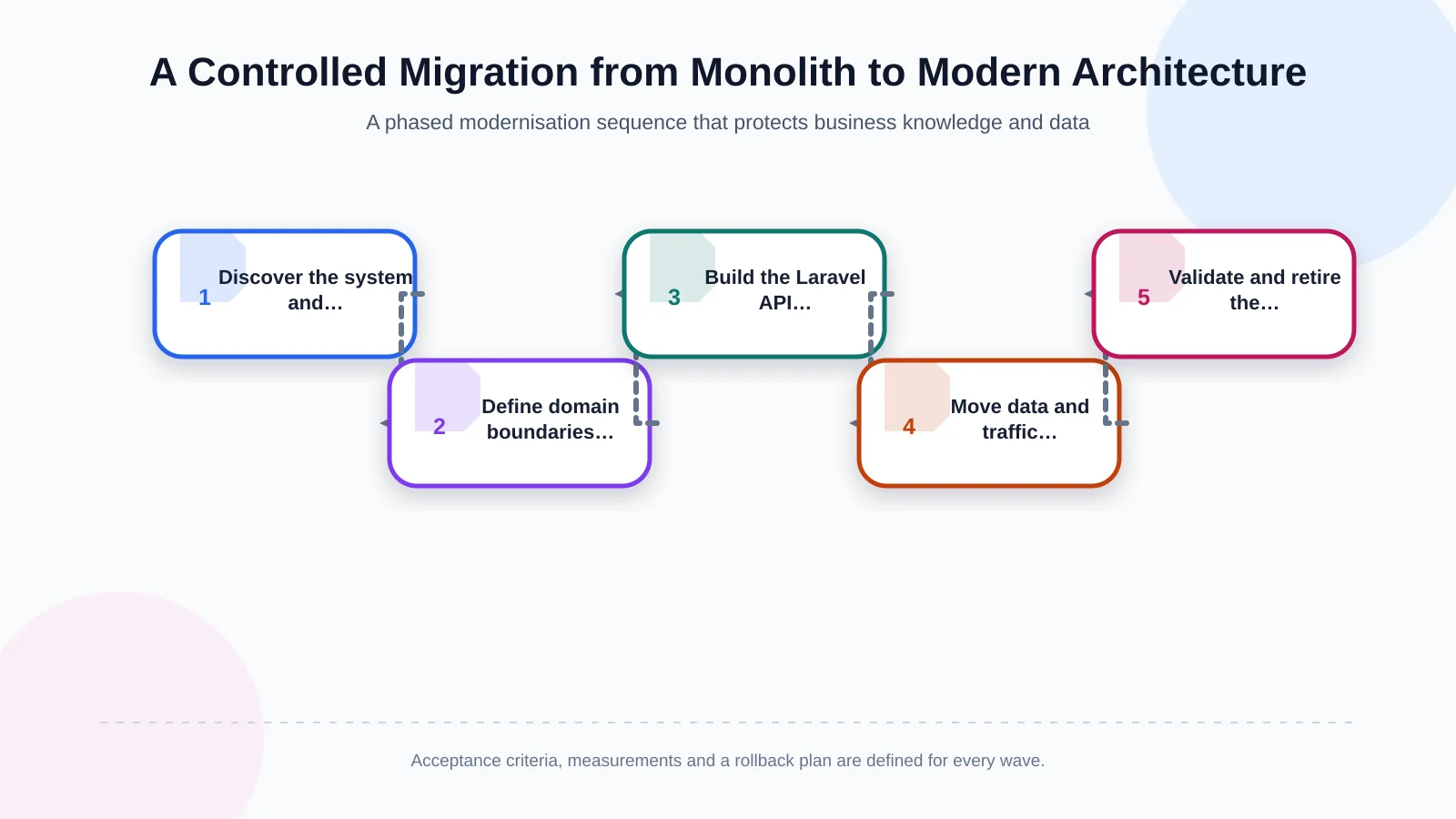
The safest approach is to move business domains in measurable increments. A capability with relatively low dependency and high business value may be selected first. A routing or adapter layer can send migrated requests to the new Laravel application while directing the remaining requests to the legacy system. The old application continues operating during this period.
Each wave should define its scope, acceptance criteria, data owner, rollback procedure and success metrics. After validation with pilot users, traffic can be increased gradually. When the new module is stable and reconciled, its legacy equivalent can be retired. This cycle continues until the remaining monolithic capabilities can be removed safely.
Which module should move first?
The choice should not be based only on which code looks easiest. Business value, frequency of change, security exposure, dependency count, data quality and testability should be assessed together. A relatively independent content or catalogue domain may make a suitable pilot. A financial closing process connected to several systems will often be better placed in a later wave.
| Stage | Core activity | Control gate | Expected deliverable |
|---|---|---|---|
| Discovery | Inventory processes, roles and integrations | Critical rules have been validated | Current-state map |
| Architecture | Define domain boundaries and API contracts | Data ownership has been established | Target architecture |
| Pilot | Build the first Laravel module and run a trial migration | Tests and rollback are ready | Limited production use |
| Phased migration | Move traffic and data in waves | Performance and error rates are acceptable | Transition to the new system |
| Retirement | Remove legacy modules and connections | Records and reports have been verified | Reduced technical debt |
Data migration is a controlled product workstream
Data migration should not be treated as one command to run on launch night. Source fields must first be profiled so that missing, duplicated and invalid records become visible. Source-to-target mappings, transformation rules and the handling of rejected records should be documented and approved.
Trial migrations should be repeated before production. Teams should compare record counts, financial totals, relationships and critical reports. During cutover, it must remain clear which system has write authority. If both systems need to run concurrently, the direction of synchronisation, acceptable delay and failed-message queue must be designed. The rollback plan must address data changes as well as application code.
ERP, CRM and enterprise integrations
One benefit of modern architecture is turning hidden integrations into visible contracts. Instead of updating database tables directly, systems can communicate through APIs, events or controlled file transfers. Every integration should define authentication, timeouts, retry behaviour, duplicate prevention and observable error records.
For example, “request sent” does not mean that an order was successfully transferred. The ERP’s acceptance or rejection response, external document number and failure reason should return to the application and become visible to authorised users. When product information is distributed across several channels, the PIM and product information management guide can help teams establish ownership, quality controls and channel-ready data.
Authorisation and API security
A headless architecture does not automatically reduce the attack surface; it makes APIs more central and potentially easier to govern. Authentication and authorisation must remain separate concerns, and every operation should be checked at both function and object level. Least privilege, rate limiting, secure secret management, input validation, audit trails and an accurate API inventory are baseline requirements.
The OWASP API Security Top 10 highlights risks including broken object-level authorisation, broken authentication, unrestricted resource consumption and improper API inventory management. Security should not be postponed until a single pre-launch penetration test. It needs to be incorporated into code review, automated testing, dependency scanning and operational monitoring.
Testing, performance and observability
Characterisation tests can document what the legacy application actually does today. In the new Laravel layer, unit, integration, contract and end-to-end tests should be used together. Critical flows involving prices, permissions, payments and data transfers need failure, timeout and retry scenarios as well as normal paths.
Performance testing should look beyond average response time. Peak load, queue latency, database queries, cache behaviour and external-service outages should all be measured. Connecting logs, metrics and traces through a shared correlation identifier makes it easier to follow a transaction from the user interface to the ERP response.
How should success be measured?
Success means more than launching the new platform. Deployment frequency, lead time for changes, defect rate, recovery time, critical transaction performance, support volume and vulnerability remediation time should be compared with their starting baselines. Business indicators can include task completion time, the number of manual steps and the percentage of users who complete an intended workflow.
Retired modules, removed integrations and decommissioned servers should also be tracked. Adding a modern interface while leaving every legacy component running does not eliminate technical debt. The roadmap should identify which old component will be closed at the end of each migration wave.
A modernisation roadmap with Kumsal Agency
Kumsal Agency does not treat legacy modernisation as a framework installation exercise. As an Istanbul-based digital and software agency, it evaluates the existing system, user roles, business rules, data sources and integrations as a connected whole. Depending on the project, the scope may include a Laravel backend and API layer, headless web or mobile experiences, ERP and CRM integrations, data migration, authorisation, testing, performance and security.
The objective is to create measurable migration waves without disrupting critical operations. Acceptance criteria, data responsibilities, technical risks and rollback options remain visible at every stage. This allows the organisation to progress towards a sustainable digital-product foundation without committing to an uncontrolled big-bang rewrite.
Contact Kumsal Agency to assess your legacy software, critical workflows and integrations, and to define the scope of a phased migration and a modern architecture roadmap.