


Aydınlatma metni yükleniyor…
Choosing a mobile app development company requires more than comparing price, presentation screens or client logos. The right team challenges the user problem, converts scope into measurable deliverables, validates technical risks early and makes ownership explicit from source code to store accounts.
This guide does not rank vendors. It provides a technical and commercial checklist for comparing mobile development companies in Türkiye or remote delivery teams on equal terms.
Clarify the Need Before Selecting a Company
Mobile web may fit when the task is occasional and does not require offline work, stores or device capabilities. Use the mobile app suitability guide before requesting proposals. An external company can fill product, design, engineering, testing and release gaps, but product ownership remains with your organisation.
Prepare One Project Brief for Every Candidate
- Target user, context and problem
- Current process and data sources
- Critical first-release journey and success measure
- iOS, Android, web and administration requirements
- Payment, mapping, ERP/CRM, notification or hardware integrations
- Security, privacy, accessibility and regulatory constraints
- Target date, decision owners and budget range
Give every candidate the same brief. If product choices remain unclear, start with the ten critical mobile product decisions.
Twelve Mobile App Company Selection Criteria
1. How the team frames the problem
A credible candidate asks about users, critical journeys, data, integrations and success before promising screens and price. It should challenge unnecessary or risky scope with reasons.
2. Relevant problem experience
Look beyond sector logos. Ask what the vendor actually delivered, whether it remains live and which proposed team members participated. When details are confidential, request evidence of process and responsibility.
3. The assigned delivery team
Separate the sales team from the product, UX/UI, mobile, backend, quality and project people doing the work. Ask where subcontractors are used and who remains accountable.
4. Product and UI/UX practice
Expect flows, prototypes, loading/error/offline states, accessibility and usability testing—not only polished screens. Use the mobile UI/UX checklist to compare scope.
5. Technology rationale
Native, cross-platform or hybrid recommendations should follow device APIs, performance, team and maintenance requirements. Ask for a prototype of risky Bluetooth, payment, offline synchronisation or background behaviour.
6. Backend and integration capability
Clarify ownership of APIs, authentication, roles, administration, migration, logging and third-party services. External dependencies need named owners and acceptance conditions.
7. Secure development
Ask about threat modelling, review, dependency management, secret handling, testing and remediation rather than accepting “secure code”. NIST SSDF groups secure practices around preparing, protecting software, producing well-secured releases and responding to vulnerabilities. (NIST SSDF) OWASP MASVS separates mobile controls across storage, authentication, networking, platform interaction, code, resilience and privacy. (OWASP MASVS)
8. Testing and acceptance
Request target devices, OS versions, critical scenarios and accessibility conditions. Acceptance criteria should define defect priority, remediation and retesting.
9. Delivery visibility
Understand demo cadence, task tracking, decision records, risk management and change requests. Measure progress through working accepted deliverables rather than percentages alone.
10. Code, account and data ownership
Put repository, hosting, analytics, notifications, maps, payments and store-account ownership in the contract. Apple's Account Holder role controls legal agreements and membership, so organisational control reduces transfer risk. (Apple Developer roles)
Record Apple Developer/App Store Connect, Google Play Console, source repositories, cloud, domains, email/SMS, push notifications, maps, analytics, crash monitoring, payments and other services in one ownership matrix. Use named users and least privilege instead of shared passwords. Apple and Google define eligibility and preparation steps for app transfer; establishing business ownership at the start reduces exit risk. (Apple app transfer; Google Play app transfer)
11. Handover
Define source code, design sources, schema, API documentation, build/release instructions, signing, service inventory and access register as deliverables. Verify handover by having another authorised team build and release a basic version.
The exit inventory should also cover release history, environments, deployment steps, secure transfer or rotation of secrets, open defects and technical debt.
12. Maintenance and incidents
Separate warranty from maintenance. Define response windows, critical incidents, OS and dependency updates, support channels and feature pricing. “Ongoing support” is not measurable without scope and time.
Separate warranty defect work, routine maintenance, operational support and new development. Define support windows, incident severity, initial response, communication, monitoring, backups, SDK updates, third-party changes and store-policy adaptation.
Compare Proposals With Evidence
| Area | Example weight | Evidence |
|---|---|---|
| Problem and scope | 15% | Assumptions, exclusions, acceptance |
| Team and experience | 15% | Assigned people, relevant problem |
| Technical approach | 20% | Architecture rationale, risk prototype |
| UX and testing | 15% | Flows, states, device/test matrix |
| Security and ownership | 15% | Controls, accounts and code terms |
| Handover, maintenance and cost | 20% | Inventory, SLA, change and total cost |
Adjust weights to the project and record evidence plus residual risk beside every score.
Compare candidates by evidence level, not only by a total score. A practical scale is 0 “no evidence”, 1 “verbal explanation”, 2 “example or document” and 3 “project-specific verified evidence”. Critical ownership conditions such as source, accounts, data and handover should not be traded through weighted scoring; treat them as explicit contractual acceptance conditions.
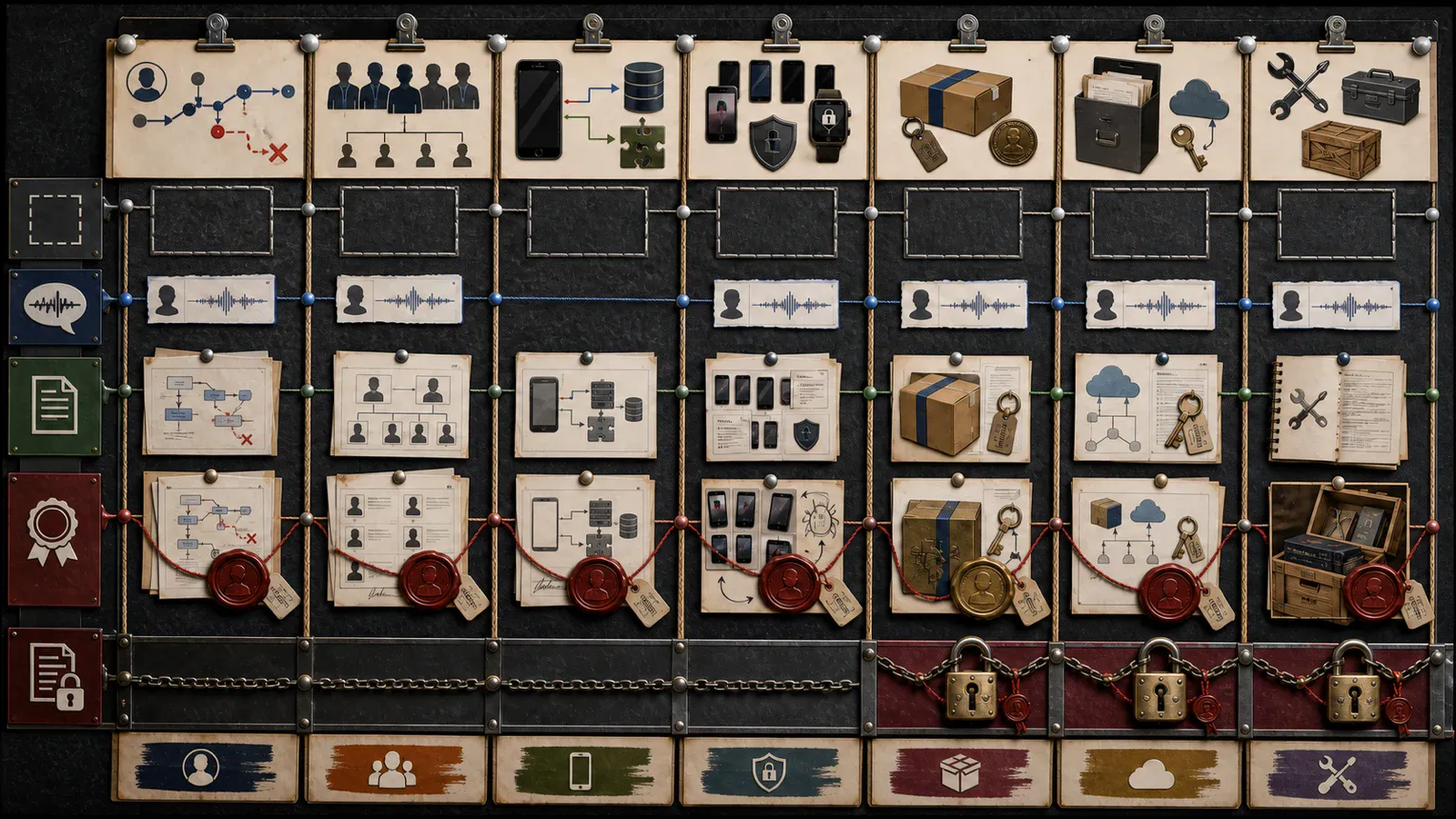
| Area | Evidence to request | Critical question | Weak signal |
|---|---|---|---|
| Problem and scope | Assumptions, users and release summary | What will we deliberately not build? | Immediate screen and schedule promise |
| Team | Names, roles, seniority and capacity | Who will do the work? | Only meeting sales staff |
| Technical system | Architecture, backend, data and integration outline | What owns data and failures? | Technology-name guarantee |
| Quality and security | Test scope and sample acceptance record | Which devices, roles and risks are tested? | One line saying “tested” |
| Store release | Accounts, packages, metadata and rejection flow | Who owns the release decision? | Approval guarantee |
| Ownership and handover | Code, account, access and document inventory | What is delivered if the supplier changes? | Closed control in agency accounts |
| Operations | Support level, maintenance and exit plan | How are incidents, updates and changes separated? | Undefined “lifetime support” |
What Should Pricing Separate?
- Discovery, product analysis and UX/UI
- Mobile clients, backend, administration and integrations
- Testing, security review and store delivery
- Cloud, licences and third-party services
- Warranty, maintenance, support and future development
- Tax, payment milestones, exclusions and change pricing
The lowest build price may not be the lowest ownership cost. Missing scope, vendor-owned accounts and undocumented systems create future transfer cost.
Sixteen Questions for Candidate Meetings
- What are the three riskiest assumptions?
- What would you remove from the first release?
- Which requirements justify your technology choice?
- How will you prove the riskiest integration?
- Who will actually deliver the project?
- How will testing and acceptance be defined?
- Who controls code, accounts, keys and data?
- How are vulnerabilities and critical crashes handled?
- How would handover to another provider work?
- What does two-year maintenance include?
- What was the supplier's actual role in comparable work?
- Who provides the backend and administration platform?
- Are API and integration failure states defined?
- Are store preparation and rejection response included?
- Who controls cloud and third-party accounts?
- Is the supplier-exit and handover inventory contractual?
Warning Signs
- Guaranteed cost and date before discovery
- Source code or store accounts withheld
- Unclear reference scope and team role
- Testing, security and maintenance written only as “included”
- The same stack and package for every project
- Unsupported sales, download or performance promises
- No written change-control process
A supplier can prepare packages, metadata, review access and rejection responses, but cannot guarantee Apple or Google approval. The proposal should separate preparation, rejection analysis, correction, resubmission and later policy changes. (Apple App Review Guidelines)
Conclusion
Selecting a mobile app company means deciding how product risk, ownership and long-term operation will be managed. Give candidates the same brief, score evidence rather than presentation quality and define handover before work starts.
To assess product scope, technical systems, delivery and maintenance, contact Kumsal Agency’s mobile application team.