


Aydınlatma metni yükleniyor…
For an established organisation seeking web design in Bayrampaşa, the project is often more than creating a few corporate pages from scratch. The existing website may contain years of product URLs, technical PDFs, dealer or sales routes, forms, images and search visibility. If a redesign starts without accounting for these assets, a more modern interface can arrive with lost information, broken links and enquiries reaching the wrong team.
This guide does not assume that every Bayrampaşa organisation is a manufacturer or wholesaler. Service companies, retailers and other operating models also exist. Its specific task is the redesign of an established B2B website with product or service data: which record should remain, which should change, which URL needs a redirect and who owns each enquiry?
Why is a migration-led plan relevant in Bayrampaşa?
The Bayrampaşa Municipality 2025–2029 Strategic Plan describes industry, trade and services together as components of the district's economic dynamics. The same plan records the loss of function in some industrial areas and decentralisation among its planning topics (Bayrampaşa Municipality 2025–2029 Strategic Plan). These statements do not mean that every organisation is moving or facing the same transition. They support checking current operating location, production capability, delivery coverage and contact information instead of copying legacy website claims automatically.
A company may now use a former production address as a sales office; its product family may have changed; documents may have expired; or enquiries may be divided among different teams. A website redesign should verify the currency and ownership of these records, not only their appearance.
Inventory the existing website before designing
The first task is not drawing a new homepage but classifying the existing assets. Combine a crawl with accountable team input. The inventory should cover at least:
- Live URL, title, canonical, language counterpart and traffic status
- Product, family, variant, stock code and technical attributes
- PDF catalogue, data sheet, instruction, certificate and version date
- Service, sector, application and solution pages
- Branch, warehouse, production, sales-office and service-area information
- Form, email, phone, dealer, distributor and sales-representative routes
- Image source, permission, currency and product match
- Analytics, advertising, CRM, email and other integrations
Assign “retain, update, consolidate, redirect or archive” to every record. Do not release undecided content, but do not remove an old-looking URL before checking its traffic, links or document value.
The Kumsal six-record B2B migration ledger
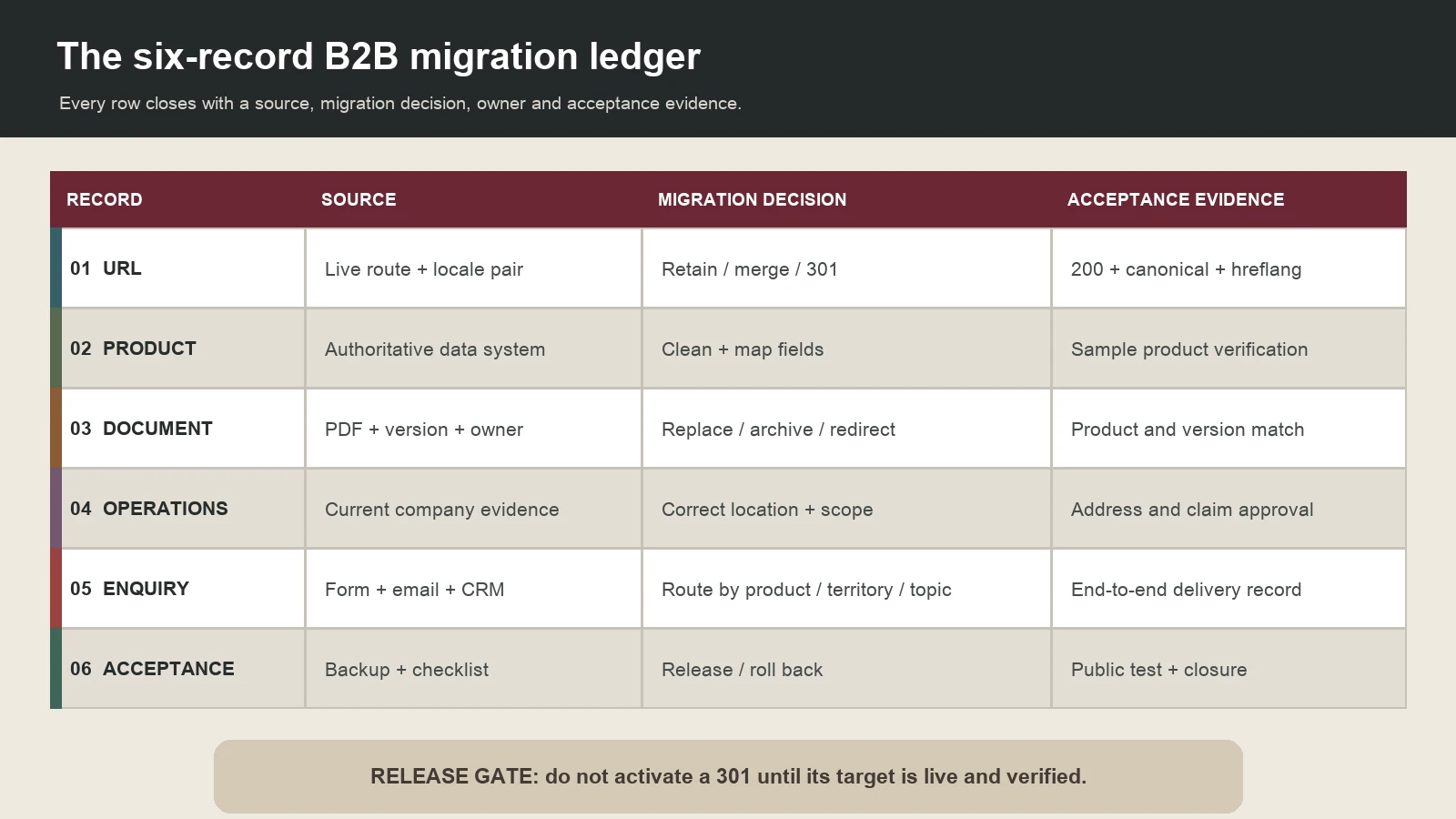
This framework moves a redesign beyond a sequence of screen approvals by managing six connected records. Each record has a source, decision owner, target state and acceptance evidence.
1. URL record
Record the current address, page purpose, language counterpart, canonical, inbound links and measurable performance. If the destination changes, define a one-to-one 301. Consolidating several old pages into one target is appropriate only when the target genuinely satisfies their important intents.
2. Product-data record
Identify the authorised source for product name, code, family relationship, attributes, options, applications and status. When website copy conflicts with ERP or spreadsheet data, define which system is authoritative. Never fill missing technical fields with marketing guesses.
3. Technical-document record
Connect every PDF or file to its product, locale, publication date, validity and accountable owner. Establish a version and archive policy rather than silently replacing an old document at the same address. Do not apply a certificate beyond the product or scope it actually covers.
4. Operating-scope and location record
State the function of each address: headquarters, sales office, warehouse, production facility, showroom or correspondence only. Publish production capability, delivery coverage and service network only with current company evidence. Serving the district does not imply a physical facility there.
5. Enquiry-ownership record
Route forms or emails according to product, territory, customer type and enquiry subject. Sales, technical support, dealer applications, service and export requests should not disappear into one unmanaged inbox. Give the user a confirmation and a realistic next step.
6. Acceptance and rollback record
Before release, test URLs, redirects, documents, filters, forms, emails, locales, analytics events and permissions. Keep a complete backup of the old version and define DNS, SSL and rollback decisions. Going live does not prove that migration succeeded; acceptance closes only after public checks pass.
The framework's original contribution is to treat B2B content as a traceable chain among URL, product, document, operating scope, enquiry and acceptance evidence—not merely as pages to be copied.
How should the product-data source of truth be defined?
Product information may exist in different versions in a web panel, ERP, spreadsheet, desktop-publishing file and individual sales folders. Build a field dictionary first: every field needs a name, format, requirement, unit, example and owner. Then define the publication workflow:
- Who creates the source data?
- Who verifies technical accuracy?
- Who writes the marketing explanation?
- Who approves each translation?
- Which system publishes to the website?
- Where are changes and rollbacks recorded?
Design filters after improving data quality. If the same measurement appears as “10 mm,” “10mm” and “1 cm,” the filter interface will expose rather than solve the inconsistency. Decide whether variants need separate URLs or options within one product by considering search intent, shareability and maintenance together.
How should technical PDFs and certificates be governed?
PDFs can be decision documents in B2B purchasing, but a file without a clear title or date is not a dependable source. Record the visible name, connected products, locale, publication/version date, document owner, validity and superseding version for each file.
If updating a document requires a new URL, define the old link's behaviour. A redirect can work when the new document fully replaces the old scope. When scope changes, an archive or expiry explanation may be more accurate. Support a downloadable PDF with an accessible HTML summary that works on mobile and helps the reader understand its purpose.
How should quotation and dealer enquiries reach the right team?
A generic contact form may not give sales enough context. Depending on actual use, a B2B enquiry can collect product or family, estimated quantity, application, delivery country/city, required date and existing customer/dealer status. Verify that every field supports a real decision and avoid unnecessary personal or commercial data.
Routing is an invisible but critical deliverable. Export enquiries may depend on language or territory, technical questions on product group and dealer applications on a separate approval owner. A success message is insufficient; verify the email or CRM record end to end using the website form monitoring guide.
When should the URL and 301 map be prepared?
A redirect table is not a defect list to create after release. Decide the target of every old URL while approving information architecture:
- Same purpose and address: refresh in place; no 301.
- Same purpose, improved new address: apply a one-to-one 301.
- Consolidated pages: confirm that the target carries all useful scope before redirecting.
- Discontinued product: route to a relevant successor or explanatory archive when one exists; do not send everything to an unrelated category.
- Empty or invalid URL: consider an accurate 404 or 410 when there is no genuine counterpart.
Map TR and EN separately; verify self-canonicals and reciprocal hreflang on the new targets. Activate a 301 only when the target is live, returns 200, has the correct canonical and provides a working language route. Use the website redesign decision guide to define what should change and what should remain.
How should web design companies serving Bayrampaşa be compared?
Do not compare providers only through a homepage concept and total price. Ask the team that will migrate B2B data to demonstrate its method on one representative product family:
- Which tools and ownership will produce the URL and content inventory?
- Who builds the product field dictionary and cleans the data?
- How are PDF, image and certificate status recorded?
- How are TR/EN product counterparts and missing translations managed?
- How are form routing, CRM and email delivery tested?
- Who verifies 301s, canonicals, hreflang and analytics migration?
- Who owns source code, data, media, domain and service accounts?
- What is the release, parallel-working, backup and rollback plan?
Use the 12-criterion website proposal scorecard to compare providers consistently. Ask which records and checks are included when a proposal says only that “all content will be migrated.”
Which deliverables belong in a Bayrampaşa web design proposal?
Alongside design templates, the proposal should separate inventory, data cleaning, content ownership, file conversion, translation, redirects and live migration. Effort depends not only on product count but also on product fields and variant structure. Document verification ownership matters as much as the number of files.
Acceptance checks can cover sample products, filter results, the old/new URL matrix, PDF links, language routes, form routing, permission roles, analytics events, performance and accessibility. The final handover should include not only a working website but also the current field dictionary, redirect file, content-ownership table, access inventory and backup/rollback record.
Conclusion: Preserve the record chain before changing the interface
When an organisation operating in Bayrampaşa redesigns a website with established product or service data, the main risk is not an ageing visual style. It is uncertainty about which information is correct, which URL carries value and who receives an enquiry. Managing URL, product, document, operating scope, enquiry and acceptance records together turns the new site into an operable source rather than merely a fresher interface.
The existing Turkish and English slugs remain unchanged, so this article refresh requires no 301. In client projects covered by the guide, however, every slug change or consolidation needs a redirect as a mandatory part of the migration package—not a task to remember after release.