


Aydınlatma metni yükleniyor…
A professional organisation searching for web design services in Beşiktaş may need more than an attractive homepage. Someone looking for consulting, legal, health, financial, architectural, engineering, creative or technical expertise first needs answers to practical questions. Does this organisation handle my type of matter? Who will assess it? What supports the stated expertise? Which information should I share at first contact, and what happens after I submit the form?
Generic claims about an experienced team, innovative solutions or high satisfaction do not answer those questions. At the same time, asking for detailed health, legal, financial or company records at the first step can create unnecessary risk. This guide treats a professional-services website as a consultation-preparation system connecting service fit, accountable expertise, permitted evidence, minimum-data intake and verified delivery—not merely as a promotional display.
Why do expertise and preliminary consultation matter in Beşiktaş?
The Beşiktaş Municipality 2025–2029 Strategic Plan places the district within Istanbul's Central Business Area. It records a combination of universities, private-sector organisations, civil society, cultural and tourism opportunities, together with daytime visitor intensity above the resident population (Beşiktaş Municipality 2025–2029 Strategic Plan).
This official context does not prove that every organisation in Beşiktaş is a consultancy, serves international clients or holds a particular level of expertise. The people, authority, service coverage and achievements of a specific organisation must come from its own current records. The narrower design implication is that visitors arriving with different purposes and levels of knowledge should be able to move from a general brand narrative to suitable expertise and a safe next step.
What should a professional-services website avoid promising?
A website should not guarantee an outcome, present expertise beyond its real authority or make general information look like personalised assessment. Claims such as guaranteed results, best provider, lowest price, rapid solution or first ranking only become meaningful when their scope, method and evidence are explicit. In many professional services, outcomes depend on the client's circumstances, regulation, third parties, timing and other conditions.
Submitting a contact form does not necessarily create an appointment, engagement, representation or confidentiality obligation. The site should explain which stage is preliminary, how acceptance or a booking is confirmed and whether the channel is suitable for urgent matters. In high-impact fields such as health, law and finance, the boundary of general information and the need for authorised assessment should be visible.
The Kumsal six-record expertise-to-consultation system
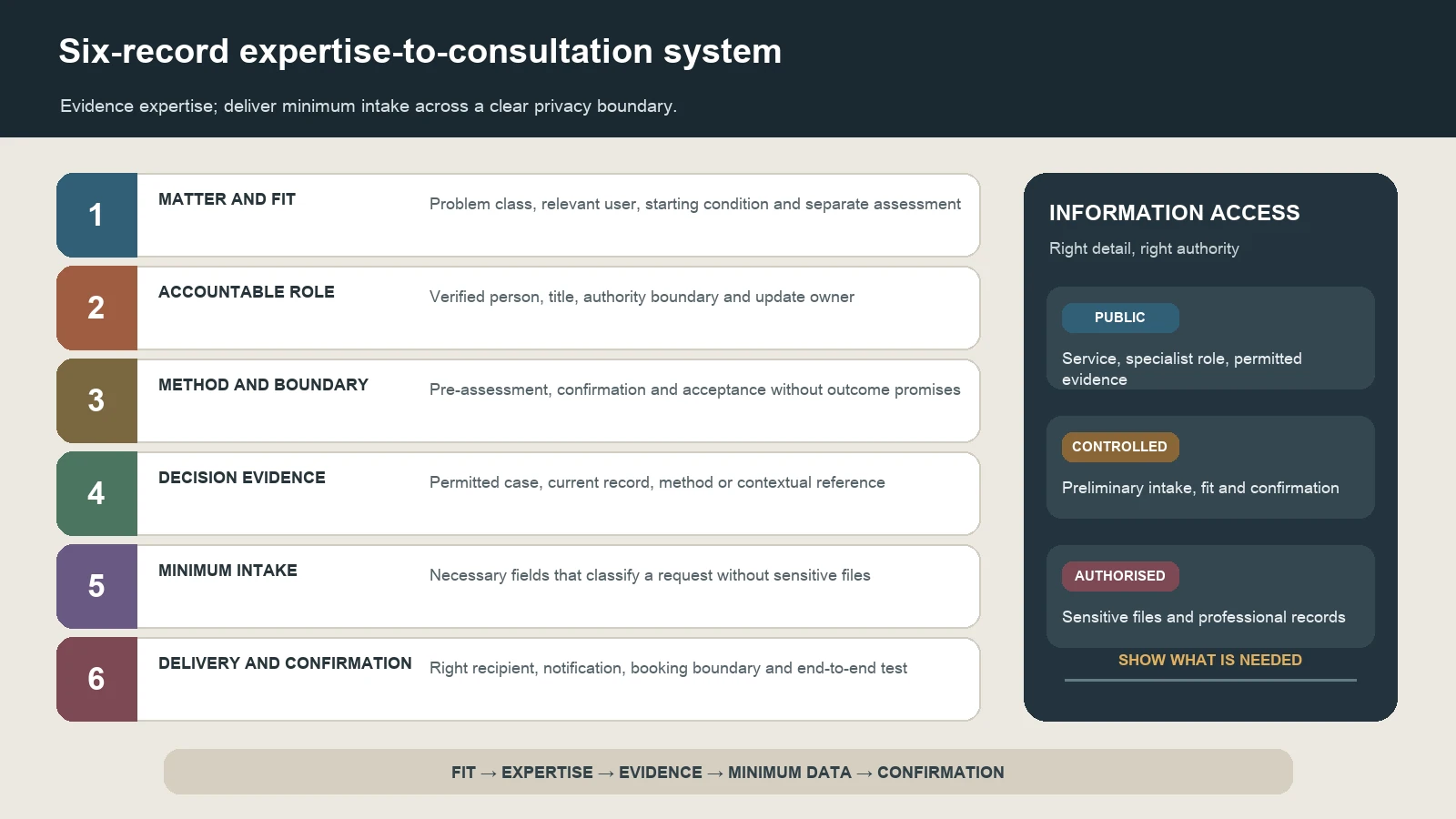
This original framework connects six governed records: matter fit, accountable role, method and boundary, decision evidence, minimum preliminary intake, and delivery with confirmation. Its purpose is not to make forms longer. It helps a visitor arrive with the right expectation, avoid unnecessary disclosure and reach a real recipient.
1. Bound the matter and service fit
Consulting, corporate solution or specialist service is not a sufficient scope statement. Explain which problem the page addresses, who it may suit, the starting conditions and situations requiring separate assessment. Closely related services may need distinct pages or clear subsections when authority, method, timing or required records differ.
Do not multiply pages by changing only a district or sector name when the user question, decision evidence and action remain the same. Add a content owner, review date and claim source to every service record. Use the corporate website content matrix to govern service, audience, decision question, evidence and action together.
2. Present the accountable person and role accurately
A visitor may need to know which role will assess the matter, not merely the company name. Show a person's name, title, practice area, current licence or professional registration only when verified. A profile for someone who has left, an expired credential or membership belonging to another entity should not remain live.
Do not imply that one person performs every stage. Preliminary assessment, specialist opinion, proposal, project management and support may have different owners. The profile should separate those roles honestly, avoid presenting a stock portrait as a real team member and omit unnecessary personal information.
3. Explain method, stage and boundary
A professional process should not end with “contact us”. Depending on the organisation, outline first contact, preliminary assessment, eligibility or conflict checks, consultation, proposal or approval, work, delivery and follow-up. Explain each stage's purpose, required input, how timing is confirmed and who owns it.
This is not an outcome guarantee. It prevents the impression that a person has been automatically accepted after first contact and makes the real operating sequence visible. If timing is uncertain, describe which information or check determines it rather than publishing an unsupported fixed promise.
4. Match each claim with permitted decision evidence
Expertise can be supported through context-appropriate evidence: verified education or professional registration, a permitted project example, an explained method, publication, presentation, case summary, independent assessment or a reference with defined scope. Keep permission and context records for customer names, logos, outcomes, before-and-after data and quotations.
Where evidence is unavailable, do not substitute a stock image, an unsourced counter or a 100-percent-success label. When confidentiality limits detail, a case can explain the problem class, process and learning boundary without identifying the party. An award or membership should not become generic proof for every service.
5. Request only necessary data at preliminary intake
The first form should classify the request, not collect the entire file. In addition to a name and contact channel, a subject category, preferred language, general time range and short context may be sufficient. Exact fields must follow the organisation's real acceptance process.
Identity documents, medical records, legal papers, financial statements, contracts, trade secrets and other sensitive files should not be requested automatically through a general email or public upload field. If a secure second stage is required, define the authorised recipient, access role, retention period and deletion method. Forms should work by keyboard, have explicit labels and give understandable correction guidance. Use the website accessibility planning guide to define these requirements before procurement.
6. Verify delivery, recipient and confirmation
A success message does not prove that the record reached an authorised person. Test the form record, email, CRM or task system, spam filtering, notification, response template and backup recipient end to end. General enquiries, existing-customer support, press, jobs and professional consultation requests should not disappear in one uncontrolled inbox.
The automatic response should state that the record was received, when and through which channel a reply may be expected, and whether the message constitutes acceptance or a confirmed appointment. Apply the end-to-end scenarios in the website form monitoring guide to verify real delivery.
The framework's original contribution is to define trust as the combined operation of fit, a verified accountable role, bounded claims, permitted evidence, minimum data and confirmed delivery—not as an abstract visual impression.
How should privacy and professional boundaries become visible?
A privacy badge or lock icon does not create a secure process. Explain in plain language which information is public, what should not be included in the first form, why data is used and where detailed records will be shared at a secure stage. Organisation-specific legal duties should be assessed by authorised legal and information-security teams.
Professional biographies, references, case details and form records can have different publication and access permissions. The content-management system should use roles; outdated access should be removed, changes logged and backups controlled. HTTPS on the form does not prove that the receiving account, attachments and every subsequent step are secure.
How should Turkish and English expertise content remain aligned?
Service scope, accountable roles, authority boundaries, fee or proposal method, data warning and consultation confirmation must be materially equivalent in both languages. The English version need not be word-for-word, but it cannot add expertise, a physical office, language support, an outcome or a response time absent from the Turkish record.
Link each language pair through the same source record and content owner. Map form choices to controlled back-end values; test automatic responses and recipients in both languages. The language selector should open the true counterpart, canonical should be self-referential for each locale, and hreflang relationships should be reciprocal.
How should web design companies in Beşiktaş be compared?
Give candidate agencies the same scenario: four professional services, two specialist roles, public and restricted evidence, a first form without sensitive data, two languages, three request types and separate recipients. Ask each provider to show how the scenario becomes pages, CMS fields, permissions, a form workflow and an acceptance test.
Review these outputs separately:
- Service, audience and fit-question inventory
- Specialist profile, role, record source and update owner
- Process stages, boundaries and acceptance or confirmation language
- Permission records for references, cases, logos and outcome claims
- Public, restricted and sensitive information classes
- First-form fields, second stage and secure file-sharing method
- Recipient, notification and backup ownership by request type
- TR/EN scope, profile, form, canonical and hreflang pairing
- Mobile, keyboard, accessibility, security and performance tests
- Publication, backup, training, maintenance and new-development boundaries
Ask for the concrete deliverable and acceptance condition behind phrases such as SEO-friendly, high-converting, fully secure, flawless or unlimited support. An attractive screen does not prove that a professional record will stay current or a sensitive request will reach the correct person.
What determines web design cost in Beşiktaş?
The district name does not determine cost. Relevant factors include original page types, specialist and evidence records, content production or migration, language count, forms and secure file flow, booking or CRM integration, user roles, accessibility, testing, training, hosting and maintenance responsibilities.
A five-page brochure is not the same scope as a system that matches specialists to services, manages multilingual profiles, receives safe preliminary requests and routes them to different accountable people. Third-party licences, usage-based services, routine maintenance and new development should be separated. Compare proposals against the same requirements record and acceptance scenarios.
How should success be measured?
Success is not represented by form volume or time on page alone. Measure whether people reach the right service, understand fit, complete the form without unnecessary sensitive disclosure, achieve real delivery and provide enough context for accountable assessment. Example indicators include:
- Intent alignment of queries reaching service and specialist pages
- Movement to the suitable service or language
- Form error and abandonment points
- Actual delivery, first-view and first-response timing
- Classification of wrong-topic, urgent, existing-customer, job and spam requests
- Repeat contact caused by missing information
- Time taken to correct outdated profiles, credentials or references
- TR/EN consistency of scope, warnings and forms
These measures do not guarantee service outcomes, revenue or ranking. Interpret them with request quality, capacity, price, specialist fit and the organisation's acceptance decision. Process personal data only for the necessary purpose and period.
Conclusion: Manage the website as a pre-consultation trust record
For a professional organisation operating in or serving Beşiktaş, web design should not attach the district's prestige to generic sales language. It should give the visitor a suitable matter, a real accountable role, an explicit method boundary, permitted evidence, minimum-data intake and a verified next step.
The current Turkish and English slugs remain unchanged, so this refresh does not require a 301 redirect. Once the six-record expertise-to-consultation system is populated with the organisation's actual processes, web design providers in Beşiktaş can be compared through expertise governance, privacy, accessible intake, delivery testing and maintainable content ownership rather than decorative promises.