


Aydınlatma metni yükleniyor…
An organisation looking for web design in Beykoz needs more than a website that appears “corporate, fast and modern.” It needs a structure that presents the evidence visitors require to make a decision. A prospective customer may need to understand whether the service fits, whether the organisation genuinely operates in the stated scope, how it handled comparable work, where the boundary lies and who will receive an enquiry.
This guide does not assume that every Beykoz organisation belongs to one sector or sales model. Hospitality and visit-led services may need current location and service evidence; manufacturers may need technical capability and product information; project-led providers may need method, deliverable and comparable-work evidence. The website should not flatten these differences into one list of adjectives.
Why may one generic corporate template be insufficient in Beykoz?
The Beykoz Municipality 2025–2029 Strategic Plan brings together objectives relating to local employment and entrepreneurship, ecotourism projects, cultural-heritage promotion and the renewal of local production centres (Beykoz Municipality 2025–2029 Strategic Plan). The plan does not prove that every local organisation follows one model. It shows why different visitor, customer and project tasks may not fit a single About–Services–Contact template.
Appearing for “web design in Beykoz” is not the complete outcome. The page should answer practical evaluation questions: What work is performed, what is excluded, which evidence can be verified and what happens next?
Start with the visitor's decision question
Placing every service and audience on the homepage can create uncertainty rather than breadth. Define one primary decision question for every important page:
- Does this service fit my need?
- Does the organisation genuinely serve this area or scope?
- How has it approached work of comparable complexity?
- Which deliverables and responsibilities are included?
- Which variables affect price or schedule?
- Who takes ownership after I submit an enquiry?
One page does not need to answer every question equally. A service page explains suitability and scope; a project page provides implementation evidence; an enquiry page collects relevant information and explains the next step.
What is the difference between evidence and a marketing claim?
Words such as “quality, professional, reliable and leading” are not evidence. Trust evidence is verifiable information that helps a visitor assess a claim or fit for their own decision. Different projects can use different evidence classes.
Identity and operating evidence
Trading identity, verified contact details, physical address where one exists, service coverage, operating model and required legal information should agree. Serving Beykoz must not be presented as having an office in Beykoz.
Service-scope evidence
Explain who the service fits, the included deliverables, required client inputs and important exclusions. Visible limits are more informative than a promise to solve every possible need.
Project and implementation evidence
Permissioned examples should contain more than a gallery. Separate the starting problem, approved scope, approach, delivered elements and any verifiable result. Do not add unmeasured sales, ranking or performance improvements afterwards.
Process and ownership evidence
Explain responsibilities across discovery, content, design, development, testing, release and maintenance. Do not present a method that applies only to some projects as a universal commitment.
Freshness evidence
Assign an owner when services, team details, pricing conditions, hours, certificates, projects or location information can change. An older project may still be useful, but it must not imply a relationship or scope that is no longer current.
How should project and portfolio pages be prepared?
A portfolio is more than a logo wall or screenshot collection. Define the permission and evidence boundary for every record. When a client cannot be named, an anonymised example may be possible; a fictional client, result or quotation is not acceptable.
A publishable project record may include:
- Sector and user task
- Verifiable starting problem
- Approved scope and exclusions
- Design, content, software or integration approach
- Delivered pages, modules or work types
- Client and delivery-team responsibilities
- Permission status for visual and brand assets
- Results only where method and period are documented
- Current or archived project status
Write the example as a decision record that lets prospective clients identify similarities and differences, not only as a success story.
The Kumsal six controlled handoffs from evidence to enquiry
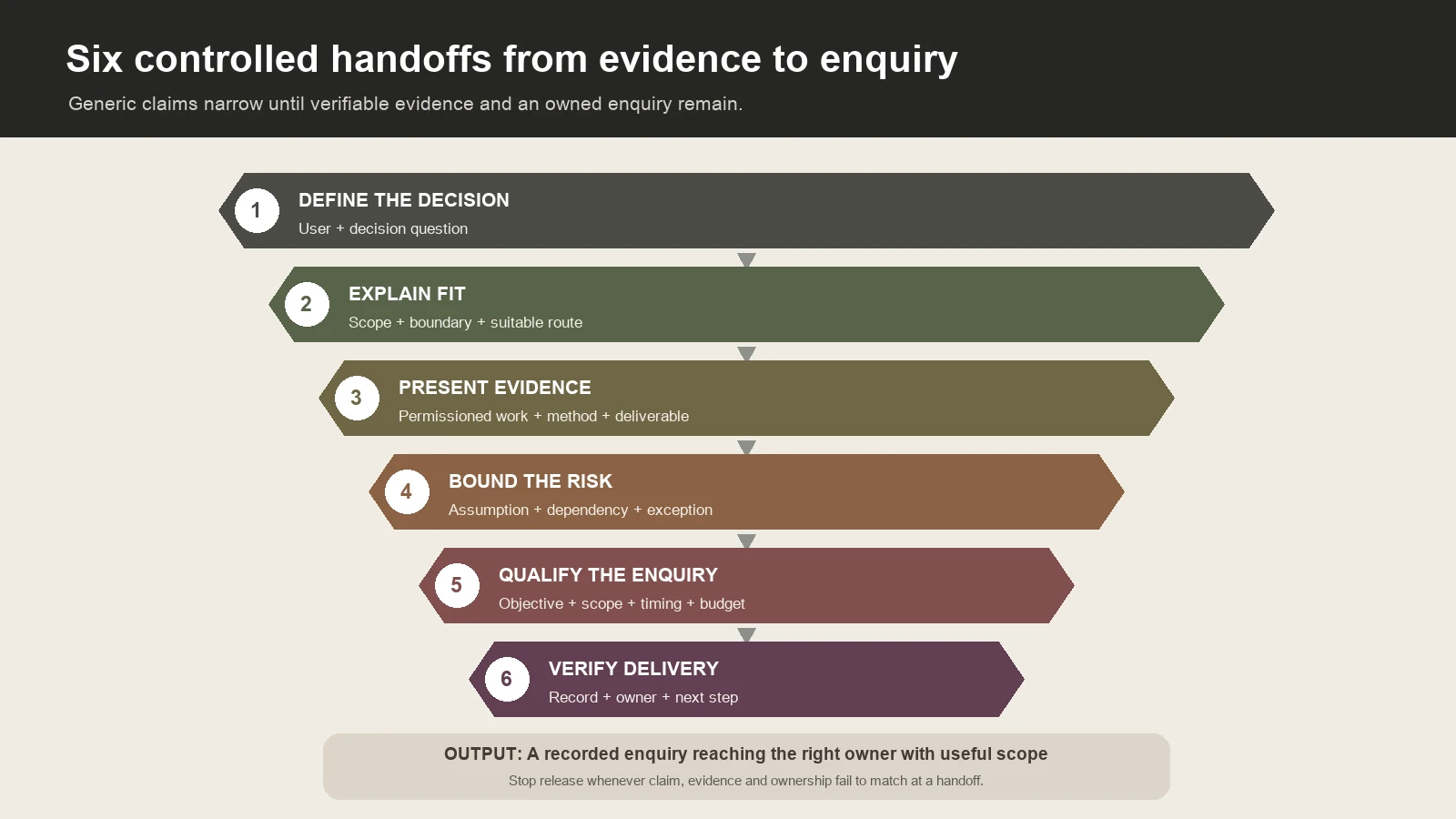
The Kumsal six-handoff model replaces the jump from generic trust claims to a long contact form with a controlled chain joining decision evidence and enquiry ownership.
1. Define the decision
State which user needs to make which decision on the page. “Suitable for everyone” is not an audience. The evidence cannot be selected until the decision question is known.
2. Explain fit
Describe the work type, scale, area, technical conditions or commercial model the service may fit, and when a different solution is needed. This can reduce unsuitable enquiries while giving the right visitor confidence.
3. Present evidence
Match the claim with the right evidence: a deliverable example for process, scope table for service, permissioned case record for a project, or a verifiable method or document for technical capability. Generic stock imagery is not project evidence.
4. Bound the risk
Explain uncertainty around price, schedule, integrations, content, third-party services, maintenance and outcomes. Do not convert unknowns into guarantees; state what will be resolved during discovery or proposal work.
5. Qualify the enquiry
The form or meeting path should collect information the receiving team will actually use. Project purpose, current website, required scope, languages, target date, budget range and integrations may help. Do not collect unused personal data or files.
6. Verify delivery
Show submission status and the next step. Confirm that the enquiry reaches the intended mailbox, CRM or owner, not only that the browser displayed success. Mention a response time only where an approved service commitment exists.
The original value of this framework is to treat trust not as a visual mood or adjective, but as a traceable chain connecting a decision question, scope, evidence, risk, enquiry data and delivery record.
Which fields belong in the enquiry form?
There is no universal form for every organisation. A visit or booking request may need date and guest count; a project-led service may prioritise objective, current system and expected deliverables. Before adding a field, identify who uses the information and which decision it supports.
Possible project-enquiry fields include:
- Organisation and contact person
- Project objective or problem to solve
- Current website or system
- Required service and priority deliverables
- Target audiences and languages
- Forms, payment, booking, CRM or other integrations
- Target date and critical dependencies
- Realistic budget range or phased-delivery preference
- Contact and data-processing permissions
Length is less important than decision value. Making details mandatory when they can be resolved in the first conversation may reduce completion. For file uploads, define type, size, malicious-content checks, access controls and retention in the technical scope.
How should the web design agency's own evidence be assessed?
Do not rely only on visual portfolio quality. Review comparable project complexity, team roles, scoping method, testing, source and account ownership, release planning and maintenance boundaries. Project outcomes vary, so ranking, sales or conversion guarantees should not count as evidence.
Use the guide to how a web design agency works to understand typical responsibilities and deliverables. This page focuses on how a service or project-led website operating in Beykoz should structure its own trust evidence and enquiry flow.
Local visibility must reflect real operating information
A Beykoz location page is not created by changing the district name in a shared paragraph. Service coverage, physical location, arrival details, operating model and contact information must reflect reality. Do not multiply neighbourhood or location pages without distinct service coverage, verifiable local information and an owner who can keep the page current.
Do not imply that Kumsal Ajans has a Beykoz office, client or local project without evidence. The ability to serve a district does not prove physical presence or completed work there.
What should a web design proposal for Beykoz include?
The proposal should go beyond “corporate site and contact form” and make these decisions visible:
- Audiences, decision questions and primary conversion routes
- Service, project, portfolio, team, location and enquiry templates
- Preparation, permission and ownership of project evidence
- Turkish and English content, localization and approval responsibilities
- Form fields, notification, CRM, file and failure behaviour
- Mobile, browser, accessibility, performance and security testing
- Analytics events and boundaries of enquiry-quality reporting
- Ownership of design, source code, data, media, domain and accounts
- Release, acceptance, warranty, maintenance and new-development boundaries
- Assumptions that can alter price and schedule
Use the guide to preparing a website requirements document to create a shared scope. Apply the 12-criterion website proposal scorecard to compare evidence and responsibilities consistently.
Conclusion: Move trust from claims into the decision chain
A website for a service, hospitality, event, production or project-led organisation operating in Beykoz should not give every audience the same general promises. A visitor should be able to confirm fit, examine evidence, understand boundaries and reach the correct owner with useful information.
The existing TR and EN slugs are preserved, so this refresh requires no 301 redirect. Defining decision questions, permissible evidence, publishing permissions, form data, enquiry ownership and acceptance criteria before requesting proposals makes web design in Beykoz more concrete and comparable.