


Aydınlatma metni yükleniyor…
For an organisation seeking web design in Kadıköy, the central question is not whether a site looks “on trend.” Can a visitor find the right service, verify fit, understand the booking or visit option and complete the task with confidence? A design decision is valuable when it makes those tasks easier.
This guide does not assume that every organisation in Kadıköy has the same customer journey. A consultancy may collect discovery-call enquiries; a clinic may manage appointments; a shop may prioritise location and stock information; a cultural or educational organisation may need to maintain programmes, registration and venue details together. The objective is not to place every need on one long homepage, but to create an information architecture that routes each visitor correctly.
Why does Kadıköy call for a task-led website plan?
The Kadıköy Municipality 2025–2029 Strategic Plan notes that daily population movement supports the urban economy, innovative sectors are concentrating in the district and cultural, artistic and design activity is strong (Kadıköy Municipality 2025–2029 Strategic Plan). This does not mean every organisation follows the same model. It helps explain why a website may need to separate content discovery, appointments, events, visits and location tasks rather than rely on an About–Services–Contact structure alone.
A person searching locally is not always looking for somewhere to visit on foot. Some services are delivered remotely, some require a branch or venue and others depend on availability on a particular date. “We serve Kadıköy” does not explain these differences. Service coverage, physical address, operating model and the appropriate next step should be verified separately.
Identify user tasks before listing pages
Starting information architecture with “how many pages?” often produces repetitive pages. Begin with tasks found in search, sales and support records:
- Understand the scope of a service and who it suits
- Compare related services, packages or specialisms
- Start an appointment, consultation, registration or reservation
- Find a branch, shop, clinic, studio or event venue
- Verify opening hours, accessibility and arrival information
- Review a current event, programme, announcement or availability
- Understand variables affecting price before requesting a proposal
- Reach the right support route after a purchase or application
For each task, identify the entry page, necessary evidence, primary action and accountable owner. Avoid duplicating the same action under several labels; create one clear route.
The Kumsal five-route local website map
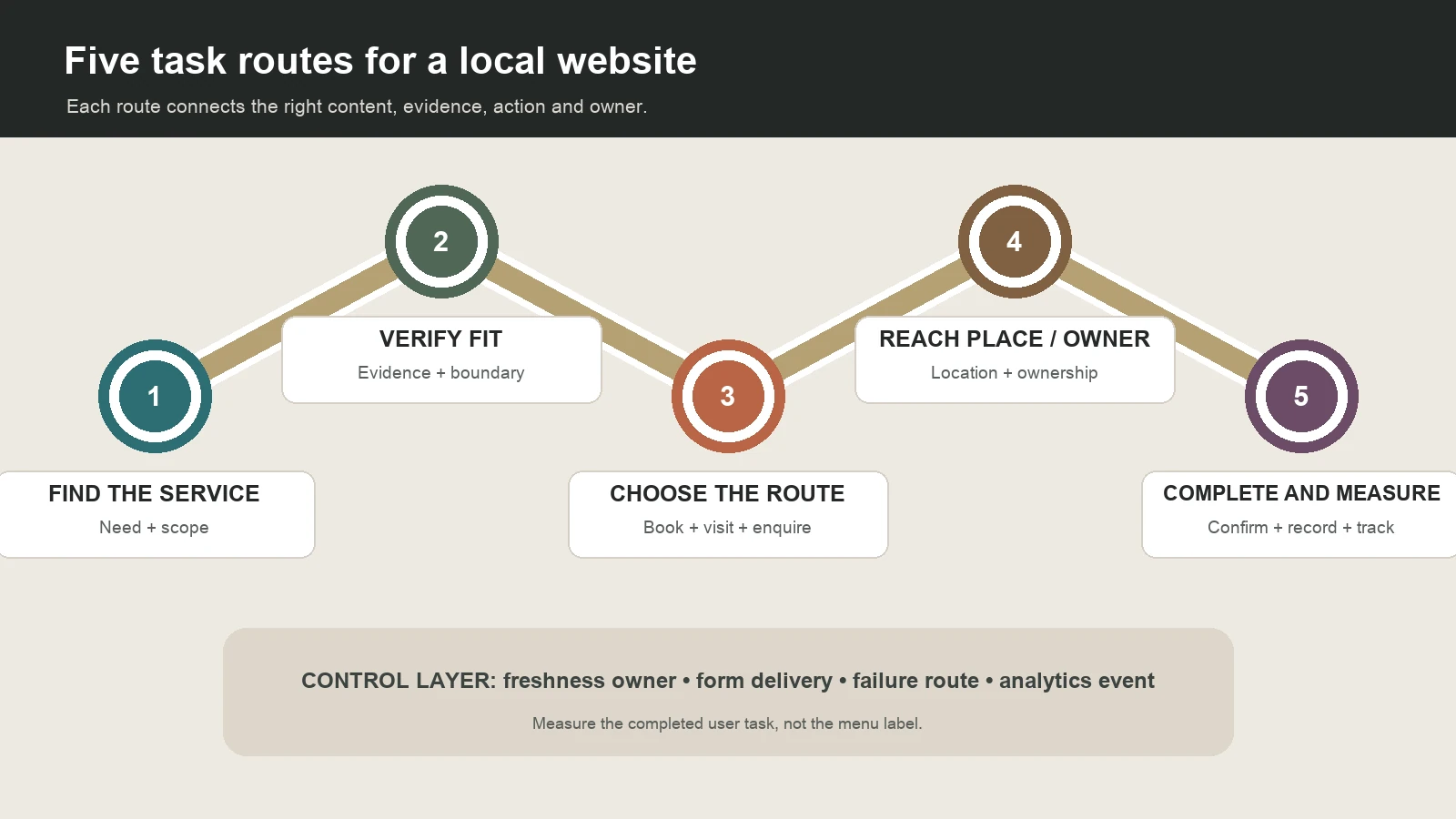
This model organises navigation around visitor decisions rather than internal departments. Routes can remain distinct, while their transitions and measurement points are designed together.
1. Find the right service
The homepage or category page should help a visitor recognise their need. Replace an ambiguous list of “all solutions” with service type, intended user, problem, deliverable and important boundaries. Brief comparisons can explain the difference between similarly named services.
2. Verify fit and evidence
A service page should say who the service fits and when another solution may be required. Permissioned project work, method, expertise, technical specification, team role or a process record can provide evidence. Unmeasured labels such as “best, quality and professional” do not establish fit.
3. Choose the booking, visit or enquiry route
Not every service is purchased directly. A visitor may book an appointment, visit a shop, register for an event or request a proposal. The page should explain which route suits which need, the information required before starting and what happens afterwards.
4. Reach the right location and owner
Where a physical visit is relevant, keep the address, map, entrance guidance, hours, accessibility and travel options current. If several locations exist, each page should show the real services available there. For remote delivery, show which team or role owns the enquiry.
5. Complete and measure the task
A form submission, booking record or directions click is not sufficient on its own. The visitor needs confirmation; the record must reach the right system and owner; an alternative route must exist when something fails. Analytics can distinguish service views, booking starts, form errors, successful submissions and location interactions.
The framework's original contribution is to treat a local website as five owned and measurable routes from service discovery to task delivery, rather than as a promotional surface alone.
How should service pages be separated?
A main service can have its own page when user intent, deliverables or evidence are genuinely different. Do not create word-order variants of the same copy or pages that change only a neighbourhood name. A service page may cover:
- The problem and intended user
- Scope, deliverables and important exceptions
- Variables affecting schedule and price
- Content, access or approvals required from the client
- Permissioned evidence with explanatory context
- Differences between related services
- The next step for booking, visiting or requesting a proposal
- The content owner and review date
For a large service set, use the corporate website content matrix to separate each page's audience, decision question, evidence and action.
Booking system or enquiry form?
A booking system may be appropriate when available slots and resource capacity are managed in real time. A short consultation form may be better when every request first requires a scope, expertise or suitability review. Asking the user to select a slot and then recreating the booking manually—or implying immediate confirmation before checking availability—can undermine trust.
Request only information that advances the decision. A success message without an email or CRM record is an invisible loss. Plan regular live tests and delivery evidence using the website form monitoring guide.
How should location and event pages stay current?
A location page should contain more than an embedded map. Verify the real address, service hours, appointment requirement, public transport or parking guidance, entrance and accessibility conditions where applicable. Do not imply a physical office or branch where none exists.
For events and programmes, date, time, venue, registration condition, capacity, price, cancellation and change information should come from one governed source. Past events can remain in an archive, but registration should be closed and the page must not appear current. Assign a content owner and review frequency to every changing data type.
Which mobile and accessibility tasks should be tested?
Mobile testing involves more than checking whether the layout overflows. On real devices, test finding a service with one hand, selecting a phone number, choosing a date, correcting a form error, opening directions and reading the confirmation. Keyboard access, visible focus, form labels, error explanations, colour contrast and motion preference can be part of acceptance criteria.
Third-party booking, mapping or payment components should not be treated separately from the website. Consent, personal data, accessibility, performance, failure behaviour and provider downtime belong in the proposal scope.
How should web design companies serving Kadıköy be compared?
Location and visual portfolios are not enough when comparing web design companies for a Kadıköy project. Proximity may be convenient, but discovery, content architecture, user research, development, testing and post-release ownership are separate capabilities. Ask providers to respond to the same scenario:
- How will they identify service, booking, location and event routes?
- Who owns the content inventory, migration and approval?
- How will booking, forms, maps, CRM and analytics integrations be tested?
- Who owns source code, domains, accounts, data and media?
- What are the mobile, accessibility, performance and security criteria?
- How are defects, maintenance and new development separated after release?
Use the 12-criterion website proposal scorecard to compare answers on a common basis. Consider the cost of missing scope and external dependencies, not only the lowest total.
What should a web design proposal for Kadıköy contain?
In addition to a page count, the proposal should name user tasks and template types. Define service/category relationships, booking or form logic, branch and location data, the event archive, search and filtering, TR/EN content ownership, redirects and analytics events.
The design deliverable should extend beyond desktop screenshots. Mobile states, empty and error screens, form validation, unavailable booking slots, past events, missing locations and third-party service failures should be included. Before release, prepare acceptance checks for content, functionality, tracking, backups, DNS, SSL and rollback.
Conclusion: Design the task, not only the menu
The success of a web design project in Kadıköy cannot be measured by the number of menu items or how closely it follows a visual trend. A visitor should be able to find a suitable service, assess evidence, choose a booking, visit or enquiry route and understand that the task has been completed.
The existing Turkish and English slugs remain unchanged, so this refresh does not require a 301 redirect. Defining the five routes, content owners, freshness rules, integrations and acceptance criteria before work begins makes proposals more comparable and the resulting website more maintainable.