


Aydınlatma metni yükleniyor…
For an organisation looking for web design in Şile, a useful website is more than scenic photography, room or service pages and a contact form. Visitors often need to confirm the current operating state: Is the business open, is the selected date available, where should they book, how will they arrive and who will answer a question? Strong visual design cannot complete the journey when those answers are stale or inconsistent.
This guide does not assume that every Şile organisation works in tourism or hospitality. It focuses on projects where seasonality, booking, a physical visit or location information affects the decision. The same control model can be simplified for year-round corporate, B2B or walk-in services.
Why does a Şile website need a current-status and booking plan?
The Şile Municipality Culture Affairs regulation lists the promotion of the district's natural, historical, cultural and geographic values, the development of tourism strategies and sustainable tourism planning among its official activity areas (Şile Municipality: Culture Affairs regulation). This does not mean that every business needs the same website. It explains why visit decisions, seasonal information and local experience content may matter more than generic corporate copy in some Şile projects.
Repeating “web design in Şile” across headings does not complete the visitor's task. If a person cannot verify current availability, identify the correct booking channel or locate the venue, the page can rank and still fail functionally.
Define the decision the website must support
Two organisations in the same district can have very different journeys. Accommodation may require dates and guest count; a restaurant may use booking time; an event venue may need capacity; a local service provider may ask for area and appointment availability. Define the primary conversion before design begins:
- Direct online booking and payment
- A controlled handoff to an external booking service
- An enquiry form containing date and service information
- A phone or messaging conversation
- Information and directions only
- A guided choice between several channels
If several channels exist, document the primary route, monitored hours and fallback when nobody can respond. Five equally prominent buttons can increase uncertainty instead of improving choice.
The Kumsal six-state seasonal readiness loop
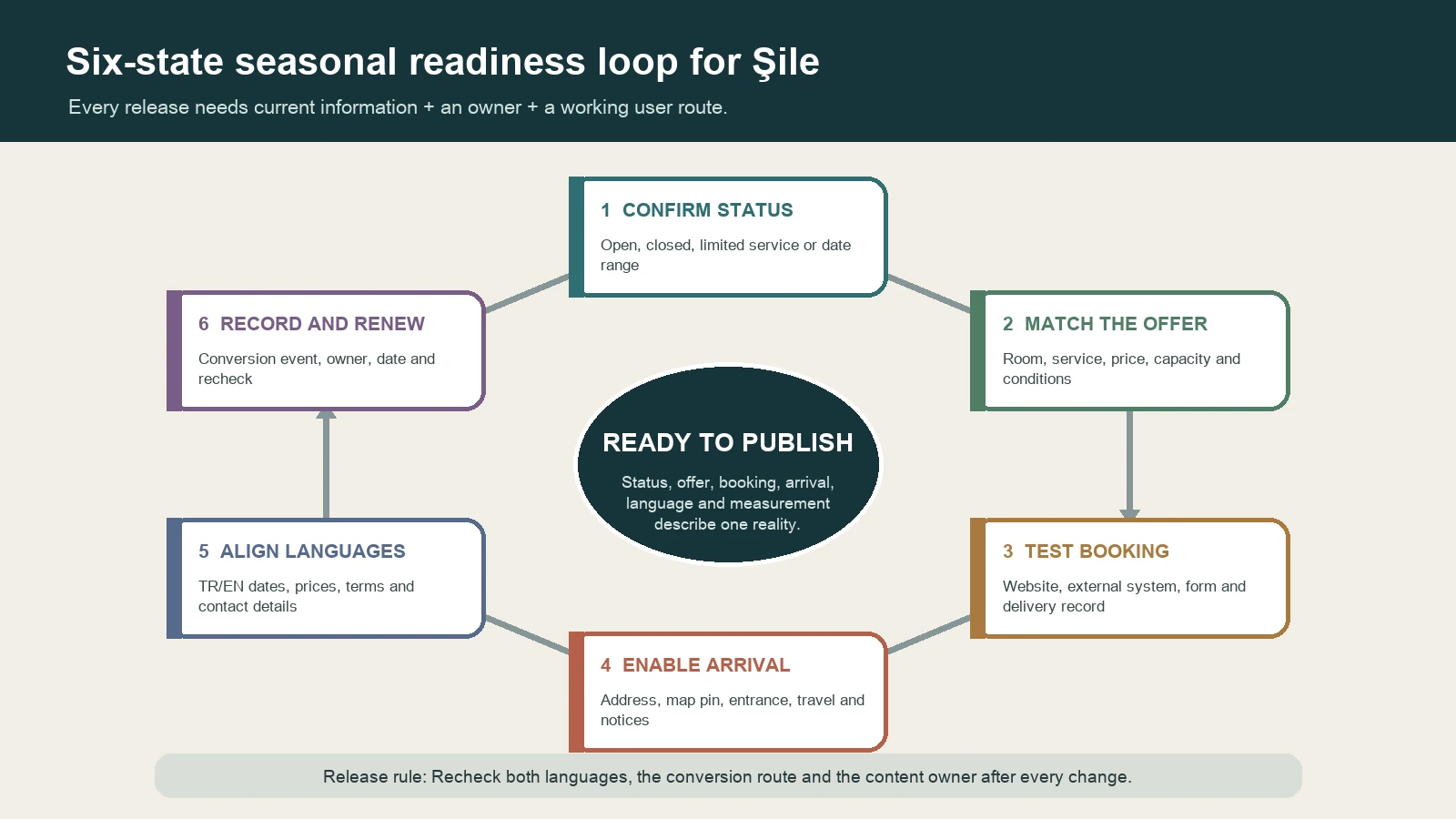
A seasonal or visit-led website should not be checked only on launch day. The Kumsal six-state loop connects every published offer with current information, an accountable owner and a working conversion route.
1. Confirm status
Verify whether the organisation is open, closed, operating a limited service or available only on defined dates. Avoid vague statements such as “open throughout the season” unless validity dates and exceptions can be managed.
2. Match the offer
Room, table, event, package or service content must reflect what can actually be sold. Where prices are shown, define tax, guest count, period, minimum stay, included services and change conditions. A reliable enquiry path is safer than a price nobody can maintain.
3. Test the booking route
Where does the visitor move from selected date to confirmation? For an external service, check the link, mobile behaviour, language, return route and failure state. For a form, a success message is not proof of delivery; confirm that the enquiry reaches the intended mailbox, CRM or record.
4. Make arrival practical
The address, map pin, arrival notes, parking or transfer information and any instructions must agree. A correct written address does not compensate for a navigation link pointing to the wrong entrance. Publish accessibility information only within a verified scope.
5. Keep languages aligned
Turkish and English pages must describe the same operating state for dates, prices, cancellation conditions, contact channels and location. Do not leave an expired offer in one language while updating the other. Localization must not arbitrarily change local names or contractual conditions.
6. Record and renew
Measure bookings, calls, directions, forms and external-system handoffs separately. Look beyond page traffic to identify completed routes and abandonment points. When the season, price or operating pattern changes, the content owner should close a recorded update task.
The original contribution of this loop is to treat the website not as a static brochure prepared before the season, but as a living operating record with status, offer, booking, arrival, language and measurement ownership.
Should the project use booking software or an enquiry form?
Direct booking software fits projects that can manage availability, price, capacity, payment and cancellation rules with current data. It may operate within the site or externally. In either case, define the system of record, double-booking prevention, payment and refund responsibility, and support channel.
An enquiry form may fit private events, groups, variable services or cases requiring human approval. Ask only for data that will be used. Date, guest count, service type and contact preference can help; unnecessary personal data and unrestricted uploads should not be added. Use the website form monitoring guide for launch and recurring checks.
How should location and arrival information be presented?
A location page should contain more than an embedded map. Visitors need relevant information for their starting point and mode of transport. Depending on the verified operating reality, consider:
- Full address and verified map pin
- Main entrance or meeting point
- Private vehicle, public transport or transfer options
- Parking availability and restrictions
- Last entry, check-in or service acceptance time
- Current road, weather or seasonal notice
- Verified access information for visitors with reduced mobility
- Contact channel for delay or an urgent arrival problem
When details appear on several pages, manage them from one source or include every instance in the change checklist. An outdated arrival instruction in a blog post must not conflict with the current contact page.
What rules should govern photography and service content?
Visuals must represent reality. Stock photography should not appear as evidence of an actual room, meal, view or facility. Record the shoot date, usage rights, represented space and pages or languages where the asset may appear. Room and service pages should replace unsupported adjectives with decision-ready facts:
- Capacity and suitable use
- Included and separately charged services
- Verified dimensions, equipment or facilities
- Child, pet or special-condition policies
- Booking, amendment and cancellation steps
- Review date or content owner
Claims such as “close to the sea”, “central” or “unique view” can create expectation gaps when they are not supported by verifiable information.
Which fields must be updated together across languages?
The English page should not be a literal word-for-word translation. Date formats, currency, phone numbers, directions, booking options and terms must be understandable to the target reader. Both languages must still remain attached to the same commercial reality.
Every record should show its TR and EN counterpart, last review date and owner. A missing counterpart should not send a visitor to an unrelated homepage; provide a suitable alternative or explicit status. The technical team should verify locale URLs, canonical tags and hreflang relationships together.
Local SEO is not mass-producing neighbourhood pages
Local visibility for Şile begins with accurate business identity, contact details, location, service area and current operating information. Duplicating one paragraph across many neighbourhood names does not create a distinct user task. A separate location or service URL should exist only where there is different coverage, verifiable information, a unique visitor need and an owner able to maintain it.
Do not imply that Kumsal Ajans has a Şile office, local client or local project without evidence. Service coverage and physical presence must remain clearly separate.
What should a web design proposal for Şile include?
The proposal should define the operation that keeps information current, not only page count and design style:
- Room, service, event, package and location templates
- Ownership of season, price, capacity and status fields
- Booking engine, form, phone and messaging routes
- External platform links, failures and fallbacks
- Turkish and English copy, localization and approval roles
- Photography, licensing, selection and renewal scope
- Maps, arrival, operating hours and special notices
- Form, payment, notification, mobile and browser testing
- Analytics events, consent management and reporting limits
- Source code, data, media, account and documentation handover
- Boundaries between maintenance, seasonal changes and new development
Use the guide to preparing a website requirements document before briefing providers. Apply the website proposal comparison scorecard to compare evidence, ownership and acceptance criteria consistently.
Conclusion: Manage the site as a current service record, not a seasonal brochure
A hospitality, food, event or visit-led web project in Şile should connect current operating state with booking, contact and arrival routes in one controlled record. Visitors need to see accurate content, choose the appropriate channel, understand whether the request was delivered and reach the organisation without avoidable uncertainty.
The existing TR and EN slugs are preserved, so this refresh requires no 301 redirect. Documenting seasonal states, offer and cancellation terms, the primary booking route, language owners, location details and measurement events before requesting proposals makes web design in Şile more concrete and comparable.